Thank you for visiting SNEWPapers!
Sign up free
The New Hampshire Gazette And General Advertiser
Portsmouth, Exeter, Rockingham County, New Hampshire
What is this article about?
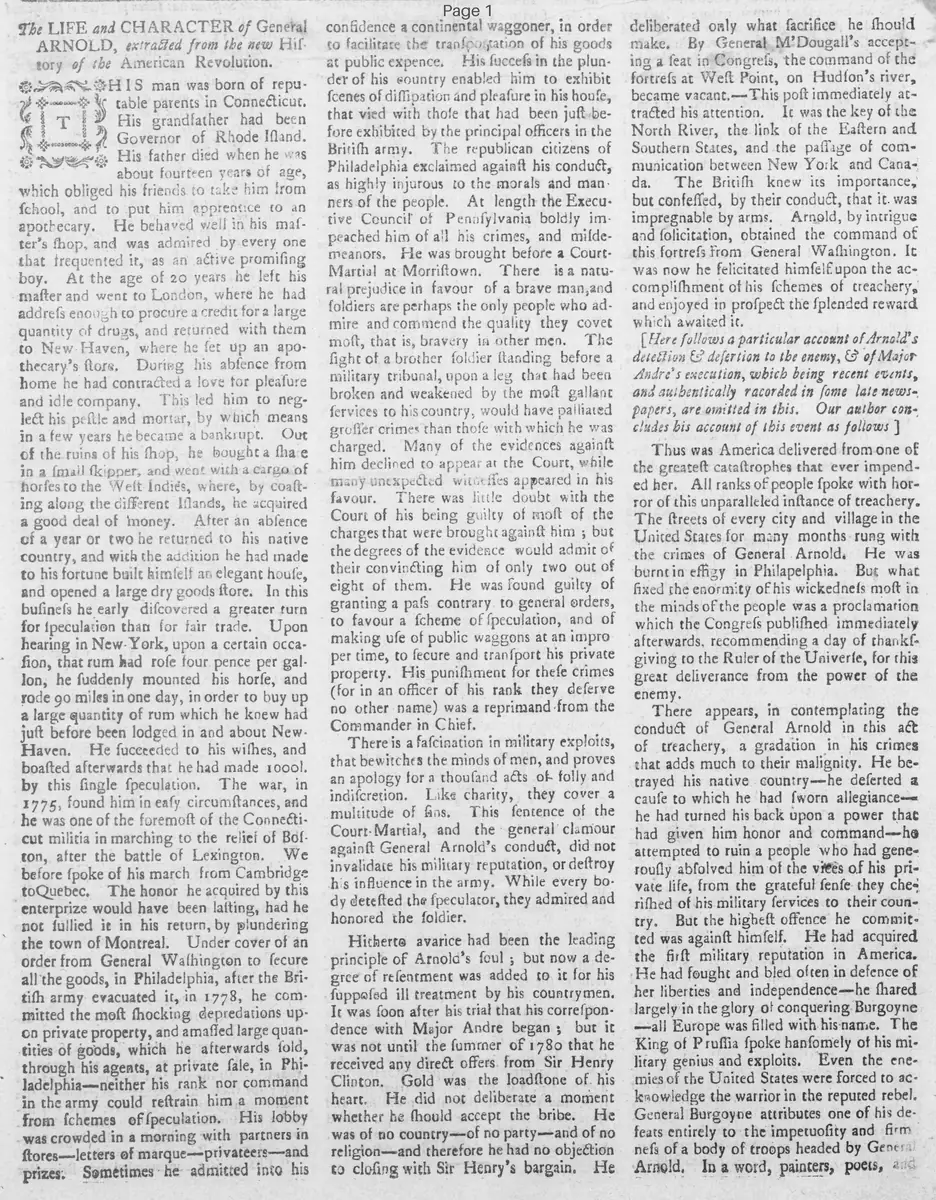
Biography of General Benedict Arnold: born in Connecticut to reputable family, apprenticed as apothecary, engaged in speculations leading to bankruptcy and later success, served in American Revolution with bravery but marred by plundering and corruption, culminating in treason by attempting to surrender West Point to the British in 1780.
Merged-components note: The image on page 1 has spatial overlap with the story bbox and is in sequential reading order, likely illustrative for the biography. The text on page 2 directly continues the Arnold biography from page 1 without interruption, forming a single coherent story component.
Clippings
1 of 2
OCR Quality
Full Text
THIS man was born of reputable parents in Connecticut. His grandfather had been Governor of Rhode Island. His father died when he was about fourteen years of age, which obliged his friends to take him from school, and to put him apprentice to an apothecary. He behaved well in his master's shop, and was admired by every one that frequented it, as an active promising boy. At the age of 20 years he left his master and went to London, where he had address enough to procure a credit for a large quantity of drugs, and returned with them to New Haven, where he set up an apothecary's store. During his absence from home he had contracted a love for pleasure and idle company. This led him to neglect his pestle and mortar, by which means in a few years he became a bankrupt. Out of the ruins of his shop, he bought a share in a small sloop, and went with a cargo of horses to the West Indies, where, by coasting along the different Islands, he acquired a good deal of money. After an absence of a year or two he returned to his native country, and with the addition he had made to his fortune built himself an elegant house, and opened a large dry goods store. In this business he early discovered a greater turn for speculation than for fair trade. Upon hearing in New-York, upon a certain occasion, that rum had rose four pence per gallon, he suddenly mounted his horse, and rode 60 miles in one day, in order to buy up a large quantity of rum which he knew had just before been lodged in and about New-Haven. He succeeded to his wishes, and boasted afterwards that he had made 1000l. by this single speculation. The war, in 1775, found him in easy circumstances, and he was one of the foremost of the Connecticut militia in marching to the relief of Boston, after the battle of Lexington. We before spoke of his march from Cambridge to Quebec. The honor he acquired by this enterprise would have been lasting, had he not sullied it in his return, by plundering the town of Montreal. Under cover of an order from General Washington to secure all the goods, in Philadelphia, after the British army evacuated it, in 1778, he committed the most shocking depredations upon private property, and amassed large quantities of goods, which he afterwards sold, through his agents, at private sale, in Philadelphia—neither his rank nor command in the army could restrain him a moment from schemes of speculation. His lobby was crowded in a morning with partners in stores—letters of marque—privateers—and prizes. Sometimes he admitted into his confidence a continental wagoner, in order to facilitate the transportation of his goods at public expense. His success in the plunder of his country enabled him to exhibit scenes of dissipation and pleasure in his house, that vied with those that had been just before exhibited by the principal officers in the British army. The republican citizens of Philadelphia exclaimed against his conduct, as highly injurious to the morals and manners of the people. At length the Executive Council of Pennsylvania boldly impeached him of all his crimes, and misdemeanors. He was brought before a Court-Martial at Morristown. There is a natural prejudice in favour of a brave man, and soldiers are perhaps the only people who admire and commend the quality they covet most, that is, bravery in other men. The sight of a brother soldier standing before a military tribunal, upon a leg that had been broken and weakened by the most gallant services to his country, would have palliated grosser crimes than those with which he was charged. Many of the evidences against him declined to appear at the Court, while many unexpected witnesses appeared in his favour. There was little doubt with the Court of his being guilty of most of the charges that were brought against him; but the degrees of the evidence would admit of their convicting him of only two out of eight of them. He was found guilty of granting a pass contrary to general orders, to favour a scheme of speculation, and of making use of public wagons at an improper time, to secure and transport his private property. His punishment for these crimes (for in an officer of his rank they deserve no other name) was a reprimand from the Commander in Chief. There is a fascination in military exploits, that bewitches the minds of men, and proves an apology for a thousand acts of folly and indiscretion. Like charity, they cover a multitude of Sins. This sentence of the Court-Martial, and the general clamour against General Arnold's conduct, did not invalidate his military reputation, or destroy his influence in the army. While every body detested the peculator, they admired and honored the soldier. Hitherto avarice had been the leading principle of Arnold's soul; but now a degree of resentment was added to it for his supposed ill treatment by his countrymen. It was soon after his trial that his correspondence with Major Andre began; but it was not until the summer of 1780 that he received any direct offers from Sir Henry Clinton. Gold was the loadstone of his heart. He did not deliberate a moment whether he should accept the bribe. He was of no country—of no party—and of no religion—and therefore he had no objection to closing with Sir Henry's bargain. He deliberated only what sacrifice he should make. By General McDougall's accepting a seat in Congress, the command of the fortress at West Point, on Hudson's river, became vacant.—This post immediately attracted his attention. It was the key of the North River, the link of the Eastern and Southern States, and the passage of communication between New York and Canada. The British knew its importance, but confessed, by their conduct, that it was impregnable by arms. Arnold, by intrigue and solicitation, obtained the command of this fortress from General Washington. It was now he felicitated himself upon the accomplishment of his schemes of treachery, and enjoyed in prospect the splendid reward which awaited it. Here follows a particular account of Arnold's detection & desertion to the enemy, & of Major Andre's execution, which being recent events, and authentically recorded in some late newspapers, are omitted in this. Our author concludes his account of this event as follows: Thus was America delivered from one of the greatest catastrophes that ever impended her. All ranks of people spoke with horror of this unparalleled instance of treachery. The streets of every city and village in the United States for many months rung with the crimes of General Arnold. He was burnt in effigy in Philadelphia. But what fixed the enormity of his wickedness most in the minds of the people was a proclamation which the Congress published immediately afterwards, recommending a day of thanksgiving to the Ruler of the Universe, for this great deliverance from the power of the enemy. There appears, in contemplating the conduct of General Arnold in this act of treachery, a gradation in his crimes that adds much to their malignity. He betrayed his native country—he deserted a cause to which he had sworn allegiance—he had turned his back upon a power that had given him honor and command—he attempted to ruin a people who had generously absolved him of the vices of his private life, from the grateful sense they cherished of his military services to their country. But the highest offence he committed was against himself. He had acquired the first military reputation in America. He had fought and bled often in defence of her liberties and independence—he shared largely in the glory of conquering Burgoyne—all Europe was filled with his name. The King of Prussia spoke handsomely of his military genius and exploits. Even the enemies of the United States were forced to acknowledge the warrior in the reputed rebel. General Burgoyne attributes one of his defeats entirely to the impetuosity and firmness of a body of troops headed by General Arnold. In a word, painters, poets, and
Historians crowded about him to ensure him immortality to their performances, by fixing upon General Arnold as the subject of them.
His name was embalmed with the first heroes in America, and was consigned for its full tribute of praise to the gratitude of posterity.
But even his reputation, for which a generous mind would have paid millions, and sacrificed a thousand lives, was basely sold for about five thousand pounds.
Arnold, the Champion of liberty—the pride of his country—one of the conquerors of Burgoyne—the admiration of Europe—and the scourge of Britain, ends in a traitor and a deserter.
An historian must be more or less than man that can mention these things, and not pause a few minutes to bewail the folly and wickedness of human nature.
If every record of the inhabitants of our globe should be lost, except the history of Arnold's defection, it would be sufficient to show other beings the extent and degrees of the depravity of man.
America has sometimes blushed for a moment, upon reflecting that in the infancy of her existence, and in the most simple state of her manners, she gave birth to this monster of iniquity.
But she soon found consolation in the recollection, that he was first contaminated by the atmosphere of London, and that after his vices had acquired their maturity, the soil of America could afford them no more nourishment.
He was compelled to seek for food for them within the limits of the British government.
General Arnold was received with open arms in New-York.
He was invited immediately to the tables of all the General Officers.
For a while he amused them with the expectations of large defections from the American army, and signed his name to a proclamation composed for that purpose.
But in this they were egregriously disappointed.
It is remarkable that scarcely a centinel left his post for near three months after Arnold's defection took place.
His conduct had stamped an infamy upon desertion, more terrible to the common soldier than the gallows.
Soon after the news of Arnold's treachery reached the Congress, they struck his name out of the list of their Major-Generals.
The resolution for this purpose was a short one.
It contained no commentary upon his crime.
This was of so atrocious and new a nature, that even that august body, so much admired for their original and just compositions, could find no words to convey to the world, and to posterity, their ideas of its peculiar enormity.
Immediately after his name was extirpated from the calendar of American officers, he received a Colonel's commission with the rank of Brigadier-General from Sir Henry Clinton.
No remonstrances were made by the officers of the British army against this outrage upon decency, and violation of the rules of promotion.
A number of them embarked with him upon a plundering expedition to Virginia.
Here he made military duty and service yield to the low purposes of speculation.
He directed the arms of Britain only against stores of tobacco, plate, feather-beds, and negroes; all of which he sold at an immense profit.
For these exploits he received the approbation of the King of Great Britain, in a letter from Lord George Germain to Sir Henry Clinton.
It was said that Lord Cornwallis had refused to do duty with General Arnold, and that this was the reason of the General's sudden departure to New-York after Cornwallis's arrival in Virginia.
But his Lordship had been too well educated in the school of despotism, to shew the least mark of disrespect to one whom his Sovereign had honored with a commission and with his royal approbation.
If this British officer, together with the other British Generals who have served in America during the revolution, had acquired the smallest share of glory for skill and bravery in battle, or for their perseverance in long and difficult marches under the most unpromising appearances of success, they have justly forfeited it, by suffering their names, and commissions, and services, to be ranked with General Arnold's.
For the gratification of every class of readers it may not be improper to add, that Arnold's person was small, but well made.
His eyes were piercing, and his whole face agreeable.
His manner was that of a gentleman's while silent; but his conversation betrayed a vulgar education.
His pronunciation was improper, and he seldom connected a sentence of grammar together.
He was a stranger to books, and made but a trifling figure upon the most ordinary subjects of conversation.
His talents in every thing were moderate, except in that species of business to which he had devoted the greatest part of his life.
In making a bargain, no abilities or ties of nature ever overcame him.
As an officer, his capacity qualified him for the command of a company.
In order to do justice to his character as a soldier, it will be necessary to introduce a distinction between courage and bravery.
The first is seated in the mind, and is equally the offspring of principle and reflection.
The second is seated in the blood, and is excited by exercise, by music, and by spirituous liquors.
By habit it may be so far improved as to produce the effect of courage.
It exists in the soldiery of all armies, and it is sometimes found in the worst characters that ever disgraced human nature.
General Arnold was destitute of courage, but possessed the highest degree of bravery.
There are authentic documents to prove that he was drunk at the time he received his wound in attacking Gen. Burgoyne's lines.
Whether he was intoxicated in the battles of Quebec, on the Lakes, and at Danbury, does not appear, but it is certain he discovered in each of those engagements an impetuosity that seemed to arise more from a fermentation of animal spirits than from principle or reflection.
It may appear difficult to some people to reconcile this military character of Gen. Arnold, with his uncommon military reputation.
But it must be considered that the world is more easily deceived with appearances in this species of character than in any other.
Success, and a wound, often constitute a military hero, whereas it is well known that many Generals have deserved the thanks of their country for their defeats, and many more have deserved to be broken for their victories.
Accident and necessity gave Arnold rank and reputation in the American army, and extraordinary attainments in villainy alone, gave him both, in the army of the King of Great-Britain.
We have already established the fact of Gen. Arnold's dishonesty and falsehood in private life.
To complete the catalogue of his private vices, it is only necessary to add, that he was unfaithful to the bed of an amiable young wife, the daughter of a wealthy and respectable citizen of Philadelphia, whom he deceived with assurances of equality and independence in point of fortune.
It is to be lamented that a character and crimes like Gen. Arnold's have not been marked, by the universal consent of nations, with such a degree of contempt and infamy as to exterminate them from the list of human productions.
The whole community of mankind have more to fear and suffer from such gross instances of national perfidy, than any one community can be benefited by them.
But a code of natural and national jurisprudence, favorable to the interests of justice and humanity, cannot be expected, while Britain maintains her present usurpations in the republic of Europe.
America has yet to learn one important lesson from the defection and treachery of Gen. Arnold.
To cultivate domestic and moral virtue as the only basis of true patriotism.
Public virtue and private vice are wholly incompatible.
A peculator in office, a drunkard, a debauchee, a sharper in business, and a man unfaithful to promises, and treacherous in private friendships, should never be trusted with any share of the power, honor, or treasure, of the United States.
What sub-type of article is it?
What themes does it cover?
What keywords are associated?
What entities or persons were involved?
Where did it happen?
Story Details
Key Persons
Location
Connecticut, New Haven, West Indies, Philadelphia, West Point, New York, Virginia
Event Date
1775 1780
Story Details
General Arnold rises from apothecary apprentice through business speculations and military service in the American Revolution, but his avarice leads to plundering, a lenient court-martial, and ultimately treason by plotting to surrender West Point to the British for gold, resulting in his defection and infamy.