Thank you for visiting SNEWPapers!
Sign up free
The Daily Alaska Empire
Juneau, Juneau County, Alaska
What is this article about?
Article discusses territorial claims in Antarctica by Britain, US, France, and Norway, focusing on Admiral Byrd's explorations and potential American claims to areas like Marie Byrd Land, amid British dominance in claims.
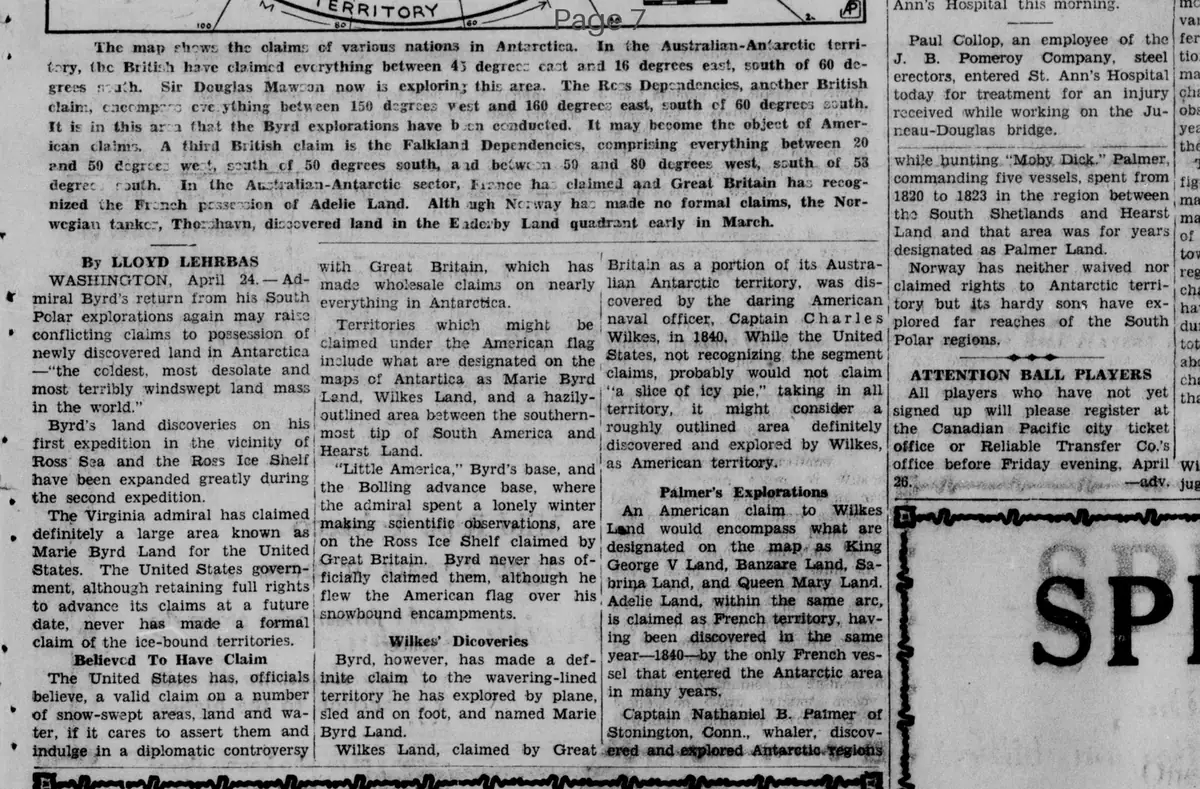
Merged-components note: Caption provides context for the map referenced in the Antarctica claims story; sequential reading order and adjacent bboxes indicate they belong together.
Clipping
OCR Quality
Full Text
By LLOYD LEHRBAS
WASHINGTON, April 24.-Admiral Byrd's return from his South Polar explorations again may raise conflicting claims to possession of newly discovered land in Antarctica "the coldest, most desolate and most terribly windswept land mass in the world."
Byrd's land discoveries on his first expedition in the vicinity of Ross Sea and the Ross Ice Shelf have been expanded greatly during the second expedition.
The Virginia admiral has claimed definitely a large area known as Marie Byrd Land for the United States. The United States government, although retaining full rights to advance its claims at a future date, never has made a formal claim of the ice-bound territories.
Believed To Have Claim
The United States has, officials believe, a valid claim on a number of snow-swept areas, land and water, if it cares to assert them and indulge in a diplomatic controversy with Great Britain, which has made wholesale claims on nearly everything in Antarctica.
Territories which might be claimed under the American flag include what are designated on the maps of Antarctica as Marie Byrd Land, Wilkes Land, and a hazily-outlined area between the southernmost tip of South America and Hearst Land.
"Little America," Byrd's base, and the Bolling advance base, where the admiral spent a lonely winter making scientific observations, are on the Ross Ice Shelf claimed by Great Britain. Byrd never has officially claimed them, although he flew the American flag over his snowbound encampments.
Wilkes' Discoveries
Byrd, however, has made a definite claim to the wavering-lined territory he has explored by plane, sled and on foot, and named Marie Byrd Land.
Wilkes Land, claimed by Great Britain as a portion of its Australian Antarctic territory, was discovered by the daring American naval officer, Captain Charles Wilkes, in 1840. While the United States, not recognizing the segment claims, probably would not claim "a slice of icy pie," taking in all territory, it might consider a roughly outlined area definitely discovered and explored by Wilkes, as American territory.
Palmer's Explorations
An American claim to Wilkes Land would encompass what are designated on the map as King George V Land, Banzare Land, Sabrina Land, and Queen Mary Land. Adelie Land, within the same arc, is claimed as French territory, having been discovered in the same year--1840--by the only French vessel that entered the Antarctic area in many years.
Captain Nathaniel B. Palmer of Stonington, Conn., whaler, discovered and explored Antarctic regions while hunting "Moby Dick." Palmer commanding five vessels, spent from 1820 to 1823 in the region between the South Shetlands and Hearst Land and that area was for years designated as Palmer Land.
Norway has neither waived nor claimed rights to Antarctic territory but its hardy sons have explored far reaches of the South Polar regions.
What sub-type of article is it?
What keywords are associated?
What entities or persons were involved?
Where did it happen?
Foreign News Details
Primary Location
Antarctica
Event Date
Reported April 24
Key Persons
Outcome
british claims on large antarctic sectors; us potential claims to marie byrd land, wilkes land; french claim to adelie land recognized by britain; norwegian discoveries in enderby land without formal claim.
Event Details
The article details British claims including Australian-Antarctic territory, Ross Dependencies, and Falkland Dependencies; French possession of Adelie Land; US explorations by Byrd claiming Marie Byrd Land, historical discoveries by Wilkes and Palmer; potential US claims conflicting with British; Norwegian exploration in Enderby Land.