Thank you for visiting SNEWPapers!
Sign up free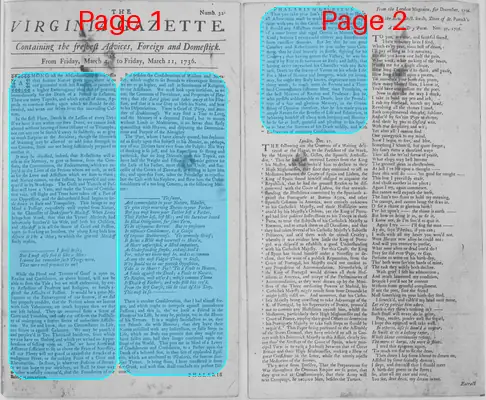
Literary
March 4, 1737
The Virginia Gazette
Richmond, Williamsburg, Richmond County, Virginia
What is this article about?
An essay discouraging immoderate grief over the death of friends or relations, appealing to reason, daily experience of mortality, religious submission, and literary examples from Shakespeare's Macduff and Hamlet, concluding with a consolatory letter attributed to Phalaris.
Merged-components note: This is a continuation of the essay on grieving, starting with 'PHALARIS TO LACRITUS' directly following the previous text.
Clippings
1 of 2
OCR Quality
95%
Excellent
Full Text
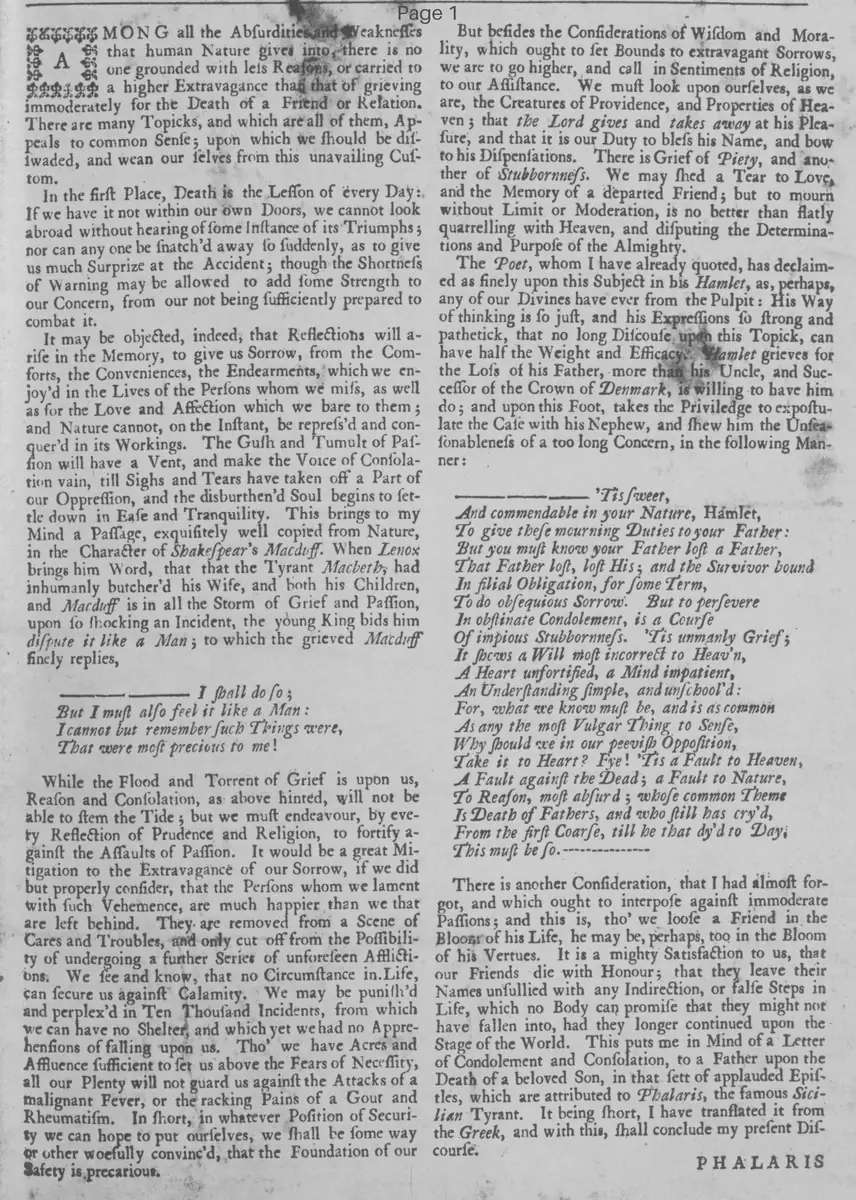
Among all the Absurdities and Weaknesses that human Nature gives into, there is no one grounded with less Reasons, or carried to a higher Extravagance than that of grieving immoderately for the Death of a Friend or Relation.
There are many Topicks, and which are all of them, Appeals to common Sense; upon which we should be dissuaded, and wean our selves from this unavailing Custom.
In the first Place, Death is the Lesson of every Day: If we have it not within our own Doors, we cannot look abroad without hearing of some Instance of its Triumphs; nor can any one be snatch'd away so suddenly, as to give us much Surprize at the Accident; though the Shortness of Warning may be allowed to add some Strength to our Concern, from our not being sufficiently prepared to combat it.
It may be objected, indeed, that Reflections will arise in the Memory, to give us Sorrow, from the Comforts, the Conveniences, the Endearments, which we enjoy'd in the Lives of the Persons whom we miss, as well as for the Love and Affection which we bare to them; and Nature cannot, on the Instant, be represt and conquer'd in its Workings. The Gush and Tumult of Passion will have a Vent, and make the Voice of Consolation vain, till Sighs and Tears have taken off a Part of our Oppression, and the disburthen'd Soul begins to settle down in Ease and Tranquility. This brings to my Mind a Passage, exquisitely well copied from Nature, in the Character of Shakespeare's Macduff. When Lenox brings him Word, that the Tyrant Macbeth, had inhumanly butcher'd his Wife, and both his Children, and Macduff is in all the Storm of Grief and Passion, upon so Shocking an Incident, the young King bids him dispute it like a Man; to which the grieved Macduff finely replies,
I shall do so;
But I must also feel it like a Man:
I cannot but remember such Things were
That were most precious to me!
While the Flood and Torrent of Grief is upon us, Reason and Consolation, as above hinted, will not be able to stem the Tide; but we must endeavour, by every Reflection of Prudence and Religion, to fortify against the Assaults of Passion. It would be a great Mitigation to the Extravagance of our Sorrow, if we did but properly consider, that the Persons whom we lament with such Vehemence, are much happier than we that are left behind. They are removed from a Scene of Cares and Troubles, and only cut off from the Possibility of undergoing a further Series of unforeseen Afflictions. We see and know that no Circumstance in Life, can secure us against Calamity. We may be punish'd and perplex'd in Ten Thousand Incidents, from which we can have no Shelter and which yet we had no Apprehensions of falling upon us. Tho' we have Acres and Affluence sufficient to set us above the Fears of Necessity, all our Plenty will not guard us against the Attacks of a malignant Fever, or the racking Pains of a Gout and Rheumatism. In Short, in whatever Position of Security we can hope to put ourselves, we shall be some way or other woefully convinc'd, that the Foundation of our Safety is precarious.
But besides the Considerations of Wisdom and Morality, which ought to set Bounds to extravagant Sorrows, we are to go higher, and call in Sentiments of Religion, to our Assistance. We must look upon ourselves, as we are, the Creatures of Providence, and Properties of Heaven; that the Lord gives and takes away at his Pleasure, and that it is our Duty to bless his Name, and bow to his Dispensations. There is Grief of Piety, and another of Stubbornness.
We may shed a Tear to Love, and the Memory of a departed Friend; but to mourn without Limit or Moderation, is no better than flatly quarrelling with Heaven, and disputing the Determinations and Purpose of the Almighty.
The Poet, whom I have already quoted, has declaimed as finely upon this Subject in his Hamlet, as, perhaps, any of our Divines have ever from the Pulpit: His Way of thinking is so just, and his Expressions so strong and pathetick, that no long Discourse upon this Topick, can have half the Weight and Efficacy. Hamlet grieves for the Loss of his Father, more than his Uncle, and Successor of the Crown of Denmark, is willing to have him do; and upon this Foot, takes the Priviledge to expostulate the Case with his Nephew, and shew him the Unseasonablenes of a too long Concern, in the following Manner:
'Tis Sweet,
And commendable in your Nature, Hamlet,
To give these mourning Duties to your Father:
But you must know your Father lost a Father,
That Father lost, lost His; and the Survivor bound
In filial Obligation, for some Term,
To do obsequious Sorrow. But to persever
In obstinate Condolement, is a Course
Of impious Stubbornness. Tis unmanly Grief;
It shews a Will most incorrect to Heav'n,
A Heart unfortified, a Mind impatient,
An Understanding simple, and unschool'd:
For, what we know must be, and is as common
As any the most Vulgar Thing to Sense,
Why should we in our peevish Opposition,
Take it to Heart? Fie! Tis a Fault to Heaven,
A Fault against the Dead; a Fault to Nature,
To Reason, most absurd; whose common Theme
Is Death of Fathers, and who still has cried,
From the first Corse, till he that died to Day:
This must be so.---
There is another Consideration, that I had almost forgot, and which ought to interpose against immoderate Passions; and this is, tho' we lose a Friend in the Bloom of his Life, he may be, perhaps, too in the Bloom of his Vertues. It is a mighty Satisfaction to us, that our Friends die with Honour; that they leave their Names unsullied with any Indirection, or false Steps in Life, which no Body can promise that they might not have fallen into, had they longer continued upon the Stage of the World. This puts me in Mind of a Letter of Condolement and Consolation, to a Father upon the Death of a beloved Son, in that set of applauded Epistles, which are attributed to Phalaris, the famous Sicilian Tyrant. It being short, I have translated it from the Greek, and with this, shall conclude my present Discourse.
PHALARIS
PHALARIS TO LACRITUS
"That you take your Son's Death too much to Heart,
all Allowances must be made; for I myself sympathize
with you in this Grief, and bear it as heavily as
I should any Affliction entirely my own: Tho' I am
of a more severe and rigid Genius in Matters of this
Kind; because I never could observe any Benefits arise
from excessive Sorrows. But let this be one great
Comfort and Refreshment to you under your Calamity,
that he died bravely in Battle, fighting for his
Country; that having gotten the Victory, he was honoured
by Fate in so fortunate an End; and lastly, that
having never impeached his Character with any Baseness,
Death set the Stamp of Virtue on his whole Life.
For a Man of Honour and Integrity, while yet living,
may, for ought any Body knows, degenerate into something
worse; so much more do Fortune and a Thousand Circumstances
influence Men, than Principles, or
the best Maxims of Reason and Prudence: But he,
who persists unblameable to Death, lays the Foundation
of a fair and glorious Memory, in the Grave.
Being of Opinion therefore, that he has made you an
ample Return for the Benefits of Life and Education, in
behaving himself all along with Integrity and Honour;
be so far at least, grateful and pleasing to his Spirit,
as to bear the Sorrows of his Death mildly, and with
Endeavours of receiving Consolation."
There are many Topicks, and which are all of them, Appeals to common Sense; upon which we should be dissuaded, and wean our selves from this unavailing Custom.
In the first Place, Death is the Lesson of every Day: If we have it not within our own Doors, we cannot look abroad without hearing of some Instance of its Triumphs; nor can any one be snatch'd away so suddenly, as to give us much Surprize at the Accident; though the Shortness of Warning may be allowed to add some Strength to our Concern, from our not being sufficiently prepared to combat it.
It may be objected, indeed, that Reflections will arise in the Memory, to give us Sorrow, from the Comforts, the Conveniences, the Endearments, which we enjoy'd in the Lives of the Persons whom we miss, as well as for the Love and Affection which we bare to them; and Nature cannot, on the Instant, be represt and conquer'd in its Workings. The Gush and Tumult of Passion will have a Vent, and make the Voice of Consolation vain, till Sighs and Tears have taken off a Part of our Oppression, and the disburthen'd Soul begins to settle down in Ease and Tranquility. This brings to my Mind a Passage, exquisitely well copied from Nature, in the Character of Shakespeare's Macduff. When Lenox brings him Word, that the Tyrant Macbeth, had inhumanly butcher'd his Wife, and both his Children, and Macduff is in all the Storm of Grief and Passion, upon so Shocking an Incident, the young King bids him dispute it like a Man; to which the grieved Macduff finely replies,
I shall do so;
But I must also feel it like a Man:
I cannot but remember such Things were
That were most precious to me!
While the Flood and Torrent of Grief is upon us, Reason and Consolation, as above hinted, will not be able to stem the Tide; but we must endeavour, by every Reflection of Prudence and Religion, to fortify against the Assaults of Passion. It would be a great Mitigation to the Extravagance of our Sorrow, if we did but properly consider, that the Persons whom we lament with such Vehemence, are much happier than we that are left behind. They are removed from a Scene of Cares and Troubles, and only cut off from the Possibility of undergoing a further Series of unforeseen Afflictions. We see and know that no Circumstance in Life, can secure us against Calamity. We may be punish'd and perplex'd in Ten Thousand Incidents, from which we can have no Shelter and which yet we had no Apprehensions of falling upon us. Tho' we have Acres and Affluence sufficient to set us above the Fears of Necessity, all our Plenty will not guard us against the Attacks of a malignant Fever, or the racking Pains of a Gout and Rheumatism. In Short, in whatever Position of Security we can hope to put ourselves, we shall be some way or other woefully convinc'd, that the Foundation of our Safety is precarious.
But besides the Considerations of Wisdom and Morality, which ought to set Bounds to extravagant Sorrows, we are to go higher, and call in Sentiments of Religion, to our Assistance. We must look upon ourselves, as we are, the Creatures of Providence, and Properties of Heaven; that the Lord gives and takes away at his Pleasure, and that it is our Duty to bless his Name, and bow to his Dispensations. There is Grief of Piety, and another of Stubbornness.
We may shed a Tear to Love, and the Memory of a departed Friend; but to mourn without Limit or Moderation, is no better than flatly quarrelling with Heaven, and disputing the Determinations and Purpose of the Almighty.
The Poet, whom I have already quoted, has declaimed as finely upon this Subject in his Hamlet, as, perhaps, any of our Divines have ever from the Pulpit: His Way of thinking is so just, and his Expressions so strong and pathetick, that no long Discourse upon this Topick, can have half the Weight and Efficacy. Hamlet grieves for the Loss of his Father, more than his Uncle, and Successor of the Crown of Denmark, is willing to have him do; and upon this Foot, takes the Priviledge to expostulate the Case with his Nephew, and shew him the Unseasonablenes of a too long Concern, in the following Manner:
'Tis Sweet,
And commendable in your Nature, Hamlet,
To give these mourning Duties to your Father:
But you must know your Father lost a Father,
That Father lost, lost His; and the Survivor bound
In filial Obligation, for some Term,
To do obsequious Sorrow. But to persever
In obstinate Condolement, is a Course
Of impious Stubbornness. Tis unmanly Grief;
It shews a Will most incorrect to Heav'n,
A Heart unfortified, a Mind impatient,
An Understanding simple, and unschool'd:
For, what we know must be, and is as common
As any the most Vulgar Thing to Sense,
Why should we in our peevish Opposition,
Take it to Heart? Fie! Tis a Fault to Heaven,
A Fault against the Dead; a Fault to Nature,
To Reason, most absurd; whose common Theme
Is Death of Fathers, and who still has cried,
From the first Corse, till he that died to Day:
This must be so.---
There is another Consideration, that I had almost forgot, and which ought to interpose against immoderate Passions; and this is, tho' we lose a Friend in the Bloom of his Life, he may be, perhaps, too in the Bloom of his Vertues. It is a mighty Satisfaction to us, that our Friends die with Honour; that they leave their Names unsullied with any Indirection, or false Steps in Life, which no Body can promise that they might not have fallen into, had they longer continued upon the Stage of the World. This puts me in Mind of a Letter of Condolement and Consolation, to a Father upon the Death of a beloved Son, in that set of applauded Epistles, which are attributed to Phalaris, the famous Sicilian Tyrant. It being short, I have translated it from the Greek, and with this, shall conclude my present Discourse.
PHALARIS
PHALARIS TO LACRITUS
"That you take your Son's Death too much to Heart,
all Allowances must be made; for I myself sympathize
with you in this Grief, and bear it as heavily as
I should any Affliction entirely my own: Tho' I am
of a more severe and rigid Genius in Matters of this
Kind; because I never could observe any Benefits arise
from excessive Sorrows. But let this be one great
Comfort and Refreshment to you under your Calamity,
that he died bravely in Battle, fighting for his
Country; that having gotten the Victory, he was honoured
by Fate in so fortunate an End; and lastly, that
having never impeached his Character with any Baseness,
Death set the Stamp of Virtue on his whole Life.
For a Man of Honour and Integrity, while yet living,
may, for ought any Body knows, degenerate into something
worse; so much more do Fortune and a Thousand Circumstances
influence Men, than Principles, or
the best Maxims of Reason and Prudence: But he,
who persists unblameable to Death, lays the Foundation
of a fair and glorious Memory, in the Grave.
Being of Opinion therefore, that he has made you an
ample Return for the Benefits of Life and Education, in
behaving himself all along with Integrity and Honour;
be so far at least, grateful and pleasing to his Spirit,
as to bear the Sorrows of his Death mildly, and with
Endeavours of receiving Consolation."
What sub-type of article is it?
Essay
What themes does it cover?
Death Mortality
Moral Virtue
Religious
What keywords are associated?
Immoderate Grief
Death Consolation
Shakespeare Macduff
Hamlet Mourning
Phalaris Letter
Religious Submission
Mortality Reflection
Literary Details
Subject
Immoderate Grief For The Death Of Friends Or Relations
Key Lines
I Shall Do So;
But I Must Also Feel It Like A Man:
I Cannot But Remember Such Things Were
That Were Most Precious To Me!
'Tis Sweet,
And Commendable In Your Nature, Hamlet,
To Give These Mourning Duties To Your Father:
But You Must Know Your Father Lost A Father,
That Father Lost, Lost His; And The Survivor Bound
In Filial Obligation, For Some Term,
To Do Obsequious Sorrow. But To Persever
In Obstinate Condolement, Is A Course
Of Impious Stubbornness. Tis Unmanly Grief;
It Shews A Will Most Incorrect To Heav'n,
A Heart Unfortified, A Mind Impatient,
An Understanding Simple, And Unschool'd:
For, What We Know Must Be, And Is As Common
As Any The Most Vulgar Thing To Sense,
Why Should We In Our Peevish Opposition,
Take It To Heart? Fie! Tis A Fault To Heaven,
A Fault Against The Dead; A Fault To Nature,
To Reason, Most Absurd; Whose Common Theme
Is Death Of Fathers, And Who Still Has Cried,
From The First Corse, Till He That Died To Day:
This Must Be So.
That You Take Your Son's Death Too Much To Heart,
All Allowances Must Be Made; For I Myself Sympathize
With You In This Grief, And Bear It As Heavily As
I Should Any Affliction Entirely My Own: Tho' I Am
Of A More Severe And Rigid Genius In Matters Of This
Kind; Because I Never Could Observe Any Benefits Arise
From Excessive Sorrows.