Thank you for visiting SNEWPapers!
Sign up free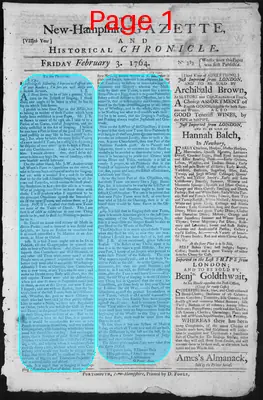
Letter to Editor
February 3, 1764
The New Hampshire Gazette And Historical Chronicle
Portsmouth, Greenland, Rockingham County, New Hampshire
What is this article about?
A letter defending the introduction of new, skillful tunes in church psalmody against objections from traditionalists, arguing they enhance worship without undermining solemnity, and refuting claims of biblical inaccuracy or excessive merriment. Signed J.X.
Clipping
OCR Quality
98%
Excellent
Full Text
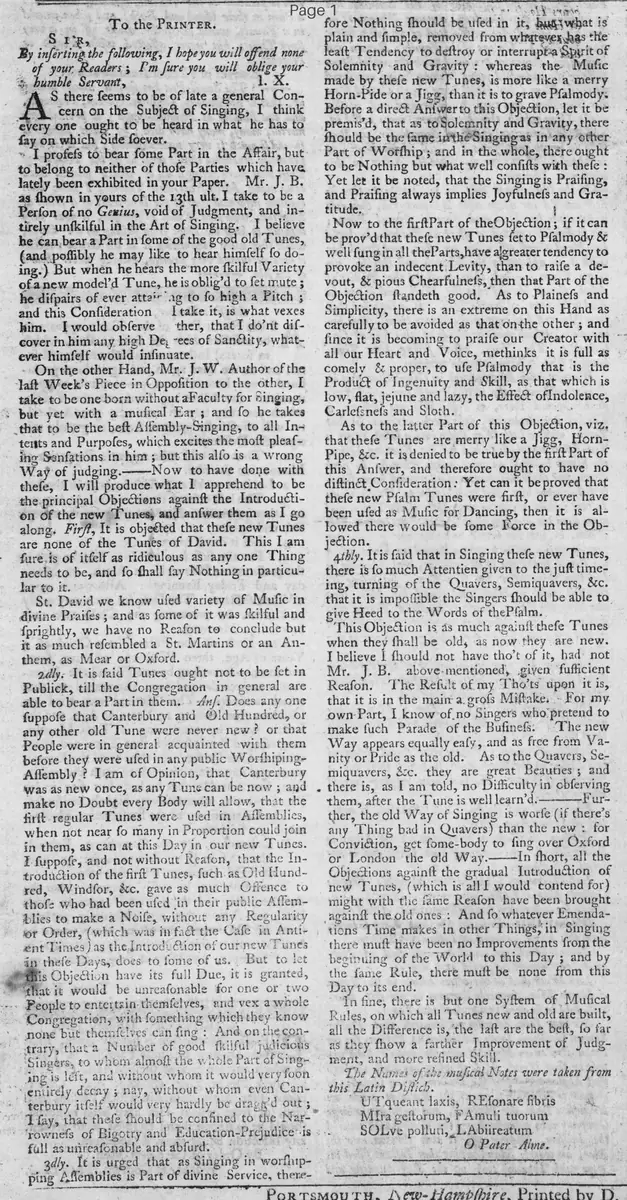
To the Printer.
SIR,
By inserting the following, I hope you will offend none of your Readers; I'm sure you will oblige your
humble Servant,
J. X.
AS there seems to be of late a general Concern
on the Subject of Singing, I think
every one ought to be heard in what he has to
say on which Side soever.
I profess to bear some Part in the Affair, but
to belong to neither of those Parties which have
lately been exhibited in your Paper. Mr. J. B.
as shown in yours of the 13th ult. I take to be a
Person of no Genius, void of Judgment, and entirely
unskillful in the Art of Singing. I believe
he can bear a Part in some of the good old Tunes,
(and possibly he may like to hear himself so doing.)
But when he hears the more skillful Variety
of a new model'd Tune, he is oblig'd to set mute;
he despairs of ever attaining so high a Pitch;
and this Consideration I take it, is what vexes
him. I would observe there, that I do not discover
in him any high Degrees of Sanctity, whatever
himself would insinuate.
On the other Hand, Mr. J. W. Author of the
last Week's Piece in Opposition to the other, I
take to be one born without a Faculty for Singing,
but yet with a musical Ear; and so he takes
that to be the best Assembly-Singing, to all Intents
and Purposes, which excites the most pleasing
Sensations in him; but this also is a wrong
Way of judging.-- Now to have done with
these, I will produce what I apprehend to be
the principal Objections against the Introduction
Of the new Tunes, and answer them as I go
along. First, It is objected that these new Tunes
are none of the Tunes of David. This I am
sure.is of itself as ridiculous as any one Thing
needs to be, and so shall say Nothing in particular
to it.
St. David we know used variety of Music in
divine Praises : and as some of it was skillful and
sprightly, we have no Reason to conclude but
it as much resembled a St. Martins Or an Anthem,
as Mear or Oxford.
2dly. It is said Tunes ought not to be set in
Publick, till the Congregation in general are
able to bear a Part in them. Ans. Does any one
suppose that Canterbury and Old Hundred, or
any other old Tune were never new ? or that
People were in general acquainted with them
before they were used in any public Worshiping
Assembly ? I am of Opinion, that Canterbury
was as new once, as any Tune can be now ; and
make no Doubt every Body will allow, that the
first regular Tunes were used in Assemblies,
when not near so many in Proportion could join
in them, as can at this Day in our new Tunes.
I suppose, and not without Reason. that the Introduction
of the first Tunes. such as Old Hundred,
Windsor, &c. gave as much Offence to
those who had been used in their public Assemblies
to make a Noise. without any Regularity
or Order. (which was in fact the Case in Ancient
Times ) as the Introduction of our new Tunes
in these Days, does to some of us. But to let
this Objection have its full Due, it is granted,
that it would be unreasonable for one or two
People to entertain-themselves, and vex a whole
Congregation, with something which they know
none but themselves can sing : And on the contrary,
that a Number of good skillful judicious
Singers, to whom almost the whole Part of Singing
is left, and without who it would very soon
entirely decay ; nay, without whom even Canterbury
itself would very hardly be dragg'd out ;
I say, that these should be confined to the Narrowness
of Bigotry and Education-Prejudice-is
full as unreasonable and absurd:
3dly. It is urged that as Singing in worshiping
Assemblies is Part of divine Service, therefore Nothing
should be used in it, but what is
plain and simple, removed from whatever has the
least Tendency to destroy or interrupt a Spirit of
Solemnity and Gravity : whereas the Music
made by these new Tunes, is more like a merry
Horn-Pipe or a Jigg, than it is to grave Psalmody.
Before a direct Answer to this Objection, let it be
premis'd, that as to Solemnity and Gravity, there
should be the same in the Singing as in any other
Part of Worship ; and in the whole, there ought
to be Nothing but what well consists with these :
Yet let it be noted, that the Singing is Praising,
and Praising always implies Joyfulness and Gratitude.
Now to the first Part of the Objection; if it can
be prov'd that these new Tunes set to Psalmody &
well sung in all the Parts, have a greater tendency to
provoke an indecent Levity, than to raise a devout,
& pious Cheerfulness, then that Part of the
Objection standeth good. As to Plains and
Simplicity, there is an extreme on this Hand as
carefully to be avoided as that on-the other : and
since it is becoming to praise our Creator with
all our Heart and Voice, methinks it is full as
comely & proper, to use Psalmody that is the
Product of Ingenuity and Skill, as that which is
low, flat, jejune and lazy, the Effect of Indolence,
Carelessness and Sloth.
As to the latter Part of this Objection, viz.
that these Tunes are merry like a Jigg, Horn-
Pipe, &c. it is denied to be true by the first Part of
this Answer, and therefore ought to have no
distinct Consideration: Yet can it be proved that
these new Psalm Tunes were first, or ever have
been used as Music for Dancing, then it is allowed
there would be some Force in the Objection.
4thly. It is said that in Singing these new Tunes,
there is so much Attention given to the just timing,
turning of the Quavers, Semiquavers, &c.
that it is impossible the Singers should be able to
give Heed to the Words of the Psalm.
This Objection is as much against these Tunes
when they shall be old, as now they are new.
I believe I should not have tho't of it, had not
Mr. J. B. above-mentioned, given sufficient
Reason. The Result of my Thoughts upon it is,
that it is in the main a gross Mistake. - For my
own-Part, I know of no Singers who pretend to
make such Parade of the Business: The new
Way appears equally easy, and as free from Vanity
or Pride as the old. As to the Quavers, Semiquavers,
&c. they are great Beauties ; and
there is, as I am told, no Difficulty in observing
them, after the Tune is well learn'd.-.-.-Further,
the old Way of Singing is worse (if there's
any Thing bad in Quavers) than the new : for
Conviction, get some-body to sing over Oxford
or London the old Way.---In short, all the
Objections against the gradual Introduction of
new Tunes, (which is all I would contend for)
might with the same Reason have been brought
against the old ones : And so whatever Emendations
Time makes in other Things, in Singing
there must have been no Improvements from the
beginning of the World to this Day ; and by
the same Rule, there must be none from this
Day to its end.
In fine, there is but one System of Musical
Rules, on which all Tunes new and old are built,
all the Difference is. the last are the best, so far
as they show a farther Improvement of Judgment,
and more refined Skill.
The Notes of the musical Notes were taken from
this Latin Dittich.
UTqueant laxis, REsonare fibris
MIra gestorum, FA muli tuorum
SOLve polluti, LAbiireatum
O.Pater - Amine
SIR,
By inserting the following, I hope you will offend none of your Readers; I'm sure you will oblige your
humble Servant,
J. X.
AS there seems to be of late a general Concern
on the Subject of Singing, I think
every one ought to be heard in what he has to
say on which Side soever.
I profess to bear some Part in the Affair, but
to belong to neither of those Parties which have
lately been exhibited in your Paper. Mr. J. B.
as shown in yours of the 13th ult. I take to be a
Person of no Genius, void of Judgment, and entirely
unskillful in the Art of Singing. I believe
he can bear a Part in some of the good old Tunes,
(and possibly he may like to hear himself so doing.)
But when he hears the more skillful Variety
of a new model'd Tune, he is oblig'd to set mute;
he despairs of ever attaining so high a Pitch;
and this Consideration I take it, is what vexes
him. I would observe there, that I do not discover
in him any high Degrees of Sanctity, whatever
himself would insinuate.
On the other Hand, Mr. J. W. Author of the
last Week's Piece in Opposition to the other, I
take to be one born without a Faculty for Singing,
but yet with a musical Ear; and so he takes
that to be the best Assembly-Singing, to all Intents
and Purposes, which excites the most pleasing
Sensations in him; but this also is a wrong
Way of judging.-- Now to have done with
these, I will produce what I apprehend to be
the principal Objections against the Introduction
Of the new Tunes, and answer them as I go
along. First, It is objected that these new Tunes
are none of the Tunes of David. This I am
sure.is of itself as ridiculous as any one Thing
needs to be, and so shall say Nothing in particular
to it.
St. David we know used variety of Music in
divine Praises : and as some of it was skillful and
sprightly, we have no Reason to conclude but
it as much resembled a St. Martins Or an Anthem,
as Mear or Oxford.
2dly. It is said Tunes ought not to be set in
Publick, till the Congregation in general are
able to bear a Part in them. Ans. Does any one
suppose that Canterbury and Old Hundred, or
any other old Tune were never new ? or that
People were in general acquainted with them
before they were used in any public Worshiping
Assembly ? I am of Opinion, that Canterbury
was as new once, as any Tune can be now ; and
make no Doubt every Body will allow, that the
first regular Tunes were used in Assemblies,
when not near so many in Proportion could join
in them, as can at this Day in our new Tunes.
I suppose, and not without Reason. that the Introduction
of the first Tunes. such as Old Hundred,
Windsor, &c. gave as much Offence to
those who had been used in their public Assemblies
to make a Noise. without any Regularity
or Order. (which was in fact the Case in Ancient
Times ) as the Introduction of our new Tunes
in these Days, does to some of us. But to let
this Objection have its full Due, it is granted,
that it would be unreasonable for one or two
People to entertain-themselves, and vex a whole
Congregation, with something which they know
none but themselves can sing : And on the contrary,
that a Number of good skillful judicious
Singers, to whom almost the whole Part of Singing
is left, and without who it would very soon
entirely decay ; nay, without whom even Canterbury
itself would very hardly be dragg'd out ;
I say, that these should be confined to the Narrowness
of Bigotry and Education-Prejudice-is
full as unreasonable and absurd:
3dly. It is urged that as Singing in worshiping
Assemblies is Part of divine Service, therefore Nothing
should be used in it, but what is
plain and simple, removed from whatever has the
least Tendency to destroy or interrupt a Spirit of
Solemnity and Gravity : whereas the Music
made by these new Tunes, is more like a merry
Horn-Pipe or a Jigg, than it is to grave Psalmody.
Before a direct Answer to this Objection, let it be
premis'd, that as to Solemnity and Gravity, there
should be the same in the Singing as in any other
Part of Worship ; and in the whole, there ought
to be Nothing but what well consists with these :
Yet let it be noted, that the Singing is Praising,
and Praising always implies Joyfulness and Gratitude.
Now to the first Part of the Objection; if it can
be prov'd that these new Tunes set to Psalmody &
well sung in all the Parts, have a greater tendency to
provoke an indecent Levity, than to raise a devout,
& pious Cheerfulness, then that Part of the
Objection standeth good. As to Plains and
Simplicity, there is an extreme on this Hand as
carefully to be avoided as that on-the other : and
since it is becoming to praise our Creator with
all our Heart and Voice, methinks it is full as
comely & proper, to use Psalmody that is the
Product of Ingenuity and Skill, as that which is
low, flat, jejune and lazy, the Effect of Indolence,
Carelessness and Sloth.
As to the latter Part of this Objection, viz.
that these Tunes are merry like a Jigg, Horn-
Pipe, &c. it is denied to be true by the first Part of
this Answer, and therefore ought to have no
distinct Consideration: Yet can it be proved that
these new Psalm Tunes were first, or ever have
been used as Music for Dancing, then it is allowed
there would be some Force in the Objection.
4thly. It is said that in Singing these new Tunes,
there is so much Attention given to the just timing,
turning of the Quavers, Semiquavers, &c.
that it is impossible the Singers should be able to
give Heed to the Words of the Psalm.
This Objection is as much against these Tunes
when they shall be old, as now they are new.
I believe I should not have tho't of it, had not
Mr. J. B. above-mentioned, given sufficient
Reason. The Result of my Thoughts upon it is,
that it is in the main a gross Mistake. - For my
own-Part, I know of no Singers who pretend to
make such Parade of the Business: The new
Way appears equally easy, and as free from Vanity
or Pride as the old. As to the Quavers, Semiquavers,
&c. they are great Beauties ; and
there is, as I am told, no Difficulty in observing
them, after the Tune is well learn'd.-.-.-Further,
the old Way of Singing is worse (if there's
any Thing bad in Quavers) than the new : for
Conviction, get some-body to sing over Oxford
or London the old Way.---In short, all the
Objections against the gradual Introduction of
new Tunes, (which is all I would contend for)
might with the same Reason have been brought
against the old ones : And so whatever Emendations
Time makes in other Things, in Singing
there must have been no Improvements from the
beginning of the World to this Day ; and by
the same Rule, there must be none from this
Day to its end.
In fine, there is but one System of Musical
Rules, on which all Tunes new and old are built,
all the Difference is. the last are the best, so far
as they show a farther Improvement of Judgment,
and more refined Skill.
The Notes of the musical Notes were taken from
this Latin Dittich.
UTqueant laxis, REsonare fibris
MIra gestorum, FA muli tuorum
SOLve polluti, LAbiireatum
O.Pater - Amine
What sub-type of article is it?
Persuasive
Religious
Informative
What themes does it cover?
Religion
What keywords are associated?
Church Singing
New Tunes
Psalmody
Objections To Music
Divine Worship
Musical Skill
Solemnity
Old Hundred
Canterbury
What entities or persons were involved?
J. X.
The Printer
Letter to Editor Details
Author
J. X.
Recipient
The Printer
Main Argument
the introduction of new, skillful tunes in church singing should be gradual and is beneficial, as they improve psalmody without violating solemnity; objections based on biblical tradition, complexity, or merriment are unfounded and echo past resistances to musical progress.
Notable Details
Critiques Mr. J.B. As Unskillful And Lacking Sanctity
Critiques Mr. J.W. As Having A Musical Ear But Poor Judgment
References Tunes: Canterbury, Old Hundred, Mear, Oxford, St. Martins, Anthem, Windsor, London
Cites David's Use Of Varied Music
Discusses Quavers And Semiquavers
Ends With Latin Ditty Origin Of Musical Notes