Thank you for visiting SNEWPapers!
Sign up free
The Freeman's Journal, Or, New Hampshire Gazette
Portsmouth, Rockingham County, New Hampshire
What is this article about?
On September 21, a suspected arson fire ravaged New York City, destroying ~1,000 houses (1/4 of the city) amid Revolutionary War tensions. British troops and sailors helped contain it after 10 hours; rebels blamed for starting multiple blazes. Several perpetrators caught; some lynched. Trinity Church and others lost.
Merged-components note: These components form a continuous narrative about the fire in New York City.
Clipping
OCR Quality
Full Text
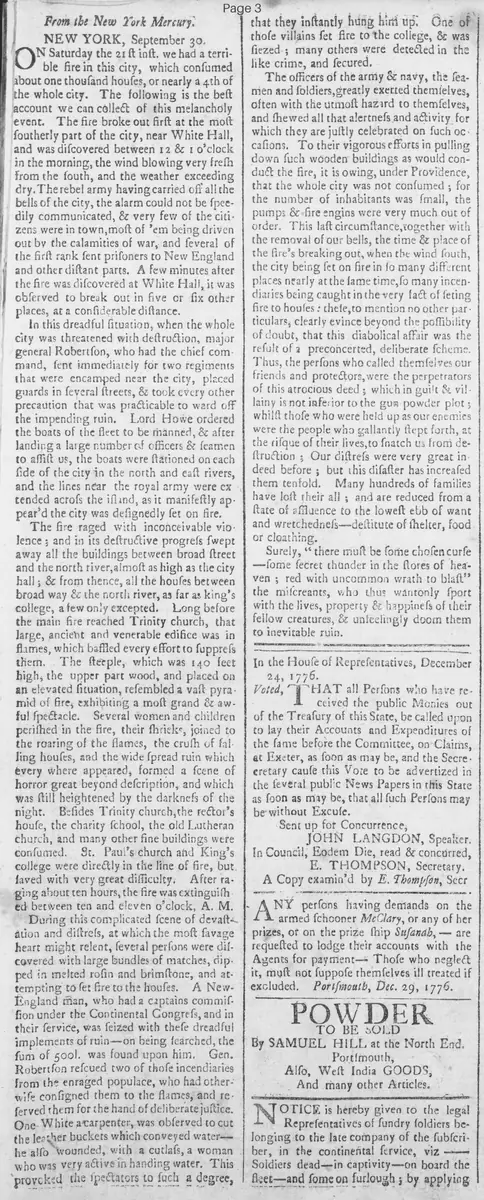
NEW YORK, September 30.
On Saturday the 21st inst. we had a terrible fire in this city, which consumed about one thousand houses, or nearly a 4th of the whole city. The following is the best account we can collect of this melancholy event. The fire broke out first at the most Southerly part of the city, near White Hall, and was discovered between 12 & 1 o'clock in the morning, the wind blowing very fresh from the south, and the weather exceeding dry. The rebel army having carried off all the bells of the city, the alarm could not be speedily communicated, & very few of the citizens were in town, most of 'em being driven out by the calamities of war, and several of the first rank sent prisoners to New England and other distant parts. A few minutes after the fire was discovered at White Hall, it was observed to break out in five or six other places, at a considerable distance.
In this dreadful situation, when the whole city was threatened with destruction, major general Robertson, who had the chief command, sent immediately for two regiments that were encamped near the city, placed guards in several streets, & took every other precaution that was practicable to ward off the impending ruin. Lord Howe ordered the boats of the fleet to be manned, & after landing a large number of officers & seamen to assist us, the boats were stationed on each side of the city in the north and east rivers, and the lines near the royal army were extended across the island, as it manifestly appeared the city was designedly set on fire.
The fire raged with inconceivable violence: and in its destructive progress swept away all the buildings between broad street and the north river, almost as high as the city hall; & from thence, all the houses between broad way & the north river, as far as king's college, a few only excepted. Long before the main fire reached Trinity church, that large, ancient and venerable edifice was in flames, which baffled every effort to suppress them. The steeple, which was 140 feet high; the upper part wood, and placed on an elevated situation, resembled a vast pyramid of fire, exhibiting a most grand & awful spectacle. Several women and children perished in the fire, their shrieks, joined to the roaring of the flames, the crush of falling houses, and the wide spread ruin which every where appeared, formed a scene of horror great beyond description, and which was still heightened by the darkness of the night. Besides Trinity church, the rector's house, the charity school, the old Lutheran church, and many other fine buildings were consumed. St. Paul's church and King's college were directly in the line of fire, but saved with very great difficulty. After raging about ten hours, the fire was extinguished between ten and eleven o'clock, A. M.
During this complicated scene of devastation and distress, at which the most savage heart might relent, several persons were discovered with large bundles of matches, dipped in melted rosin and brimstone, and attempting to set fire to the houses. A New-England man, who had a captain's commission under the Continental Congress, and in their service, was seized with these dreadful implements of ruin--on being searched, the sum of 500l. was found upon him. Gen. Robertson rescued two of those incendiaries from the enraged populace, who had otherwise consigned them to the flames, and reserved them for the hand of deliberate justice. One White a carpenter, was observed to cut the leather buckets which conveyed water-- he also wounded, with a cutlas, a woman who was very active in handing water. This provoked the spectators to such a degree, that they instantly hung him up. One of those villains set fire to the college. & was seized; many others were detected in the like crime, and secured.
The officers of the army & navy, the seamen and soldiers, greatly exerted themselves, often with the utmost hazard to themselves, and shewed all that alertness and activity for which they are justly celebrated on such occasions. To their vigorous efforts in pulling down such wooden buildings as would conduct the fire, it is owing, under Providence, that the whole city was not consumed; for the number of inhabitants was small, the pumps & fire engines were very much out of order. This last circumstance, together with the removal of our bells, the time & place of the fire's breaking out, when the wind south, the city being set on fire in so many different places nearly at the same time, so many incendiaries being caught in the very fact of setting fire to houses: these, to mention no other particulars, clearly evince beyond the possibility of doubt, that this diabolical affair was the result of a preconcerted, deliberate scheme.
Thus, the persons who called themselves our friends and protectors, were the perpetrators of this atrocious deed; which in guilt & villainy is not inferior to the gun powder plot: whilst those who were held up as our enemies were the people who gallantly stepped forth, at the risque of their lives, to snatch us from destruction: Our distresses were very great indeed before: but this disaster has increased them tenfold. Many hundreds of families have lost their all: and are reduced from a state of affluence to the lowest ebb of want and wretchedness--destitute of shelter, food or cloathing.
Surely, 'there must be some chosen curse --some secret thunder in the stores of heaven; red with uncommon wrath to blast' the miscreants, who thus wantonly sport with the lives, property & happiness of their fellow creatures, & unfeelingly doom them to inevitable ruin.
What sub-type of article is it?
What themes does it cover?
What keywords are associated?
What entities or persons were involved?
Where did it happen?
Story Details
Key Persons
Location
New York City, Near White Hall
Event Date
September 21
Story Details
A massive fire broke out in New York City on September 21, destroying about one thousand houses, nearly a quarter of the city. Suspected as deliberate arson by rebels, it started near White Hall and spread rapidly due to wind and dry weather. British forces under Major General Robertson and Lord Howe assisted in containing it after 10 hours, saving parts of the city. Several incendiaries were caught and some executed by the crowd.