Thank you for visiting SNEWPapers!
Sign up free
Daily National Intelligencer
Washington, District Of Columbia
What is this article about?
On July 30, a meeting at the City of London Tavern to relieve the poor's distress features speeches by Wilberforce urging focus on charity over politics, debates with Lord Cochrane on distress causes, interventions by Dukes of Kent and Cambridge, and resolutions passed for subscriptions and relief efforts amid political clamor.
Clipping
OCR Quality
Full Text
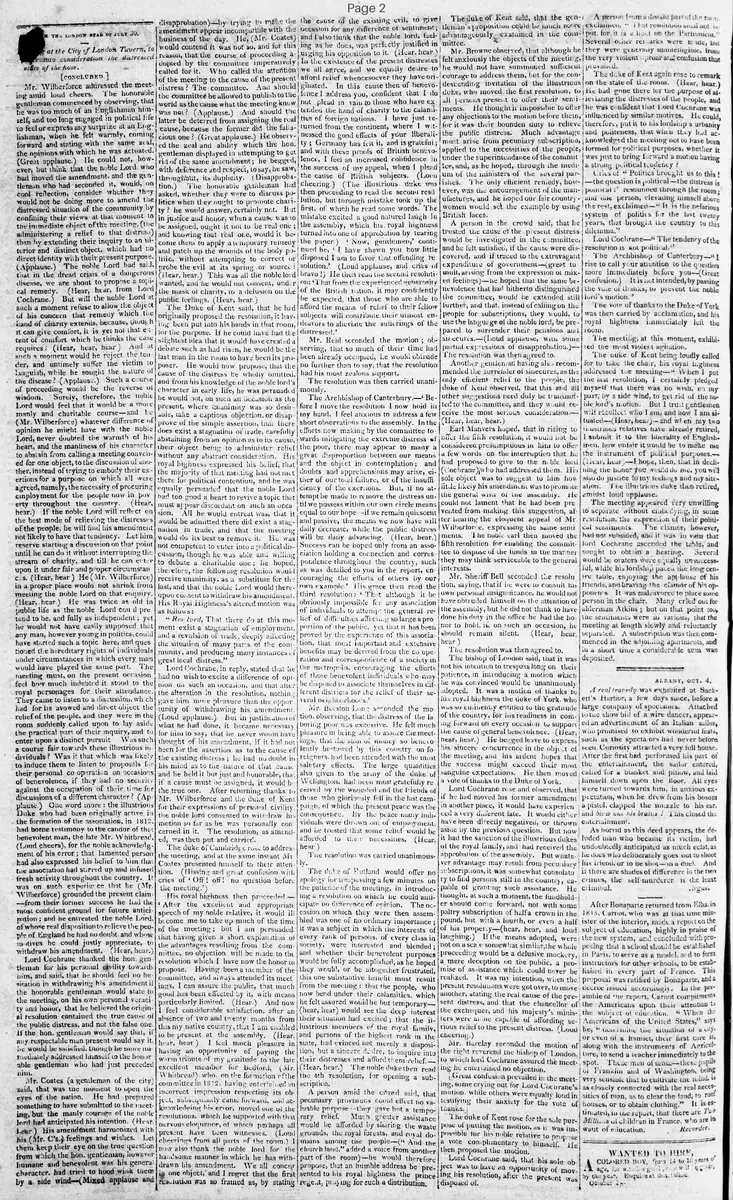
At the City of London Tavern, to take into consideration the distressed situation of the poor.
CONCLUDED.
Mr. Wilberforce addressed the meeting amid loud cheers. The honorable gentleman commenced by observing, that he was too much of an Englishman himself, and too long engaged in political life to feel or express any surprise at an Englishman, when he felt warmly, coming forward and stating with the same zeal, the opinions with which he was actuated. (Great applause.) He could not, however, but think that the noble Lord who had moved the amendment, and the gentleman who had seconded it, would, on cool reflection, consider whether they would not be doing more to amend the distressed situation of the community by confining their views at that moment to the immediate object of the meeting, (the administering a relief to that distress) than by extending their inquiry to an ulterior and distinct object, which had no direct identity with their present purpose. (Applause.) The noble Lord had said, that in the dread crisis of a dangerous disease, we are about to propose a topical remedy. (Hear, hear, from Lord Cochrane.) But will the noble Lord at such a moment refuse to allow the object of his concern that remedy which the hand of charity extends, because, (though it can give comfort, it is yet not that extent of comfort which he thinks the case requires? (Hear, hear, hear.) And at such a moment would he reject the tender, and untimely suffer the victim to languish, while he sought the nature of the disease? (Applause.) Such a course of proceeding would be the reverse of wisdom. Surely, therefore, the noble Lord would feel that it would be a more manly and charitable course--and he (Mr. Wilberforce) whatever difference of opinion he might have with the noble Lord, never doubted the warmth of his heart, and the manliness of his character to abstain from calling a meeting convened for one object, to the discussion of another, instead of trying to embody their exertions for a purpose on which all were agreed, namely, the necessity of procuring employment for the people now in poverty throughout the country. (Hear, hear.) If the noble Lord will reflect on the best mode of relieving the distresses of the people, he will find his amendment not likely to have that tendency. Let him reserve starting a discussion on that point until he can do it without interrupting the stream of charity, and till he can enter upon it under fair and proper circumstances. (Hear, hear.) He (Mr. Wilberforce) in a proper place would not shrink from meeting the noble Lord on that enquiry. (Hear, hear.) He was twice as old in public life as the noble Lord could pretend to be, and fully as independent; yet he would not have easily supposed that any man, however young in politics, could have started such a topic here, and questioned the hereditary rights of individuals under circumstances in which every man would have played the same part. The meeting must, on the present occasion, feel how much indebted it stood to the royal personages for their attendance. They came to listen to a discussion, which had for its avowed and direct object the relief of the people, and they were in the room suddenly called upon to lay aside the practical part of their inquiry, and to enter upon a distinct pursuit. Was such a course fair towards these illustrious individuals? Was it that which was likely to induce them to listen to proposals for their personal co-operation on occasions of benevolence, if they had no security against the occupation of their time for discussions of a different character? (Applause.) One word more: the illustrious Duke who had been originally active in the formation of the association, in 1812, had borne testimony to the candor of that benevolent man, the late Mr. Whitbread, (Loud cheers), for the noble acknowledgment of his error; that lamented person had also expressed his belief to him that the association had stirred up and infused fresh activity throughout the country. It was on such experience that he (Mr. Wilberforce) grounded the present claim --from their former success he had the most confident ground for future anticipation; and he entreated the noble Lord, of whose real disposition to relieve the people of England he had no doubt, and whose motives he could justly appreciate, to withdraw his amendment. (Hear, hear.)
Lord Cochrane thanked the hon. gentleman for his personal civility towards him, and said, that he should feel no hesitation in withdrawing his amendment if the honorable gentleman would state to the meeting, on his own personal veracity and honor, that he believed the original resolution contained the true cause of the public distress, and not the false one. If the hon. gentleman would say that, if any respectable man present would say it, he would be satisfied, though he more immediately addressed himself to the honorable gentleman who had just preceded him.
Mr. Coates (a gentleman of the city) said, that was the moment to open the eyes of the nation. He had prepared something to have submitted to the meeting, but the manly courage of the noble lord had anticipated his intention. (Hear, hear.) His amendment harmonized with his (Mr. C's.) feelings and wishes. Let them keep their eye on the true question from which the hon. gentleman, however humane and benevolent was his general character, had tried to hood-wink them by a side wind (Mixed applause and disapprobation)-by trying to make the amendment appear incompatible with the business of the day. He, (Mr. Coates) would contend it was not so, and for this reason, that the course of proceeding adopted by the committee imperatively called for it. Who called the attention of the meeting to the cause of the present distress? The committee. And should the committee be allowed to publish to the world as the cause what the meeting knew was not? (Applause.) And should the latter be deterred from assigning the real cause, because the former did the fallacious one? (Great applause.) He observed the zeal and ability which the hon. gentleman displayed in attempting to get rid of the same amendment; he begged, with deference and respect, to say, he saw, throughout, its duplicity. (Disapprobation.) The honorable gentleman had asked, whether they were to discuss politics when they ought to promote charity? he would answer, certainly not. But in justice and honor, when a cause was to be assigned, ought it not to be real one; and knowing that real one, would it become them to apply a temporary remedy and patch up the wounds of the body politic, without attempting to correct or probe the evil at its spring or source? (Hear, hear.) This was all the noble lord wanted, and he would not consent, under the mask of charity, to a delusion on the public feelings. (Hear, hear.)
The Duke of Kent said, that he had originally proposed the resolution, it having been put into his hands in that room, for the purpose. If he could have had the slightest idea that it would have created a debate such as had risen, he would be the last man in the room to have been its proposer. He would now propose, that the cause of the distress be wholly omitted, and from his knowledge of the noble lord's character in early life, he was persuaded he would not, on such an occasion as the present, where unanimity was so desirable, take a captious objection, or disapprove of the simple assertion, that there does exist a stagnation of trade, carefully abstaining from an opinion as to its cause, their object being to administer relief without any abstract consideration. His royal highness expressed his belief, that the majority of that meeting had not met there for political contention, and he was equally persuaded that the noble Lord had too good a heart to revive a topic that must appear discordant on such an occasion. All he would entreat was, that it would be admitted there did exist a stagnation in trade, and that the meeting would do its best to remove it. He was not competent to enter into a political discussion, though he was able and willing to debate a charitable one; he hoped, therefore, the following resolution would receive unanimity, as a substitute for the last, and that the noble Lord would thereupon consent to withdraw his amendment. His Royal Highness's altered motion was as follows:
"Resolved, That there do at this moment exist a stagnation of employment, and a revulsion of trade, deeply affecting the situation of many parts of the community, and producing many instances of great local distress."
Lord Cochrane, in reply, stated that he had no wish to excite a difference of opinion on such an occasion, and that after the alteration in the resolution, nothing gave him more pleasure than the opportunity of withdrawing his amendment. (Loud applause.) But in justification of what he had done, it became necessary for him to say, that he never would have thought of his amendment, if it had not been for the assertion as to the cause of the existing distress: he had no doubt in his mind as to the nature of that cause and he held it but just and honorable, that if a cause must be assigned, it would be the true one. After returning thanks to Mr. Wilberforce and the duke of Kent for their expressions of personal civility the noble lord consented to withdraw his motion so far as he was personally concerned in it. The resolution, as amended, was then put and carried.
The duke of Cambridge rose to address the meeting, and at the same instant Mr. Coates presented himself to their attention. (Hissing and great confusion with cries of 'Off! off! no question before the meeting.')
His royal highness then proceeded.- After the excellent and appropriate speech of my noble relative, it would ill become me to take up much of the time of the meeting; but I am persuaded that having given a short explanation of the advantages resulting from the committee, no objection will be made to the resolution which I have now the honor to propose. Having been a member of the committee, and always attended its meetings, I can assure the public, that much good has been effected by it, with means particularly limited. (Hear.) And now I feel considerable satisfaction, after an absence of two and twenty months from this my native country, that I am enabled to be present at the assembly. (Hear, hear, hear) I feel much pleasure in having an opportunity of paying the warm tribute of my gratitude to the late excellent member for Bedford, (Mr. Whitbread) who, on the formation of the committee in 1812, having entertained an incorrect impression respecting its object, subsequently came forward, and acknowledging his error, moved one of the resolutions, which he supported with that nervous eloquence, of which perhaps all present have been witnesses. (Loud cheerings from all parts of the room.) I now also thank the noble lord for the handsome manner in which he has withdrawn his amendment. If all concur in one object, and I regret that the first resolution was so framed as, by stating the cause of the existing evil, to give occasion for any difference of sentiment; and I also think that the noble lord, feeling as he does, was perfectly justified in urging his opposition to it. (Hear, hear.) In the existence of the present distresses we all agree, and we equally desire to afford relief whencesoever they have originated. In this cause then of benevolence I address you, confident that I do not plead in vain to those who have extended the hand of charity to the calamities of foreign nations. I have just returned from the continent, where I witnessed the good effects of your liberality; Germany has felt it, and is grateful; and with these proofs of British benevolence, I feel an increased confidence in the success of my appeal, when I plead the cause of British subjects. (Loud cheering.) (The illustrious duke was then proceeding to read the second resolution, but through mistake took up the first, of which he read some words. The mistake excited a good natured laugh in the assembly, which his royal highness turned into one of approbation by tearing the paper.) Now, gentlemen, continued he, 'I have shewn you how little disposed I am to favor that offending resolution.' (Loud applause; and cries of bravo!) He then read the second resolution: "That from the experienced generosity of the British nation, it may confidently be expected, that those who are able to afford the means of relief to their fellow subjects will contribute their utmost endeavors to alleviate the sufferings of the distressed."
Mr. Reid seconded the motion; observing, that so much of their time had been already occupied, he would obtrude no further than to say, that the resolution had his most zealous support.
The resolution was then carried unanimously.
The Archbishop of Canterbury.- 'Before I move the resolution I now hold in my hand. I feel anxious to address a few short observations to the assembly. In the efforts now making by the committee towards mitigating the extreme distress of the poor, there may appear to many a great disproportion between our means and the object in contemplation; and doubts and apprehensions may arise, either of our total failure, or of the insufficiency of the exertions. But, if no attempt be made to remove the distress until we possess within our own circle means equal to our hope--if we remain quiescent and passive, the means we now have will daily decrease, while the public distress will be daily advancing. (Hear, hear.) Success can be hoped only from an association holding a connection and correspondence throughout the country, such as was detailed to you in the report, encouraging the efforts of others by our own example.' His grace then read the third resolution: That although it be obviously impossible for any association of individuals to attempt the general relief of difficulties affecting so large a proportion of the public, yet that it has been proved by the experience of this association, that most important and extensive benefits may be derived from the co-operation and correspondence of a society in the metropolis, encouraging the efforts of those benevolent individuals who may be disposed to associate themselves in different districts for the relief of their several neighborhoods.
Mr. Beeston Long seconded the motion, observing, that the distress of the laboring poor was excessive. He felt much pleasure in being able to assure the meeting, that the sum of money so benevolently bestowed by this country on foreigners, had been attended with the most salutary effects. The large quantities also given to the army of the duke of Wellington, had been most gratefully received by the wounded and the friends of those who gloriously fell in the last campaign, of which the present peace was the consequence. By the peace many individuals were thrown out of employment, and he trusted that some relief would be afforded to their necessities. (Hear, hear)
The resolution was carried unanimously.
The duke of Rutland would offer no apology for trespassing a few minutes on the patience of the meeting, in introducing a resolution on which he could anticipate no difference of opinion. The occasion on which they were then assembled was one of no ordinary importance; it was a subject in which the interests of every rank of persons, of every class in society, were interested and blended; and whether their benevolent purposes would be fully accomplished, as he hoped they would, or be altogether frustrated, this one substantive benefit must result from the meeting: that the people, who now bend under their calamities, which he felt assured would be but temporary-- (hear, hear) would see the deep interest their situation had excited; that the illustrious members of the royal family, and persons of the highest rank in the state, had evinced not merely a disposition, but a sincere desire, to inquire into their distresses and afford them relief.- (Hear, hear.) The noble duke then read the 4th resolution, for opening a subscription.
A person amid the crowd said, that pecuniary provisions could effect no valuable purpose--they gave but a temporary relief. Much greater assistance would be afforded by sharing the waste grounds, the royal forests, and royal domains among the people-("And the church land," added a voice from another part of the room) he would therefore propose, that an humble address be presented to his royal highness the prince regent, praying for such a distribution.
The duke of Kent said, that the gentleman's proposition could be much more advantageously examined in the committee.
Mr. Browne observed, that although he felt anxiously the objects of the meeting, he would not have summoned sufficient courage to address them, but for the condescending invitation of the illustrious duke, who moved the first resolution, to all persons present to offer their sentiments. He thought it impossible to offer any objections to the motion before them, for it was their bounden duty to relieve the public distress. Much advantage must arise from pecuniary subscription, applied to the necessities of the people, under the superintendence of the committee, and, as he hoped, through the medium of the ministers of the several parishes. The only efficient remedy, however, was the encouragement of the manufactures, and he hoped our fair country-women would set the example by using British laces.
A person in the crowd said; that he trusted the cause of the present distress would be investigated in the committee, and he felt satisfied, if the cause were discovered, and if traced to the extravagant expenditure of government-(great tumult, arising from the expression of mixed feelings)-he hoped that the same benevolence that had hitherto distinguished the committee; would be extended still further, and that, instead of calling on the people for subscriptions, they would, to use the language of the noble lord, be prepared to surrender their pensions and sinecures.-(Loud applause, with some partial expressions of disapprobation.)--
The resolution was then agreed to.
Another gentleman having also recommended the surrender of sinecures, as the only efficient relief to the people, the duke of Kent observed. that this and all other suggestions need duly be transmitted to the committee, and they would receive the most serious consideration.-- (Hear, hear, hear.)
Earl Manvers hoped, that in rising to offer the fifth resolution, it would not be considered presumptuous in him to offer a few words on the interruption that he had proposed to give to the noble lord (Cochrane) who had addressed them. His sole object was to suggest to him how little likely his amendment was to promote the general wish of the assembly. He could not lament that he had been prevented from making this suggestion, after hearing the eloquent appeal of Mr. Wilberforce, expressing the same sentiments. The noble earl then moved the fifth resolution for enabling the committee to dispose of the funds in the manner they may think serviceable to the general interests.
Mr. Sheriff Bell seconded the resolution, saying, that if he were to consult his own personal insignificance, he would not have obtruded himself on the attention of the assembly, but he did not think to have done his duty in the office he had the honor to hold, if, on such an occasion, he should remain silent. (Hear, hear, hear)
The resolution was then agreed to.
The bishop of London said, that it was not his intention to trespass long on their patience, in introducing a motion which he was convinced would be unanimously adopted. It was a motion of thanks to his royal highness the duke of York, who was so eminently entitled to the gratitude of the country, for his readiness in coming forward on every occasion to support the cause of general benevolence. (Hear, hear, hear.) He begged leave to express his sincere concurrence in the object of the meeting, and his ardent hopes that the success might exceed their most sanguine expectations. He then moved a vote of thanks to the Duke of York.
Lord Cochrane rose and observed, that if he had moved his former amendment in another place, it would have experienced a very different fate. It would either have been directly negatived, or thrown aside by the previous question. But now it had the sanction of the illustrious dukes of the royal family, and had received the approbation of the assembly. But whatever advantage may result from pecuniary subscriptions, it was somewhat consolatory to find persons still in the country, capable of granting such assistance. He thought, at such a moment, the fundholder should come forward, not with some paltry subscription of half a crown in the pound, but with a fourth, or even a half of his property-(hear, hear, and loud laughing.) If the means adopted, were not on a scale somewhat similar, the whole proceeding would be a delusive mockery, a mere deception on the public, a promise of assistance which could never be realized. It was my intention, when the present resolutions were got over, to move another, stating the real cause of the present distress, and that the chancellor of the exchequer, and his majesty's ministers were alone capable of affording serious relief to the present distress. (Loud cheering.)
Mr. Barclay seconded the motion of the right reverend the bishop of London, to which lord Cochrane assured the meeting he entertained no objection.
Great confusion prevailed in the meeting, some crying out for Lord Cochrane's motion, while others were equally loud in testifying their anxiety for the vote of thanks.
The duke of Kent rose for the sole purpose of putting the motion, as it was impossible for his noble relative to propose a vote complimentary to himself. He then proposed the motion.
Lord Cochrane said, that his sole object was to have an opportunity of moving his resolution, after the present was disposed of.
A person from a distant part of the room exclaimed, "that resolution shall not be put, for it is a fraud on the Parliament."
Several other remarks were made, but they were generally unintelligible, from the very violent uproar and confusion that prevailed.
The duke of Kent again rose to remark on the state of the room. (Hear, hear.) He had gone there for the purpose of alleviating the distresses of the people, and he was confident that Lord Cochrane was influenced by similar motives. He could, therefore, put it to his lordship's urbanity and politeness, that when they had acknowledged the meeting not to have been formed for political purposes, whether it was just to bring forward a motion having a strong political tendency.
Cries of "Politics brought us to this! -the question is political -the distress is political:" resounded through the room; and one person, elevating himself above the rest, exclaimed-"It is the nefarious system of politics for the last twenty years, that brought the country to this dilemma."
Lord Cochrane—"The tendency of the resolution is not political."
The Archbishop of Canterbury-"I rise to call your attention to the question more immediately before you--(Great confusion.) It is not intended, by passing the vote of thanks, to prevent the noble lord's motion."
The vote of thanks to the Duke of York was then carried by acclamation, and his royal highness immediately left the room.
The meeting, at this moment, exhibited the most violent agitation.
The duke of Kent being loudly called for to take the chair, his royal highness addressed the meeting-"When I put the last resolution, I certainly pledged myself that there was no wish, on my part, by a side wind, to get rid of the noble lord's motion. But I trust gentlemen will recollect who I am and how I am situated-(Hear, hear)--and when my two illustrious relatives have already retired, I submit it to the liberality of Englishmen, how unfair it would be to make me the instrument of political purposes.-- (Hear, hear ,--I hope, then, that in declining the honor you would do me, you will also do justice to my feelings and my situation. The illustrious duke then retired, amidst loud applause.
The meeting appeared very unwilling to separate without embodying, in some resolution, the expression of their political sentiments. The clamor, however, had not subsided, and it was in vain that lord Cochrane ascended the table, and sought to obtain a hearing. Several would be orators were equally unsuccessful, while his lordship paced the long centre table, enjoying the applause of his friends, and braving the clamor of his opponents. It was endeavored to place some person in the chair. Many cried out for alderman Atkins; but on that point too, the sentiments were so various, that the meeting at length slowly and reluctantly separated. A subscription was then commenced in the adjoining apartments, and in a short time a considerable sum was deposited.
What sub-type of article is it?
What keywords are associated?
What entities or persons were involved?
Where did it happen?
Foreign News Details
Primary Location
City Of London Tavern, London
Event Date
July 30
Key Persons
Outcome
resolutions passed unanimously acknowledging stagnation of employment and trade, calling for subscriptions and relief efforts; amendment on distress causes withdrawn; vote of thanks to duke of york carried; subscription commenced with a considerable sum deposited; meeting ends in confusion without further political resolution.
Event Details
A meeting convened to address the distressed situation of the poor features debates on resolutions, with Mr. Wilberforce advocating focus on immediate relief over political causes, Lord Cochrane proposing an amendment on true causes of distress which is withdrawn after alteration, speeches by royal dukes emphasizing charity and past successes, calls for investigating government expenditure and surrendering sinecures, and ultimate passage of resolutions for relief and subscriptions amid political interruptions and crowd clamor.