Thank you for visiting SNEWPapers!
Sign up free
Story
May 27, 1865
Daily National Republican
Washington, District Of Columbia
What is this article about?
Detailed account of the organization, commanders, and battle history of General Sherman's Grand Army, focusing on the Right Wing (15th and 17th Corps, Army of the Tennessee) and Left Wing (20th and 14th Corps, Army of Georgia) during the Civil War, including rosters and key engagements.
Clipping
OCR Quality
88%
Good
Full Text
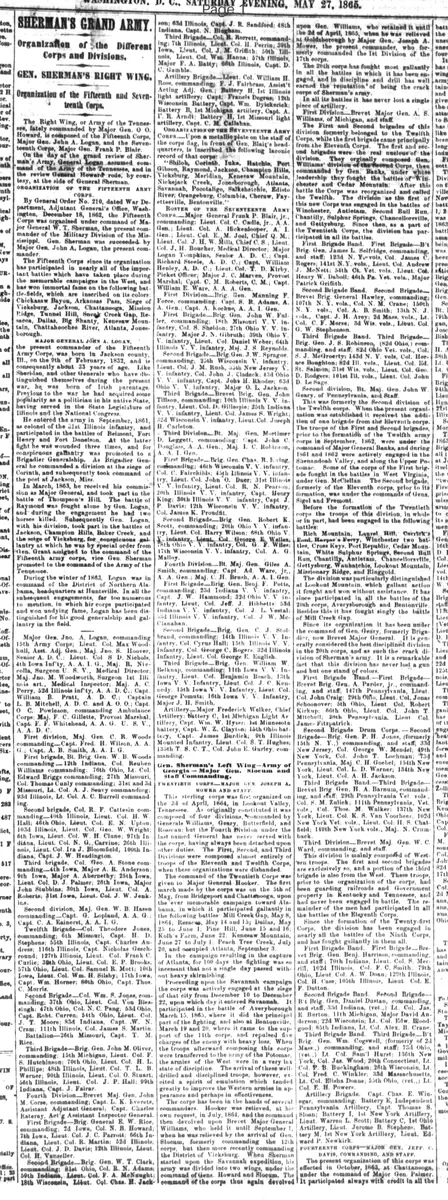
SHERMAN'S GRAND ARMY.
Organization of the Different Corps and Divisions,
GEN. SHERMAN'S RIGHT WING.
Organization of the Fifteenth and Seventeenth Corps.
The Right Wing, or Army of the Tennessee, lately commanded by Major Gen. O. O. Howard, is composed of the Fifteenth Corps, Major Gen. John A. Logan, and the Seventeenth Corps, Major Gen. Frank P. Blair.
On the day of the grand review of Sherman's Army, General Logan assumed command of the Army of the Tennessee, and in the review General Howard rode, by courtesy, at the side of General Sherman.
ORGANIZATION OF THE FIFTEENTH ARMY CORPS.
By General Order No. 210, dated War Department, Adjutant General's Office, Washington, December 18, 1862, the Fifteenth Corps was organized under command of Major General W. T. Sherman, the present commander of the Military Division of the Mississippi. Gen. Sherman was succeeded by Major Gen. John A. Logan, the present commander.
The Fifteenth Corps since its organization has participated in nearly all of the important battles which have taken place during the memorable campaigns in the West, and has won immortal fame on the following battle-fields, which are inscribed on its colors:
Chickasaw Bayou, Arkansas Post, Siege of Vicksburg, Jackson, Chattanooga, Mission Ridge, Tunnel Hill, Snake Creek Gap, Resaca, Dallas, Big Shanty, Kenesaw Mountain, Chattahoochee River, Atlanta, Jonesborough.
MAJOR GENERAL JOHN A. LOGAN,
the present commander of the Fifteenth Army Corps, was born in Jackson county, Ill., on the 9th of February, 1822, and is consequently about 33 years of age. Like Sheridan, and other Generals who have distinguished themselves during the present war, he was born of Irish parentage.
Previous to the war he had acquired some popularity as a politician in his native State, having served in the State Legislature of Illinois and the National Congress.
He entered the army in September, 1861, as colonel of the 31st Illinois infantry, and participated in the battles of Belmont, Fort Henry and Fort Donelson. At the latter fight he was wounded three times, and for conspicuous gallantry was promoted to a Brigadier Generalship. As Brigadier General he commanded a division at the siege of Corinth, and subsequently took command of the post at Jackson, Miss.
In March, 1863, he received his commission as Major General, and took part in the battle of Thompson's Hill. The battle of Raymond was fought alone by Gen. Logan, and during the engagement he had two horses killed. Subsequently Gen. Logan, with his division, took part in the battles of Jackson, Champion Hills, Baker's Creek, and the siege of Vicksburg, for conspicuous gallantry at which he was by special order from Gen. Grant assigned to the command of the Fifteenth army corps, vice Gen. Sherman promoted to the command of the Army of the Tennessee.
During the winter of 1863, Logan was in command of the District of Northern Alabama, headquarters at Huntsville. In all the subsequent engagements, far too numerous to mention, in which his corps participated and won undying fame, Logan has been distinguished for his good generalship and gallantry in the field.
Major Gen. Jno. A. Logan, commanding 15th Army Corps; Lieut. Col. Max Woodhull, Asst. Adjt. Gen.; Maj. Jno. S. Hoover, Senior A. D. C.; Lieut. Col. S. D. Nichols, 4th Iowa Inf'ty, A. A. I. G.; Maj. R. Niccolls, Surgeon U. S. V., Medical Director.
Maj. Jno. M. Woodworth, Surgeon 1st Illinois art., Medical Inspector; Maj. A. C. Perry, 52d Illinois inf'ty, A. A. D. C.; Capt. William B. Pratt, A. D. C.; Captain L. B. Mitchell, A. D. C. and A. Q. M.; Capt. O. C. Powelson, commanding Ambulance Corps; Maj. F. C. Gillette, Provost Marshal; Capt. F. F. Whitehead, A. A. A. G. U. S. V., A. A. D. C.
First division, Maj. Gen. C. R. Woods commanding—Capt. Fred. H. Wilson, A. A. A. G.; Capt. A. B. Smith, A. A. I. G.
First brigade, Bt. Brig. Gen. W. B. Woods commanding—12th Indiana, Col. Reuben Williams commanding; 76th Ohio, Lt. Col. Edward Briggs commanding; 27th Missouri, Col. Thomas Curly commanding; 31st and 3d Missouri, Lt. Col. A. J. Seavy commanding; 93d Illinois, Lt. Col. A. C. Burrell commanding.
Second brigade, Col. R. F. Catterson commanding—40th Illinois, Lieut. Col. H. W. Hall; 4th Ohio, Lieut. Col. E. N. Upton; 103d Illinois, Lieut. Col. Geo. W. Wright; 6th Iowa, Lieut. Col. W. H. Clune; 97th Indiana, Lieut. Col. N. G. Carvine; 26th Illinois, Lieut. Col. Ira J. Bloomfield; 100th Indiana, Capt. J. W. Headington.
Third brigade, Col. Geo. A. Stone commanding—4th Iowa, Major A. R. Anderson; 9th Iowa, Major A. Abernethy; 25th Iowa, Lieut. Col. D. J. Palmer; 26th Iowa, Major John Stubbins; 30th Iowa, Lieut. Col. A. Roberts; 31st Iowa, Lieut. Col. J. W. Jenkins.
Second division, Maj. Gen. W. B. Hazen commanding—Capt. G. Lopland, A. A. G.; Capt. C. A. Eanest, A. A. I. G.
Twelfth Brigade—Col. Theodore Jones, commanding; 6th Missouri, Capt. H. D. Stephens; 55th Illinois, Capt. Charles Andrews; 116th Illinois, Capt. Nicholas Geschwind; 127th Illinois, Lieut. Col. Frank C. Currie; 30th Ohio, Lieut. Col. E. P. Brooks; 57th Ohio, Lieut. Col. Samuel R. Mott; 10th Iowa, Lieut. Col. Wm. H. Silsby; 17th Iowa, Capt. Wm. Horner; 80th Ohio, Capt. Thos. C. Morris.
Second Brigade—Col. Wm. S. Jones, commanding; 37th Ohio, Lieut. Col. Von Blessingham; 47th Ohio, Col. N. C. Pang; 53d Ohio, Capt. Robt. Curren; 54th Ohio, Lieut. Col. J. T. Moore; 83d Indiana, Capt. W. N. Cram; 111th Illinois, Col. James S. Martin; Battalion 26th Missouri, Capt. T. M. Rice.
Third Brigade—Brig. Gen. John M. Oliver commanding; 15th Michigan, Lieut. Col. F. S. Hutchinson; 70th Ohio, Lieut. Col. H. L. Phillips; 48th Illinois, Lieut. Col. T. L. B. Werner; 90th Illinois, Lieut. Col. O. Stuart; 56th Illinois, Lieut. Col. J. P. Hall; 99th Indiana, Capt. J. Fairar.
Fourth Division—Brevet Maj. Gen. John M. Corse, commanding; Capt. L. K. Everett, Assistant Adjutant General; Capt. Charles Ratray, Act'g Assistant Inspector General.
First Brigade—Brig. General E. W. Rice, commanding, 2d Iowa, Col. N. B. Howard; 7th Iowa, Lieut. Col. J. C. Parrott; 66th Indiana, Lieut. Col. R. Martin; 52d Illinois, Lieut. Col. J. D. Davis; 12th Illinois, Lieut. Col. H. Vansellor.
Second Brigade—Brig. Gen. W. T. Clark, commanding; 81st Ohio, Col. R. N. Adams; 59th Indiana, Lieut. Col. F. A. McNaught; 18th Wisconsin, Lieut. Col. Chas. H. Jackson; 63d Illinois, Capt. J. R. Sandford; 48th Indiana, Capt. N. Bingham.
Third Brigade—Col. R. Barrett, commanding; 7th Illinois, Lieut. Col. H. Perrin; 39th Iowa, Lieut. Col. J. M. Griffith; 50th Illinois, Lieut. Col. Wm. Hanna; 57th Illinois, Major F. A. Batty; 66th Illinois, Capt. D. C. Gamble.
Artillery Brigade—Lieut. Col. William H. Ross, commanding; F. J. Fairbrass, Assist't Acting Adj. Gen.; Battery H, 1st Illinois light artillery; Capt. Francis Degras; 12th Wisconsin Battery, Capt. Wm. Dickerson; Battery B, 1st Michigan artillery, Capt. A. J. R. Arndt; Battery H, 1st Missouri light artillery, Capt. C. M. Callahan.
Organization of the Seventeenth Army Corps.—Upon a metallic plate on the staff of the corps flag, in front of Gen. Blair's head-quarters, is inscribed the following laconic record of that corps:
"Shiloh, Corinth, Iuka, Hatchie, Port Gibson, Raymond, Jackson, Champion Hills, Vicksburg, Meridian, Kenesaw Mountain, Nickajack Creek, Jonesborough, Atlanta, Savannah, Pocotaligo, Salkehatchie, Edisto River, Orangeburg, Columbia, Cheraw, Fayetteville, Bentonville."
Roster of the Seventeenth Army Corps.—Major General Frank P. Blair, jr., commanding; Lieut. Col. C. Cadle, jr., A. A. Gen.; Lieut. Col. A. Hickenlooper, A. I. Gen.; Lieut. Col. E. M. Joel, Chief Q. M.; Lieut. Col. J. H. W. Mills, Chief C. S.; Lieut. Col. J. H. Boucher, Medical Director; Major Logan Tompkins, Senior A. D. C.; Capt. Richard Steele, A. D. C.; Capt. William Henley, A. D. C.; Lieut. Col. T. D. Kirby, Picket Officer; Major J. C. Marvin, Provost Marshal; Capt. C. M. Roberts, C. M.; Capt. William E. Ware, A. A. A. Gen.
First Division—Brig. Gen. Manning F. Force, commanding; Capt. S. R. Adams, A. A. Gen.; Capt. A. Koehne, A. A. I. Gen.
First Brigade—Brig. Gen. John W. Fuller commanding; 18th Missouri V. V. infantry, Col. S. Sheldon; 21st Ohio V. V. infantry, Major J. N. Glibruth; 39th Ohio V. V. infantry, Lieut. Col. Daniel Weber; 64th Illinois V. V. infantry, Maj. J. S. Reynolds.
Second Brigade—Brig. Gen. J. W. Sprague commanding; 25th Wisconsin V. infantry, Lieut. Col. J. M. Rusk; 31st New Jersey V. V. infantry, Col. John J. Cladek; 43d Ohio V. V. infantry, Capt. John H. Rhodes; 63d Ohio V. V. infantry, Major O. L. Jackson.
Third Brigade—Brevet Brig. Gen. John Tillson, commanding; 10th Illinois V. V. infantry, Lieut. Col. D. Gillespie; 20th Indiana V. V. infantry, Lieut. Col. James S. Wright; 32d Wisconsin V. infantry, Lieut. Col. Joseph H. Carleton.
Third Division—Bt. Maj. Gen. Mortimer D. Leggett, commanding; Capt. John C. Douglass, A. A. Gen., Maj. I. C. Rolinson, A. A. I. Gen.
First Brigade—Brig. Gen. Chas. R. Ewing commanding; 46th Wisconsin V. V. infantry, Col. C. Fairchilds; 45th Illinois V. V. infantry, Lieut. Col. John C. Duor; 31st Illinois V. V. infantry, Lieut. Col. R. N. Pearson; 20th Illinois V. V. infantry, Capt. Henry King; 30th Illinois V. V. infantry, Capt. J. P. Davis; 12th Wisconsin V. V. infantry, Col. James K. Proudfit.
Second Brigade—Brig. Gen. Robert K. Scott, commanding; 20th Ohio V. V. infantry, Lieut. Col. Harry Wilson; 68th Ohio V. V. infantry, Lieut. Col. George E. Welles; 78th Ohio V. V. infantry, Col. G. F. Wiles; 17th Wisconsin V. V. infantry, Col. A. G. Malloy.
Fourth Division—Bt. Maj. Gen. Giles A. Smith, commanding; Capt. Ad. Ware, jr., A. A. Gen.; Maj. C. H. Brush, A. A. I. Gen.
First Brigade—Brig. Gen. Benj. F. Potts, commanding, 23d Indiana V. V. infantry, Capt. J. W. Hammond; 32d Ohio V. V. infantry, Lieut. Col. Jeff. J. Hibbetts; 53d Indiana V. V. infantry, Col. J. I. Vestal; 80th Illinois V. V. infantry, Col. J. W. McClanahan.
Second Brigade—Brig. Gen. C. J. Stolbrand, commanding; 14th Illinois V. V. Infantry, Col. Cyrus Hall; 15th Illinois V. V. Infantry, Col. George C. Rogers; 32d Illinois Infantry, Lieut. Col. George E. English.
Third Brigade—Brig. Gen. William W. Belknap, commanding; 11th Iowa V. V. Infantry, Lieut. Col. Benjamin Beach; 13th Iowa V. V. Infantry, Lieut. Col. J. C. Kennedy; 15th Iowa V. V. Infantry, Lieut. Col. George Pomutz; 16th Iowa V. V. Infantry, Major J. J. Smith.
Artillery—Major Frederick Welker, Chief Artillery; Battery C, 1st Michigan Light Artillery, Capt. Wm. W. Hyzer; 1st Minnesota battery, Capt. W. Z. Clayton; 15th Ohio battery, Capt. James Burdick; 9th Illinois Mounted Infantry, Lieut. Col. S. T. Hughes; 135th U. S. C. T., Col. John E. Gurley, commanding.
Gen. Sherman's Left Wing—Army of Georgia—Major Gen. Slocum and Staff Commanding.
TWENTIETH CORPS—MAJOR GEN. JOSEPH A. MOWER AND STAFF.
This sterling corps was first organized on the 3d of April, 1864, in Lookout Valley, Tennessee. As originally constituted it was composed of four divisions, commanded by Generals Williams, Geary, Butterfield, and Rosseau; but the Fourth Division under the last named General has never served with the corps, having always been detached upon other duties. The First, Second, and Third Divisions were composed almost entirely of troops of the Eleventh and Twelfth Corps, when these organizations were disbanded.
The command of the Twentieth Corps was given to Major General Hooker. The first march made by the corps was on the 5th of May, from Bridgeport and Chattanooga, upon the ever memorable campaign toward Alabama, in which it participated gallantly in the following battles: Mill Creek Gap, May 8, 1864, Resaca, May 14 and 15; Dallas, May 25 to June 1, Pine Hill, June 15 and 16, Kolb's Farm, June 22, Kenesaw Mountain, June 27 to July 1; Peach Tree Creek, July 20, and occupied Atlanta, September 3.
In the campaign resulting in the capture of Atlanta, for one hundred days the fighting was so incessant that not a single day passed without heavy skirmishing.
Proceeding upon the Savannah campaign the corps was actively engaged at the siege of that city from December 10 to December 22, upon which day it entered Savannah. It participated in the battle of Averysborough, March 16, 1865, where it did the principal part of the fighting, and also at Bentonville, March 19 and 20, where it came to the support of the 15th corps, and repulsed five charges of the enemy with heavy loss. When the troops afterward composing this corps were transferred to the army of the Potomac, the armies of the West were in a very lax state of discipline. The arrival of these well-drilled and disciplined troops, however, excited a spirit of emulation which tended greatly to improve the Western armies in appearance and perhaps in effectiveness.
The corps has been in the hands of several commanders. Hooker was relieved, at his own request, in July, 1864, and the command then devolved upon Brevet Major General Williams, who held it until September 1, when he was relieved by the arrival of Gen. Slocum, formerly commanding the 12th corps, but then more recently commanding the District of Vicksburg. When Sherman started upon the Savannah expedition, his army was divided into two wings, under the command of Gens. Howard and Slocum. The command of the corps thus again devolved upon Gen. Williams, who retained it until the 2d of April, 1865, when he was relieved at Goldsborough by Major Gen. Joseph A. Mower, the present commander, who formerly commanded the 1st Division of the 17th corps.
The 20th corps has fought most gallantly in all the battles in which it has been engaged, and in discipline and drill has well earned the reputation of being the crack corps of Sherman's army.
In all its battles it has never lost a single piece of artillery.
First Division—Brevet Major Gen. A. S. Williams, of Michigan, and staff.
The First and Second brigades of this division formerly belonged to the Twelfth Corps, while the first brigade came principally from the Eleventh Corps. The first and second brigades were the real nucleus of the division. They originally composed Gen. Williams' division of the Second Corps, then commanded by Gen. Banks, under whose leadership they fought the battles of Winchester and Cedar Mountain. After this battle the Corps was reorganized and called the Twelfth. The division was the first of this new Corps engaged in the battles of Winchester, Antietam, Second Bull Run, Chantilly, Sulphur Springs, Chancellorsville, and Gettysburg. Since then, as a part of the Twentieth Corps, the division has participated in all its battles.
First Brigade Band. First Brigade—B't Brig. Gen. James L. Selfridge, commanding, and staff: 123d N. Y. vols, Col. James C. Rogers; 141st N. Y. vols., Lieut. Col. Andrew J. McNett; 54th Ct. Vet. vols., Lieut. Col. Henry W. Daboll; 46th Pa. Vet. vols., Major Patrick Griffith.
Second Brigade Band. Second Brigade—Brevet Brig. General Hawley, commanding: 107th N. Y. vols, Col. N. M. Crane; 150th N. Y. vols., Col. A. B. Smith; 13th N. J. vols., Capt. J. H. Arey; 2d Mass. vols., Lt. Col. C. F. Morse; 3d Wis. vols., Lieut. Col. G. W. Stephenson.
Third Brigade Band. Third Brigade—Brig. Gen. J. S. Robinson, (82d Ohio,) commanding, and staff: 82d Ohio Vet. vols., Col. S. J. McGroarty; 143d N. Y. vols. Col. Horace Boughton; 82d Ill. vols., Lieut. Col. Ed. St. Salmon; 31st Wis. vols., Lieut. Col. Geo. D. Rodgers; 101st Ill. vols., Lieut. Col. John D. Le Sage.
Second division, Bt. Maj. Gen. John W. Geary, of Pennsylvania, and Staff.
This was formerly the Second division of the Twelfth corps. When the present organization was established it received the addition of one brigade from the Eleventh corps. The troops of the First and Second brigades, prior to the formation of the Twelfth army corps in September, 1862, were under the command of Major General Banks, and during 1861 and 1862 were actively engaged in the Shenandoah Valley, and along the Upper Potomac. Some of the corps of the First brigade fought in the battles in West Virginia, under Gen. McClellan. The Second brigade, formerly of the Eleventh corps, prior to its formation, was under the commands of Gens. Sigel and Fremont.
Before the formation of the Twentieth corps the troops of this division, in whole or in part, had been engaged in the following battles:
Rich Mountain, Laurel Hill, Carrick's Ford, Harper's Ferry, Winchester two battles, Cross Keys, Port Republic, Cedar Mountain, White Sulphur Springs, Second Bull Run, Chantilly, Antietam, Chancellorsville, Gettysburg, Wauhatchie, Lookout Mountain, Missionary Ridge, and Ringgold.
The division was particularly distinguished at Lookout Mountain, which gallant action it fought and won without assistance. It has since participated in all the battles of the 20th corps, Averysborough and Bentonville. Besides this it has fought singly the battle of Mill Creek Gap.
Since its organization it has been under the command of Gen. Geary, formerly Brigadier, now Brevet Major General. It is generally considered the best disciplined division in the 20th corps, and as such the crack division of Sherman's army. It is a remarkable fact that this division has never lost a gun and but one stand of colors.
First Brigade Band.—First Brigade—Brevet Brig. Gen. A. Parker, jr., commanding, and staff: 147th Pennsylvania, Lieut. Col. John Craig; 29th Ohio, Lieut. Col. Jonas Schoonover; 5th Ohio, Lieut. Col. Robert Kirkup; 66th Ohio, Lieut. Col. John T. Mitchell; 20th Pennsylvania, Lieut. Col. James Fitzpatrick.
Second Brigade Drum Corps.—Second Brigade—Brig. Gen. P. H. Jones, (formerly 15th N. Y.,) commanding, and staff: 33d New Jersey, Col. George W. Mendel; 49th New York, Col. John T. Lochman; 73d Pennsylvania, Maj. C. H. Goebel; 154th New York, Lieut. Col. L. D. Warner; 134th New York, Lieut. Col. A. H. Jackson.
Third Brigade Band.—Third Brigade—Brevet Brig. Gen. H. A. Barnum, commanding, and staff; 29th Pennsylvania Vet. vols., Col. S. M. Zulick; 111th Pennsylvania, Vet. vols., Col. Thos. M. Walker; 137th New York, Lieut. Col. K. S. Van Voorhees; 102d New York Vet. vols., Lieut. Col. H. S. Chatfield; 149th New York vols., Maj. N. Crumbeck.
Third Division—Brevet Maj. Gen. W. C. Ward, commanding, and staff.
This division is mainly composed of Western troops. The first and second brigades are exclusively so, and a portion of the third brigade is also from the West. These troops, prior to the organization of the corps, had been guarding railroads and Government property in Kentucky and Tennessee, and had never been engaged in battle. The remainder of the men had participated in all the battles of the Eleventh Corps.
Since the formation of the Twentieth Corps, the division has been engaged in nearly all the battles of the Ninth Corps, and has fought gallantly in them all.
First Brigade Band. First Brigade—Brevet Brig. Gen. Benj. Harrison, commanding, and staff: 70th Indiana, Lieut. Col. S. Merrill; 102d Illinois, Col. F. C. Smith; 79th Ohio, Lieut. Col. A. W. Doan; 129th Illinois, Col. H. Case; 105th Illinois, Lieut. Col. E. F. Dutton.
Second Brigade Band. Second Brigade—B't Brig. Gen. Daniel Dustin, commanding, and staff, 33d Indiana, (vet.,) Lt. Col. Jas. E. Barton; 11th Michigan, Major David Anderson; 22d Wisconsin, Lt. Col. Edw. Bloodgood; 85th Indiana, Lt. Col. Alex. B. Crane.
Third Brigade Band. Third Brigade—B't Brig. Gen. Wm. Cogswell, (formerly of 2d Mass.,) commanding, and staff; 73d Ohio, (vet.,) Lt. Col. Sam'l Hurst; 136th New York, Col. Jas. Wood; 20th Connecticut, Lt. Col. P. B. Buckingham; 26th Wisconsin, Lt. Col. Fred. C. Winkler; 33d Massachusetts, Lt. Col. Elisha Doane; 55th Ohio, (vet.,) Lt. Col. F. H. Powers.
Artillery Brigade. Capt. Chas. E. Wingar, commanding: Battery E, Independent Pennsylvania Artillery, Capt. Thomas S. Sloan; Battery I, 1st New York Artillery, Lieut. Warren L. Scott; Battery C, 1st Ohio Artillery, Lieut. Jerome B. Stephens; Battery M, 1st New York Artillery, Lieut. Edward P. Newkirk.
FOURTEENTH CORPS—MAJOR GEN. JEFF. C. DAVIS, COMMANDING, AND STAFF.
The present organization of this corps was effected in October, 1863, at Chattanooga, under the command of Major Gen. Palmer.
It participated always with credit in all the battles of the Atlanta campaign, and fought the battle of Jonesborough (below Atlanta) unsupported, driving a large force of the enemy from the works and capturing two four-gun batteries.
It participated in the pursuit of Hood, and has since formed with the 20th corps the left wing (now the army of Georgia) of Sherman's army. At the battle of Bentonville it sustained the first shock of Johnston's attack, and resisted so stubbornly that time was given for the arrival of the 20th corps, when the army of Georgia repulsed all Johnston's attacks, which finding fruitless he withdrew to Smithfield. The history of the 14th corps has been an eventful one, but is so nearly like that of the 20th corps, with which it has been so closely connected, that to give a lengthened sketch of its services would be to indulge in needless repetition.
First Division—Brig. Gen. Chas. E. Walcott, commanding, and staff.
This division left Louisville (the First Division of the old Fourteenth Army Corps) on the 1st of October, 1862; fought at Perryville, October 8, 1862; reached Nashville in November; participated in the hard-fought battle of Stone River, December 31, January 1, 2 and 3. At Murfreesborough the division was reorganized, and started in January, 1863, on the Tullahoma campaign; was in the battles of Hoover's Gap, June 24, and Chickamauga, Sept. 19 and 20, Brig. Gen. Baird being then in command. At Chattanooga it was reorganized, since which time it has been actively engaged in all the battles of the present Fourteenth Corps. Since its organization it has had the following commanders: Brig. Gen. Rousseau, Brig. Gen. Baird, Brig. Gen. Rousseau again, Brig. Gen. Johnson, Brig. Gen. King, Brig. Gen. Carlin, and Brig. Gen. Walcott, its present leader.
Second Brigade Band. Second brigade, Bt. Brig. Gen. Geo. P. Buell commanding—79th Ohio, Major R. P. Findley; 13th Michigan, Col. J. B. Culver; 69th Ohio, Lt. Col. Joseph Brigham; 21st Michigan, Lt. Col. Bishop.
Third Brigade Band. Third brigade, Col. H. A. Hambright commanding, and Staff—38th Indiana, Col. D. H. Patton; 21st Ohio, Lt. Col. A. McMahon; 70th Pennsylvania, Lt. Col. D. Miles.
First Brigade Band. First brigade, Bt. Brig. Gen. Hobart commanding, and Staff—94th Ohio, Major W. H. Snyder; 88th Indiana, Lieut. Col. C. E. Briant; 83d Ohio, Major J. Henson; 42d Indiana, Major E. W. Kelloway; 21st Wisconsin, Lt. Col. M. H. Fitch; 101st Illinois, Lt. Col. Hapeman.
Second division, Bt. Maj. Gen. James D. Morgan commanding, and Staff.
This division was organized October 10, 1863, under command of Jeff. C. Davis, then Brigadier General. It has participated in all the battles of the Fourteenth corps, and at Jonesborough, particularly, distinguished itself. In this action there were, to quote the words of Gen. Morgan's official report, "two four-gun batteries taken, one by the First and one by the Second brigade; 394 prisoners, (one Brigadier General, 24 commissioned officers,) over 1,000 stand of small arms, and six battle-flags." It was detached to capture Rome, Ga., and succeeded. In its attack on Kenesaw Mountain it lost 1,300 men in 20 minutes, and five field officers.
First Brigade Band. First Brigade—Brig. Gen. Wm. Vandever, commanding, and staff; 16th Ill. Vet. vol. Infantry, Lieut. Col. Chas. D. Kerr; 17th N. Y. Vet. vol. infantry, Lt. Col. James Lake; 60th Ill. Vet. vol. Infantry, Lieut. Col. Geo. W. Evans; 10th Mich. Vet. vol. infantry, Lieut. Col. W. H. Dumphy; 14th Mich. Vet. vol. Infantry, Lieut. Col. G. W. Grummond.
Second Brigade Band. Second Brigade—Brig. Gen. John Mitchell, commanding, and staff; 102d Ohio, Lieut. Col. Joseph Good; 113th Ohio, Capt. Toland Jones; 121st Ohio, Lieut. Col. A. B. Robinson; 34th Illinois, (Vet.,) Lieut. Col. P. Ege; 78th Illinois, Lieut. Col. R. M. Vernon; 98th Ohio, Major D. E. Rouch.
Third Brigade Band. Third Brigade—Lieut. Col. James W. Langley, commanding, and staff: 52d Ohio, Major J. T. Holmes; 22d Indiana, (Vet.,) Major Thomas Shea; 125th Illinois, Capt. G. W. Cook; 85th Ill., Lieut. Col. J. H. Griffith; 80th Illinois, Lieut. Col. A. R. Fahnestock.
Third Division—Brevet Maj. Gen. Baird, commanding, and staff.
This division, like the preceding, was organized at Chattanooga in October, 1863, and has sustained an excellent reputation in all of the numerous battles in which it has been engaged. At Jonesborough its loss was very heavy, but the works in its front were gallantly carried. At Bentonville it was ordered forward, unsupported by the other divisions, and made a successful reconnoissance of the enemy's position. Its men still proudly remember that they belonged to Major Gen. Geo. H. Thomas' division at the first successful battle of the war—Mill Springs, where Zollicoffer met his death.
Third Brigade Band.—Third Brigade,—Brig. Gen. Geo. S. Greene commanding, 18th Kentucky, Lt. Col. I. K. Milward; 14th Ohio, Lt. Col. Albert Moore; 88th Ohio, Capt. Chas. M. Gilbert; 74th Indiana, Lt. Col. Thomas Morgan.
First Brigade Band—First Brigade—Col. M. C. Hunter commanding, and 23d Missouri, Major John H. Julty; 89th Ohio, Lieut. Col. Wm. H. Glenn; 92d Ohio, Lieut. Col. John C. Morrow; 31st Ohio, Capt. Eli Wilkin; 82d Indiana, Lieut. Col. J. M. Mathews; 17th Ohio, Lieut. Col. Benjamin H. Showers.
Second Brigade Band—Second Brigade—Col. N. Gleason, Commanding, and Staff, 2d Minnesota, Col. J. W. Bishop; 75th Indiana, Lieut. Col. Wm. O'Brien; 100th Indiana, Lieut. Col. Thomas Doane; 87th Indiana, Lieut. Col. Edwin P. Hammond; 105th Ohio, Lieut. Col. Geo. T. Perkins.
Organization of the Different Corps and Divisions,
GEN. SHERMAN'S RIGHT WING.
Organization of the Fifteenth and Seventeenth Corps.
The Right Wing, or Army of the Tennessee, lately commanded by Major Gen. O. O. Howard, is composed of the Fifteenth Corps, Major Gen. John A. Logan, and the Seventeenth Corps, Major Gen. Frank P. Blair.
On the day of the grand review of Sherman's Army, General Logan assumed command of the Army of the Tennessee, and in the review General Howard rode, by courtesy, at the side of General Sherman.
ORGANIZATION OF THE FIFTEENTH ARMY CORPS.
By General Order No. 210, dated War Department, Adjutant General's Office, Washington, December 18, 1862, the Fifteenth Corps was organized under command of Major General W. T. Sherman, the present commander of the Military Division of the Mississippi. Gen. Sherman was succeeded by Major Gen. John A. Logan, the present commander.
The Fifteenth Corps since its organization has participated in nearly all of the important battles which have taken place during the memorable campaigns in the West, and has won immortal fame on the following battle-fields, which are inscribed on its colors:
Chickasaw Bayou, Arkansas Post, Siege of Vicksburg, Jackson, Chattanooga, Mission Ridge, Tunnel Hill, Snake Creek Gap, Resaca, Dallas, Big Shanty, Kenesaw Mountain, Chattahoochee River, Atlanta, Jonesborough.
MAJOR GENERAL JOHN A. LOGAN,
the present commander of the Fifteenth Army Corps, was born in Jackson county, Ill., on the 9th of February, 1822, and is consequently about 33 years of age. Like Sheridan, and other Generals who have distinguished themselves during the present war, he was born of Irish parentage.
Previous to the war he had acquired some popularity as a politician in his native State, having served in the State Legislature of Illinois and the National Congress.
He entered the army in September, 1861, as colonel of the 31st Illinois infantry, and participated in the battles of Belmont, Fort Henry and Fort Donelson. At the latter fight he was wounded three times, and for conspicuous gallantry was promoted to a Brigadier Generalship. As Brigadier General he commanded a division at the siege of Corinth, and subsequently took command of the post at Jackson, Miss.
In March, 1863, he received his commission as Major General, and took part in the battle of Thompson's Hill. The battle of Raymond was fought alone by Gen. Logan, and during the engagement he had two horses killed. Subsequently Gen. Logan, with his division, took part in the battles of Jackson, Champion Hills, Baker's Creek, and the siege of Vicksburg, for conspicuous gallantry at which he was by special order from Gen. Grant assigned to the command of the Fifteenth army corps, vice Gen. Sherman promoted to the command of the Army of the Tennessee.
During the winter of 1863, Logan was in command of the District of Northern Alabama, headquarters at Huntsville. In all the subsequent engagements, far too numerous to mention, in which his corps participated and won undying fame, Logan has been distinguished for his good generalship and gallantry in the field.
Major Gen. Jno. A. Logan, commanding 15th Army Corps; Lieut. Col. Max Woodhull, Asst. Adjt. Gen.; Maj. Jno. S. Hoover, Senior A. D. C.; Lieut. Col. S. D. Nichols, 4th Iowa Inf'ty, A. A. I. G.; Maj. R. Niccolls, Surgeon U. S. V., Medical Director.
Maj. Jno. M. Woodworth, Surgeon 1st Illinois art., Medical Inspector; Maj. A. C. Perry, 52d Illinois inf'ty, A. A. D. C.; Capt. William B. Pratt, A. D. C.; Captain L. B. Mitchell, A. D. C. and A. Q. M.; Capt. O. C. Powelson, commanding Ambulance Corps; Maj. F. C. Gillette, Provost Marshal; Capt. F. F. Whitehead, A. A. A. G. U. S. V., A. A. D. C.
First division, Maj. Gen. C. R. Woods commanding—Capt. Fred. H. Wilson, A. A. A. G.; Capt. A. B. Smith, A. A. I. G.
First brigade, Bt. Brig. Gen. W. B. Woods commanding—12th Indiana, Col. Reuben Williams commanding; 76th Ohio, Lt. Col. Edward Briggs commanding; 27th Missouri, Col. Thomas Curly commanding; 31st and 3d Missouri, Lt. Col. A. J. Seavy commanding; 93d Illinois, Lt. Col. A. C. Burrell commanding.
Second brigade, Col. R. F. Catterson commanding—40th Illinois, Lieut. Col. H. W. Hall; 4th Ohio, Lieut. Col. E. N. Upton; 103d Illinois, Lieut. Col. Geo. W. Wright; 6th Iowa, Lieut. Col. W. H. Clune; 97th Indiana, Lieut. Col. N. G. Carvine; 26th Illinois, Lieut. Col. Ira J. Bloomfield; 100th Indiana, Capt. J. W. Headington.
Third brigade, Col. Geo. A. Stone commanding—4th Iowa, Major A. R. Anderson; 9th Iowa, Major A. Abernethy; 25th Iowa, Lieut. Col. D. J. Palmer; 26th Iowa, Major John Stubbins; 30th Iowa, Lieut. Col. A. Roberts; 31st Iowa, Lieut. Col. J. W. Jenkins.
Second division, Maj. Gen. W. B. Hazen commanding—Capt. G. Lopland, A. A. G.; Capt. C. A. Eanest, A. A. I. G.
Twelfth Brigade—Col. Theodore Jones, commanding; 6th Missouri, Capt. H. D. Stephens; 55th Illinois, Capt. Charles Andrews; 116th Illinois, Capt. Nicholas Geschwind; 127th Illinois, Lieut. Col. Frank C. Currie; 30th Ohio, Lieut. Col. E. P. Brooks; 57th Ohio, Lieut. Col. Samuel R. Mott; 10th Iowa, Lieut. Col. Wm. H. Silsby; 17th Iowa, Capt. Wm. Horner; 80th Ohio, Capt. Thos. C. Morris.
Second Brigade—Col. Wm. S. Jones, commanding; 37th Ohio, Lieut. Col. Von Blessingham; 47th Ohio, Col. N. C. Pang; 53d Ohio, Capt. Robt. Curren; 54th Ohio, Lieut. Col. J. T. Moore; 83d Indiana, Capt. W. N. Cram; 111th Illinois, Col. James S. Martin; Battalion 26th Missouri, Capt. T. M. Rice.
Third Brigade—Brig. Gen. John M. Oliver commanding; 15th Michigan, Lieut. Col. F. S. Hutchinson; 70th Ohio, Lieut. Col. H. L. Phillips; 48th Illinois, Lieut. Col. T. L. B. Werner; 90th Illinois, Lieut. Col. O. Stuart; 56th Illinois, Lieut. Col. J. P. Hall; 99th Indiana, Capt. J. Fairar.
Fourth Division—Brevet Maj. Gen. John M. Corse, commanding; Capt. L. K. Everett, Assistant Adjutant General; Capt. Charles Ratray, Act'g Assistant Inspector General.
First Brigade—Brig. General E. W. Rice, commanding, 2d Iowa, Col. N. B. Howard; 7th Iowa, Lieut. Col. J. C. Parrott; 66th Indiana, Lieut. Col. R. Martin; 52d Illinois, Lieut. Col. J. D. Davis; 12th Illinois, Lieut. Col. H. Vansellor.
Second Brigade—Brig. Gen. W. T. Clark, commanding; 81st Ohio, Col. R. N. Adams; 59th Indiana, Lieut. Col. F. A. McNaught; 18th Wisconsin, Lieut. Col. Chas. H. Jackson; 63d Illinois, Capt. J. R. Sandford; 48th Indiana, Capt. N. Bingham.
Third Brigade—Col. R. Barrett, commanding; 7th Illinois, Lieut. Col. H. Perrin; 39th Iowa, Lieut. Col. J. M. Griffith; 50th Illinois, Lieut. Col. Wm. Hanna; 57th Illinois, Major F. A. Batty; 66th Illinois, Capt. D. C. Gamble.
Artillery Brigade—Lieut. Col. William H. Ross, commanding; F. J. Fairbrass, Assist't Acting Adj. Gen.; Battery H, 1st Illinois light artillery; Capt. Francis Degras; 12th Wisconsin Battery, Capt. Wm. Dickerson; Battery B, 1st Michigan artillery, Capt. A. J. R. Arndt; Battery H, 1st Missouri light artillery, Capt. C. M. Callahan.
Organization of the Seventeenth Army Corps.—Upon a metallic plate on the staff of the corps flag, in front of Gen. Blair's head-quarters, is inscribed the following laconic record of that corps:
"Shiloh, Corinth, Iuka, Hatchie, Port Gibson, Raymond, Jackson, Champion Hills, Vicksburg, Meridian, Kenesaw Mountain, Nickajack Creek, Jonesborough, Atlanta, Savannah, Pocotaligo, Salkehatchie, Edisto River, Orangeburg, Columbia, Cheraw, Fayetteville, Bentonville."
Roster of the Seventeenth Army Corps.—Major General Frank P. Blair, jr., commanding; Lieut. Col. C. Cadle, jr., A. A. Gen.; Lieut. Col. A. Hickenlooper, A. I. Gen.; Lieut. Col. E. M. Joel, Chief Q. M.; Lieut. Col. J. H. W. Mills, Chief C. S.; Lieut. Col. J. H. Boucher, Medical Director; Major Logan Tompkins, Senior A. D. C.; Capt. Richard Steele, A. D. C.; Capt. William Henley, A. D. C.; Lieut. Col. T. D. Kirby, Picket Officer; Major J. C. Marvin, Provost Marshal; Capt. C. M. Roberts, C. M.; Capt. William E. Ware, A. A. A. Gen.
First Division—Brig. Gen. Manning F. Force, commanding; Capt. S. R. Adams, A. A. Gen.; Capt. A. Koehne, A. A. I. Gen.
First Brigade—Brig. Gen. John W. Fuller commanding; 18th Missouri V. V. infantry, Col. S. Sheldon; 21st Ohio V. V. infantry, Major J. N. Glibruth; 39th Ohio V. V. infantry, Lieut. Col. Daniel Weber; 64th Illinois V. V. infantry, Maj. J. S. Reynolds.
Second Brigade—Brig. Gen. J. W. Sprague commanding; 25th Wisconsin V. infantry, Lieut. Col. J. M. Rusk; 31st New Jersey V. V. infantry, Col. John J. Cladek; 43d Ohio V. V. infantry, Capt. John H. Rhodes; 63d Ohio V. V. infantry, Major O. L. Jackson.
Third Brigade—Brevet Brig. Gen. John Tillson, commanding; 10th Illinois V. V. infantry, Lieut. Col. D. Gillespie; 20th Indiana V. V. infantry, Lieut. Col. James S. Wright; 32d Wisconsin V. infantry, Lieut. Col. Joseph H. Carleton.
Third Division—Bt. Maj. Gen. Mortimer D. Leggett, commanding; Capt. John C. Douglass, A. A. Gen., Maj. I. C. Rolinson, A. A. I. Gen.
First Brigade—Brig. Gen. Chas. R. Ewing commanding; 46th Wisconsin V. V. infantry, Col. C. Fairchilds; 45th Illinois V. V. infantry, Lieut. Col. John C. Duor; 31st Illinois V. V. infantry, Lieut. Col. R. N. Pearson; 20th Illinois V. V. infantry, Capt. Henry King; 30th Illinois V. V. infantry, Capt. J. P. Davis; 12th Wisconsin V. V. infantry, Col. James K. Proudfit.
Second Brigade—Brig. Gen. Robert K. Scott, commanding; 20th Ohio V. V. infantry, Lieut. Col. Harry Wilson; 68th Ohio V. V. infantry, Lieut. Col. George E. Welles; 78th Ohio V. V. infantry, Col. G. F. Wiles; 17th Wisconsin V. V. infantry, Col. A. G. Malloy.
Fourth Division—Bt. Maj. Gen. Giles A. Smith, commanding; Capt. Ad. Ware, jr., A. A. Gen.; Maj. C. H. Brush, A. A. I. Gen.
First Brigade—Brig. Gen. Benj. F. Potts, commanding, 23d Indiana V. V. infantry, Capt. J. W. Hammond; 32d Ohio V. V. infantry, Lieut. Col. Jeff. J. Hibbetts; 53d Indiana V. V. infantry, Col. J. I. Vestal; 80th Illinois V. V. infantry, Col. J. W. McClanahan.
Second Brigade—Brig. Gen. C. J. Stolbrand, commanding; 14th Illinois V. V. Infantry, Col. Cyrus Hall; 15th Illinois V. V. Infantry, Col. George C. Rogers; 32d Illinois Infantry, Lieut. Col. George E. English.
Third Brigade—Brig. Gen. William W. Belknap, commanding; 11th Iowa V. V. Infantry, Lieut. Col. Benjamin Beach; 13th Iowa V. V. Infantry, Lieut. Col. J. C. Kennedy; 15th Iowa V. V. Infantry, Lieut. Col. George Pomutz; 16th Iowa V. V. Infantry, Major J. J. Smith.
Artillery—Major Frederick Welker, Chief Artillery; Battery C, 1st Michigan Light Artillery, Capt. Wm. W. Hyzer; 1st Minnesota battery, Capt. W. Z. Clayton; 15th Ohio battery, Capt. James Burdick; 9th Illinois Mounted Infantry, Lieut. Col. S. T. Hughes; 135th U. S. C. T., Col. John E. Gurley, commanding.
Gen. Sherman's Left Wing—Army of Georgia—Major Gen. Slocum and Staff Commanding.
TWENTIETH CORPS—MAJOR GEN. JOSEPH A. MOWER AND STAFF.
This sterling corps was first organized on the 3d of April, 1864, in Lookout Valley, Tennessee. As originally constituted it was composed of four divisions, commanded by Generals Williams, Geary, Butterfield, and Rosseau; but the Fourth Division under the last named General has never served with the corps, having always been detached upon other duties. The First, Second, and Third Divisions were composed almost entirely of troops of the Eleventh and Twelfth Corps, when these organizations were disbanded.
The command of the Twentieth Corps was given to Major General Hooker. The first march made by the corps was on the 5th of May, from Bridgeport and Chattanooga, upon the ever memorable campaign toward Alabama, in which it participated gallantly in the following battles: Mill Creek Gap, May 8, 1864, Resaca, May 14 and 15; Dallas, May 25 to June 1, Pine Hill, June 15 and 16, Kolb's Farm, June 22, Kenesaw Mountain, June 27 to July 1; Peach Tree Creek, July 20, and occupied Atlanta, September 3.
In the campaign resulting in the capture of Atlanta, for one hundred days the fighting was so incessant that not a single day passed without heavy skirmishing.
Proceeding upon the Savannah campaign the corps was actively engaged at the siege of that city from December 10 to December 22, upon which day it entered Savannah. It participated in the battle of Averysborough, March 16, 1865, where it did the principal part of the fighting, and also at Bentonville, March 19 and 20, where it came to the support of the 15th corps, and repulsed five charges of the enemy with heavy loss. When the troops afterward composing this corps were transferred to the army of the Potomac, the armies of the West were in a very lax state of discipline. The arrival of these well-drilled and disciplined troops, however, excited a spirit of emulation which tended greatly to improve the Western armies in appearance and perhaps in effectiveness.
The corps has been in the hands of several commanders. Hooker was relieved, at his own request, in July, 1864, and the command then devolved upon Brevet Major General Williams, who held it until September 1, when he was relieved by the arrival of Gen. Slocum, formerly commanding the 12th corps, but then more recently commanding the District of Vicksburg. When Sherman started upon the Savannah expedition, his army was divided into two wings, under the command of Gens. Howard and Slocum. The command of the corps thus again devolved upon Gen. Williams, who retained it until the 2d of April, 1865, when he was relieved at Goldsborough by Major Gen. Joseph A. Mower, the present commander, who formerly commanded the 1st Division of the 17th corps.
The 20th corps has fought most gallantly in all the battles in which it has been engaged, and in discipline and drill has well earned the reputation of being the crack corps of Sherman's army.
In all its battles it has never lost a single piece of artillery.
First Division—Brevet Major Gen. A. S. Williams, of Michigan, and staff.
The First and Second brigades of this division formerly belonged to the Twelfth Corps, while the first brigade came principally from the Eleventh Corps. The first and second brigades were the real nucleus of the division. They originally composed Gen. Williams' division of the Second Corps, then commanded by Gen. Banks, under whose leadership they fought the battles of Winchester and Cedar Mountain. After this battle the Corps was reorganized and called the Twelfth. The division was the first of this new Corps engaged in the battles of Winchester, Antietam, Second Bull Run, Chantilly, Sulphur Springs, Chancellorsville, and Gettysburg. Since then, as a part of the Twentieth Corps, the division has participated in all its battles.
First Brigade Band. First Brigade—B't Brig. Gen. James L. Selfridge, commanding, and staff: 123d N. Y. vols, Col. James C. Rogers; 141st N. Y. vols., Lieut. Col. Andrew J. McNett; 54th Ct. Vet. vols., Lieut. Col. Henry W. Daboll; 46th Pa. Vet. vols., Major Patrick Griffith.
Second Brigade Band. Second Brigade—Brevet Brig. General Hawley, commanding: 107th N. Y. vols, Col. N. M. Crane; 150th N. Y. vols., Col. A. B. Smith; 13th N. J. vols., Capt. J. H. Arey; 2d Mass. vols., Lt. Col. C. F. Morse; 3d Wis. vols., Lieut. Col. G. W. Stephenson.
Third Brigade Band. Third Brigade—Brig. Gen. J. S. Robinson, (82d Ohio,) commanding, and staff: 82d Ohio Vet. vols., Col. S. J. McGroarty; 143d N. Y. vols. Col. Horace Boughton; 82d Ill. vols., Lieut. Col. Ed. St. Salmon; 31st Wis. vols., Lieut. Col. Geo. D. Rodgers; 101st Ill. vols., Lieut. Col. John D. Le Sage.
Second division, Bt. Maj. Gen. John W. Geary, of Pennsylvania, and Staff.
This was formerly the Second division of the Twelfth corps. When the present organization was established it received the addition of one brigade from the Eleventh corps. The troops of the First and Second brigades, prior to the formation of the Twelfth army corps in September, 1862, were under the command of Major General Banks, and during 1861 and 1862 were actively engaged in the Shenandoah Valley, and along the Upper Potomac. Some of the corps of the First brigade fought in the battles in West Virginia, under Gen. McClellan. The Second brigade, formerly of the Eleventh corps, prior to its formation, was under the commands of Gens. Sigel and Fremont.
Before the formation of the Twentieth corps the troops of this division, in whole or in part, had been engaged in the following battles:
Rich Mountain, Laurel Hill, Carrick's Ford, Harper's Ferry, Winchester two battles, Cross Keys, Port Republic, Cedar Mountain, White Sulphur Springs, Second Bull Run, Chantilly, Antietam, Chancellorsville, Gettysburg, Wauhatchie, Lookout Mountain, Missionary Ridge, and Ringgold.
The division was particularly distinguished at Lookout Mountain, which gallant action it fought and won without assistance. It has since participated in all the battles of the 20th corps, Averysborough and Bentonville. Besides this it has fought singly the battle of Mill Creek Gap.
Since its organization it has been under the command of Gen. Geary, formerly Brigadier, now Brevet Major General. It is generally considered the best disciplined division in the 20th corps, and as such the crack division of Sherman's army. It is a remarkable fact that this division has never lost a gun and but one stand of colors.
First Brigade Band.—First Brigade—Brevet Brig. Gen. A. Parker, jr., commanding, and staff: 147th Pennsylvania, Lieut. Col. John Craig; 29th Ohio, Lieut. Col. Jonas Schoonover; 5th Ohio, Lieut. Col. Robert Kirkup; 66th Ohio, Lieut. Col. John T. Mitchell; 20th Pennsylvania, Lieut. Col. James Fitzpatrick.
Second Brigade Drum Corps.—Second Brigade—Brig. Gen. P. H. Jones, (formerly 15th N. Y.,) commanding, and staff: 33d New Jersey, Col. George W. Mendel; 49th New York, Col. John T. Lochman; 73d Pennsylvania, Maj. C. H. Goebel; 154th New York, Lieut. Col. L. D. Warner; 134th New York, Lieut. Col. A. H. Jackson.
Third Brigade Band.—Third Brigade—Brevet Brig. Gen. H. A. Barnum, commanding, and staff; 29th Pennsylvania Vet. vols., Col. S. M. Zulick; 111th Pennsylvania, Vet. vols., Col. Thos. M. Walker; 137th New York, Lieut. Col. K. S. Van Voorhees; 102d New York Vet. vols., Lieut. Col. H. S. Chatfield; 149th New York vols., Maj. N. Crumbeck.
Third Division—Brevet Maj. Gen. W. C. Ward, commanding, and staff.
This division is mainly composed of Western troops. The first and second brigades are exclusively so, and a portion of the third brigade is also from the West. These troops, prior to the organization of the corps, had been guarding railroads and Government property in Kentucky and Tennessee, and had never been engaged in battle. The remainder of the men had participated in all the battles of the Eleventh Corps.
Since the formation of the Twentieth Corps, the division has been engaged in nearly all the battles of the Ninth Corps, and has fought gallantly in them all.
First Brigade Band. First Brigade—Brevet Brig. Gen. Benj. Harrison, commanding, and staff: 70th Indiana, Lieut. Col. S. Merrill; 102d Illinois, Col. F. C. Smith; 79th Ohio, Lieut. Col. A. W. Doan; 129th Illinois, Col. H. Case; 105th Illinois, Lieut. Col. E. F. Dutton.
Second Brigade Band. Second Brigade—B't Brig. Gen. Daniel Dustin, commanding, and staff, 33d Indiana, (vet.,) Lt. Col. Jas. E. Barton; 11th Michigan, Major David Anderson; 22d Wisconsin, Lt. Col. Edw. Bloodgood; 85th Indiana, Lt. Col. Alex. B. Crane.
Third Brigade Band. Third Brigade—B't Brig. Gen. Wm. Cogswell, (formerly of 2d Mass.,) commanding, and staff; 73d Ohio, (vet.,) Lt. Col. Sam'l Hurst; 136th New York, Col. Jas. Wood; 20th Connecticut, Lt. Col. P. B. Buckingham; 26th Wisconsin, Lt. Col. Fred. C. Winkler; 33d Massachusetts, Lt. Col. Elisha Doane; 55th Ohio, (vet.,) Lt. Col. F. H. Powers.
Artillery Brigade. Capt. Chas. E. Wingar, commanding: Battery E, Independent Pennsylvania Artillery, Capt. Thomas S. Sloan; Battery I, 1st New York Artillery, Lieut. Warren L. Scott; Battery C, 1st Ohio Artillery, Lieut. Jerome B. Stephens; Battery M, 1st New York Artillery, Lieut. Edward P. Newkirk.
FOURTEENTH CORPS—MAJOR GEN. JEFF. C. DAVIS, COMMANDING, AND STAFF.
The present organization of this corps was effected in October, 1863, at Chattanooga, under the command of Major Gen. Palmer.
It participated always with credit in all the battles of the Atlanta campaign, and fought the battle of Jonesborough (below Atlanta) unsupported, driving a large force of the enemy from the works and capturing two four-gun batteries.
It participated in the pursuit of Hood, and has since formed with the 20th corps the left wing (now the army of Georgia) of Sherman's army. At the battle of Bentonville it sustained the first shock of Johnston's attack, and resisted so stubbornly that time was given for the arrival of the 20th corps, when the army of Georgia repulsed all Johnston's attacks, which finding fruitless he withdrew to Smithfield. The history of the 14th corps has been an eventful one, but is so nearly like that of the 20th corps, with which it has been so closely connected, that to give a lengthened sketch of its services would be to indulge in needless repetition.
First Division—Brig. Gen. Chas. E. Walcott, commanding, and staff.
This division left Louisville (the First Division of the old Fourteenth Army Corps) on the 1st of October, 1862; fought at Perryville, October 8, 1862; reached Nashville in November; participated in the hard-fought battle of Stone River, December 31, January 1, 2 and 3. At Murfreesborough the division was reorganized, and started in January, 1863, on the Tullahoma campaign; was in the battles of Hoover's Gap, June 24, and Chickamauga, Sept. 19 and 20, Brig. Gen. Baird being then in command. At Chattanooga it was reorganized, since which time it has been actively engaged in all the battles of the present Fourteenth Corps. Since its organization it has had the following commanders: Brig. Gen. Rousseau, Brig. Gen. Baird, Brig. Gen. Rousseau again, Brig. Gen. Johnson, Brig. Gen. King, Brig. Gen. Carlin, and Brig. Gen. Walcott, its present leader.
Second Brigade Band. Second brigade, Bt. Brig. Gen. Geo. P. Buell commanding—79th Ohio, Major R. P. Findley; 13th Michigan, Col. J. B. Culver; 69th Ohio, Lt. Col. Joseph Brigham; 21st Michigan, Lt. Col. Bishop.
Third Brigade Band. Third brigade, Col. H. A. Hambright commanding, and Staff—38th Indiana, Col. D. H. Patton; 21st Ohio, Lt. Col. A. McMahon; 70th Pennsylvania, Lt. Col. D. Miles.
First Brigade Band. First brigade, Bt. Brig. Gen. Hobart commanding, and Staff—94th Ohio, Major W. H. Snyder; 88th Indiana, Lieut. Col. C. E. Briant; 83d Ohio, Major J. Henson; 42d Indiana, Major E. W. Kelloway; 21st Wisconsin, Lt. Col. M. H. Fitch; 101st Illinois, Lt. Col. Hapeman.
Second division, Bt. Maj. Gen. James D. Morgan commanding, and Staff.
This division was organized October 10, 1863, under command of Jeff. C. Davis, then Brigadier General. It has participated in all the battles of the Fourteenth corps, and at Jonesborough, particularly, distinguished itself. In this action there were, to quote the words of Gen. Morgan's official report, "two four-gun batteries taken, one by the First and one by the Second brigade; 394 prisoners, (one Brigadier General, 24 commissioned officers,) over 1,000 stand of small arms, and six battle-flags." It was detached to capture Rome, Ga., and succeeded. In its attack on Kenesaw Mountain it lost 1,300 men in 20 minutes, and five field officers.
First Brigade Band. First Brigade—Brig. Gen. Wm. Vandever, commanding, and staff; 16th Ill. Vet. vol. Infantry, Lieut. Col. Chas. D. Kerr; 17th N. Y. Vet. vol. infantry, Lt. Col. James Lake; 60th Ill. Vet. vol. Infantry, Lieut. Col. Geo. W. Evans; 10th Mich. Vet. vol. infantry, Lieut. Col. W. H. Dumphy; 14th Mich. Vet. vol. Infantry, Lieut. Col. G. W. Grummond.
Second Brigade Band. Second Brigade—Brig. Gen. John Mitchell, commanding, and staff; 102d Ohio, Lieut. Col. Joseph Good; 113th Ohio, Capt. Toland Jones; 121st Ohio, Lieut. Col. A. B. Robinson; 34th Illinois, (Vet.,) Lieut. Col. P. Ege; 78th Illinois, Lieut. Col. R. M. Vernon; 98th Ohio, Major D. E. Rouch.
Third Brigade Band. Third Brigade—Lieut. Col. James W. Langley, commanding, and staff: 52d Ohio, Major J. T. Holmes; 22d Indiana, (Vet.,) Major Thomas Shea; 125th Illinois, Capt. G. W. Cook; 85th Ill., Lieut. Col. J. H. Griffith; 80th Illinois, Lieut. Col. A. R. Fahnestock.
Third Division—Brevet Maj. Gen. Baird, commanding, and staff.
This division, like the preceding, was organized at Chattanooga in October, 1863, and has sustained an excellent reputation in all of the numerous battles in which it has been engaged. At Jonesborough its loss was very heavy, but the works in its front were gallantly carried. At Bentonville it was ordered forward, unsupported by the other divisions, and made a successful reconnoissance of the enemy's position. Its men still proudly remember that they belonged to Major Gen. Geo. H. Thomas' division at the first successful battle of the war—Mill Springs, where Zollicoffer met his death.
Third Brigade Band.—Third Brigade,—Brig. Gen. Geo. S. Greene commanding, 18th Kentucky, Lt. Col. I. K. Milward; 14th Ohio, Lt. Col. Albert Moore; 88th Ohio, Capt. Chas. M. Gilbert; 74th Indiana, Lt. Col. Thomas Morgan.
First Brigade Band—First Brigade—Col. M. C. Hunter commanding, and 23d Missouri, Major John H. Julty; 89th Ohio, Lieut. Col. Wm. H. Glenn; 92d Ohio, Lieut. Col. John C. Morrow; 31st Ohio, Capt. Eli Wilkin; 82d Indiana, Lieut. Col. J. M. Mathews; 17th Ohio, Lieut. Col. Benjamin H. Showers.
Second Brigade Band—Second Brigade—Col. N. Gleason, Commanding, and Staff, 2d Minnesota, Col. J. W. Bishop; 75th Indiana, Lieut. Col. Wm. O'Brien; 100th Indiana, Lieut. Col. Thomas Doane; 87th Indiana, Lieut. Col. Edwin P. Hammond; 105th Ohio, Lieut. Col. Geo. T. Perkins.
What sub-type of article is it?
Historical Event
Military Action
What themes does it cover?
Bravery Heroism
Triumph
What keywords are associated?
Sherman Army
Civil War Corps
Military Organization
Battle Honors
Army Roster
Western Campaigns
Grand Review
What entities or persons were involved?
William T. Sherman
John A. Logan
Frank P. Blair
O. O. Howard
Joseph A. Mower
Jeff. C. Davis
Henry W. Slocum
Where did it happen?
Western Theater, Including Vicksburg, Atlanta, Savannah, Chattanooga
Story Details
Key Persons
William T. Sherman
John A. Logan
Frank P. Blair
O. O. Howard
Joseph A. Mower
Jeff. C. Davis
Henry W. Slocum
Location
Western Theater, Including Vicksburg, Atlanta, Savannah, Chattanooga
Event Date
1861 1865
Story Details
Description of the structure, commanders, and battle achievements of Sherman's army corps during Civil War campaigns in the West, highlighting key engagements and organizational changes leading to the Grand Review.