Thank you for visiting SNEWPapers!
Sign up free
Editorial
November 29, 1803
The New Hampshire Gazette
Portsmouth, Rockingham County, New Hampshire
What is this article about?
This satirical editorial mocks pretentious Englishmen in America who rudely disparage local food and customs by comparing them unfavorably to England's, recounting an anecdote of one exposed for ignorance. It defends American sentiments, asserting respect for true English gentlemen but contempt for boorish impostors.
Clipping
OCR Quality
98%
Excellent
Full Text
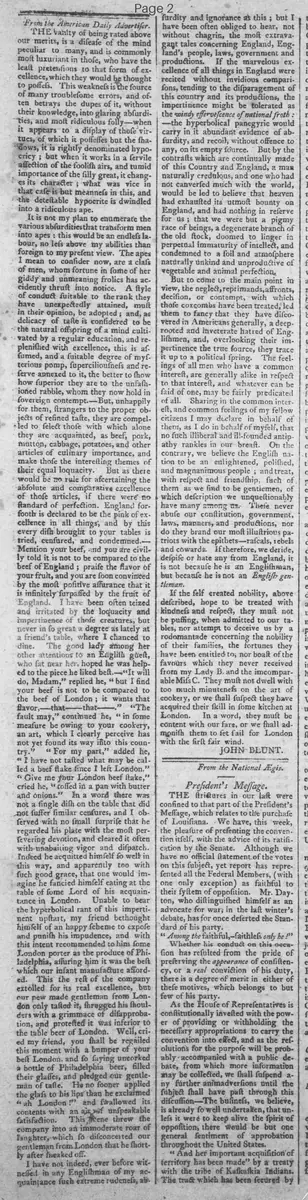
From the American Daily Advertiser.
THE vanity of being rated above our merits, is a disease of the mind peculiar to many, and is commonly most luxuriant in those, who have the least pretensions to that form of excellence, which they would be thought to possess. This weakness is the source of many troublesome errors, and often betrays the dupes of it, without their knowledge, into glaring absurdities, and most ridiculous folly—when it appears to a display of those virtues, of which it possesses but the shadow, it is rightly denominated hypocrisy; but when it works in a servile affection of the foolish airs, and tumid importance of the silly great, it changes its character; what was vice in that case is but meanness in this, and the detestable hypocrite is dwindled into a ridiculous ape.
It is not my plan to enumerate the various absurdities that transform men into apes: this would be an endless labour, no less above my abilities than foreign to my present view. The apes I mean to consider now, are a class of men, whom fortune in some of her giddy and unmeaning frolics has accidentally thrust into notice. A style of conduct suitable to the rank they have unexpectedly attained, must in their opinion, be adopted; and, as delicacy of taste is considered to be the natural offspring of a mind cultivated by a regular education, and replenished with excellence, this is assumed, and a suitable degree of mysterious pomp, superciliousness and reserve annexed to it, the better to show how superior they are to the unfashioned rabble, whom they now hold in sovereign contempt.—But, unhappily for them, strangers to the proper objects of refined taste, they are compelled to select those with which alone they are acquainted, as beef, pork, mutton, cabbage, potatoes, and other articles of culinary importance, and make those the interesting themes of their equal loquacity. But as there would be no rule for ascertaining the absolute and comparative excellence of those articles, if there were no standard of perfection. England forthwith is declared to be the pink of excellence in all things, and by this every dish brought to your tables is tried, censured, and condemned.—
Mention your beef, and you are civilly told it is not to be compared to the beef of England; praise the flavor of your fruit, and you are soon convinced by the most positive assurance that it is infinitely surpassed by the fruit of England. I have been often teased and irritated by the loquacity and impertinence of those creatures, but never in so great a degree as lately at a friend's table, where I chanced to dine. The good lady among her other attentions to an English guest, who sat near her, hoped he was helped to the piece he liked best.—"It will do, Madam," replied he, "but I find your beef is not to be compared to the beef of London; it wants that flavor,—that—that—." "The fault may," continued he, "in some measure be owing to your cookery, an art, which I clearly perceive has not yet found its way into this country." "For my part," added he, "I have not tasted what may be called a beef steak since I left London." "Give me your London beef steak," cried he, "toasted in a pan with butter and onions." In a word there was not a single dish on the table that did not suffer similar censures, and I observed with no small surprise that he regarded his plate with the most persevering devotion, and cleared it ostentatiously with unabating vigor and dispatch. Indeed he acquitted himself so well in this way, and apparently too with such good grace, that one would imagine he fancied himself eating at the table of some Lord of his acquaintance in London. Unable to bear the hyperbolical rant of this impertinent upstart, my friend bethought himself of a happy scheme to expose and punish his impudence, and with this intent recommended to him some London porter as the produce of Philadelphia, assuring him it was the best which our infant manufacture afforded. This the rest of the company extolled for its real excellence, but our new made gentleman from London only tasted it, shrugged his shoulders with a grimace of disapprobation, and protested it was inferior to the table beer of London. Well, cried my friend, you shall be regaled this moment with a bumper of your best London. and so saying uncorked a bottle of Philadelphia beer, filled their glasses, and pledged our gentleman of taste. He no sooner applied the glass to his lips than he exclaimed "ah London!" and swallowed its contents with an air of unspeakable satisfaction. This scene threw the company into an immoderate roar of laughter, which so disconcerted our gentleman from London that he shortly after sneaked off.
I have not indeed, ever before witnessed in any Englishman of my acquaintance such extreme rudeness, absurdity and ignorance as this: but I have been often obliged to hear, not without chagrin, the most extravagant tales concerning England, England's people, laws, government and productions. If the marvelous excellence of all things in England were recited without invidious comparisons, tending to the disparagement of this country and its productions, the impertinence might be tolerated as the windy effervescence of national froth: —the hyperbolical panegyric would carry in it abundant evidence of absurdity, and recoil, without offence to any, on its empty source. But by the contrasts which are continually made of this Country and England, a man naturally credulous, and one who had not canvassed much with the world. would be led to believe that heaven had exhausted its utmost bounty on England, and had nothing in reserve for us; that we were but a pigmy race of beings, a degenerate branch of the old stock, doomed to linger in perpetual immaturity of intellect, and condemned to a soil and atmosphere naturally unkind and unproductive of vegetable and animal perfection.
But to come to the main point in view, the neglect, reprimands, affronts, decision, or contempt, with which those coxcombs have been treated, led them to fancy that they have discovered in Americans generally, a deep-rooted and inveterate hatred of Englishmen, and, overlooking their impertinence the true source, they trace it up to a political spring. The feelings of all men who have a common interest, are generally alike in respect to that interest, and whatever can be said of one, may be fairly predicated of all. Sharing in the common interest, and common feelings of my fellow citizens I may declare in behalf of them, as I do in behalf of myself, that no such illiberal and ill-founded antipathy rankles in our breast. On the contrary, we believe the English nation to be an enlightened, polished, and magnanimous people; and treat, with respect and friendship, such of them as we find to be gentlemen, of which description we unquestionably have many among us. These never abuse our constitution, government, laws, manners, and productions, nor do they brand our most illustrious patriots with the epithets—rascals, rebels and cowards. If therefore, we deride, despise or hate any from England, it is not because he is an Englishman, but because he is not an English gentleman.
If the self created nobility, above described. hope to be treated with kindness and respect, they must not be puffing, when admitted to our tables, nor attempt to deceive us by a rodomontade concerning the nobility of their families, the fortunes they have been entitled to, nor boast of the favours which they never received from my Lady B. and the incomparable Miss C. They must not dwell with too much minuteness on the art of cookery, or we shall suspect they have acquired their skill in some kitchen at London. In a word, they must be content with our fare, or we shall admonish them to set sail for London with the first fair wind.
JOHN BLUNT.
THE vanity of being rated above our merits, is a disease of the mind peculiar to many, and is commonly most luxuriant in those, who have the least pretensions to that form of excellence, which they would be thought to possess. This weakness is the source of many troublesome errors, and often betrays the dupes of it, without their knowledge, into glaring absurdities, and most ridiculous folly—when it appears to a display of those virtues, of which it possesses but the shadow, it is rightly denominated hypocrisy; but when it works in a servile affection of the foolish airs, and tumid importance of the silly great, it changes its character; what was vice in that case is but meanness in this, and the detestable hypocrite is dwindled into a ridiculous ape.
It is not my plan to enumerate the various absurdities that transform men into apes: this would be an endless labour, no less above my abilities than foreign to my present view. The apes I mean to consider now, are a class of men, whom fortune in some of her giddy and unmeaning frolics has accidentally thrust into notice. A style of conduct suitable to the rank they have unexpectedly attained, must in their opinion, be adopted; and, as delicacy of taste is considered to be the natural offspring of a mind cultivated by a regular education, and replenished with excellence, this is assumed, and a suitable degree of mysterious pomp, superciliousness and reserve annexed to it, the better to show how superior they are to the unfashioned rabble, whom they now hold in sovereign contempt.—But, unhappily for them, strangers to the proper objects of refined taste, they are compelled to select those with which alone they are acquainted, as beef, pork, mutton, cabbage, potatoes, and other articles of culinary importance, and make those the interesting themes of their equal loquacity. But as there would be no rule for ascertaining the absolute and comparative excellence of those articles, if there were no standard of perfection. England forthwith is declared to be the pink of excellence in all things, and by this every dish brought to your tables is tried, censured, and condemned.—
Mention your beef, and you are civilly told it is not to be compared to the beef of England; praise the flavor of your fruit, and you are soon convinced by the most positive assurance that it is infinitely surpassed by the fruit of England. I have been often teased and irritated by the loquacity and impertinence of those creatures, but never in so great a degree as lately at a friend's table, where I chanced to dine. The good lady among her other attentions to an English guest, who sat near her, hoped he was helped to the piece he liked best.—"It will do, Madam," replied he, "but I find your beef is not to be compared to the beef of London; it wants that flavor,—that—that—." "The fault may," continued he, "in some measure be owing to your cookery, an art, which I clearly perceive has not yet found its way into this country." "For my part," added he, "I have not tasted what may be called a beef steak since I left London." "Give me your London beef steak," cried he, "toasted in a pan with butter and onions." In a word there was not a single dish on the table that did not suffer similar censures, and I observed with no small surprise that he regarded his plate with the most persevering devotion, and cleared it ostentatiously with unabating vigor and dispatch. Indeed he acquitted himself so well in this way, and apparently too with such good grace, that one would imagine he fancied himself eating at the table of some Lord of his acquaintance in London. Unable to bear the hyperbolical rant of this impertinent upstart, my friend bethought himself of a happy scheme to expose and punish his impudence, and with this intent recommended to him some London porter as the produce of Philadelphia, assuring him it was the best which our infant manufacture afforded. This the rest of the company extolled for its real excellence, but our new made gentleman from London only tasted it, shrugged his shoulders with a grimace of disapprobation, and protested it was inferior to the table beer of London. Well, cried my friend, you shall be regaled this moment with a bumper of your best London. and so saying uncorked a bottle of Philadelphia beer, filled their glasses, and pledged our gentleman of taste. He no sooner applied the glass to his lips than he exclaimed "ah London!" and swallowed its contents with an air of unspeakable satisfaction. This scene threw the company into an immoderate roar of laughter, which so disconcerted our gentleman from London that he shortly after sneaked off.
I have not indeed, ever before witnessed in any Englishman of my acquaintance such extreme rudeness, absurdity and ignorance as this: but I have been often obliged to hear, not without chagrin, the most extravagant tales concerning England, England's people, laws, government and productions. If the marvelous excellence of all things in England were recited without invidious comparisons, tending to the disparagement of this country and its productions, the impertinence might be tolerated as the windy effervescence of national froth: —the hyperbolical panegyric would carry in it abundant evidence of absurdity, and recoil, without offence to any, on its empty source. But by the contrasts which are continually made of this Country and England, a man naturally credulous, and one who had not canvassed much with the world. would be led to believe that heaven had exhausted its utmost bounty on England, and had nothing in reserve for us; that we were but a pigmy race of beings, a degenerate branch of the old stock, doomed to linger in perpetual immaturity of intellect, and condemned to a soil and atmosphere naturally unkind and unproductive of vegetable and animal perfection.
But to come to the main point in view, the neglect, reprimands, affronts, decision, or contempt, with which those coxcombs have been treated, led them to fancy that they have discovered in Americans generally, a deep-rooted and inveterate hatred of Englishmen, and, overlooking their impertinence the true source, they trace it up to a political spring. The feelings of all men who have a common interest, are generally alike in respect to that interest, and whatever can be said of one, may be fairly predicated of all. Sharing in the common interest, and common feelings of my fellow citizens I may declare in behalf of them, as I do in behalf of myself, that no such illiberal and ill-founded antipathy rankles in our breast. On the contrary, we believe the English nation to be an enlightened, polished, and magnanimous people; and treat, with respect and friendship, such of them as we find to be gentlemen, of which description we unquestionably have many among us. These never abuse our constitution, government, laws, manners, and productions, nor do they brand our most illustrious patriots with the epithets—rascals, rebels and cowards. If therefore, we deride, despise or hate any from England, it is not because he is an Englishman, but because he is not an English gentleman.
If the self created nobility, above described. hope to be treated with kindness and respect, they must not be puffing, when admitted to our tables, nor attempt to deceive us by a rodomontade concerning the nobility of their families, the fortunes they have been entitled to, nor boast of the favours which they never received from my Lady B. and the incomparable Miss C. They must not dwell with too much minuteness on the art of cookery, or we shall suspect they have acquired their skill in some kitchen at London. In a word, they must be content with our fare, or we shall admonish them to set sail for London with the first fair wind.
JOHN BLUNT.
What sub-type of article is it?
Satire
Foreign Affairs
What keywords are associated?
English Pretension
American Hospitality
Cultural Satire
National Pride
English Superiority
Dinner Anecdote
Phila Beer Trick
What entities or persons were involved?
Englishmen
Americans
John Blunt
Editorial Details
Primary Topic
Mockery Of Pretentious Englishmen Disparaging American Customs
Stance / Tone
Satirical Defense Of American Pride Against English Snobbery
Key Figures
Englishmen
Americans
John Blunt
Key Arguments
Vanity Leads To Ridiculous Pretensions Among Newly Prominent Individuals
English Guests Rudely Compare American Food Unfavorably To England's
Anecdote Exposes An Englishman's Ignorance About Beer Origins
Americans Respect True English Gentlemen But Despise Impertinent Coxcombs
No Inherent Hatred Of Englishmen, Only Of Those Lacking Gentlemanly Conduct