Thank you for visiting SNEWPapers!
Sign up free
Literary
January 30, 1896
The Princeton Union
Princeton, Mille Lacs County, Minnesota
What is this article about?
In Victorian society, widow Lady Brereton anticipates rekindling past affections with Captain Valence, returned from India after her husband's death. Initially dismissive, she realizes her feelings when he declares love for another woman, leading to her emotional collapse.
Clipping
OCR Quality
98%
Excellent
Full Text
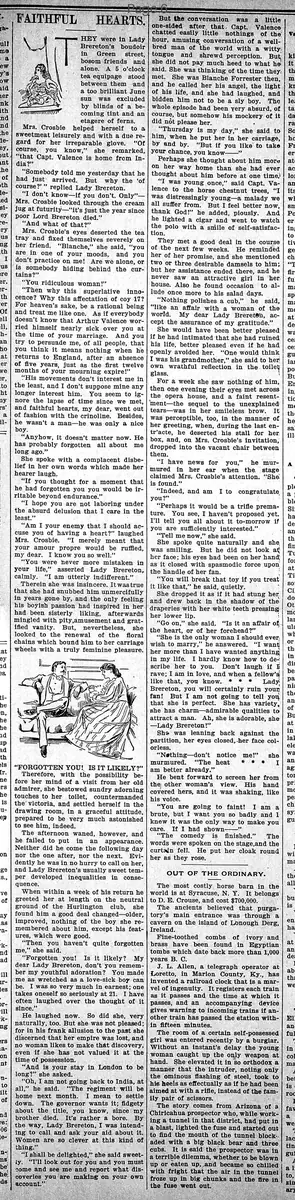
FAITHFUL HEARTS.
They were in Lady Brereton's boudoir in Green street, bosom friends and alone. A 5 o'clock tea equipage stood between them and a too brilliant June sun was excluded by blinds of a becoming tint and an etagere of ferns.
Mrs. Crosbie helped herself to a sweetmeat leisurely and with a due regard for her irreparable glove.
'Of course, you know,' she remarked, 'that Capt. Valence is home from India?'
'Somebody told me yesterday that he had just arrived. But why the 'of course?' ' replied Lady Brereton.
'I don't know—if you don't. Only'— Mrs. Crosbie looked through the cream jug at futurity—'it's just the year since poor Lord Brereton died.'
'And what of that?'
Mrs. Crosbie's eyes deserted the tea tray and fixed themselves severely on her friend. 'Blanche,' she said, 'you are in one of your moods, and you don't practice on me! Are we alone, or is somebody hiding behind the curtains?'
'You ridiculous woman!'
'Then why this superlative innocence? Why this affectation of coyness? For heaven's sake, be a rational being and treat me like one. As if everybody doesn't know that Arthur Valence worried himself nearly sick over you at the time of your marriage. And you try to persuade me, of all people, that you think it means nothing when he returns to England, after an absence of five years, just as the first twelve months of your mourning expire!'
'His movements don't interest me in the least, and I don't suppose mine any longer interest him. You seem to ignore the lapse of time since we met, and faithful hearts, my dear, went out of fashion with the crinoline. Besides, he wasn't a man—he was only a nice boy.'
'Anyhow, it doesn't matter now. He has probably forgotten all about me long ago.'
She spoke with a complacent disbelief in her own words which made her hearer laugh.
'If you thought for a moment that he had forgotten you you would be irritable beyond endurance.'
'I hope you are not laboring under the absurd delusion that I care in the least.'
'Am I your enemy that I should accuse you of having a heart?' laughed Mrs. Crosbie. 'I merely meant that your amour propre would be ruffled, my dear. I know you so well.'
'You were never more mistaken in your life,' asserted Lady Brereton, calmly. 'I am utterly indifferent.'
Therein she was insincere. It was true that she had snubbed him unmercifully in years gone by, and the only feeling his boyish passion had inspired in her had been sisterly liking, afterwards mingled with pity, amusement and gratified vanity. But, nevertheless, she looked to the renewal of the floral chains which bound him to her carriage wheels with a truly feminine pleasure.
'FORGOTTEN YOU! IS IT LIKELY?'
Therefore, with the possibility before her mind of a visit from her old admirer, she bestowed sundry adorning touches to her toilet, countermanded the victoria, and settled herself in the drawing room, in a graceful attitude, prepared to be very much astonished to see him, indeed.
The afternoon waned, however, and he failed to put in an appearance. Neither did he come the following day nor the one after, nor the next. Evidently he was in no hurry to call on her, and Lady Brereton's usually sweet temper developed inequalities in consequence.
When within a week of his return he greeted her at length on the neutral ground of the Hurlington club, she found him a good deal changed—older, improved, nothing of the boy she remembered about him, except his features, which were good.
'Then you haven't quite forgotten me,' she said.
'Forgotten you! Is it likely? My dear Lady Brereton, don't you remember my youthful adoration? You made me as wretched as a love-sick boy can be. I was so very much in earnest; one takes oneself so seriously at 21. I have often laughed over the thought of it since.'
He laughed now. So did she, very naturally, too. But she was not pleased; for in his frank allusion to the past she discerned that her empire was lost, and no woman likes to make that discovery, even if she has not valued it at the time of possession.
'And is your stay in London to be long?' she asked.
'Oh, I am not going back to India, at all,' he said. 'The regiment will be home next month. I mean to settle down. The governor wants it; fidgety about the title, you know, since my brother died. It's rather a bore. By the way, Lady Brereton, I was intending to call and ask your aid about it. Women are so clever at this kind of thing.'
'I shall be delighted,' she said sweetly. 'I'll look out for you and you must come and see me and report what discoveries you are making on your own account.'
But the conversation was a little one-sided after that. Capt. Valence chatted easily little nothings of the hour, amusing conversation of a well-bred man of the world with a witty tongue and shrewd perception. But she did not pay much heed to what he said. She was thinking of the time they met. She was Blanche Forrester then, and he called her his angel, the light of his life, and she had laughed, and bidden him not to be a silly boy. The whole episode had been very absurd, of course, but somehow his mockery of it did not please her.
'Thursday is my day,' she said to him, when he put her in her carriage, by and by. 'But if you like to take your chance, you know.'
Perhaps she thought about him more on her way home than she had ever thought about him before at one time.
'I was young once,' said Capt. Valence to the horse chestnut trees, 'I was distressingly young—a malady we all suffer from. But I feel better now, thank God!' he added, piously. And he lighted a cigar and went to watch the polo with a smile of self-satisfaction.
They met a good deal in the course of the next few weeks. He reminded her of her promise, and she mentioned two or three desirable damsels to him; but her assistance ended there, and he never saw an attractive girl in her house. Also he found occasion to allude once more to his salad days.
'Nothing polishes a cub,' he said, 'like an affair with a woman of the world. My dear Lady Brereton, accept the assurance of my gratitude.'
She would have been better pleased if he had intimated that she had ruined his life, better pleased even if he had openly avoided her. 'One would think I was his grandmother,' she said to her own wrathful reflection in the toilet glass.
For a week she saw nothing of him, then one evening their eyes met across the opera house, and a faint resentment—the sequel to the unexplained tears—was in her smileless brow. It was perceptible, too, in the manner of her greeting, when, during the last entr'acte, he deserted his stall for her box, and, on Mrs. Crosbie's invitation, dropped into the vacant chair between them.
'I have news for you,' he murmured in her ear when the stage claimed Mrs. Crosbie's attention. 'She is found.'
'Indeed, and am I to congratulate you?'
'Perhaps it would be a trifle premature. You see, I haven't proposed yet. I'll tell you all about it to-morrow if you are sufficiently interested.'
'Tell me now,' she said.
She spoke quite naturally and she was smiling. But he did not look at her face; his eyes had been on her hand as it closed with spasmodic force upon the handle of her fan.
'You will break that toy if you treat it like that,' he said, quietly.
She dropped it as if it had stung her and drew back in the shadow of the draperies with her white teeth pressing her lower lip.
'Go on,' she said. 'Is it an affair of the heart, or of her forehead?'
'She is the only woman I should ever wish to marry,' he answered. 'I want her more than I have wanted anything in my life. I hardly know how to describe her to you. Don't laugh if I rave; I am in love, and when a fellow's like that, you know. * *
Lady Brereton, you will certainly ruin your fan! But I am not going to tell you that she is perfect. She has variety, she has charm—admirable qualities to attract a man. Ah, she is adorable, she—Lady Brereton!'
She was leaning back against the partition, her eyes closed, her face colorless.
'Nothing—don't notice me!' she murmured. 'The heat—I am better already.'
He bent forward to screen her from the other woman's view. His hand covered hers, and it was shaking, like his voice.
'You are going to faint! I am a brute, but I want you so badly and I knew it was the only way to make you care. If I had shown—'
'The comedy is finished.'
The words were spoken on the stage, and the curtain fell. He put her cloak round her as they rose.
They were in Lady Brereton's boudoir in Green street, bosom friends and alone. A 5 o'clock tea equipage stood between them and a too brilliant June sun was excluded by blinds of a becoming tint and an etagere of ferns.
Mrs. Crosbie helped herself to a sweetmeat leisurely and with a due regard for her irreparable glove.
'Of course, you know,' she remarked, 'that Capt. Valence is home from India?'
'Somebody told me yesterday that he had just arrived. But why the 'of course?' ' replied Lady Brereton.
'I don't know—if you don't. Only'— Mrs. Crosbie looked through the cream jug at futurity—'it's just the year since poor Lord Brereton died.'
'And what of that?'
Mrs. Crosbie's eyes deserted the tea tray and fixed themselves severely on her friend. 'Blanche,' she said, 'you are in one of your moods, and you don't practice on me! Are we alone, or is somebody hiding behind the curtains?'
'You ridiculous woman!'
'Then why this superlative innocence? Why this affectation of coyness? For heaven's sake, be a rational being and treat me like one. As if everybody doesn't know that Arthur Valence worried himself nearly sick over you at the time of your marriage. And you try to persuade me, of all people, that you think it means nothing when he returns to England, after an absence of five years, just as the first twelve months of your mourning expire!'
'His movements don't interest me in the least, and I don't suppose mine any longer interest him. You seem to ignore the lapse of time since we met, and faithful hearts, my dear, went out of fashion with the crinoline. Besides, he wasn't a man—he was only a nice boy.'
'Anyhow, it doesn't matter now. He has probably forgotten all about me long ago.'
She spoke with a complacent disbelief in her own words which made her hearer laugh.
'If you thought for a moment that he had forgotten you you would be irritable beyond endurance.'
'I hope you are not laboring under the absurd delusion that I care in the least.'
'Am I your enemy that I should accuse you of having a heart?' laughed Mrs. Crosbie. 'I merely meant that your amour propre would be ruffled, my dear. I know you so well.'
'You were never more mistaken in your life,' asserted Lady Brereton, calmly. 'I am utterly indifferent.'
Therein she was insincere. It was true that she had snubbed him unmercifully in years gone by, and the only feeling his boyish passion had inspired in her had been sisterly liking, afterwards mingled with pity, amusement and gratified vanity. But, nevertheless, she looked to the renewal of the floral chains which bound him to her carriage wheels with a truly feminine pleasure.
'FORGOTTEN YOU! IS IT LIKELY?'
Therefore, with the possibility before her mind of a visit from her old admirer, she bestowed sundry adorning touches to her toilet, countermanded the victoria, and settled herself in the drawing room, in a graceful attitude, prepared to be very much astonished to see him, indeed.
The afternoon waned, however, and he failed to put in an appearance. Neither did he come the following day nor the one after, nor the next. Evidently he was in no hurry to call on her, and Lady Brereton's usually sweet temper developed inequalities in consequence.
When within a week of his return he greeted her at length on the neutral ground of the Hurlington club, she found him a good deal changed—older, improved, nothing of the boy she remembered about him, except his features, which were good.
'Then you haven't quite forgotten me,' she said.
'Forgotten you! Is it likely? My dear Lady Brereton, don't you remember my youthful adoration? You made me as wretched as a love-sick boy can be. I was so very much in earnest; one takes oneself so seriously at 21. I have often laughed over the thought of it since.'
He laughed now. So did she, very naturally, too. But she was not pleased; for in his frank allusion to the past she discerned that her empire was lost, and no woman likes to make that discovery, even if she has not valued it at the time of possession.
'And is your stay in London to be long?' she asked.
'Oh, I am not going back to India, at all,' he said. 'The regiment will be home next month. I mean to settle down. The governor wants it; fidgety about the title, you know, since my brother died. It's rather a bore. By the way, Lady Brereton, I was intending to call and ask your aid about it. Women are so clever at this kind of thing.'
'I shall be delighted,' she said sweetly. 'I'll look out for you and you must come and see me and report what discoveries you are making on your own account.'
But the conversation was a little one-sided after that. Capt. Valence chatted easily little nothings of the hour, amusing conversation of a well-bred man of the world with a witty tongue and shrewd perception. But she did not pay much heed to what he said. She was thinking of the time they met. She was Blanche Forrester then, and he called her his angel, the light of his life, and she had laughed, and bidden him not to be a silly boy. The whole episode had been very absurd, of course, but somehow his mockery of it did not please her.
'Thursday is my day,' she said to him, when he put her in her carriage, by and by. 'But if you like to take your chance, you know.'
Perhaps she thought about him more on her way home than she had ever thought about him before at one time.
'I was young once,' said Capt. Valence to the horse chestnut trees, 'I was distressingly young—a malady we all suffer from. But I feel better now, thank God!' he added, piously. And he lighted a cigar and went to watch the polo with a smile of self-satisfaction.
They met a good deal in the course of the next few weeks. He reminded her of her promise, and she mentioned two or three desirable damsels to him; but her assistance ended there, and he never saw an attractive girl in her house. Also he found occasion to allude once more to his salad days.
'Nothing polishes a cub,' he said, 'like an affair with a woman of the world. My dear Lady Brereton, accept the assurance of my gratitude.'
She would have been better pleased if he had intimated that she had ruined his life, better pleased even if he had openly avoided her. 'One would think I was his grandmother,' she said to her own wrathful reflection in the toilet glass.
For a week she saw nothing of him, then one evening their eyes met across the opera house, and a faint resentment—the sequel to the unexplained tears—was in her smileless brow. It was perceptible, too, in the manner of her greeting, when, during the last entr'acte, he deserted his stall for her box, and, on Mrs. Crosbie's invitation, dropped into the vacant chair between them.
'I have news for you,' he murmured in her ear when the stage claimed Mrs. Crosbie's attention. 'She is found.'
'Indeed, and am I to congratulate you?'
'Perhaps it would be a trifle premature. You see, I haven't proposed yet. I'll tell you all about it to-morrow if you are sufficiently interested.'
'Tell me now,' she said.
She spoke quite naturally and she was smiling. But he did not look at her face; his eyes had been on her hand as it closed with spasmodic force upon the handle of her fan.
'You will break that toy if you treat it like that,' he said, quietly.
She dropped it as if it had stung her and drew back in the shadow of the draperies with her white teeth pressing her lower lip.
'Go on,' she said. 'Is it an affair of the heart, or of her forehead?'
'She is the only woman I should ever wish to marry,' he answered. 'I want her more than I have wanted anything in my life. I hardly know how to describe her to you. Don't laugh if I rave; I am in love, and when a fellow's like that, you know. * *
Lady Brereton, you will certainly ruin your fan! But I am not going to tell you that she is perfect. She has variety, she has charm—admirable qualities to attract a man. Ah, she is adorable, she—Lady Brereton!'
She was leaning back against the partition, her eyes closed, her face colorless.
'Nothing—don't notice me!' she murmured. 'The heat—I am better already.'
He bent forward to screen her from the other woman's view. His hand covered hers, and it was shaking, like his voice.
'You are going to faint! I am a brute, but I want you so badly and I knew it was the only way to make you care. If I had shown—'
'The comedy is finished.'
The words were spoken on the stage, and the curtain fell. He put her cloak round her as they rose.
What sub-type of article is it?
Prose Fiction
What themes does it cover?
Love Romance
Social Manners
What keywords are associated?
Unrequited Love
Victorian Society
Widow
Admirer
Realization
Romance
Jealousy
Literary Details
Title
Faithful Hearts.
Key Lines
'Forgotten You! Is It Likely? My Dear Lady Brereton, Don't You Remember My Youthful Adoration?'
'She Is The Only Woman I Should Ever Wish To Marry,' He Answered. 'I Want Her More Than I Have Wanted Anything In My Life.'
'You Are Going To Faint! I Am A Brute, But I Want You So Badly And I Knew It Was The Only Way To Make You Care.'