Thank you for visiting SNEWPapers!
Sign up free
Story
August 23, 1833
Delaware State Journal, Advertiser And Star
Wilmington, New Castle County, Delaware
What is this article about?
Extract from Edward Bulwer's novel 'England and the English' satirically portrays Samuel Square, a modern radical philosopher who rigidly adheres to first principles, ignores human passions, and embodies impractical utilitarianism, lacking sympathy and real-world utility.
Clipping
OCR Quality
98%
Excellent
Full Text
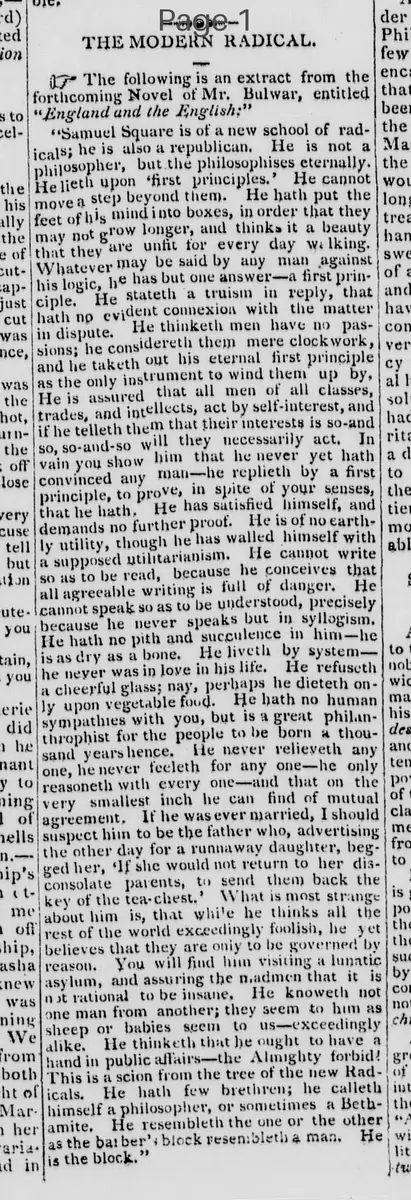
THE MODERN RADICAL.
The following is an extract from the forthcoming Novel of Mr. Bulwer, entitled "England and the English:"
"Samuel Square is of a new school of radicals; he is also a republican. He is not a philosopher, but he philosophises eternally. He hath put the feet of his mind into boxes, in order that they may not grow longer, and thinks it a beauty that they are unfit for every day walking. He lieth upon 'first principles.' He cannot move a step beyond them. Whatever may be said by any man against his logic, he has but one answer-a first principle. He stateth a truism in reply, that hath no evident connexion with the matter in dispute. He thinketh men have no passions; he considereth them mere clockwork, and he taketh out his eternal first principle as the only instrument to wind them up by, He is assured that all men of all classes, trades, and intellects, act by self-interest, and if he telleth them that their interests is so-and so, so-and-so will they necessarily act. In vain you show him that he never yet hath convinced any man-he replieth by a first principle, to prove, in spite of your senses, that he hath," He has satisfied himself, and demands no further proof. He is of no earthly utility, though he has walled himself with a supposed utilitarianism. He cannot write so as to be read, because he conceives that all agreeable writing is full of danger. He cannot speak so as to be understood, precisely because he never speaks but in syllogism. He hath no pith and succulence in him-he is as dry as a bone. He liveth by system-he never was in love in his life. He refuseth a cheerful glass; nay, perhaps he dieteth only upon vegetable food. He hath no human sympathies with you, but is a great philanthropist for the people to be born a thousand years hence. He never relieveth any one, he never feeleth for any one-he only reasoneth with every one-and that on the very smallest inch he can find of mutual agreement, If he was ever married, I should suspect him to be the father who, advertising the other day for a runaway daughter, begged her, 'If she would not return to her disconsolate parents, to send them back the key of the tea-chest.' What is most strange about him is, that while he thinks all the rest of the world exceedingly foolish, he yet believes that they are only to be governed by reason. You will find him visiting a lunatic asylum, and assuring the madmen that it is not rational to be insane, He knoweth not one man from another; they seem to him as sheep or babies seen to us-exceedingly alike. He thinketh that he ought to have a hand in public affairs-the Almighty forbid This is a scion from the tree of the new Radicals. He hath few brethren; he calleth himself a philosopher, or sometimes a Benthamite. He resembleth the one or the other as the barber's block resembleth a man. He is the block."
The following is an extract from the forthcoming Novel of Mr. Bulwer, entitled "England and the English:"
"Samuel Square is of a new school of radicals; he is also a republican. He is not a philosopher, but he philosophises eternally. He hath put the feet of his mind into boxes, in order that they may not grow longer, and thinks it a beauty that they are unfit for every day walking. He lieth upon 'first principles.' He cannot move a step beyond them. Whatever may be said by any man against his logic, he has but one answer-a first principle. He stateth a truism in reply, that hath no evident connexion with the matter in dispute. He thinketh men have no passions; he considereth them mere clockwork, and he taketh out his eternal first principle as the only instrument to wind them up by, He is assured that all men of all classes, trades, and intellects, act by self-interest, and if he telleth them that their interests is so-and so, so-and-so will they necessarily act. In vain you show him that he never yet hath convinced any man-he replieth by a first principle, to prove, in spite of your senses, that he hath," He has satisfied himself, and demands no further proof. He is of no earthly utility, though he has walled himself with a supposed utilitarianism. He cannot write so as to be read, because he conceives that all agreeable writing is full of danger. He cannot speak so as to be understood, precisely because he never speaks but in syllogism. He hath no pith and succulence in him-he is as dry as a bone. He liveth by system-he never was in love in his life. He refuseth a cheerful glass; nay, perhaps he dieteth only upon vegetable food. He hath no human sympathies with you, but is a great philanthropist for the people to be born a thousand years hence. He never relieveth any one, he never feeleth for any one-he only reasoneth with every one-and that on the very smallest inch he can find of mutual agreement, If he was ever married, I should suspect him to be the father who, advertising the other day for a runaway daughter, begged her, 'If she would not return to her disconsolate parents, to send them back the key of the tea-chest.' What is most strange about him is, that while he thinks all the rest of the world exceedingly foolish, he yet believes that they are only to be governed by reason. You will find him visiting a lunatic asylum, and assuring the madmen that it is not rational to be insane, He knoweth not one man from another; they seem to him as sheep or babies seen to us-exceedingly alike. He thinketh that he ought to have a hand in public affairs-the Almighty forbid This is a scion from the tree of the new Radicals. He hath few brethren; he calleth himself a philosopher, or sometimes a Benthamite. He resembleth the one or the other as the barber's block resembleth a man. He is the block."
What sub-type of article is it?
Biography
Curiosity
What themes does it cover?
Social Manners
Moral Virtue
What keywords are associated?
Modern Radical
Samuel Square
First Principles
Utilitarianism
Satire
Benthamite
What entities or persons were involved?
Samuel Square
Mr. Bulwer
Story Details
Key Persons
Samuel Square
Mr. Bulwer
Story Details
Satirical sketch of Samuel Square, a modern radical who philosophizes rigidly on first principles, denies human passions, lives systematically without sympathy or practicality, and is critiqued as a dry, useless blockhead.