Thank you for visiting SNEWPapers!
Sign up free
Editorial
September 25, 1810
The Rhode Island American, And General Advertiser
Providence, Providence County, Rhode Island
What is this article about?
Editorial criticizes US administration under Madison for failing to protect American commerce from Napoleonic France's seizures and port closures by allies like Prussia, Denmark, and Norway. Urges arming for defense, resenting injuries, and avoiding alliances that demand war with England. Calls for emulating revolutionary spirit to restore national honor.
Clipping
OCR Quality
95%
Excellent
Full Text
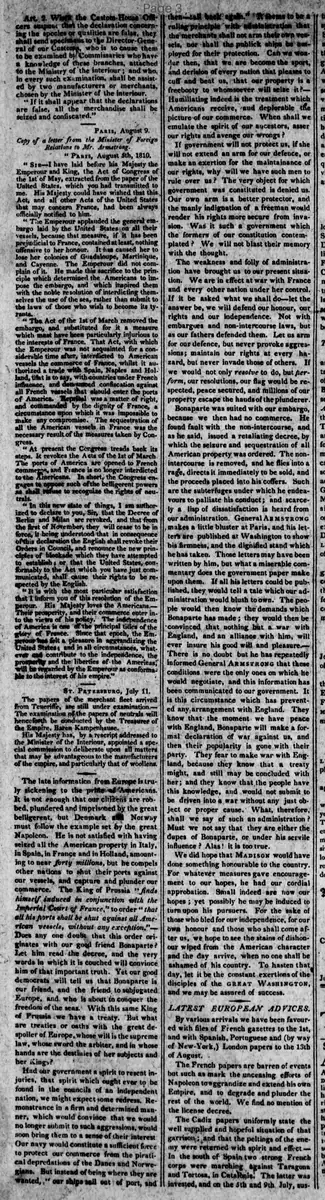
It is not enough that our citizens are robbed, plundered and imprisoned by the great belligerents, but Denmark and Norway must follow the example set by the great Napoleon. He is not satisfied with having seized all the American property in Italy, in Spain, in France and in Holland, amounting to near forty millions, but he compels other nations to shut their ports against our vessels, and capture and plunder our commerce. The King of Prussia "finds himself induced in conjunction with the Imperial Court of France," to order "that all his ports shall be shut against all American vessels, without any exception."
Does any one doubt that this order originates with our good friend Bonaparte? Let him read the decree, and the very words in which it is couched will convince him of that important truth. Yet our good democrats will tell us that Bonaparte is our friend, and the friend to subjugated Europe, and who is about to conquer the freedom of the seas. With this same King of Prussia we have a treaty. But what are treaties or oaths with the great despoiler of Europe, whose will is the supreme law, whose sword the arbiter, and in whose hands are the destinies of her subjects and her Kings?
Had our government a spirit to resent injuries, that spirit which ought ever to be found in the councils of an independent nation, we might expect some redress. Remonstrance in a firm and determined manner, which would convince that we would no longer submit to such aggressions, would soon bring them to a sense of their interest. Our navy would constitute a sufficient force to protect our commerce from the piratical depredations of the Danes and Norwegians. But instead of being where they are wanted, our ships sail out of port, and then detail back again. It seems to be a ruling principle with administration that the merchants shall not arm their own vessels, nor shall the public ships be employed for their protection. Can we wonder then, that we are become the sport, and derision of every nation that pleases to cuff and beat us, that our property is a freebooty to whomsoever will seize it?—Humiliating indeed is the treatment which Americans receive, and deplorable, the picture of our commerce. When shall we emulate the spirit of our ancestors, assert our rights and avenge our wrongs?
If government will not protect us, if she will not extend an arm for our defence, or make an exertion for the maintenance of our rights, why will we have such men to rule over us? The very object for which government was constituted is denied us. Our own arm is a better protector, and the manly indignation of a freeman would render his rights more secure from invasion. Was it such a government which the formers of our constitution contemplated? We will not blast their memory with the thought.
The weakness and folly of administration have brought us to our present situation. We are in effect at war with France and every other nation under her control. If it be asked what we shall do let the answer be, we will defend our honour, our rights and our independence. Not with embargoes and non-intercourse laws, but as our fathers defended them. Let us arm for our defence, but never provoke aggressions; maintain our rights at every hazard, but never invade those of others. If we would not only resolve to do, but perform, our resolutions, our flag would be respected, peace secured, and millions of our property escape the hands of the plunderer.
Bonaparte was suited with our embargo, because we then had no commerce. He found fault with the non-intercourse, and as he said, issued a retaliating decree, by which the seizure and sequestration of all American property was ordered. The non-intercourse is removed, and he flies into a rage, directs it immediately to be sold, and the proceeds placed into his coffers. Such are the subterfuges under which he endeavours to palliate his conduct; and scarcely a lisp of dissatisfaction is heard from our administration. General Armstrong makes a little bluster at Paris, and his letters are published at Washington to show his firmness, and the dignified stand which he has taken. Those letters may have been written by him, but what a miserable commentary does the government paper make upon them. If all his letters could be published, they would tell a tale which our administration would blush to own. The people would then know the demands which Bonaparte has made; they would then be convinced that nothing but a war with England, and an alliance with him, will ever insure his good will and pleasure.—There is no doubt but he has repeatedly informed General Armstrong that these conditions were the only ones on which he would negotiate, and this information has been communicated to our government. It is this circumstance which has prevented any arrangement with England. They know that the moment we have peace with England, Bonaparte will make a formal declaration of war against us, and then their popularity is gone with their party. They fear to make war with England, because they know that a treaty might, and still may be concluded with her; and they know that the people have this knowledge, and would not submit to be driven into a war without any just object or proper cause. What, therefore, shall we say of such an administration? Must we not say that they are either the dupes of Bonaparte, or under his servile influence? Alas! it is too true.
We did hope that Madison would have done something honourable to the country. For whatever measures gave encouragement to our hopes, he had our cordial approbation. Small indeed are now our hopes; yet possibly he may be induced to turn upon his pursuers. For the sake of those who bled for our independence, for our own honour and those who shall come after us, we hope to see the stains of dishonour wiped from the American character and the day arrive, when no one shall be ashamed of his country. To hasten that day, let it be the constant exertions of the disciples of the GREAT WASHINGTON, and we may be assured of success.
Does any one doubt that this order originates with our good friend Bonaparte? Let him read the decree, and the very words in which it is couched will convince him of that important truth. Yet our good democrats will tell us that Bonaparte is our friend, and the friend to subjugated Europe, and who is about to conquer the freedom of the seas. With this same King of Prussia we have a treaty. But what are treaties or oaths with the great despoiler of Europe, whose will is the supreme law, whose sword the arbiter, and in whose hands are the destinies of her subjects and her Kings?
Had our government a spirit to resent injuries, that spirit which ought ever to be found in the councils of an independent nation, we might expect some redress. Remonstrance in a firm and determined manner, which would convince that we would no longer submit to such aggressions, would soon bring them to a sense of their interest. Our navy would constitute a sufficient force to protect our commerce from the piratical depredations of the Danes and Norwegians. But instead of being where they are wanted, our ships sail out of port, and then detail back again. It seems to be a ruling principle with administration that the merchants shall not arm their own vessels, nor shall the public ships be employed for their protection. Can we wonder then, that we are become the sport, and derision of every nation that pleases to cuff and beat us, that our property is a freebooty to whomsoever will seize it?—Humiliating indeed is the treatment which Americans receive, and deplorable, the picture of our commerce. When shall we emulate the spirit of our ancestors, assert our rights and avenge our wrongs?
If government will not protect us, if she will not extend an arm for our defence, or make an exertion for the maintenance of our rights, why will we have such men to rule over us? The very object for which government was constituted is denied us. Our own arm is a better protector, and the manly indignation of a freeman would render his rights more secure from invasion. Was it such a government which the formers of our constitution contemplated? We will not blast their memory with the thought.
The weakness and folly of administration have brought us to our present situation. We are in effect at war with France and every other nation under her control. If it be asked what we shall do let the answer be, we will defend our honour, our rights and our independence. Not with embargoes and non-intercourse laws, but as our fathers defended them. Let us arm for our defence, but never provoke aggressions; maintain our rights at every hazard, but never invade those of others. If we would not only resolve to do, but perform, our resolutions, our flag would be respected, peace secured, and millions of our property escape the hands of the plunderer.
Bonaparte was suited with our embargo, because we then had no commerce. He found fault with the non-intercourse, and as he said, issued a retaliating decree, by which the seizure and sequestration of all American property was ordered. The non-intercourse is removed, and he flies into a rage, directs it immediately to be sold, and the proceeds placed into his coffers. Such are the subterfuges under which he endeavours to palliate his conduct; and scarcely a lisp of dissatisfaction is heard from our administration. General Armstrong makes a little bluster at Paris, and his letters are published at Washington to show his firmness, and the dignified stand which he has taken. Those letters may have been written by him, but what a miserable commentary does the government paper make upon them. If all his letters could be published, they would tell a tale which our administration would blush to own. The people would then know the demands which Bonaparte has made; they would then be convinced that nothing but a war with England, and an alliance with him, will ever insure his good will and pleasure.—There is no doubt but he has repeatedly informed General Armstrong that these conditions were the only ones on which he would negotiate, and this information has been communicated to our government. It is this circumstance which has prevented any arrangement with England. They know that the moment we have peace with England, Bonaparte will make a formal declaration of war against us, and then their popularity is gone with their party. They fear to make war with England, because they know that a treaty might, and still may be concluded with her; and they know that the people have this knowledge, and would not submit to be driven into a war without any just object or proper cause. What, therefore, shall we say of such an administration? Must we not say that they are either the dupes of Bonaparte, or under his servile influence? Alas! it is too true.
We did hope that Madison would have done something honourable to the country. For whatever measures gave encouragement to our hopes, he had our cordial approbation. Small indeed are now our hopes; yet possibly he may be induced to turn upon his pursuers. For the sake of those who bled for our independence, for our own honour and those who shall come after us, we hope to see the stains of dishonour wiped from the American character and the day arrive, when no one shall be ashamed of his country. To hasten that day, let it be the constant exertions of the disciples of the GREAT WASHINGTON, and we may be assured of success.
What sub-type of article is it?
Foreign Affairs
War Or Peace
Partisan Politics
What keywords are associated?
Napoleonic Aggression
American Commerce
Foreign Policy
Administration Weakness
Armed Defense
Bonaparte Influence
War With England
Treaty Violations
Naval Protection
Patriotic Resolve
What entities or persons were involved?
Napoleon
Bonaparte
King Of Prussia
Madison
General Armstrong
Washington
France
England
Denmark
Norway
Editorial Details
Primary Topic
Criticism Of Us Administration's Weakness Against Napoleonic Aggressions On American Commerce
Stance / Tone
Strongly Critical Of Administration, Calls For Armed Defense And Assertion Of Rights
Key Figures
Napoleon
Bonaparte
King Of Prussia
Madison
General Armstrong
Washington
France
England
Denmark
Norway
Key Arguments
Napoleon Compels Other Nations Like Denmark, Norway, And Prussia To Close Ports To American Vessels And Seize Property
Us Democrats Claim Bonaparte Is A Friend, But He Violates Treaties And Plunders Commerce
Administration Lacks Spirit To Resent Injuries, Fails To Protect Commerce With Navy
Merchants Cannot Arm Vessels, Public Ships Not Used For Protection, Leading To Humiliation
Government Fails Its Purpose Of Protection, Better To Rely On Own Arms
Us Effectively At War With France And Her Allies Due To Administration's Weakness
Bonaparte Suited With Embargo But Retaliates Against Non Intercourse By Seizing Property
General Armstrong's Bluster Hides Demands For Us War With England And Alliance With France
Administration Dupes Or Under Bonaparte's Influence, Fears Losing Popularity
Call To Emulate Ancestors, Arm For Defense, Maintain Rights Without Provocation