Thank you for visiting SNEWPapers!
Sign up free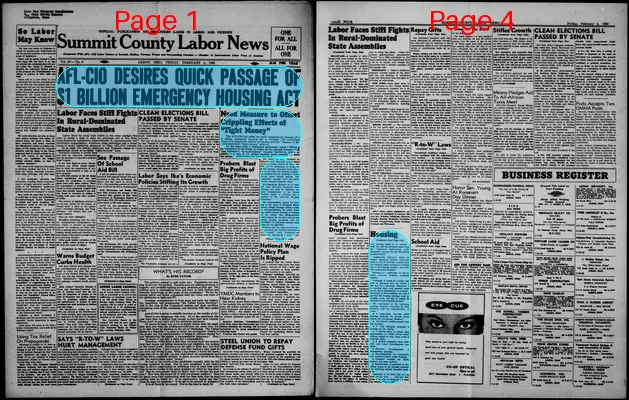
Summit County Labor News
Akron, Summit County, Ohio
What is this article about?
The AFL-CIO urges swift passage of a $1 billion emergency housing bill to counter the Eisenhower Administration's tight-money policies threatening a decline in housing starts from 1.25 million in 1959 to under 1 million in 1960. They also advocate for comprehensive long-term housing programs including public housing, middle-income support, and anti-discrimination measures.
Merged-components note: Merged headline with main article and its continuation from page 1 to page 4 due to matching topic on housing bill and 'Continued on Page Four' indicator.
Clippings
1 of 2
OCR Quality
Full Text
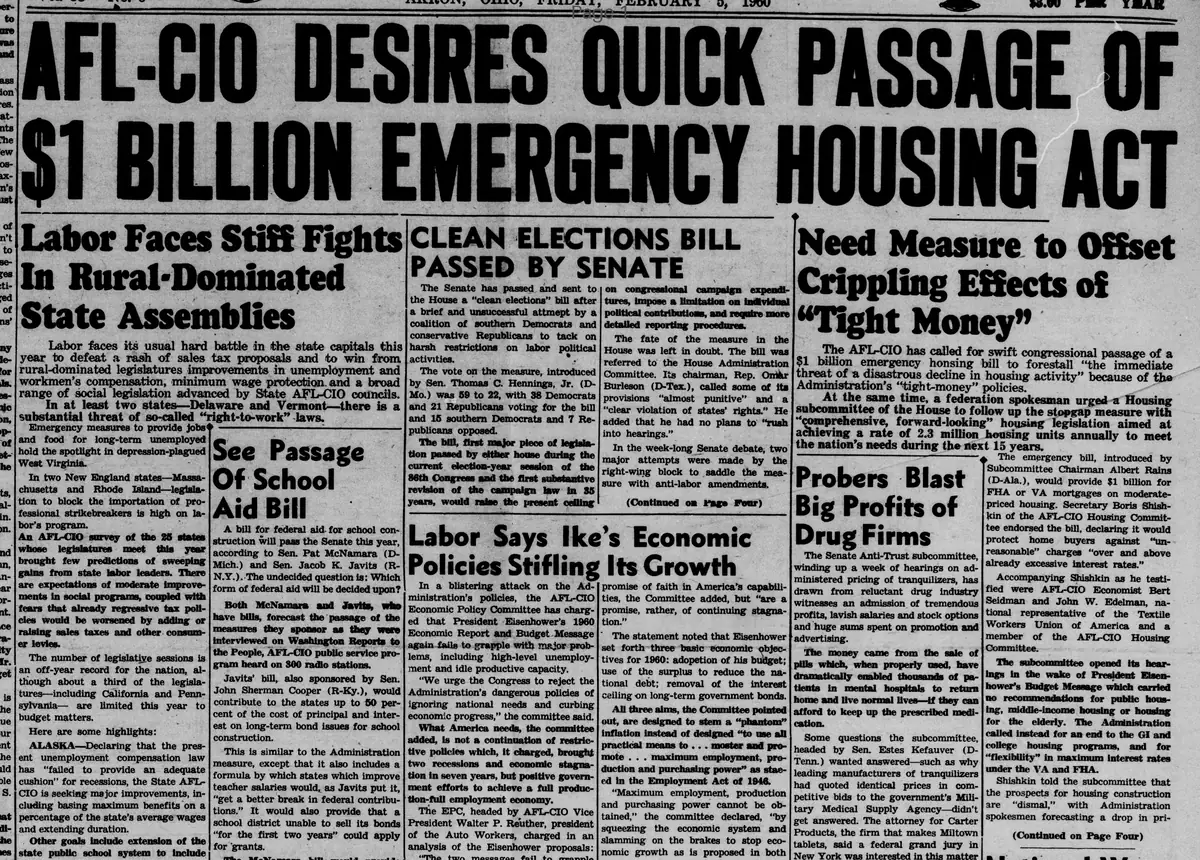
PASSAGE OF
$1 BILLION EMERGENCY HOUSING ACT
Need
Measure to Offset
Crippling
Effects of
"Tight
Money"
The AFL-CIO has called for swift congressional passage of a $1 billion emergency housing bill to forestall "the immediate threat of a disastrous decline in housing activity" because of the Administration's "tight-money" policies.
At the same time, a federation spokesman urged a Housing subcommittee of the House to follow up the stopgap measure with "comprehensive, forward-looking" housing legislation aimed at achieving a rate of 2.3 million housing units annually to meet the nation's needs during the next 15 years.
The emergency bill, introduced by Subcommittee Chairman Albert Rains (D-Ala.), would provide $1 billion for FHA or VA mortgages on moderate-priced housing. Secretary Boris Shishkin of the AFL-CIO Housing Committee endorsed the bill, declaring it would protect home buyers against "unreasonable" charges "over and above already excessive interest rates."
Accompanying Shishkin as he testified were AFL-CIO Economist Bert Seidman and John W. Edelman, national representative of the Textile Workers Union of America and a member of the AFL-CIO Housing Committee.
The subcommittee opened its hearings in the wake of President Eisenhower's Budget Message which carried no recommendations for public housing, middle-income housing or housing for the elderly. The Administration called instead for an end to the GI and college housing programs, and for "flexibility" in maximum interest rates under the VA and FHA.
Shishkin told the subcommittee that the prospects for housing construction are "dismal," with Administration spokesmen forecasting a drop in private home building from 1,250,000 units in 1959 to less than a million in 1960.
(Continued on Page Four)
(Continued from Page One)
Housing starts are expected to decline to 1.1 million in 1960. He said the situation stems from the "disastrous tight-money policy adamantly pursued by the Eisenhower Administration."
"Substantial discounts, which are simply disguised interest payments, piled on top of sky-high interest rates are keeping large numbers of families out of the housing market," the AFL CIO spokesman declared.
Housing is a bellwether of the national economy, Shishkin continued, adding:
"Certainly it would be a tragic mistake to disregard now the lesson of the last two recessions. Therefore, it is essential that every possible measure be taken immediately to forestall a downturn in home-building not only to prevent the housing shortage from becoming worse, but also to bolster the overall level of economic activity."
The ingredients of the long-range housing program advocated by labor, Shishkin told the subcommittee, include:
A large-scale, low-rent public housing program "to provide decent homes for low-income families."
• An effective middle-income housing program.
• A fully adequate program of housing for the elderly.
• A federal policy to assure equal opportunities to obtain decent homes without regard to race, color, creed or national origin.
A greatly expanded slum clearance and urban redevelopment program.
Effective encouragement of metropolitan planning.
Encouragement for cooperative and moderate-priced rental housing.
Adequate housing for family farmers and farm workers.
Requirement of payment of prevailing wages in any housing construction involving federal financial assistance.
Enactment of the Rains bill, he said, would be the "first . . . vital step Congress must take to discharge its housing responsibility in 1960."
What sub-type of article is it?
What themes does it cover?
What keywords are associated?
What entities or persons were involved?
Story Details
Key Persons
Event Date
1960
Story Details
AFL-CIO calls for immediate passage of $1 billion emergency housing bill introduced by Rep. Albert Rains to mitigate effects of tight-money policy causing housing decline; endorses long-term programs for public housing, middle-income, elderly, fair housing, slum clearance, and prevailing wages.