Thank you for visiting SNEWPapers!
Sign up free
Edgefield Advertiser
Edgefield, Edgefield County, South Carolina
What is this article about?
The Charleston Mercury reports on the deteriorating commercial condition of England, highlighting the Bank of England's failure to control foreign exchanges despite efforts to curtail circulation and raise interest rates. Bullion reserves have dropped by over £5 million in the year before June 25, with exchanges worsening by July 4, signaling a potential revolution in world commerce.
Clipping
OCR Quality
Full Text
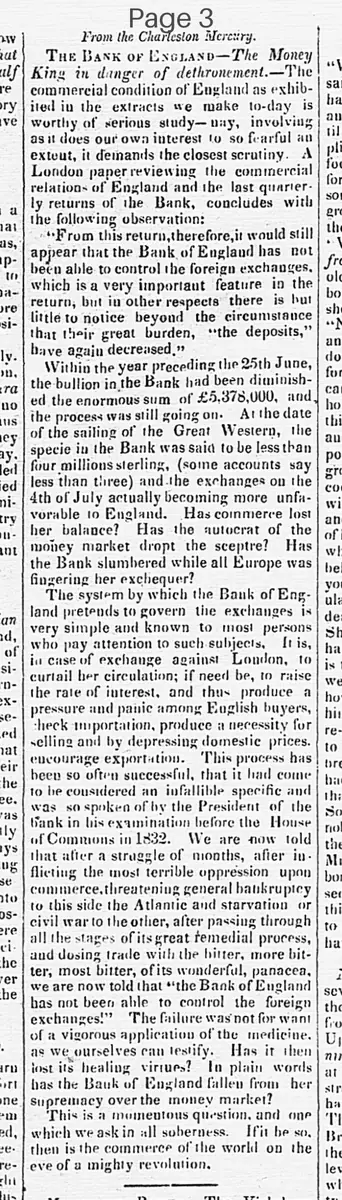
The Bank of England-The Money King in danger of dethronement.-The commercial condition of England as exhibited in the extracts we make to-day is worthy of serious study-nay, involving as it does our own interest to so fearful an extent, it demands the closest scrutiny. A London paper reviewing the commercial relations of England and the last quarterly returns of the Bank, concludes with the following observation:
"From this return, therefore, it would still appear that the Bank of England has not been able to control the foreign exchanges, which is a very important feature in the return, but in other respects there is but little to notice beyond the circumstance that their great burden, 'the deposits,' have again decreased."
Within the year preceding the 25th June, the bullion in the Bank had been diminished the enormous sum of £5,378,000, and the process was still going on. At the date of the sailing of the Great Western, the specie in the Bank was said to be less than four millions sterling, (some accounts say less than three) and the exchanges on the 4th of July actually becoming more unfavorable to England. Has commerce lost her balance? Has the autocrat of the money market dropped the sceptre? Has the Bank slumbered while all Europe was fingering her exchequer?
The system by which the Bank of England pretends to govern the exchanges is very simple and known to most persons who pay attention to such subjects. It is in case of exchange against London, to curtail her circulation; if need be, to raise the rate of interest, and thus produce a pressure and panic among English buyers, check importation, produce a necessity for selling and by depressing domestic prices, encourage exportation. This process has been so often successful, that it had come to be considered an infallible specific and was so spoken of by the President of the bank in his examination before the House of Commons in 1832. We are now told that after a struggle of months, after inflicting the most terrible oppression upon commerce, threatening general bankruptcy to this side the Atlantic and starvation or civil war to the other, after passing through all the stages of its great remedial process, and dosing trade with the bitter, more bitter, most bitter, of its wonderful, panacea, we are now told that "the Bank of England has not been able to control the foreign exchanges!" The failure was not for want of a vigorous application of the medicine, as we ourselves can testify. Has it then lost its healing virtues? In plain words has the Bank of England fallen from her Supremacy over the money market?
This is a momentous question, and one which we ask in all soberness. If it be so, then is the commerce of the world on the eve of a mighty revolution.
What sub-type of article is it?
What keywords are associated?
Where did it happen?
Foreign News Details
Primary Location
England
Event Date
Year Preceding 25th June And 4th Of July
Outcome
bullion diminished by £5,378,000; specie less than four millions sterling; bank unable to control foreign exchanges, leading to potential commercial revolution
Event Details
A London paper notes the Bank of England's failure to control foreign exchanges despite decreased deposits and bullion. The Bank's traditional methods of curtailing circulation and raising interest rates have not succeeded after months of effort, causing oppression on commerce and threats of bankruptcy and war. This raises questions about the Bank's supremacy in the money market.