Thank you for visiting SNEWPapers!
Sign up free
Letter to Editor
January 16, 1793
National Gazette
Philadelphia, Philadelphia County, Pennsylvania
What is this article about?
A letter to Mr. Freneau condemns a negative depiction of the French Revolution from the Connecticut Courant as aristocratic propaganda. It quotes the Courant's criticism of French infidelity, anarchy, and extremism, contrasting it with Lafayette's moderate constitutional plan, and defends the Revolution as revered by friends of freedom.
Clipping
OCR Quality
95%
Excellent
Full Text
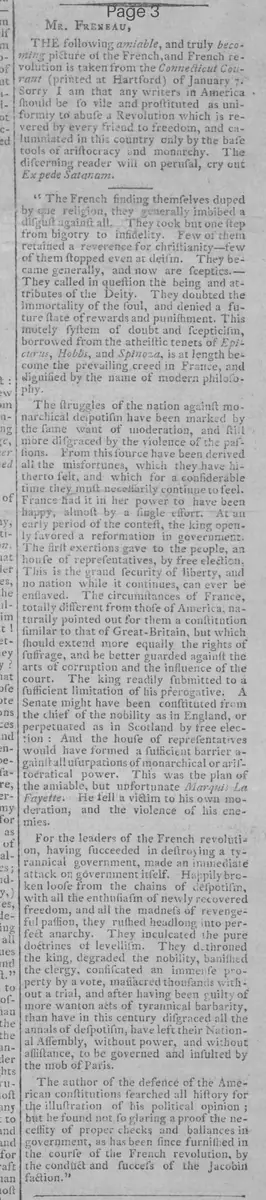
MR. FRENEAU,
THE following amiable, and truly becoming picture of the French, and French revolution is taken from the Connecticut Courant (printed at Hartford) of January 7.
Sorry I am that any writers in America should be so vile and prostituted as uniformly to abuse a Revolution which is revered by every friend to freedom, and calumniated in this country only by the base tools of aristocracy and monarchy. The discerning reader will on perusal, cry out Ex pede Satanam.
"The French finding themselves duped by one religion, they generally imbibed a disgust against all. They took but one step from bigotry to infidelity. Few of them retained a reverence for christianity—few of them stopped even at deism. They became generally, and now are skeptics.—
They called in question the being and attributes of the Deity. They doubted the immortality of the soul, and denied a future state of rewards and punishment. This mutely system of doubt and skepticism, borrowed from the atheistic tenets of Epicurus, Hobbs, and Spinoza, is at length become the prevailing creed in France, and dignified by the name of modern philosophy.
The struggles of the nation against monarchical despotism have been marked by the same want of moderation, and still more disgraced by the violence of the passions. From this source have been derived all the misfortunes, which they have hitherto felt, and which for a considerable time they must necessarily continue to feel.
France had it in her power to have been happy, almost by a single effort. At an early period of the contest, the king openly favored a reformation in government.
The first exertions gave to the people, an house of representatives, by free election.
This is the grand security of liberty, and no nation while it continues, can ever be enslaved. The circumstances of France, totally different from those of America, naturally pointed out for them a constitution similar to that of Great-Britain, but which should extend more equally the rights of suffrage, and be better guarded against the arts of corruption and the influence of the court. The king readily submitted to a sufficient limitation of his prerogative. A Senate might have been constituted from the chief of the nobility as in England, or perpetuated as in Scotland by free election: And the house of representatives would have formed a sufficient barrier against all usurpations of monarchical or aristocratical power. This was the plan of the amiable, but unfortunate Marquis La Fayette. He fell a victim to his own moderation, and the violence of his enemies.
For the leaders of the French revolution, having succeeded in destroying a tyrannical government, made an immediate attack on government itself. Happily broken loose from the chains of despotism, with all the enthusiasm of newly recovered freedom, and all the madness of revengeful passion, they rushed headlong into perfect anarchy. They inculcated the pure doctrines of levelism. They dethroned the king, degraded the nobility, banished the clergy, confiscated an immense property by a vote, massacred thousands without a trial, and after having been guilty of more wanton acts of tyrannical barbarity, than have in this century disgraced all the annals of despotism, have left their National Assembly, without power, and without assistance, to be governed and insulted by the mob of Paris.
The author of the defence of the American constitutions searched all history for the illustration of his political opinion; but he found not so glaring a proof the necessity of proper checks and ballances in government, as has been since furnished in the course of the French revolution, by the conduct and success of the Jacobin faction."
THE following amiable, and truly becoming picture of the French, and French revolution is taken from the Connecticut Courant (printed at Hartford) of January 7.
Sorry I am that any writers in America should be so vile and prostituted as uniformly to abuse a Revolution which is revered by every friend to freedom, and calumniated in this country only by the base tools of aristocracy and monarchy. The discerning reader will on perusal, cry out Ex pede Satanam.
"The French finding themselves duped by one religion, they generally imbibed a disgust against all. They took but one step from bigotry to infidelity. Few of them retained a reverence for christianity—few of them stopped even at deism. They became generally, and now are skeptics.—
They called in question the being and attributes of the Deity. They doubted the immortality of the soul, and denied a future state of rewards and punishment. This mutely system of doubt and skepticism, borrowed from the atheistic tenets of Epicurus, Hobbs, and Spinoza, is at length become the prevailing creed in France, and dignified by the name of modern philosophy.
The struggles of the nation against monarchical despotism have been marked by the same want of moderation, and still more disgraced by the violence of the passions. From this source have been derived all the misfortunes, which they have hitherto felt, and which for a considerable time they must necessarily continue to feel.
France had it in her power to have been happy, almost by a single effort. At an early period of the contest, the king openly favored a reformation in government.
The first exertions gave to the people, an house of representatives, by free election.
This is the grand security of liberty, and no nation while it continues, can ever be enslaved. The circumstances of France, totally different from those of America, naturally pointed out for them a constitution similar to that of Great-Britain, but which should extend more equally the rights of suffrage, and be better guarded against the arts of corruption and the influence of the court. The king readily submitted to a sufficient limitation of his prerogative. A Senate might have been constituted from the chief of the nobility as in England, or perpetuated as in Scotland by free election: And the house of representatives would have formed a sufficient barrier against all usurpations of monarchical or aristocratical power. This was the plan of the amiable, but unfortunate Marquis La Fayette. He fell a victim to his own moderation, and the violence of his enemies.
For the leaders of the French revolution, having succeeded in destroying a tyrannical government, made an immediate attack on government itself. Happily broken loose from the chains of despotism, with all the enthusiasm of newly recovered freedom, and all the madness of revengeful passion, they rushed headlong into perfect anarchy. They inculcated the pure doctrines of levelism. They dethroned the king, degraded the nobility, banished the clergy, confiscated an immense property by a vote, massacred thousands without a trial, and after having been guilty of more wanton acts of tyrannical barbarity, than have in this century disgraced all the annals of despotism, have left their National Assembly, without power, and without assistance, to be governed and insulted by the mob of Paris.
The author of the defence of the American constitutions searched all history for the illustration of his political opinion; but he found not so glaring a proof the necessity of proper checks and ballances in government, as has been since furnished in the course of the French revolution, by the conduct and success of the Jacobin faction."
What sub-type of article is it?
Persuasive
Political
Historical
What themes does it cover?
Politics
Constitutional Rights
What keywords are associated?
French Revolution
Connecticut Courant
Lafayette
Jacobins
Constitutional Plan
Anarchy
Aristocracy
What entities or persons were involved?
Mr. Freneau
Letter to Editor Details
Recipient
Mr. Freneau
Main Argument
criticizes american writers for abusing the french revolution as tools of aristocracy and monarchy, presenting a quoted negative view from the connecticut courant as evidence of such vileness, while implying support for the revolution revered by friends of freedom.
Notable Details
Quotes Connecticut Courant Article Criticizing French Infidelity And Anarchy
Mentions Marquis La Fayette's Moderate Constitutional Plan
References Jacobin Faction And Need For Checks And Balances
Latin Phrase 'Ex Pede Satanam'