Thank you for visiting SNEWPapers!
Sign up free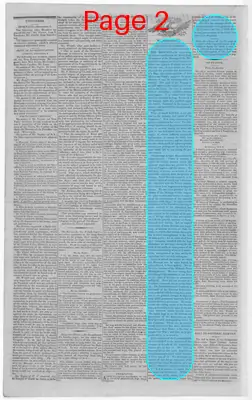
Editorial
December 7, 1815
Daily National Intelligencer
Washington, District Of Columbia
What is this article about?
The editorial expresses satisfaction with President Madison's message to Congress, praising its clarity on national affairs, recommendations for military improvement, avoidance of European entanglements, and overall Republican tone, while noting silence on Florida cession.
Clipping
OCR Quality
98%
Excellent
Full Text
WASHINGTON
THURSDAY, DECEMBER 7.
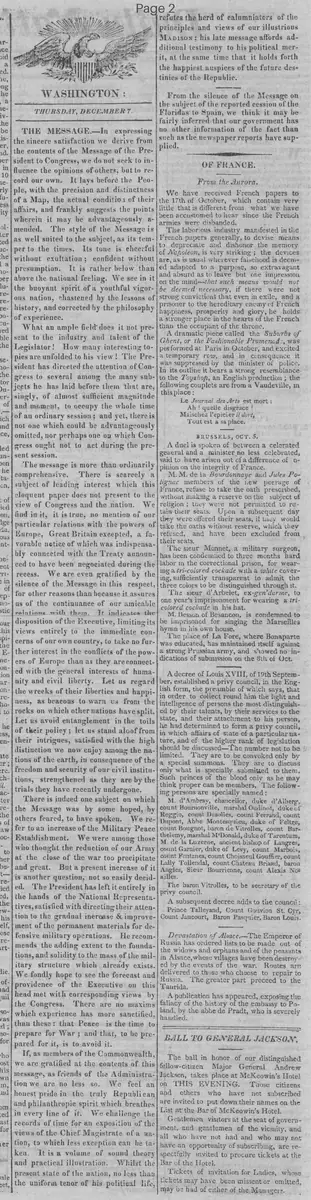
THE MESSAGE.—In expressing the sincere satisfaction we derive from the contents of the Message of the President to Congress, we do not seek to influence the opinions of others, but to record our own. It lays before the People, with the precision and distinctness of a Map, the actual condition of their affairs, and frankly suggests the points wherein it may be advantageously amended. The style of the Message is as well suited to the subject, as its temper to the times. Its tone is cheerful without exultation; confident without presumption. It is rather below than above the national feeling. We see in it the buoyant spirit of a youthful vigorous nation, chastened by the lessons of history, and corrected by the philosophy of experience.
What an ample field does it not present to the industry and talent of the Legislator! How many interesting topics are unfolded to his view! The President has directed the attention of Congress to several among the many subjects he has laid before them that are, singly, of almost sufficient magnitude and moment, to occupy the whole time of an ordinary session; and yet, there is not one which could be advantageously omitted, nor perhaps one on which Congress ought not to act during the present session.
The message is more than ordinarily comprehensive. There is scarcely a subject of leading interest which this eloquent paper does not present to the view of Congress and the nation. We find in it, it is true, no mention of our particular relations with the powers of Europe, Great Britain excepted, a favorable notice of which was indispensably connected with the Treaty announced to have been negociated during the recess. We are even gratified by the silence of the Message in this respect, for other reasons than because it assures us of the continuance of our amicable relations with them. It indicates the disposition of the Executive, limiting its views entirely to the immediate concerns of our own country, to take no further interest in the conflicts of the powers of Europe than as they are connected with the general interests of humanity and civil liberty. Let us regard the wrecks of their liberties and happiness, as beacons to warn us from the rocks on which other nations have split. Let us avoid entanglement in the toils of their policy; let us stand aloof from their intrigues, satisfied with the high distinction we now enjoy among the nations of the earth, in consequence of the freedom and security of our civil institutions, strengthened as they are by the trials they have recently undergone.
There is indeed one subject on which the Message was by some hoped, by others feared, to have spoken. We refer to an increase of the Military Peace Establishment. We were among those who thought the reduction of our Army at the close of the war too precipitate and great. But a present increase of it is another question, not so easily decided. The President has left it entirely in the hands of the National Representatives, satisfied with directing their attention to the gradual increase & improvement of the permanent materials for defensive military operations. He recommends the adding extent to the foundations, and solidity to the mass of the military structure which already exists.
We fondly hope to see the forecast and providence of the Executive on this head met with corresponding views by the Congress. There are no maxims which experience has more sanctified, than these: that Peace is the time to prepare for War; and that, to be prepared for it, is to avoid it.
If, as members of the Commonwealth, we are gratified at the contents of this message, as friends of the Administration we are no less so. We feel an honest pride in the truly Republican and philanthropic spirit which breathes in every line of it. We challenge the records of time for an exposition of the views of the Chief Magistrate of a nation, to which less exception can be taken. It is a volume of sound theory and practical illustration. Whilst the present state of the nation, no less than the uniform tenor of his political life, refutes the herd of calumniators of the principles and views of our illustrious Madison; his late message affords additional testimony to his political merit, at the same time that it holds forth the happiest auspices of the future destinies of the Republic.
From the silence of the Message on the subject of the reported cession of the Floridas to Spain, we think it may be fairly inferred that our government has no other information of the fact than such as the newspaper reports have supplied.
THURSDAY, DECEMBER 7.
THE MESSAGE.—In expressing the sincere satisfaction we derive from the contents of the Message of the President to Congress, we do not seek to influence the opinions of others, but to record our own. It lays before the People, with the precision and distinctness of a Map, the actual condition of their affairs, and frankly suggests the points wherein it may be advantageously amended. The style of the Message is as well suited to the subject, as its temper to the times. Its tone is cheerful without exultation; confident without presumption. It is rather below than above the national feeling. We see in it the buoyant spirit of a youthful vigorous nation, chastened by the lessons of history, and corrected by the philosophy of experience.
What an ample field does it not present to the industry and talent of the Legislator! How many interesting topics are unfolded to his view! The President has directed the attention of Congress to several among the many subjects he has laid before them that are, singly, of almost sufficient magnitude and moment, to occupy the whole time of an ordinary session; and yet, there is not one which could be advantageously omitted, nor perhaps one on which Congress ought not to act during the present session.
The message is more than ordinarily comprehensive. There is scarcely a subject of leading interest which this eloquent paper does not present to the view of Congress and the nation. We find in it, it is true, no mention of our particular relations with the powers of Europe, Great Britain excepted, a favorable notice of which was indispensably connected with the Treaty announced to have been negociated during the recess. We are even gratified by the silence of the Message in this respect, for other reasons than because it assures us of the continuance of our amicable relations with them. It indicates the disposition of the Executive, limiting its views entirely to the immediate concerns of our own country, to take no further interest in the conflicts of the powers of Europe than as they are connected with the general interests of humanity and civil liberty. Let us regard the wrecks of their liberties and happiness, as beacons to warn us from the rocks on which other nations have split. Let us avoid entanglement in the toils of their policy; let us stand aloof from their intrigues, satisfied with the high distinction we now enjoy among the nations of the earth, in consequence of the freedom and security of our civil institutions, strengthened as they are by the trials they have recently undergone.
There is indeed one subject on which the Message was by some hoped, by others feared, to have spoken. We refer to an increase of the Military Peace Establishment. We were among those who thought the reduction of our Army at the close of the war too precipitate and great. But a present increase of it is another question, not so easily decided. The President has left it entirely in the hands of the National Representatives, satisfied with directing their attention to the gradual increase & improvement of the permanent materials for defensive military operations. He recommends the adding extent to the foundations, and solidity to the mass of the military structure which already exists.
We fondly hope to see the forecast and providence of the Executive on this head met with corresponding views by the Congress. There are no maxims which experience has more sanctified, than these: that Peace is the time to prepare for War; and that, to be prepared for it, is to avoid it.
If, as members of the Commonwealth, we are gratified at the contents of this message, as friends of the Administration we are no less so. We feel an honest pride in the truly Republican and philanthropic spirit which breathes in every line of it. We challenge the records of time for an exposition of the views of the Chief Magistrate of a nation, to which less exception can be taken. It is a volume of sound theory and practical illustration. Whilst the present state of the nation, no less than the uniform tenor of his political life, refutes the herd of calumniators of the principles and views of our illustrious Madison; his late message affords additional testimony to his political merit, at the same time that it holds forth the happiest auspices of the future destinies of the Republic.
From the silence of the Message on the subject of the reported cession of the Floridas to Spain, we think it may be fairly inferred that our government has no other information of the fact than such as the newspaper reports have supplied.
What sub-type of article is it?
Foreign Affairs
Military Affairs
Partisan Politics
What keywords are associated?
President's Message
Madison
Foreign Relations
Military Establishment
European Conflicts
Republican Spirit
Congress
What entities or persons were involved?
President Madison
Congress
Great Britain
Powers Of Europe
Editorial Details
Primary Topic
Praise For President Madison's Message To Congress
Stance / Tone
Supportive And Complimentary
Key Figures
President Madison
Congress
Great Britain
Powers Of Europe
Key Arguments
Message Clearly Outlines National Affairs And Suggests Amendments
Style Is Cheerful, Confident, And Suited To The Times
Avoid Entanglement In European Conflicts And Focus On Domestic Concerns
President Recommends Gradual Increase And Improvement Of Military Establishment
Peace Is The Time To Prepare For War
Message Demonstrates Republican And Philanthropic Spirit
Silence On Florida Cession Indicates Reliance On Newspaper Reports