Thank you for visiting SNEWPapers!
Sign up free
Alexandria Advertiser And Commercial Intelligencer
Alexandria, Virginia
What is this article about?
Thomas Paine's continued letter to George Washington criticizes Washington's silence on Paine's French imprisonment, accuses his faction of slander, and denounces the Jay Treaty as a treacherous betrayal of France, perverting the US-France alliance to aid England during war.
Merged-components note: Merged continuation of Thomas Paine's letter to Washington across pages, which is an opinion piece criticizing the administration; relabeled from 'story' to 'editorial' as it fits opinion/editorial content.
Clippings
1 of 2
OCR Quality
Full Text
LETTER
GENERAL WASHINGTON.
Continued.
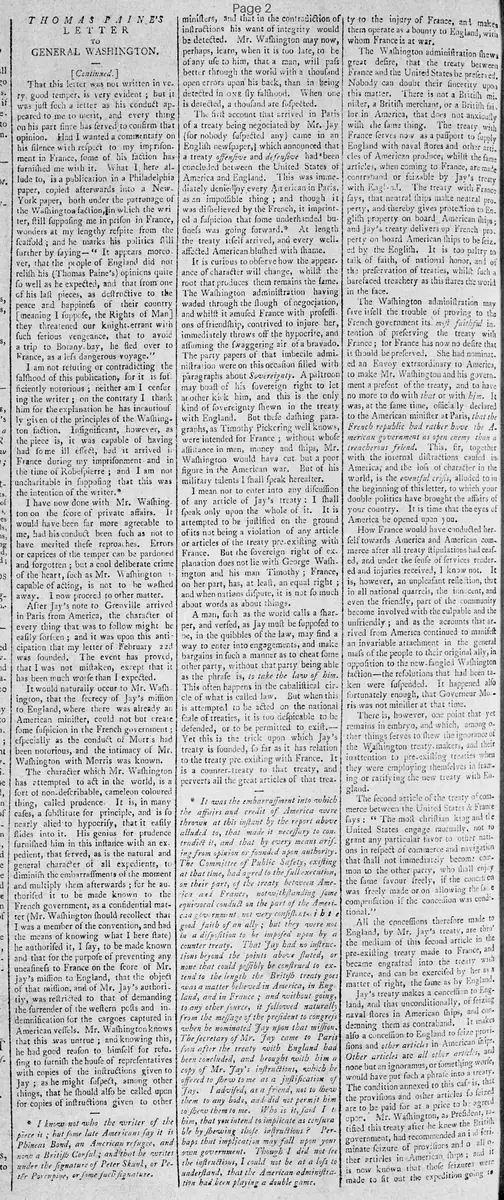
That this letter was not written in very good temper, is very evident; but it was just such a letter as his conduct appeared to me to merit, and every thing on his part since has served to confirm that opinion. Had I wanted a commentary on his silence with respect to my imprisonment in France, some of his faction has furnished me with it. What I here allude to, is a publication in a Philadelphia paper, copied afterwards into a New York paper, both under the patronage of the Washington faction, in which the writer, still supposing me in prison in France, wonders at my lengthy respite from the scaffold: and he marks his politics still further by saying- "It appears moreover, that the people of England did not relish his (Thomas Paine's) opinions quite so well as he expected, and that from one of his last pieces, as destructive to the peace and happiness of their country [meaning I suppose, the Rights of Man] they threatened our knight-errant with such serious vengeance, that to avoid a trip to Botany Bay, he fled over to France, as a less dangerous voyage."
I am not refuting or contradicting the falsehood of this publication, for it is sufficiently notorious: neither am I censoring the writer: on the contrary I thank him for the explanation he has incautiously given of the principles of the Washington faction. Insignificant, however, as the piece is, it was capable of having had some ill effect, had it arrived in France during my imprisonment and in the time of Robespierre; and I am not uncharitable in supposing that this was the intention of the writer.*
I have now done with Mr. Washington on the score of private affairs. It would have been far more agreeable to me, had his conduct been such as not to have merited these reproaches. Errors or caprices of the temper can be pardoned and forgotten: but a cool deliberate crime of the heart, such as Mr. Washington is capable of acting, is not to be washed away. I now proceed to other matter.
After Jay's note to Grenville arrived in Paris from America, the character of every thing that was to follow might be easily foreseen; and it was upon this anticipation that my letter of February 22d was founded. The event has proved, that I was not mistaken, except that it has been much worse than I expected.
It would naturally occur to Mr. Washington, that the secrecy of Jay's mission to England, where there was already an American minister, could not but create some suspicion in the French government; especially as the conduct of Morris had been notorious, and the intimacy of Mr. Washington with Morris was known.
The character which Mr. Washington has attempted to act in the world, is a sort of non-describable, chameleon coloured thing, called prudence. It is, in many cases, a substitute for principle, and is so nearly allied to hypocrisy, that it easily slides into it. His genius for prudence furnished him in this instance with an expedient, that served, as is the natural and general character of all expedients, to diminish the embarrassments of the moment and multiply them afterwards; for he authorised it to be made known to the French government, as a confidential matter (Mr. Washington should recollect that I was a member of the convention, and had the means of knowing what I here state) he authorised it, I say, to be made known and that for the purpose of preventing any uneasiness to France on the score of Mr. Jay's mission to England, that the object of that mission, and of Mr. Jay's authority, was restricted to that of demanding the surrender of the western posts and indemnification for the cargoes captured in American vessels. Mr. Washington knows that this was untrue; and knowing this, he had good reason to himself for refusing to furnish the house of representatives with copies of the instructions given to Jay; as he might suspect, among other things, that he should also be called upon for copies of instructions given to other ministers, and that in the contradiction of instructions his want of integrity would be detected. Mr. Washington may now, perhaps, learn, when it is too late, to be of any use to him, that a man, will pass better through the world with a thousand open errors upon his back, than in being detected in one sly falsehood. When one is detected, a thousand are suspected.
The first account that arrived in Paris of a treaty being negotiated by Mr. Jay (for nobody suspected any) came in an English newspaper, which announced that a treaty offensive and defensive had been concluded between the United States of America and England. This was immediately denied by every American in Paris, as an impossible thing; and though it was disbelieved by the French, it imprinted a suspicion that some underhanded business was going forward.* At length the treaty itself arrived, and every well-affected American blushed with shame.
It is curious to observe how the appearance of character will change, whilst the root that produces them remains the same.
The Washington administration having waded through the slough of negotiation, and whilst it amused France with professions of friendship, contrived to injure her, immediately throws off the hypocrite, and assuming the swaggering air of a bravado.
The party papers of that imbecile administration were on this occasion filled with paragraphs about Sovereignty. A poltroon may boast of his sovereign right to let another kick him, and this is the only kind of sovereignty shewn in the treaty with England. But these dashing paragraphs, as Timothy Pickering well knows, were intended for France: without whose assistance in men, money and ships, Mr. Washington would have cut but a poor figure in the American war. But of his military talents I shall speak hereafter.
I mean not to enter into any discussion of any article of Jay's treaty: I shall speak only upon the whole of it. It is attempted to be justified on the ground of its not being a violation of any article or articles of the treaty pre-existing with France. But the sovereign right of explanation does not lie with George Washington and his man Timothy; France, on her part, has, at least, an equal right; and when nations dispute, it is not so much about words as about things.
A man, such as the world calls a sharper, and versed, as Jay must be supposed to be, in the quibbles of the law, may find a way to enter into engagements, and make bargains in such a manner as to cheat some other party, without that party being able as the phrase is, to take the law of him.
This often happens in the cabbalistical circle of what is called law. But when this is attempted to be acted on the national scale of treaties, it is too despicable to be defended, or to be permitted to exist.--
Yet this is the trick upon which Jay's treaty is founded, so far as it has relation to the treaty pre-existing with France. It is a counter-treaty to that treaty, and perverts all the great articles of that treaty to the injury of France, and makes them operate as a bounty to England, with whom France is at war.
It was the embarrassment into which the affairs and credit of America were thrown at this instant by the report above alluded to, that made it necessary to contradict it, and that by every means arising from opinion or founded upon authority.
The Committee of Public Safety, existing at that time, had agreed to the full execution, on their part, of the treaty between America and France, notwithstanding some equivocal conduct on the part of the American government not very consistent with the good faith of an ally; but they were not in a disposition to be imposed upon by a counter treaty. That Jay had no instructions beyond the points above stated, or none that could possibly be construed to extend to the length the British treaty goes, was a matter believed in America, in England, and in France; and without going, to any other source, it followed naturally from the message of the president to congress when he nominated Jay upon that mission.
The secretary of Mr. Jay came to Paris soon after the treaty with England had been concluded, and brought with him a copy of Mr. Jay's instructions, which he offered to shew to some as a justification of Jay. I advised, as a friend, not to shew them to any body, and did not permit him to shew them to me. Who is it, said I to him, that you intend to implicate as censurable by shewing those instructions? Perhaps that implication may fall upon your own government. Though I did not see the instructions, I could not be at a loss to understand, that the American administration had been playing a double game,
The Washington administration shews great desire, that the treaty between France and the United States be preserved.
Nobody can doubt their sincerity upon this matter. There is not a British minister, a British merchant, or a British sailor in America, that does not anxiously wish the same thing. The treaty with France serves now as a passport to supply England with naval stores and other articles of American produce, whilst the same articles, when coming to France, are made contraband or seizable by Jay's treaty with England. The treaty with France says, that neutral ships make neutral property, and thereby gives protection to English property on board American ships; and Jay's treaty delivers up French property on board American ships to be seized by the English. It is too paltry to talk of faith, of national honor, and of the preservation of treaties, whilst such a barefaced treachery as this stares the world in the face.
The Washington administration may save itself the trouble of proving to the French government its most faithful intention of preserving the treaty with France; for France has now no desire that it should be preserved. She had nominated an Envoy extraordinary to America, to make Mr. Washington and his government a present of the treaty, and to have no more to do with that or with him. It was, at the same time, officially declared to the American minister at Paris, that the French republic had rather have the American government as open enemy than a treacherous friend. This, sir, together with the internal distractions caused in America; and the loss of character in the world, is the eventful crisis, alluded to in the beginning of this letter, to which your double politics have brought the affairs of your country. It is time that the eyes of America be opened upon you.
How France would have conducted herself towards America and American commerce after all treaty stipulations had ceased, and under the sense of services rendered and injuries received, I know not. It is, however, an unpleasant reflection, that in all national quarrels, the innocent, and even the friendly, part of the community become involved with the culpable and the unfriendly; and as the accounts that arrived from America continued to manifest an invariable attachment in the general mass of the people to their original ally, in opposition to the new-fangled Washington faction-the resolutions that had been taken were suspended. It happened also fortunately enough, that Gouverneur Morris was not minister at that time.
There is, however, one point that yet remains in embryo, and which, among other things serves to shew the ignorance of the Washington treaty-makers, and their inattention to pre-existing treaties when they were employing themselves in framing or ratifying the new treaty with England.
The second article of the treaty of commerce between the United States & France says: "The most christian king and the United States engage mutually, not to grant any particular favor to other nations in respect of commerce and navigation that shall not immediately become common to the other party, who shall enjoy the same favour freely, if the concession was freely made or on allowing the same compensation if the concession was conditional."
All the concessions therefore made to England, by Mr. Jay's treaty, are thro' pre-existing treaty made to France, and the medium of this second article in the treaty became engrafted into the treaty with France, and can be exercised by her as a matter of right, the same as by England.
Jay's treaty makes a concession to England, and that unconditionally, of seizing naval stores in American Ships, and condemning them as contraband. It makes also a concession to England to seize provisions and other articles in American ships.
Other articles are all other articles, and none but an ignoramus, or something worse, would have put such a phrase into a treaty.
The provisions and other articles so seized are to be paid for at a price to be agreed upon. The condition annexed to this capitation is, that
Mr. Washington, as President, ratified this treaty after he knew the British government, had recommended an indiscriminate seizure of provisions and o all o-ther articles in American ships: and it is now known that those seizures were made to it out the expedition going to hand that they would be made. The Quiberon Bay, and it was known, before evidence goes, also, a good way to prove other upon that subject. Mr. Pinckney, that Jay and Grenville understood each when he passed through France on his way place. The French government had by the seizures as a thing that would take to Spain, spoke of the recommencement of some means received information from London to the same purpose, with the addition, that the recommencement of the seizures would cause no misunderstanding between the British and American governments. Grenville in defending himself against the opposition in parliament, on account of the scarcity of corn, said (see his speech at the opening of parliament, that met Oct. 29th, 1793.) that "the supplies for the Quiberon expedition were furnished out of the American ships;" and all the accounts received at that time from England stated, that those seizures were made under the treaty. After the supplies for the Quiberon expedition had been procured, and the expected success had failed, the seizures were countermanded; and, had the French seized provision vessels bound to England, it is probable that the Quiberon expedition could not have been attempted.
In one point of view, the treaty with England operates as a loan on the English government. It gives permission to that government to take American property at sea, to any amount, and pay for it when it suits her; and besides this, the treaty is in every point of view, a surrender of the rights of American commerce and navigation, and a refusal to France of the rights of neutrality. The American flag is not now a neutral flag to France; Jay's treaty of surrender gives a monopoly of it to England.
On the contrary, the treaty of commerce between America and France was founded on the most liberal principles, and calculated to give the greatest encouragement to the infant commerce of America. France was neither a carrier nor an exporter of naval stores or provisions. These articles belonged wholly to America, and they had all the protection in that treaty which a treaty could give. But so much has that treaty been perverted, that the liberality of it, on the part of France, has served to encourage Jay to form a counter treaty with England; for he must have supposed the hands of France tied up by her treaty with America, when he was making such large concessions in favor of England.
The injury which Mr. Washington's administration has done to the character as well as to the commerce of America is too great to be repaired by him. Foreign nations will be shy of making treaties with a government that has given the faithless example of perverting the liberality of a former treaty to the injury of the party with whom it was made.
In what a fraudulent light must Mr. Washington's character appear to the world, when his declarations and his conduct are compared together! Here follows the letter he wrote to the committee of Public Safety, whilst Jay was negotiating in profound secrecy this treacherous treaty.
"GEORGE WASHINGTON, President of the United States of America, to the Representatives of the French People, members of the Committee of Public Safety of the French Republic, the great and good friend and ally of the United States.
"On the intimation of the wish of the French republic, that a new minister should be sent from the United States, I resolved to manifest my sense of the readiness with which my request was fulfilled [that of recalling Genet] by immediately fulfilling the request of your government [that of recalling Morris.]
"It was some time before a character could be obtained, worthy of the high office of expressing the attachment of the United States to the happiness of our allies, and drawing closer the bonds of our friendship. I have now made choice of Mr. James Monroe, one of our distinguished citizens, to reside near the French republic, in quality of minister plenipotentiary of the United States of America.
He is instructed to bear to you sincere solicitude for your welfare, and to cultivate with zeal the cordiality so happily subsisting between us. From a knowledge of his fidelity, probity and good conduct, I have entire confidence that he will render himself acceptable to you, and give effect to our desire of preserving and advancing, on all occasions, the interest and connection of the two nations. I beseech you, therefore, to give full credence to whatever he shall say to you, on the part of the United States, and, most of all, when he shall assure you that your prosperity is an object of our affection and I pray God to have the French republic in his holy keeping.
"G. WASHINGTON."
What sub-type of article is it?
What keywords are associated?
What entities or persons were involved?
Editorial Details
Primary Topic
Criticism Of Jay's Treaty And Washington's Betrayal Of France
Stance / Tone
Strongly Critical And Accusatory
Key Figures
Key Arguments