Thank you for visiting SNEWPapers!
Sign up free
Literary
September 5, 1884
Seattle Daily Post Intelligencer
Seattle, King County, Washington
What is this article about?
Excerpt from Edward Eggleston's article on colonial commerce, detailing the development of saw mills in early American colonies, timber trade challenges, historical establishments in Virginia, New York, and New England, and supplying masts for the royal navy.
Clipping
OCR Quality
95%
Excellent
Full Text
Colonial Saw Mills.
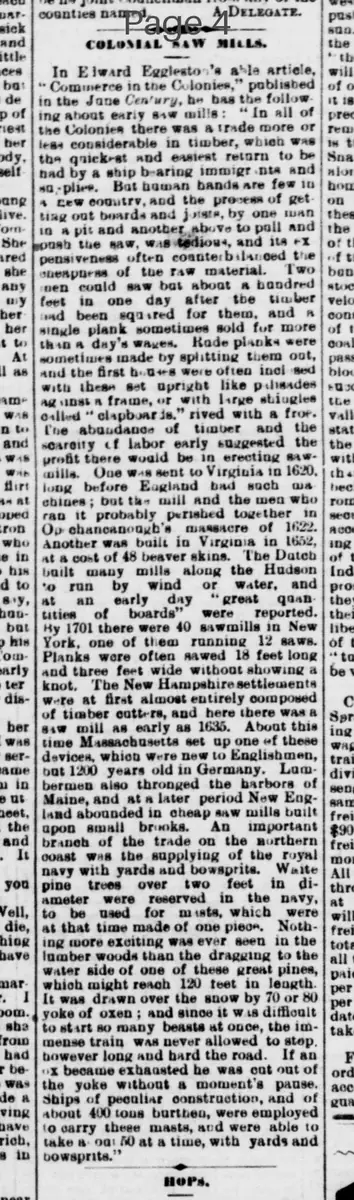
In Edward Eggleston's able article, "Commerce in the Colonies," published in the June Century, he has the following about early saw mills: "In all of the Colonies there was a trade more or less considerable in timber, which was the quickest and easiest return to be had by a ship bearing immigrants and supplies. But human hands are few in a new country, and the process of getting out boards and joists, by one man in a pit and another above to pull and push the saw, was tedious, and its expensiveness often counterbalanced the cheapness of the raw material. Two men could saw but about a hundred feet in one day after the timber had been squared for them, and a single plank sometimes sold for more than a day's wages. Rude planks were sometimes made by splitting them out, and the first houses were often inclosed with these set upright like palisades against a frame, or with large shingles called "clapboards," rived with a froe.
The abundance of timber and the scarcity of labor early suggested the profit there would be in erecting saw mills. One was sent to Virginia in 1620, long before England had such machines; but the mill and the men who ran it probably perished together in Opechancanough's massacre of 1622. Another was built in Virginia in 1652, at a cost of 48 beaver skins. The Dutch built many mills along the Hudson to run by wind or water, and at an early day great quantities of boards were exported. By 1701 there were 40 sawmills in New York, one of them running 12 saws. Planks were often sawed 18 feet long and three feet wide without showing a knot. The New Hampshire settlements were at first almost entirely composed of timber cutters, and here there was a saw mill as early as 1635. About this time Massachusetts set up one of these devices, which were new to Englishmen, but 1200 years old in Germany. Lumbermen also thronged the harbors of Maine, and at a later period New England abounded in cheap saw mills built upon small brooks. An important branch of the trade on the northern coast was the supplying of the royal navy with yards and bowsprits. White pine trees over two feet in diameter were reserved in the navy, to be used for masts, which were at that time made of one piece. Nothing more exciting was ever seen in the lumber woods than the dragging to the water side of one of these great pines, which might reach 120 feet in length. It was drawn over the snow by 70 or 80 yoke of oxen; and since it was difficult to start so many beasts at once, the immense train was never allowed to stop, however long and hard the road. If an ox became exhausted he was cut out of the yoke without a moment's pause. Ships of peculiar construction, and of about 400 tons burthen, were employed to carry these masts, and were able to take a mast 110 at a time, with yards and bowsprits."
In Edward Eggleston's able article, "Commerce in the Colonies," published in the June Century, he has the following about early saw mills: "In all of the Colonies there was a trade more or less considerable in timber, which was the quickest and easiest return to be had by a ship bearing immigrants and supplies. But human hands are few in a new country, and the process of getting out boards and joists, by one man in a pit and another above to pull and push the saw, was tedious, and its expensiveness often counterbalanced the cheapness of the raw material. Two men could saw but about a hundred feet in one day after the timber had been squared for them, and a single plank sometimes sold for more than a day's wages. Rude planks were sometimes made by splitting them out, and the first houses were often inclosed with these set upright like palisades against a frame, or with large shingles called "clapboards," rived with a froe.
The abundance of timber and the scarcity of labor early suggested the profit there would be in erecting saw mills. One was sent to Virginia in 1620, long before England had such machines; but the mill and the men who ran it probably perished together in Opechancanough's massacre of 1622. Another was built in Virginia in 1652, at a cost of 48 beaver skins. The Dutch built many mills along the Hudson to run by wind or water, and at an early day great quantities of boards were exported. By 1701 there were 40 sawmills in New York, one of them running 12 saws. Planks were often sawed 18 feet long and three feet wide without showing a knot. The New Hampshire settlements were at first almost entirely composed of timber cutters, and here there was a saw mill as early as 1635. About this time Massachusetts set up one of these devices, which were new to Englishmen, but 1200 years old in Germany. Lumbermen also thronged the harbors of Maine, and at a later period New England abounded in cheap saw mills built upon small brooks. An important branch of the trade on the northern coast was the supplying of the royal navy with yards and bowsprits. White pine trees over two feet in diameter were reserved in the navy, to be used for masts, which were at that time made of one piece. Nothing more exciting was ever seen in the lumber woods than the dragging to the water side of one of these great pines, which might reach 120 feet in length. It was drawn over the snow by 70 or 80 yoke of oxen; and since it was difficult to start so many beasts at once, the immense train was never allowed to stop, however long and hard the road. If an ox became exhausted he was cut out of the yoke without a moment's pause. Ships of peculiar construction, and of about 400 tons burthen, were employed to carry these masts, and were able to take a mast 110 at a time, with yards and bowsprits."
What sub-type of article is it?
Essay
What themes does it cover?
Commerce Trade
What keywords are associated?
Colonial Saw Mills
Timber Trade
Lumber Export
Navy Masts
New England Mills
What entities or persons were involved?
Edward Eggleston
Literary Details
Title
Colonial Saw Mills.
Author
Edward Eggleston
Subject
Early Saw Mills And Timber Trade In The Colonies
Key Lines
Two Men Could Saw But About A Hundred Feet In One Day After The Timber Had Been Squared For Them, And A Single Plank Sometimes Sold For More Than A Day's Wages.
One Was Sent To Virginia In 1620, Long Before England Had Such Machines; But The Mill And The Men Who Ran It Probably Perished Together In Opechancanough's Massacre Of 1622.
By 1701 There Were 40 Sawmills In New York, One Of Them Running 12 Saws.
White Pine Trees Over Two Feet In Diameter Were Reserved In The Navy, To Be Used For Masts, Which Were At That Time Made Of One Piece.
It Was Drawn Over The Snow By 70 Or 80 Yoke Of Oxen; And Since It Was Difficult To Start So Many Beasts At Once, The Immense Train Was Never Allowed To Stop, However Long And Hard The Road.