Thank you for visiting SNEWPapers!
Sign up free
Daily National Intelligencer
Washington, District Of Columbia
What is this article about?
Proceedings of the U.S. Congress on January 18, covering Senate actions on mint reports, public lands petitions, bills for sea-wall repairs and relief, resolutions on lands and canals/roads; House reports on lands, relief bills, post roads, army reduction debates including amendments on engineers, salaries, and structure.
Merged-components note: Continuation of the congressional proceedings story across multiple sections on page 3.
Clipping
OCR Quality
Full Text
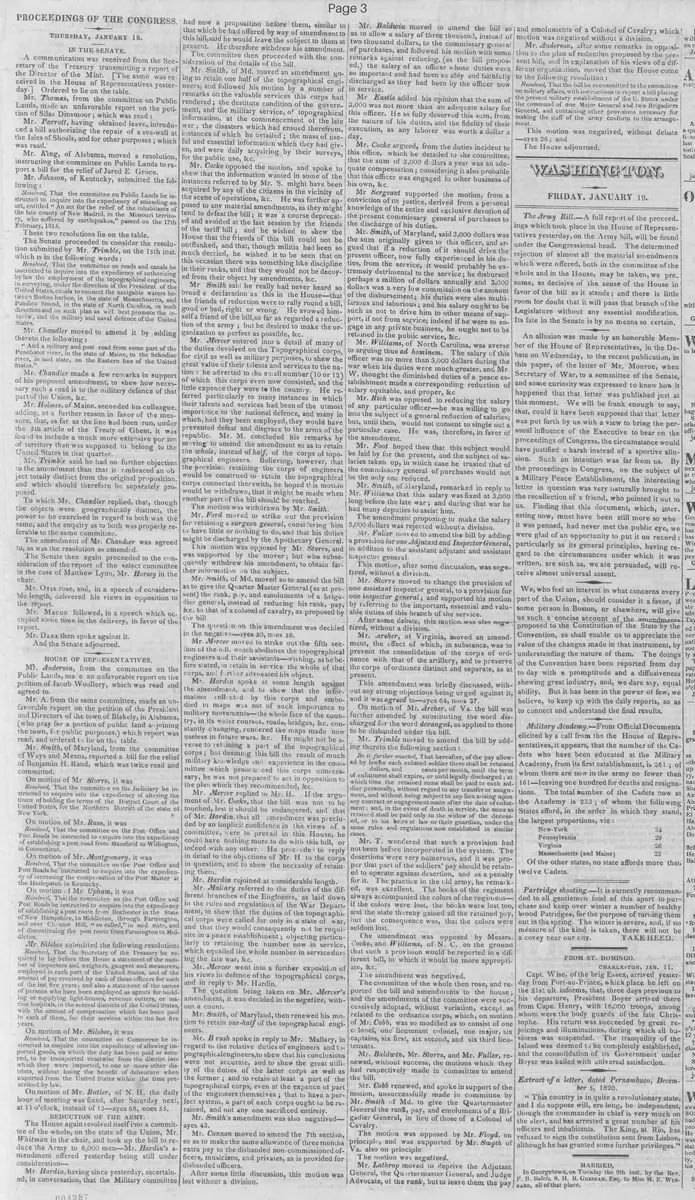
THURSDAY, JANUARY 18.
IN THE SENATE.
A communication was received from the Secretary of the Treasury transmitting a report of the Director of the Mint. [The same was received in the House of Representatives yesterday.] Ordered to lie on the table.
Mr. Thomas, from the committee on Public Lands, made an unfavorable report on the petition of Silas Dinsmoor; which was read.
Mr. Parrott, having obtained leave, introduced a bill authorizing the repair of a sea-wall at the Isles of Shoals, and for other purposes; which was read.
Mr. King, of Alabama, moved a resolution, instructing the committee on Public Lands to report a bill for the relief of Jared E. Groce.
Mr. Johnson, of Kentucky, submitted the following:
Resolved, That the committee on Public Lands be instructed to inquire into the expediency of amending an act, entitled "An act for the relief of the inhabitants of the late county of New Madrid, in the Missouri territory, who suffered by earthquakes," passed on the 17th February, 1815.
These two resolutions lie on the table.
The Senate proceeded to consider the resolution submitted by Mr. Trimble, on the 15th inst., which is in the following words:
Resolved, That the committee on roads and canals be instructed to inquire into the expediency of authorizing by law the employment of the topographical engineers in surveying, under the direction of the President of the United States, canals to connect the navigable waters between Boston harbor, in the state of Massachusetts, and Pamlico Sound, in the state of North Carolina, in such direction and on such plan as will best promote the interests, and the military and naval defence of the United States.
Mr. Chandler moved to amend it by adding thereto the following:
"And a military and post road from some part of the Penobscot river, in the state of Maine, to the Schodiac river, in said state, on the Eastern line of the United States."
Mr. Chandler made a few remarks in support of his proposed amendment, to shew how necessary such a road is to the military defence of that part of the Union, &c.
Mr. Holmes, of Maine, seconded his colleague, adding, as a further reason in favor of the measure, that, as far as the line had been run, under the 5th article of the Treaty of Ghent, it was found to include a much more extensive portion of territory than was supposed to belong to the United States in that quarter.
Mr. Trimble said he had no further objection to the amendment than that it embraced an object totally distinct from the original proposition, and which should therefore be separately proposed.
To which Mr. Chandler replied, that, though the objects were geographically distinct, the power to be exercised in regard to both was the same, and the enquiry as to both was properly referable to the same committee.
The amendment of Mr. Chandler was agreed to, as was the resolution as amended.
The Senate then again proceeded to the consideration of the report of the select committee in the case of Matthew Lyon, Mr. Horsey in the chair.
Mr. Otis rose, and, in a speech of considerable length, delivered his views in opposition to the report.
Mr. Macon followed, in a speech which occupied some time in the delivery, in favor of the report.
Mr. Dana then spoke against it.
And the Senate adjourned.
HOUSE OF REPRESENTATIVES.
Mr. Anderson, from the committee on the Public Lands, made an unfavorable report on the petition of Jacob Woolerry, which was read and agreed to.
Mr. A., from the same committee, made an unfavorable report on the petition of the President and Directors of the town of Blakely, in Alabama, (who pray for a portion of public land adjoining the town, for public purposes,) which report was read, and ordered to lie on the table.
Mr. Smith, of Maryland, from the committee of Ways and Means, reported a bill for the relief of Benjamin H. Rand, which was twice read and committed.
On motion of Mr. Storrs, it was
Resolved, That the committee on the Judiciary be instructed to enquire into the expediency of altering the times of holding the terms of the District Court of the United States, for the Northern District of the state of New York.
On motion of Mr. Russ, it was
Resolved, That the committee on the Post Office and Post Roads be instructed to enquire into the expediency of establishing a post road from Mansfield to Willington, in Connecticut.
On motion of Mr. Montgomery, it was
Resolved, That the committee on the Post Office and Post Roads be instructed to enquire into the expediency of increasing the compensation of the Post Master at the Hazlepatch in Kentucky.
On motion of Mr. Upham, it was
Resolved, That the committee on the Post Office and Post Roads be instructed to enquire into the expediency of establishing a post route from Rochester in the State of New Hampshire, to Middleton, through Farmington, and over Chestnut Hill, "so called," in said state, and of discontinuing the post route from Farmington to Middleton.
Mr. Silsbee submitted the following resolution:
Resolved, That the Secretary of the Treasury be required to lay before this House a statement of the number of inspectors and weighers, gaugers and measurers, employed in each port of the United States, and of the amount of pay received by each of those officers for each of the last five years; and also a statement of the names of persons who have been employed as agents for building or supplying light-houses, revenue cutters, or marine hospitals, in the several districts of the United States, with the amount of compensation which has been paid to each of them, for their services within the last five years.
On motion of Mr. Silsbee, it was
Resolved, That the committee on Commerce be instructed to enquire into the expediency of allowing imported goods, on which the duty has been paid or secured, to be transported coastwise from the district into which they were imported, to one or more other districts, without losing the benefit of debenture when exported from the United States within the time prescribed by law.
On motion of Mr. Butler, of N. H. the daily hour of meeting was fixed, after Saturday next, at 11 o'clock instead of 12—ayes 68, noes 55.
REDUCTION OF THE ARMY.
The House again resolved itself into a committee of the whole, on the state of the Union, Mr. Whitman in the chair, and took up the bill to reduce the Army to 6,000 men—Mr. Hardin's amendment offered yesterday being still under consideration—
Mr. Hardin, having since yesterday, ascertained, in conversation, that the Military committee had now a proposition before them, similar to that which he had offered by way of amendment to this bill, said he would leave the subject to them at present. He therefore withdrew his amendment.
The committee then proceeded with the consideration of the details of the bill.
Mr. Smith, of Md. moved an amendment going to retain one half of the topographical engineers, and followed his motion by a number of remarks on the valuable services this corps had rendered; the destitute condition of the government, and the military service, of topographical information, at the commencement of the late war; the disasters which had ensued therefrom, instances of which he detailed: the mass of useful and essential information which they had given, and were daily acquiring by their surveys, for the public use, &c.
Mr. Cocke opposed the motion, and spoke to shew that the information wanted in some of the instances referred to by Mr. S. might have been acquired by any of the citizens in the vicinity of the scene of operations, &c. He was further opposed to any material amendments, as they might tend to defeat the bill; it was a course deprecated and avoided at the last session by the friends of the tariff bill; and he wished to shew the House that the friends of this bill could not be outflanked, and that, though militia had been so much decried, he wished it to be seen that on this occasion there was something like discipline in their ranks, and that they would not be decoyed from their object by amendments, &c.
Mr. Smith said he really had never heard so broad a declaration as this in the House—that the friends of reduction were to rally round a bill, good or bad, right or wrong. He avowed himself a friend of the bill, so far as regarded a reduction of the army; but he desired to make the organization as perfect as possible, &c.
Mr. Mercer entered into a detail of many of the duties devolved on the Topographical corps, for civil as well as military purposes, to shew the great value of their talents and services to the nation: he adverted to the small number (10 or 12) of which this corps even now consisted, and the little expence they were to the country. He referred particularly to many instances in which their talents and services had been of the utmost importance to the national defence, and many in which, had they been employed, they would have prevented defeat and disgrace to the arms of the republic. Mr. M. concluded his remarks by moving to amend the amendment so as to retain the whole, instead of half, of the corps of topographical engineers. Believing, however, that the provision retaining the corps of engineers would be construed to retain the topographical corps connected therewith, he hoped this motion would be withdrawn, that it might be made when another part of the bill should be reached.
The motion was withdrawn by Mr. Smith.
Mr. Ford moved to strike out the provision for retaining a surgeon general, considering him to have little or nothing to do, and that his duties might be discharged by the Apothecary General.
This motion was opposed by Mr. Storrs, and was supported by the mover; but who subsequently withdrew his amendment, to obtain further information on the subject.
Mr. Smith, of Md. moved so to amend the bill as to give the Quarter Master General (as at present) the rank, pay, and emoluments of a brigadier general, instead of reducing his rank, pay, &c. to that of a colonel of cavalry, as proposed by the bill.
The question on this amendment was decided in the negative—ayes 50, noes 58.
Mr. Mercer moved to strike out the fifth section of the bill, which abolishes the topographical engineers and their assistants—wishing, as he before stated, to retain in service the whole of that corps, and further advocated his object.
Mr. Hardin spoke at some length against the amendment, and to shew that the information collected by this corps and embodied in maps was not of such importance to military movements—the whole face of the country, in its water courses, roads, bridges, &c. constantly changing, rendered the maps made now useless in future wars, &c. He might not be averse to retaining a part of the topographical corps; but deeming this bill the result of much military knowledge and experience in the committee which pronounced this corps unnecessary, he was not prepared to act in opposition to the plan which they recommended, &c.
Mr. Mercer replied to Mr. H. If the argument of Mr. Cocke, that the bill was not to be touched, lest it should be endangered, and that of Mr. Hardin, that all amendment was precluded by an implicit confidence in the views of a committee, were to prevail in this House, he could have nothing more to do with this bill, or indeed with any other. He proceeded to reply in detail to the objections of Mr. H. to the corps in question, and to shew the necessity of retaining them.
Mr. Hardin rejoined at considerable length.
Mr. Mallary referred to the duties of the different branches of the Engineers, as laid down in the rules and regulations of the War Department, to shew that the duties of the topographical corps were called for only in a state of war, and that they would consequently not be requisite in a peace establishment; objecting particularly to retaining the number now in service, which equalled the whole number in service during the late war, &c.
Mr. Mercer went into a further exposition of his views in defence of the topographical corps, and in reply to Mr. Hardin.
The question being taken on Mr. Mercer's amendment, it was decided in the negative, without a count.
Mr. Smith, of Maryland, then renewed his motion to retain one-half of the topographical engineers.
Mr. Brush spoke in reply to Mr. Mallary, in regard to the relative duties of engineers and topographical engineers, to shew that his conclusions were not accurate, and to shew the great utility of the duties of the latter corps as well as the former; and to retain at least a part of the topographical corps, even at the expence of part of the engineers themselves; that to have a perfect system, a part of each corps ought to be retained, and not any one sacrificed entirely.
Mr. Smith's amendment was also negatived—ayes 43.
Mr. Cannon moved to amend the 7th section, so as to make the same allowance of three months extra pay to the disbanded non-commissioned officers, musicians, and privates, as is provided for disbanded officers.
After some little discussion, this motion was lost without a division.
Mr. Baldwin moved to amend the bill so as to allow a salary of three thousand, instead of two thousand dollars, to the commissary general of purchases, and followed his motion with some remarks against reducing, (as the bill proposed,) the salary of an officer whose duties were so important and had been so ably and faithfully discharged as they had been by the officer now in service.
Mr. Eustis added his opinion that the sum of 3,000 was not more than an adequate salary for this officer. He as fully deserved this sum, from the nature of his duties, and the fidelity of their execution, as any laborer was worth a dollar a day.
Mr. Cocke argued, from the duties incident to this office, which he detailed to the committee, that the sum of 2,000 dollars a year was an adequate compensation; considering it also probable that this officer was engaged in other business of his own, &c.
Mr. Sergeant supported the motion, from a conviction of its justice, derived from a personal knowledge of the entire and exclusive devotion of the present commissary general of purchases to the discharge of his duties.
Mr. Smith, of Maryland, said 3,000 dollars was the sum originally given to this officer, and argued that if a reduction of it should drive the present officer, now fully experienced in his duties, from the service, it would probably be extremely detrimental to the service; he disbursed perhaps a million of dollars annually and 3,000 dollars was a very low commission on the amount of the disbursement: his duties were also multifarious and laborious; and his salary ought to be such as not to drive him to other means of support, if not from service; indeed if he were to engage in any private business, he ought not to be retained in the public service, &c.
Mr. Williams, of North Carolina, was averse to arguing thus ad hominem. The salary of this officer was no more than 3,000 dollars during the war when his duties were much greater, and Mr. W. thought the diminished duties of a peace establishment made a corresponding reduction of salary equitable, and proper, &c.
Mr. Rich was opposed to reducing the salary of any particular officer—he was willing to go into the subject of a general reduction of salaries; but, until then, would not consent to single out a particular case. He was, therefore, in favor of the amendment.
Mr. Foot hoped then that this subject would be laid by for the present, and the subject of salaries taken up, in which case he trusted that of the commissary general of purchases would not be the only one reduced.
Mr. Smith, of Maryland, remarked in reply to Mr. Williams that this salary was fixed at 3,000 long before the late war; and during that war he had many deputies to assist him.
The amendment proposing to make the salary 3,000 dollars was rejected without a division.
Mr. Fuller moved to amend the bill by adding a provision for one Adjutant and Inspector General, in addition to the assistant adjutant and assistant inspector general.
This motion, after some discussion, was negatived, without a division.
Mr. Storrs moved to change the provision of one assistant inspector general, to a provision for one inspector general; and supported his motion by referring to the important, essential and valuable duties of this branch of the service.
After some debate, this motion was also negatived, without a division.
Mr. Archer, of Virginia, moved an amendment, the effect of which, in substance, was to prevent the consolidation of the corps of ordnance with that of the artillery, and to preserve the corps of ordnance distinct and separate, as at present.
This amendment was briefly discussed, without any strong objections being urged against it, and it was agreed to—ayes 64, noes 37.
On motion of Mr. Archer, of Va. the bill was further amended by substituting the word discharged for the word deranged, as applied to those to be disbanded under the bill.
Mr. Trimble moved to amend the bill by adding thereto the following section:
Be it further enacted, That hereafter, of the pay allowed by law to each enlisted soldier there shall be retained dollars, and cents per month, until the term of enlistment shall expire, or until legally discharged; at which time the retained sums shall be paid to each soldier personally, without regard to any transfer or assignment, and without being subject to any lien arising upon any contract or engagement made after the date of enlistment: and, in the event of death in service, the sums so retained shall be paid only to the widow of the deceased, or to his heirs at law or their guardian, under the same rules and regulations now established in similar cases.
Mr. T. wondered that such a provision had not been before incorporated in the system. The desertions were very numerous, and it was proper that part of the soldiers' pay should be retained to operate against desertion, and as a penalty for it. The practice in the old army, he remarked, was excellent. The books of the regiment always accompanied the colors of the regiment—if the colors were lost, the books were lost too, and the state thereby gained all the retained pay, but the consequence was, that the colors were seldom lost.
The amendment was opposed by Messrs. Cocke, and Williams, of N. C. on the ground that such a provision would be reported in a different bill, in which it would be more appropriate, &c.
The amendment was negatived.
The committee of the whole then rose, and reported the bill and amendments to the house; and the amendments of the committee were successively adopted, without variation, except as related to the ordnance corps, which, on motion of Mr. Cobb, was so modified as to consist of one colonel, one lieutenant colonel, one major, six captains, six first, six second, and six third lieutenants.
Mr. Baldwin, Mr. Storrs, and Mr. Fuller, renewed, without success, the motions which they had respectively made in committee to amend the bill.
Mr. Cobb renewed, and spoke in support of the motion, unsuccessfully made in committee by Mr. Smith of Md. to give the Quartermaster General the rank, pay, and emoluments of a Brigadier General, in lieu of those of a Colonel of Cavalry.
The motion was opposed by Mr. Floyd, on principle, and was supported by Mr. Smyth of Va. also on principle.
The motion was negatived.
Mr. Lathrop moved to deprive the Adjutant General, the Quartermaster General, and Judge Advocate, of the rank, but to leave them the pay and emoluments of a Colonel of Cavalry; which motion was negatived without a division.
Mr. Anderson, after some remarks in opposition to the plan of reduction proposed by the present bill, and in explanation of his views of a different organization, moved that the House come to the following resolution:
Resolved, That the bill be recommitted to the committee on military affairs, with instructions to report a bill placing the present military establishment of the U. States under the command of one Major General and two Brigadier Generals, and containing other provisions necessary for making the staff of the army conform to this arrangement.
This motion was negatived, without debate—ayes 26;
and
The House adjourned.
What sub-type of article is it?
What keywords are associated?
What entities or persons were involved?
Where did it happen?
Story Details
Key Persons
Location
United States Congress
Event Date
Thursday, January 18
Story Details
The Senate received reports and petitions on public lands, introduced bills and resolutions for relief, repairs, and inquiries into amendments and infrastructure like canals and roads; debated a report on Matthew Lyon. The House handled unfavorable reports on petitions, introduced relief bills and resolutions for courts, post roads, compensation, and commerce; extensively debated and amended a bill to reduce the army to 6,000 men, focusing on retaining topographical engineers, salaries, and organizational structure, with most amendments rejected.