Thank you for visiting SNEWPapers!
Sign up free
Atlanta Daily World
Atlanta, Fulton County, Georgia
What is this article about?
U.S. Supreme Court rulings in May ban segregation in public schools, housing, and government-supported amusement venues, prompting integration actions by some boards but opposition from Southern states like Georgia and Mississippi.
Merged-components note: Merged page 1 story about Supreme Court decisions with its continuation on page 5.
Clippings
1 of 2
OCR Quality
Full Text
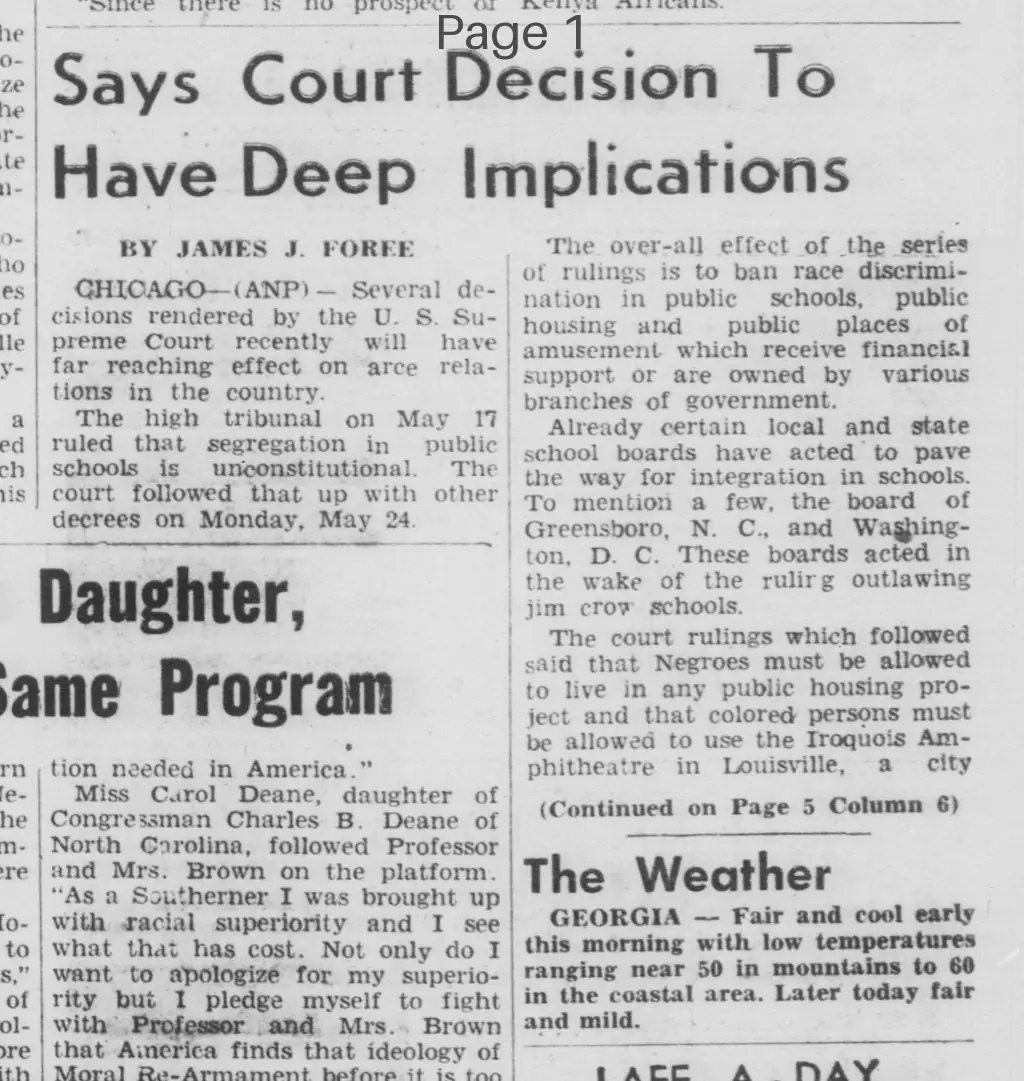
CHICAGO-(ANP)- Several decisions rendered by the U. S. Supreme Court recently will have far reaching effect on race relations in the country.
The high tribunal on May 17 ruled that segregation in public schools is unconstitutional. The court followed that up with other decrees on Monday, May 24.
The over-all effect of the series of rulings is to ban race discrimination in public schools, public housing and public places of amusement which receive financial support or are owned by various branches of government.
Already certain local and state school boards have acted to pave the way for integration in schools.
To mention a few, the board of Greensboro, N. C., and Washington, D. C. These boards acted in the wake of the ruling outlawing jim crow schools.
The court rulings which followed said that Negroes must be allowed to live in any public housing project and that colored persons must be allowed to use the Iroquois Amphitheatre in Louisville, a city
(Continued on Page 5 Column 6)
The Weather
GEORGIA -- Fair and cool early this morning with low temperatures ranging near 50 in mountains to 60 in the coastal area. Later today fair and mild.
Says Court
(Continued From Page One)
...owned theatre.
In other rulings, the court returned two school cases to lower courts with the advice that the courts reconsider the cases in light of the recent high court decision outlawing segregation in schools.
Probably the most important of the rulings is that on school segregation. It will mean that in the next few years separate schools will be a thing of the past.
The transition is expected to experience opposition from die-hards in some areas. Also expected to oppose the change are Negro teachers who fear loss of jobs.
Some state officials of Georgia and Mississippi have asserted that the Supreme Court ruling on schools will be ignored.
"We're not going to secede from the Union," Gov. Herman Talmadge of Georgia said. "But the people of Georgia will not comply with the decision of the court.
"It would take several divisions of troops down here to police every school building in Georgia and then they wouldn't be able to enforce it."
What sub-type of article is it?
What themes does it cover?
What keywords are associated?
What entities or persons were involved?
Where did it happen?
Story Details
Key Persons
Location
United States
Event Date
May 17 And May 24
Story Details
U.S. Supreme Court rules segregation in public schools unconstitutional on May 17, followed by decisions banning race discrimination in public housing and government-supported amusement places on May 24; some school boards begin integration while Southern officials vow non-compliance.