Thank you for visiting SNEWPapers!
Sign up free
The Daily Advertiser
New York, New York County, New York
What is this article about?
Americanus counters Cato's critiques of the proposed US Constitution, arguing that diverse state interests demand a strong federal government for reconciliation and security; highlights the Constitution's safeguards for liberty compared to Britain's more absolutist monarchy, and rejects fears of presidential power leading to tyranny.
Clipping
OCR Quality
Full Text
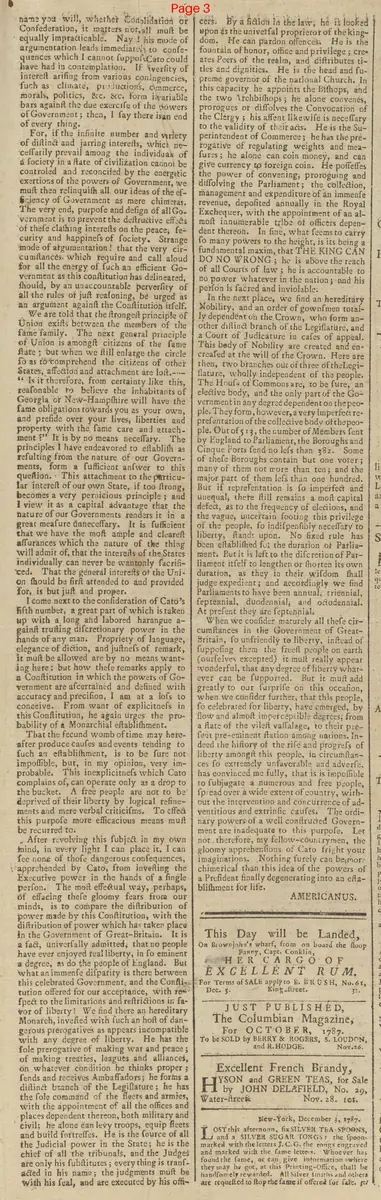
For, if the infinite number and variety of distinct and jarring interests, which necessarily prevail among the individuals of a society in a state of civilization cannot be controlled and reconciled by the energetic exertions of the powers of Government, we must then relinquish all our ideas of the efficiency of Government as mere chimeras.
The very end, purpose and design of all Government is to prevent the destructive effects of these clashing interests on the peace, security and happiness of society. Strange mode of argumentation! that the very circumstances, which require and call aloud for all the energy of such an efficient Government as this constitution has delineated, should, by an unaccountable perversity of all the rules of just reasoning, be urged as an argument against the Constitution itself.
We are told that the strongest principle of Union exists between the members of the same family. The next general principle of Union is amongst citizens of the same state: but when we still enlarge the circle so as to comprehend the citizens of other States, affection and attachment are lost.--- Is it therefore from certainty like this, reasonable to believe the inhabitants of Georgia or New-Hampshire will have the same obligations towards you as your own, and preside over your lives, liberties and property with the same care and attachment? It is by no means necessary. The principles I have endeavored to establish as resulting from the nature of our Governments, form a sufficient answer to this question. This attachment to the particular interest of our own State, if too strong, becomes a very pernicious principle; and I view it as a capital advantage that the nature of our Governments renders it in a great measure unnecessary. It is sufficient that we have the most ample and clearest assurances which the nature of the thing will admit of, that the interests of the States individually can never be wantonly sacrificed. That the general interests of the Union should be first attended to and provided for, is but just and proper.
I come next to the consideration of Cato's fifth number, a great part of which is taken up with a long and labored harangue against trusting discretionary power in the hands of any man. Propriety of language, elegance of diction, and justness of remark, it must be allowed are by no means wanting here: but how these remarks apply to a Constitution in which the powers of Government are ascertained and defined with accuracy and precision, I am at a loss to conceive. From want of explicitness in this Constitution, he again urges the probability of a Monarchical establishment. That the fecund womb of time may hereafter produce causes and events tending to such an establishment, is to be sure not impossible, but, in my opinion, very improbable. This inexplicitness which Cato complains of, can operate only as a drop to the bucket. A free people are not to be deprived of their liberty by logical refinements and mere verbal criticisms. To effect this purpose more efficacious means must be recurred to:
After revolving this subject in my own mind, in every light I can place it, I can see none of those dangerous consequences, apprehended by Cato, from investing the Executive power in the hands of a single person. The most effectual way, perhaps, of effacing these gloomy fears from our minds, is to compare the distribution of power made by this Constitution, with the distribution of power which has taken place in the Government of Great-Britain. It is a fact, universally admitted; that no people have ever enjoyed real liberty, in so eminent a degree, as do the people of England. But what an immense disparity is there between this celebrated Government, and the Constitution offered for our acceptance, with respect to the limitations and restrictions in favor of liberty! We find there an hereditary Monarch, invested with such an host of dangerous prerogatives as appears incompatible with any degree of liberty. He has the sole prerogative of making war and peace; of making treaties, leagues and alliances, on whatever condition he thinks proper; sends and receives Ambassadors; he forms a distinct branch of the Legislature; he has the sole command of the fleets and armies, with the appointment of all the offices and places dependent thereon, both military and civil; he alone can levy troops, equip fleets and build fortresses. He is the source of all the Judicial power in the State; he is the chief of all the tribunals, and the Judges are only his substitutes; every thing is transacted in his name; the judgments must be with his seal, and are executed by his officers. By a fiction in the law: he is looked upon as the universal proprietor of the kingdom. He can pardon offences. He is the fountain of honor, office and privilege; creates Peers of the realm. and distributes titles and dignities. He is the head and supreme governor of the national Church. In this capacity he appoints the Bishops, and the two Archbishops; he alone convenes, prorogues or dissolves the Convocation of the Clergy ; his assent likewise is necessary to the validity of their acts. He is the Superintendent of Commerce; he has the prerogative of regulating weights and measures; he alone can coin money, and can give currency to foreign coin. He possesses the power of convening, proroguing and dissolving the Parliament; the collection, management and expenditure of an immense revenue, deposited annually in the Royal Exchequer, with the appointment of an almost innumerable tribe of officers dependent thereon. In fine, what seems to carry so many powers to the height, is its being a fundamental maxim, that THE KING CAN DO NO WRONG; he is above the reach of all Courts of law ; he is accountable to no power whatever in the nation; and his person is sacred and inviolable:
In the next place, we find an hereditary Nobility, and an order of commoners totally dependent on the Crown, who form another distinct branch of the Legislature, and a Court of Judicature in cases of appeal. This body of Nobility are created and encreased at the will of the Crown. Here are then, two branches out of three of the Legislature, wholly independent of the people. The House of Commons are, to be sure, an elective body, and the only part of the Government in any degree dependent on the people. They form, however, a very imperfect representation of the collective body of the people. Out of 513, the number of Members sent by England to Parliament, the Boroughs and Cinque Ports send no less than 308. Some of these Boroughs contain but one voter; many of them not more than ten; and the major part of them less than one hundred. But if representation is so imperfect and unequal, there still remains a most capital defect, as to the frequency of elections, and the vague, uncertain footing this privilege of the people, so indispensably necessary to liberty, stands upon. No fixed rule has been established for the duration of Parliament. But it is left to the discretion of Parliament itself to lengthen or shorten its own duration, as they in their wisdom shall judge expedient; and accordingly we find Parliaments to have been annual, triennial, septennial, duodenial, and octodenial. At present they are septennial.
When we consider maturely all these circumstances in the Government of Great-Britain, so unfriendly to liberty, instead of supposing them the freest people on earth (ourselves excepted) it must really appear wonderful, that any degree of liberty whatever can be supported. But it must add greatly to our surprise on this occasion, when we consider further, that this people, so celebrated for liberty, have emerged, by slow and almost imperceptible degrees; from a state of the vilest vassalage, to their present pre-eminent station among nations. Indeed the history of the rise and progress of liberty amongst this people, in circumstances so extremely unfavorable and adverse, has convinced me fully, that it is impossible to subjugate a numerous and free people, spread over a wide extent of country, without the intervention and concurrence of adventitious and extrinsic causes. The ordinary powers of a well constructed Government are inadequate to this purpose. Let not, therefore, my fellow-countrymen, the gloomy apprehensions of Cato fright your imaginations. Nothing surely can be more chimerical than this idea of the powers of a President finally degenerating into an establishment for life.
AMERICANUS.
What sub-type of article is it?
What themes does it cover?
What keywords are associated?
What entities or persons were involved?
Letter to Editor Details
Author
Americanus.
Main Argument
defends the us constitution against cato's arguments by asserting that diverse interests among states and individuals require an energetic federal government to reconcile them and protect liberty; compares the constitution favorably to the british system, which has greater risks to liberty despite its monarchy, and dismisses fears of the executive evolving into a lifelong or monarchical power.
Notable Details