Thank you for visiting SNEWPapers!
Sign up free
Story
July 26, 1868
The Daily Phoenix
Columbia, Richland County, South Carolina
What is this article about?
An editorial critiques the misuse of 'rebel' and 'rebel sympathizer' by radicals to label political opponents in post-Civil War America, arguing it insults the majority and equates non-radicalism with treason, as noted by the Baltimore Sun.
Clipping
OCR Quality
98%
Excellent
Full Text
False Names.
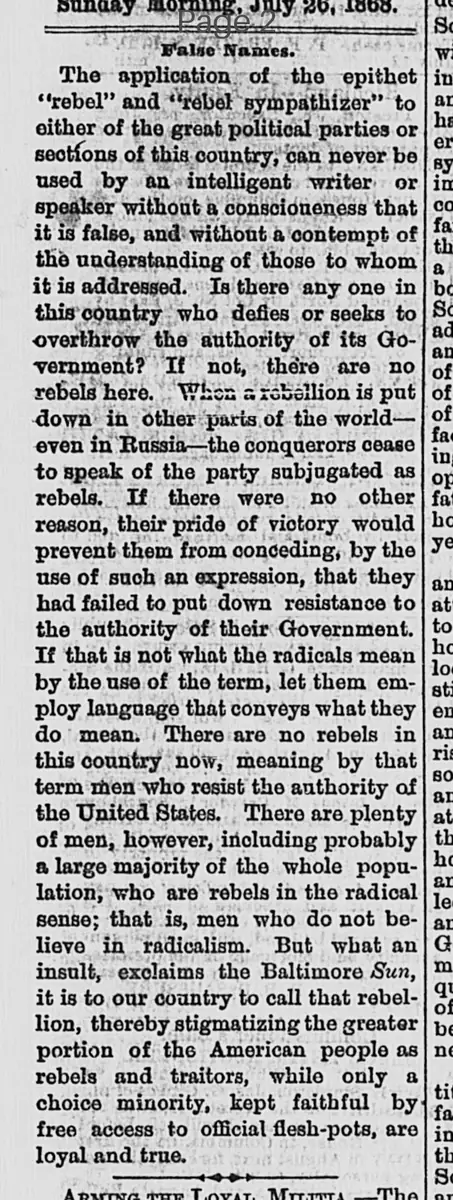
The application of the epithet "rebel" and "rebel sympathizer" to either of the great political parties or sections of this country, can never be used by an intelligent writer or speaker without a consciousness that it is false, and without a contempt of the understanding of those to whom it is addressed. Is there any one in this country who defies or seeks to overthrow the authority of its Government? If not, there are no rebels here. When a rebellion is put down in other parts of the world-- even in Russia --the conquerors cease to speak of the party subjugated as rebels. If there were no other reason, their pride of victory would prevent them from conceding, by the use of such an expression, that they had failed to put down resistance to the authority of their Government. If that is not what the radicals mean by the use of the term, let them employ language that conveys what they do mean. There are no rebels in this country now, meaning by that term men who resist the authority of the United States. There are plenty of men, however, including probably a large majority of the whole population, who are rebels in the radical sense; that is, men who do not believe in radicalism. But what an insult, exclaims the Baltimore Sun, it is to our country to call that rebellion, thereby stigmatizing the greater portion of the American people as rebels and traitors, while only a choice minority, kept faithful by free access to official flesh-pots, are loyal and true.
The application of the epithet "rebel" and "rebel sympathizer" to either of the great political parties or sections of this country, can never be used by an intelligent writer or speaker without a consciousness that it is false, and without a contempt of the understanding of those to whom it is addressed. Is there any one in this country who defies or seeks to overthrow the authority of its Government? If not, there are no rebels here. When a rebellion is put down in other parts of the world-- even in Russia --the conquerors cease to speak of the party subjugated as rebels. If there were no other reason, their pride of victory would prevent them from conceding, by the use of such an expression, that they had failed to put down resistance to the authority of their Government. If that is not what the radicals mean by the use of the term, let them employ language that conveys what they do mean. There are no rebels in this country now, meaning by that term men who resist the authority of the United States. There are plenty of men, however, including probably a large majority of the whole population, who are rebels in the radical sense; that is, men who do not believe in radicalism. But what an insult, exclaims the Baltimore Sun, it is to our country to call that rebellion, thereby stigmatizing the greater portion of the American people as rebels and traitors, while only a choice minority, kept faithful by free access to official flesh-pots, are loyal and true.
What sub-type of article is it?
Editorial
Political Commentary
What keywords are associated?
False Names
Rebel Epithet
Radicalism
Political Insult
American Loyalty
Baltimore Sun
Where did it happen?
United States
Story Details
Location
United States
Story Details
Critiques the false application of 'rebel' to political opponents by radicals, arguing no true rebels remain after the Civil War, and such labeling insults the majority who oppose radicalism, per the Baltimore Sun.