Thank you for visiting SNEWPapers!
Sign up free
Alexandria Gazette & Daily Advertiser
Alexandria, Virginia
What is this article about?
Nassau report on March 29 recounts the execution of pirate Reynaldo Delville on the 20th, based on his confessions. Born in England, educated in America, he claimed ties to Mexican insurgents, assumed false commissions, and led plundering cruises in the West Indies, alarming locals and capturing vessels before his capture and hanging.
Clipping
OCR Quality
Full Text
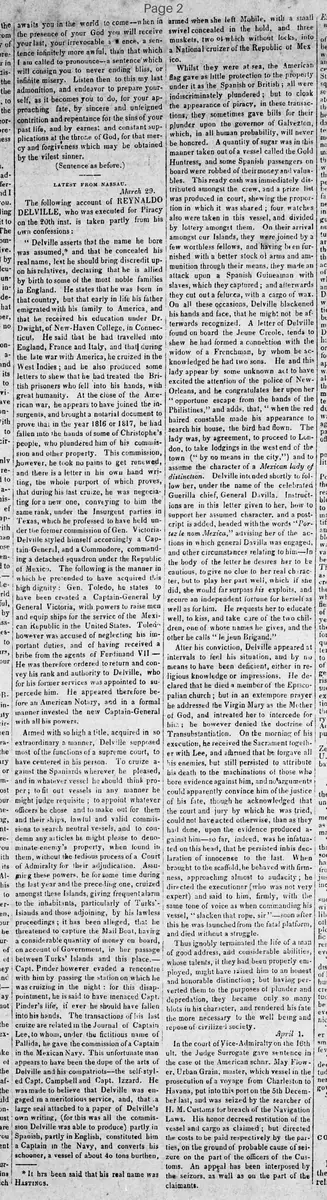
March 29.
The following account of REYNALDO DELVILLE, who was executed for Piracy on the 20th inst. is taken partly from his own confessions:
"Delville asserts that the name he bore was assumed,* and that he concealed his real name, lest he should bring discredit upon his relatives, declaring that he is allied by birth to some of the most noble families in England. He states that he was born in that country, but that early in life his father emigrated with his family to America, and that he received his education under Dr. Dwight, of New-Haven College, in Connecticut. He said that he had travelled into England, France and Italy, and that during the late war with America, he cruized in the West Indies; and he also produced some letters to shew that he had treated the British prisoners who fell into his hands, with great humanity. At the close of the American war, he appears to have joined the insurgents, and brought a notarial document to prove that in the year 1816 or 1817, he had fallen into the hands of some of Christophe's people, who plundered him of his commission and other property. This commission, however, he took no pains to get renewed, and there is a letter in his own hand writing, the whole purport of which proves, that during his last cruize, he was negotiating for a new one, conveying to him the same rank, under the Insurgent parties in Texas, which he professed to have held under the former commission of Gen. Victoria. Delville styled himself accordingly a Captain-General, and a Commodore, commanding a detached squadron under the Republic of Mexico. The following is the manner in which he pretended to have acquired this high dignity: Gen. Toledo, he states to have been created a Captain-General by General Victoria, with powers to raise men and equip ships for the service of the Mexican Republic in the United States. Toledo however was accused of neglecting his important duties, and of having received a bribe from the agents of Ferdinand VII-- He was therefore ordered to return and convey his rank and authority to Delville, who for his former services was appointed to supersede him. He appeared therefore before an American Notary, and in a formal manner invested the new Captain-General with all his powers. Armed with so high a title, acquired in so extraordinary a manner, Delville supposed most of the functions of a supreme court, to have centered in his person. To cruize against the Spaniards wherever he pleased, and in whatever vessel he should think proper; to fit out vessels in any manner he might judge requisite; to appoint whatever officers he chose and to make out for them and their ships, lawful and valid commissions to search neutral vessels, and to condemn any articles he might please to denominate enemy's property, when found in them, without the tedious process of a Court of Admiralty for their adjudication. Assuming these powers, he for some time during the last year and the preceding one, cruized amongst these Islands, giving frequent alarm to the inhabitants, particularly of Turks'-Islands and those adjoining, by his lawless proceedings; it has been alleged, that he threatened to capture the Mail Boat, having a considerable quantity of money on board, on account of Government, in her passage between Turks' Islands and this place.-- Capt. Pinder however evaded a rencontre with him by passing the station on which he was cruizing in the night: for this disappointment, he is said to have menaced Capt. Pinder's life, if ever he should have fallen into his hands. The transactions of his last cruize are related in the Journal of Captain Lee, to whom, under the fictitious name of Pallida, he gave the commission of a Captain in the Mexican Navy. This unfortunate man appears to have been the dupe of the arts of Delville and his compatriots--the self-styled Capt. Campbell and Capt. Izzard. He was made to believe that Delville was engaged in a meritorious service, and, that a large seal attached to a paper of Delville's own writing, (for this was all the commission Delville was able to produce) partly in Spanish, partly in English, constituted him a Captain in the Navy, and converts his schooner, a vessel of about 40 tons burthen, armed when she left Mobile, with a small swivel concealed in the hold, and three muskets, two of which without locks, into a National cruizer of the Republic of Mexico. Whilst they were at sea, the American flag gave as little protection to the property under it as the Spanish or British; all were indiscriminately plundered; but to cloak the appearance of piracy, in these transactions, they sometimes gave bills for their plunder upon the governor of Galveston, which, in all human probability, will never be honored. A quantity of sugar was in this manner taken out of a vessel called the Gold Huntress, and some Spanish passengers on board were robbed of their money and valuables. This ready cash was immediately distributed amongst the crew, and a prize list was produced in court, shewing the proportion in which it was shared; four watches also were taken in this vessel, and divided by lottery amongst them. On their arrival amongst our Islands, they were joined by a few worthless fellows, and having been furnished with a better stock of arms and ammunition through their means, they made an attack upon a Spanish Guineaman with slaves, which they captured; and afterwards they cut out a felucca, with a cargo of wax. On all these occasions, Delville blackened his hands and face, that he might not be afterwards recognized. A letter of Delville found on board the Jeune Creole, tends to shew he had formed a connection with the widow of a Frenchman, by whom he acknowledged he had two sons. He and this lady appear by some unknown act to have excited the attention of the police of New-Orleans, and he congratulates her upon her "opportune escape from the hands of the Philistines," and adds, that, "when the red haired constable made his appearance to search his house, the bird had flown. The lady was, by agreement, to proceed to London, to take lodgings in the west end of the town ("by no means in the city," ) and to assume the character of a Mexican lady of distinction. Delville intended shortly to follow her, under the name of the celebrated Guerilla chief, General Davilla. Instructions are in this letter given to her, how to support her assumed character, and a postscript is added, headed with the words "Portez le nom Mexicain," advising her of the actions in which general Davilla was engaged, and other circumstances relating to him--In the body of the letter he desires her to be cautious, to give no clue to her real character, but to play her part well, which if she did, she would far surpass his exploits, and secure an independent fortune for herself as well as for him. He requests her to educate well, to kiss, and take care of the two children, one of whose names he gives, and the other he calls "le jeune Brigand." After his conviction, Delville appeared at intervals to feel his situation, and by no means to have been deficient, either in religious knowledge or impressions. He declared that he died a member of the Episcopalian church; but in an extempore prayer he addressed the Virgin Mary as the Mother of God, and intreated her to intercede for him; he however denied the doctrine of Transubstantiation. On the morning of his execution, he received the Sacrament together with Lee, and affirmed that he forgave all his enemies, but still persisted to attribute his death to the machinations of those who bore evidence against him, and no arguments could apparently convince him of the justice of his fate, though he acknowledged that the court and jury by which he was tried, could not have acted otherwise, than as they had done, upon the evidence produced against him--so far, indeed, was he infatuated on this head, that he persisted in his declaration of innocence to the last. When brought to the scaffold, he behaved with firmness, approaching almost to audacity; he directed the executioner (who was not very expert) and said to him, firmly, with the same tone of voice as when commanding his vessel, "slacken that rope, sir" soon after this he was launched from the fatal platform, and died without a struggle. Thus ignobly terminated the life of a man of good address, and considerable abilities, whose talents, if they had been properly employed, might have raised him to an honest and honorable distinction; but having perverted them to the purposes of plunder and depredation, they became only so many blots in his character, and rendered his fate the more necessary to the well being and repose of civilized society.
* It has been said that his real name was HASTINGS.
What sub-type of article is it?
What keywords are associated?
What entities or persons were involved?
Where did it happen?
Foreign News Details
Primary Location
Nassau
Event Date
March 29
Key Persons
Outcome
execution of reynaldo delville by hanging on the 20th inst.; he died without struggle, maintaining innocence.
Event Details
Reynaldo Delville, executed for piracy, confessed to assuming a false name to protect his noble English relatives; born in England, educated in Connecticut, traveled Europe, cruised West Indies during war, treated prisoners humanely. Joined insurgents post-war, lost commission to Christophe's men in 1816-1817. Negotiated new commission under Texas insurgents, styling himself Captain-General and Commodore for Mexico. Claimed authority from Gen. Toledo, superseded for bribery. Assumed supreme powers to cruise against Spaniards, fit vessels, issue commissions. Cruised islands last two years, alarming inhabitants of Turks' Islands, threatened mail boat. Last cruise: commissioned Capt. Lee under false name; plundered vessels indiscriminately, issued fake bills on Galveston governor; captured Gold Huntress (sugar, watches, money), Spanish Guineaman with slaves, felucca with wax; disguised face. Connected to French widow in New Orleans, planned escape to London under aliases. Post-conviction, showed religious knowledge, received Sacrament with Lee, forgave enemies but blamed witnesses; behaved firmly on scaffold.