Thank you for visiting SNEWPapers!
Sign up free
The New Hampshire Gazette
Portsmouth, Rockingham County, New Hampshire
What is this article about?
Trial of Richard Lawrence for assaulting President Andrew Jackson with intent to kill, held in Washington on April 11, 1835. Lawrence, deemed insane by believing himself king, was acquitted on grounds of insanity after testimony of his derangement.
Merged-components note: Continuation of the report on the trial of Richard Lawrence for assault on the President.
Clipping
OCR Quality
Full Text
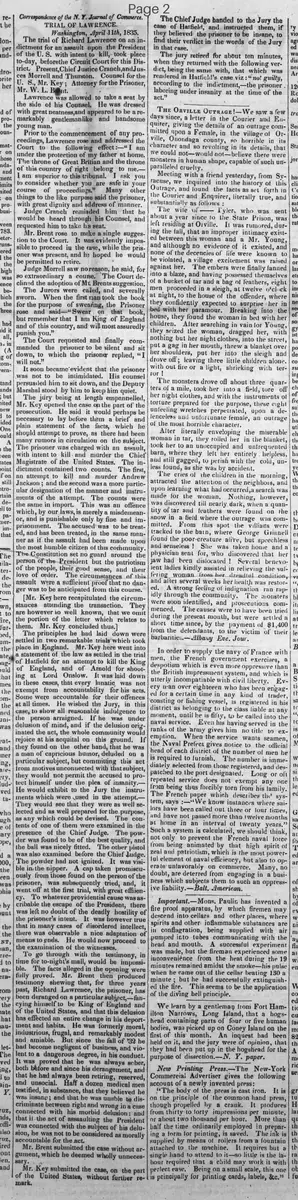
TRIAL OF LAWRENCE.
Washington, April 11th, 1835.
The trial of Richard Lawrence on an indictment for an assault upon the President of the U. S. with intent to kill, took place to-day, before the Circuit Court for this District. Present Chief Justice Cranch, and Justices Morrell and Thurston. Counsel for the U. S., Mr. Key; Attorney for the Prisoner, Mr. W. L. Brent.
Lawrence was allowed to take a seat by the side of his Counsel. He was dressed with great neatness, and appeared to be a remarkably gentlemanlike and handsome young man.
Prior to the commencement of any proceedings, Lawrence rose and addressed the Court to the following effect:—"I am under the protection of my father at home. The throne of Great Britain and the throne of this country of right belong to me.—I am superior to this tribunal. I ask you to consider whether you are safe in your course of proceedings." Many other things to the like purpose said the prisoner, with great dignity and address of manner.
Judge Cranch reminded him that he would be heard through his Counsel, and requested him to take his seat.
Mr. Brent rose to make a single suggestion to the Court. It was evidently impossible to proceed in the case, while the prisoner was present, and he hoped he would be permitted to retire.
Judge Morrell saw no reason, he said, for so extraordinary a course. The Court declined the adoption of Mr. Brent's suggestion.
The Jurors were called, and severally sworn. When the first man took the book for the purpose of swearing, the Prisoner rose and said—"Swear on that book, but remember that I am King of England and of this country, and will most assuredly punish you."
The Court requested and finally commanded the prisoner to be silent and sit down, to which the prisoner replied, "I will not."
It soon became evident that the prisoner was not to be intimidated. His counsel persuaded him to sit down, and the Deputy Marshal stood by him to keep him quiet.
The jury being at length empanelled.
Mr. Key opened the case on the part of the prosecution. He said it would perhaps be necessary to lay before them a brief and plain statement of the facts, which he should attempt to prove, as there had been many rumors in circulation on the subject.
The prisoner was charged with an assault, with intent to kill and murder the Chief Magistrate of the United States. The indictment contained two counts. The first, an attempt to kill and murder Andrew Jackson; and the second was a more particular designation of the manner and instruments of the attempt. The counts were the same in import. This was an offence which, by our laws, is merely a misdemeanor, and is punishable only by fine and imprisonment. The accused was to be treated, and has been treated, in the same manner as if the assault had been made upon the most humble citizen of this community.
The Constitution set no guard around the person of the President but the patriotism of the people, their good sense, and their love of order. The circumstances of this assault were a sufficient proof that no danger was to be anticipated from this course.
[Mr. Key here recapitulated the circumstances attending the transaction. They are however so well known, that we omit the portion of the letter which relates to them. Mr. Key concluded thus.]
The principles he had laid down were settled in two remarkable trials which took place in England. Mr. Key here went into a statement of the law as settled in the trial of Hatfield for an attempt to kill the King of England, and of Arnold for shooting at Lord Onslow. It was laid down in these cases, that every lunatic was not exempt from accountability for his acts. Some were accountable for their offences at all times. He wished the Jury, in this case, to show all reasonable indulgence to the person arraigned. If he was under delusion of mind, and if the delusion originated the act, the whole community would rejoice at his acquittal on this ground. If they found on the other hand, that he was a man of capricious humor, deluded on a particular subject, but committing this act from motives unconnected with that subject, they would not permit the accused to protect himself under the plea of insanity.—
He would exhibit to the Jury the instruments which were used in the attempt.—They would see that they were as well selected and as well prepared for the purpose, as any which could be devised. The contents of one of them were examined in the presence of the Chief Judge. The powder was found to be of the best quality, and the ball was nicely fitted. The other pistol was also examined before the Chief Judge. The powder had not ignited. It was visible in the nipple. A cap taken promiscuously from those found on the person of the prisoner, was subsequently tried, and it went off at the first trial, with great efficiency. To whatever providential cause was ascribable the escape of the President, there was left no doubt of the deadly hostility of the prisoner's intent. It was however true that in many cases of disordered intellect, there was observable a nice adaptation of means to ends. He would now proceed to the examination of the witnesses.
To go through with the testimony, in time for to-night's mail, would be impossible. The facts alleged in the opening were fully proved. Mr. Brent then produced testimony shewing that, for three years past, Richard Lawrence, the prisoner, has been deranged on a particular subject,—fancying himself to be King of England and of the United States, and that this delusion has effected an entire change in his deportment and habits. He was formerly moral, industrious, frugal, and remarkably modest and amiable. But since the fall of '32 he had become negligent of business, and violent to a dangerous degree, in his conduct. It was proved that he was always sober, both before and since his derangement, and that he had always been retiring, reserved, and unsocial. Half a dozen medical men testified, in substance, that they believed he was insane; and that he was unable to discriminate between right and wrong in a case connected with his morbid delusion: and that if the act of assaulting the President was connected with the subject of his delusion, he was not to be considered as morally accountable for the act.
Mr. Brent submitted the case without argument, which he deemed wholly unnecessary.
Mr. Key submitted the case, on the part of the United States, without further remark.
The Chief Judge handed to the Jury the case of Hatfield, and instructed them, if they believed the prisoner to be insane, to find their verdict in the words of the Jury in that case.
The jury retired for about ten minutes, when they returned with the following verdict, being the same with, that which was rendered in Hatfield's case viz: "not guilty, according to the indictment,—the prisoner laboring under insanity at the time of the act."
What sub-type of article is it?
What themes does it cover?
What keywords are associated?
What entities or persons were involved?
Where did it happen?
Story Details
Key Persons
Location
Washington, Circuit Court For The District
Event Date
April 11th, 1835
Story Details
Richard Lawrence, delusional in believing himself king of England and the US, was tried for assaulting President Jackson with intent to kill. Despite his disruptive behavior in court, testimony proved his long-term insanity connected to the act, leading to acquittal by jury after brief deliberation.