Thank you for visiting SNEWPapers!
Sign up free
The Willimantic Journal
Willimantic, Windham County, Connecticut
What is this article about?
Detailed description of the State Reform School in Meriden, including its facilities, farm operations under D. P. Chamberlain yielding strong 1873 crops, management by Dr. E. W. Hatch and S. B. Little since 1854, workshops producing cane seat chairs, and a recent visit by the State Board of Agriculture featuring chapel exercises, songs, and remarks by ex-Lieut. Gov. Hyde, T. S. Gold, Rev. W. Clift, Mr. Starr, and Mr. Loveland.
Clipping
OCR Quality
Full Text
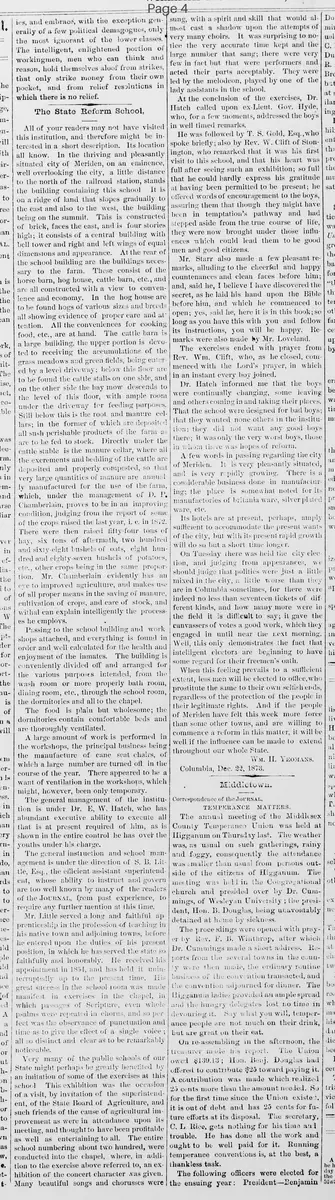
All of your readers may not have visited this institution, and therefore might be interested in a short description. Its location all know. In the thriving and pleasantly situated city of Meriden, on an eminence, well overlooking the city, a little distance to the north of the railroad station, stands the building containing this school. It is on a ridge of land that slopes gradually to the east and also to the west, the building being on the summit. This is constructed of brick, faces the east, and is four stories high; it consists of a central building with bell tower and right and left wings of equal dimensions and appearance. At the rear of the school building are the buildings necessary to the farm. These consist of the horse barn, hog house, cattle barn, etc., and are all constructed with a view to convenience and economy. In the hog house are to be found hogs of various sizes and breeds all showing evidence of proper care and attention. All the conveniences for cooking food, etc., are at hand. The cattle barn is a large building, the upper portion is devoted to receiving the accumulations of the grass meadows and green fields, being entered by a level driveway; below this floor are to be found the cattle stalls on one side, and on the other side the hay mow descends to the level of this floor, with ample room under the driveway for feeding purposes. Still below this is the root and manure cellars; in the former of which are deposited all such perishable products of the farm as are to be fed to stock. Directly under the cattle stable is the manure cellar, where all the excrements and bedding of the cattle are deposited and properly composted, so that very large quantities of manure are annually manufactured for the use of the farm, which, under the management of D. P. Chamberlain, proves to be in an improving condition, judging from the report of some of the crops raised the last year, i. e. in 1873. There were then raised fifty-four tons of hay, six tons of aftermath, two hundred and sixty-eight bushels of oats, eight hundred and eighty-seven bushels of potatoes, etc., other crops being in the same proportion. Mr. Chamberlain evidently has an eye to improved agriculture, and makes use of all proper means in the saving of manure, cultivation of crops, and care of stock, and withal can explain intelligently the processes he employs.
Passing to the school building and work shops attached, and everything is found in order and well calculated for the health and enjoyment of the inmates. The building is conveniently divided off and arranged for the various purposes intended, from the wash room or more properly bath room, dining room, etc., through the school room, the dormitories and all to the chapel. The food is plain but wholesome; the dormitories contain comfortable beds and are thoroughly ventilated. A large amount of work is performed in the workshops, the principal business being the manufacture of cane seat chairs, of which a large number are turned off in the course of the year. There appeared to be a want of ventilation in the workshops, which might, however, been only temporary. The general management of the institution is under Dr. E. W. Hatch, who has abundant executive ability to execute all that is at present required of him, as is shown in the entire control he has over the youths under his charge. The general instruction and school management is under the direction of S. B. Little, Esq., the efficient assistant superintendent, whose ability to instruct and govern are too well known by many of the readers of the JOURNAL, from past experience, to require any further mention at this time. Mr. Little served a long and faithful apprenticeship in the profession of teaching in his native town and adjoining towns, before he entered upon the duties of his present position, in which he has served the state so faithfully and honorably. He received his appointment in 1854, and has held it uninterruptedly up to the present time. His great success in the school room was made manifest in exercises in the chapel, in which passages of Scripture, even whole psalms were repeated in chorus, and so perfect was the observance of punctuation and time as to give the effect of a single voice; all so distinct and clear as to be remarkably noticeable. Very many of the public schools of our State might perhaps be greatly benefited by an imitation of some of the exercises at this school. This exhibition was the occasion of a visit, by invitation of the superintendent, of the State Board of Agriculture, and such friends of the cause of agricultural improvement as were in attendance upon its meeting, and thought to have been profitable as well as entertaining to all. The entire school numbering about two hundred, were conducted into the chapel, where, in addition to the exercise above referred to, an exhibition of the concert character was given. Many beautiful songs and choruses were sung, with a spirit and skill that would almost cast a shadow upon the attempts of very many choirs. It was surprising to notice the very accurate time kept and the large number that sang; there were very few in fact but that were performers and acted their parts acceptably. They were led by the melodeon, played by one of the lady assistants in the school. At the conclusion of the exercises, Dr. Hatch called upon ex-Lieut. Gov. Hyde, who, for a few moments, addressed the boys in well timed remarks. He was followed by T. S. Gold, Esq., who spoke briefly; also by Rev. W. Clift of Stonington, who remarked that it was his first visit to this school, and that his heart was full after seeing such an exhibition; so full that he could hardly express his gratitude at having been permitted to be present; he offered words of encouragement to the boys, assuring them that though they might have been in temptation's pathway and had stepped aside from the true course of life, they were now brought under those influences which could lead them to be good men and good citizens. Mr. Starr also made a few pleasant remarks, alluding to the cheerful and happy countenances and clean faces before him; and, said he, I believe I have discovered the secret, as he laid his hand upon the Bible before him, and which he commenced to open; yes, said he, here it is in this book; so long as you have this with you and follow its instructions, you will be happy. Remarks were also made by Mr. Loveland. The exercises ended with prayer from Rev. Wm. Clift, who, as he closed, commenced with the Lord's prayer, in which in an instant every boy joined. Dr. Hatch informed me that the boys were continually changing, some leaving and others coming in and taking their places. That the school were designed for bad boys; that they wanted none others in the institution; they did not want any good boys there; it was only the very worst boys, those in whom there was hopes of reform.
What sub-type of article is it?
What keywords are associated?
What entities or persons were involved?
Where did it happen?
Domestic News Details
Primary Location
Meriden
Key Persons
Outcome
school serves about 200 boys for reform; farm improving with 1873 crops including 54 tons hay, 887 bushels potatoes; positive visit with exercises and speeches encouraging reform.
Event Details
Description of State Reform School facilities, farm management, workshops producing cane seat chairs, and a visit by State Board of Agriculture featuring chapel recitations, songs, and addresses by dignitaries emphasizing moral and agricultural improvement.