Thank you for visiting SNEWPapers!
Sign up free
Literary
March 1, 1877
The Beaufort Tribune And Port Royal Commercial
Beaufort, Beaufort County, South Carolina
What is this article about?
Sara Prescott struggles to choose between suitors Ralph Curtis and Walter Crosbie, who propose a race to settle the matter. The competition turns deadly, resulting in both men's deaths from stabbing and shooting.
Clipping
OCR Quality
98%
Excellent
Full Text
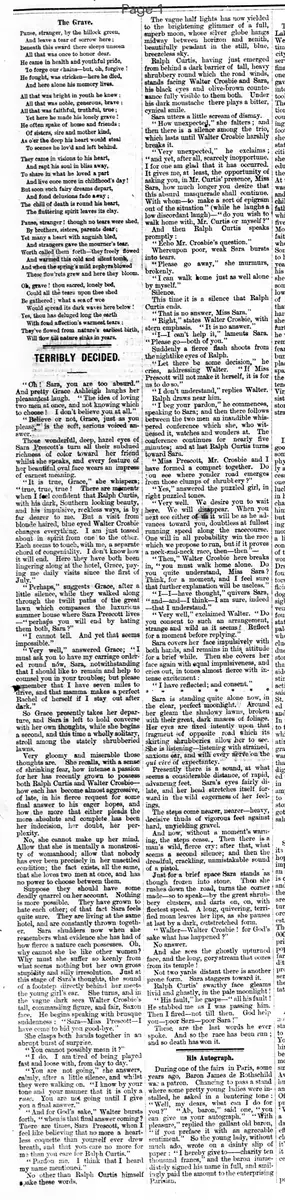
TERRIBLY DECIDED.
"Oh! Sara, you are too absurd."
And pretty Grace Ashleigh laughs her pleasantest laugh. "The idea of loving two men at once, and not knowing which to choose! I don't believe you at all."
"Believe or not, Grace, just as you please," is the soft, serious voiced answer.
Those wonderful, deep, hazel eyes of Sara Prescott's turn all their subdued richness of color toward her friend whilst she speaks, and every feature of her beautiful oval face wears an impress of earnest meaning.
"It is true, Grace," she whispers; "true, true, true! There are moments when I feel confident that Ralph Curtis, with his dark, Southern looking beauty, and his impulsive, reckless ways, is by far dearer to me. But a visit from blonde haired, blue eyed Walter Crosbie changes everything. I am just tossed about in spirit from one to the other. Each seems to touch, with me, a separate chord of congeniality. I don't know how it will end. Here they have both been lingering along at the hotel, Grace, paying me daily visits since the first of July."
"Perhaps," suggests Grace, after a little silence, while they walked along through the twilit paths of the great lawn which compasses the luxurious summer house where Sara Prescott lives—"perhaps you will end by hating them both, Sara?"
"I cannot tell. And yet that seems impossible."
"Very well," answered Grace; "I must ask you to have my carriage ordered round now, Sara, notwithstanding that I should like to remain and help to counsel you in your troubles: but please remember that I have seven miles to drive, and that mamma makes a perfect Rachel of herself if I stay out after dark."
So Grace presently takes her departure, and Sara is left to hold converse with her own thoughts, while she begins a second, and this time a wholly solitary, stroll among the stately shrubberied lawns.
Very gloomy and miserable those thoughts are. She recalls, with a sense of shrinking fear, how intense a passion for her has recently grown to possess both Ralph Curtis and Walter Crosbie—how each has become almost aggressive of late, in his fierce request for some final answer to his eager hopes, and how the more that either pleads the more absolute and complete has been her indecision, her doubt, her perplexity.
No, she cannot make up her mind. Allow that she is mentally a monstrosity of womanhood; allow that nobody has ever been precisely in her unsettled condition; the fact exists, all the same, that she loves two men at once, and has no power to choose between them.
Suppose they should have some deadly quarrel on her account. Nothing is more possible. They have grown to hate each other; of that fact Sara feels quite sure. They are living at the same hotel, and are constantly thrown together.
Sara shudders now when she remembers what evidence she has had of how fierce a nature each possesses. Oh, why cannot she be like other women? Why must she suffer so keenly from what seems nothing but her own gross stupidity and silly irresolution. Just at this stage of Sara's thoughts, the sound of a footstep directly behind her meets the young girl's ear. She turns, and in the vague dark sees Walter Crosbie's tall, commanding figure, and fair, Saxon face. He begins speaking with brusque suddenness: "Sara—Miss Prescott—I have come to bid you good-bye."
She clasps both hands together in an abrupt burst of surprise.
"You cannot possibly mean it?"
"I do. I am tired of being played fast and loose with, from day to day."
"You are not going," she answers calmly, after a little silence, and whilst they were walking on. "I know by your tone and your manner that it is only a ruse. You are not going until I give you a final answer."
"And for God's sake," Walter bursts forth, "when is that final answer coming? There are times, Sara Prescott, when I feel like believing that no more heartless coquette than yourself ever drew breath, and that you care no more for me than you care for Ralph Curtis."
"Pardon me. I think that I heard my name mentioned."
No other than Ralph Curtis himself spake these words.
The vague half lights has now yielded to the brightening glimmer of a full, superb moon, whose silver globe hangs midway between horizon and zenith, beautifully pendant in the still, blue, breezeless sky.
Ralph Curtis, having just emerged from behind a dark barrier of tall, heavy shrubbery round which the road winds, stands facing Walter Crosbie and Sara, his black eyes and olive-brown countenance fully visible to them both. Under his dark moustache there plays a bitter, cynical smile.
Sara utters a little scream of dismay.
"How unexpected," she falters: and then there is a silence among the trio, which lasts until Walter Crosbie harshly breaks it.
"Very unexpected," he exclaims; "and yet, after all, scarcely inopportune. I for one am glad that it has occurred. It gives me, at least, the opportunity of asking you, in Mr. Curtis' presence, Miss Sara, how much longer you desire that this absurd masquerade shall continue. With whom—to make a sort of epigram out of the situation" (while he laughs a low discordant laugh) "do you wish to walk home with, Mr. Curtis or myself?"
And then Ralph Curtis speaks promptly:
"Echo Mr. Crosbie's question."
Whereupon poor, weak Sara bursts into tears.
"Please go away," she murmurs, brokenly. "I can walk home just as well alone by myself."
Silence.
This time it is a silence that Ralph Curtis ends.
"That is no answer, Miss Sara."
"Right," states Walter Crosbie, with stern emphasis. "It is no answer."
"I can't help it," laments Sara. "Please go—both of you."
Suddenly a fierce flash shoots from the nightlike eyes of Ralph.
"Let there be some decision," he cries, addressing Walter. "If Miss Prescott will not make it herself, it is for us to do so."
"I don't understand," replies Walter.
Ralph draws near him,
"I beg your pardon," he commences, speaking to Sara; and then there follows between the two men an inaudible whispered conference which she, who witnessed it, watches and wonders at. The conference continues for nearly five minutes; and at last Ralph Curtis turns toward Sara.
"Miss Prescott, Mr. Crosbie and I have formed a compact together. Do you see where yonder road emerges from those clumps of shrubbery?"
"Yes," answered the puzzled girl, in right puzzled tones.
"Very well. We desire you to wait here. We will disappear. When you next see either of us it will be as he advances toward you, doubtless at fullest running speed along the racecourse. One will in all probability win the race which we propose to run, but if it proves a neck-and-neck race, then—then"
"Then," Walter Crosbie here breaks in, "you must walk home alone. Do you quite understand, Miss Sara? Think, for a moment, and I feel sure that further explanation will be useless."
"I—I—have thought," quivers Sara, "and—and—I think—I am sure, indeed that I understand."
"Very well," exclaimed Walter. "Do you consent to such an arrangement, strange and wild as it seems? Reflect for a moment before replying."
Sara covers her face impulsively with both hands, and remains in this attitude for a brief while. Then she uncovers her face again with equal impulsiveness, and cries out, in tones almost fierce with intense excitement:
"I have reflected: and consent."
Sara is standing quite alone now, in the clear, perfect moonlight. Around her gleam the shadowy lawns, broken with their great, dark masses of foliage.
Her eyes are fixed intently upon that fragment of opposite road which its skirting shrubberies allow her to see.
She is listening—listening with strained anxious ear, and with every nerve on the qui vive of expectancy.
Presently there is a sound, at what seems a considerable distance, of rapid advancing feet. Sara's eyes fairly dilate, and her head stretches itself forward in the wild eagerness of her feelings.
The steps come nearer, nearer—heavy, decisive thuds of vigorous feet against hard, unyielding gravel.
And now, without a moment's warning, the steps cease. Then there is a man's wild, fierce cry; after that, what seems a second silence: and then the dreadful, crackling, unmistakable sound of a pistol.
Just for a brief space Sara stands as though frozen into stone. Then she rushes down the road, turns the corner made—so to speak—by the great shrubbery clusters, and darts on, on, with fleetest speed. A long, quivering, terrified moan leaves her lips, as she pauses at last by a dark, outstretched form.
"Walter—Walter Crosbie! for God's sake what has happened?"
No answer.
And she sees the ghostly upturned face, and the long, gory stream that oozes from its temple!
Not two yards distant there is another prone form. Sara staggers toward it.
Ralph Curtis' swarthy face gleams livid and ghastly, in the pale moonlight!
"His fault," he gasps—"all his fault! He stabbed me as I was passing him. Then I fired—not till then. God help you—poor Sara—poor Sara!"
These are the last words he ever spoke. And so the race has been run; and so death has won it.
"Oh! Sara, you are too absurd."
And pretty Grace Ashleigh laughs her pleasantest laugh. "The idea of loving two men at once, and not knowing which to choose! I don't believe you at all."
"Believe or not, Grace, just as you please," is the soft, serious voiced answer.
Those wonderful, deep, hazel eyes of Sara Prescott's turn all their subdued richness of color toward her friend whilst she speaks, and every feature of her beautiful oval face wears an impress of earnest meaning.
"It is true, Grace," she whispers; "true, true, true! There are moments when I feel confident that Ralph Curtis, with his dark, Southern looking beauty, and his impulsive, reckless ways, is by far dearer to me. But a visit from blonde haired, blue eyed Walter Crosbie changes everything. I am just tossed about in spirit from one to the other. Each seems to touch, with me, a separate chord of congeniality. I don't know how it will end. Here they have both been lingering along at the hotel, Grace, paying me daily visits since the first of July."
"Perhaps," suggests Grace, after a little silence, while they walked along through the twilit paths of the great lawn which compasses the luxurious summer house where Sara Prescott lives—"perhaps you will end by hating them both, Sara?"
"I cannot tell. And yet that seems impossible."
"Very well," answered Grace; "I must ask you to have my carriage ordered round now, Sara, notwithstanding that I should like to remain and help to counsel you in your troubles: but please remember that I have seven miles to drive, and that mamma makes a perfect Rachel of herself if I stay out after dark."
So Grace presently takes her departure, and Sara is left to hold converse with her own thoughts, while she begins a second, and this time a wholly solitary, stroll among the stately shrubberied lawns.
Very gloomy and miserable those thoughts are. She recalls, with a sense of shrinking fear, how intense a passion for her has recently grown to possess both Ralph Curtis and Walter Crosbie—how each has become almost aggressive of late, in his fierce request for some final answer to his eager hopes, and how the more that either pleads the more absolute and complete has been her indecision, her doubt, her perplexity.
No, she cannot make up her mind. Allow that she is mentally a monstrosity of womanhood; allow that nobody has ever been precisely in her unsettled condition; the fact exists, all the same, that she loves two men at once, and has no power to choose between them.
Suppose they should have some deadly quarrel on her account. Nothing is more possible. They have grown to hate each other; of that fact Sara feels quite sure. They are living at the same hotel, and are constantly thrown together.
Sara shudders now when she remembers what evidence she has had of how fierce a nature each possesses. Oh, why cannot she be like other women? Why must she suffer so keenly from what seems nothing but her own gross stupidity and silly irresolution. Just at this stage of Sara's thoughts, the sound of a footstep directly behind her meets the young girl's ear. She turns, and in the vague dark sees Walter Crosbie's tall, commanding figure, and fair, Saxon face. He begins speaking with brusque suddenness: "Sara—Miss Prescott—I have come to bid you good-bye."
She clasps both hands together in an abrupt burst of surprise.
"You cannot possibly mean it?"
"I do. I am tired of being played fast and loose with, from day to day."
"You are not going," she answers calmly, after a little silence, and whilst they were walking on. "I know by your tone and your manner that it is only a ruse. You are not going until I give you a final answer."
"And for God's sake," Walter bursts forth, "when is that final answer coming? There are times, Sara Prescott, when I feel like believing that no more heartless coquette than yourself ever drew breath, and that you care no more for me than you care for Ralph Curtis."
"Pardon me. I think that I heard my name mentioned."
No other than Ralph Curtis himself spake these words.
The vague half lights has now yielded to the brightening glimmer of a full, superb moon, whose silver globe hangs midway between horizon and zenith, beautifully pendant in the still, blue, breezeless sky.
Ralph Curtis, having just emerged from behind a dark barrier of tall, heavy shrubbery round which the road winds, stands facing Walter Crosbie and Sara, his black eyes and olive-brown countenance fully visible to them both. Under his dark moustache there plays a bitter, cynical smile.
Sara utters a little scream of dismay.
"How unexpected," she falters: and then there is a silence among the trio, which lasts until Walter Crosbie harshly breaks it.
"Very unexpected," he exclaims; "and yet, after all, scarcely inopportune. I for one am glad that it has occurred. It gives me, at least, the opportunity of asking you, in Mr. Curtis' presence, Miss Sara, how much longer you desire that this absurd masquerade shall continue. With whom—to make a sort of epigram out of the situation" (while he laughs a low discordant laugh) "do you wish to walk home with, Mr. Curtis or myself?"
And then Ralph Curtis speaks promptly:
"Echo Mr. Crosbie's question."
Whereupon poor, weak Sara bursts into tears.
"Please go away," she murmurs, brokenly. "I can walk home just as well alone by myself."
Silence.
This time it is a silence that Ralph Curtis ends.
"That is no answer, Miss Sara."
"Right," states Walter Crosbie, with stern emphasis. "It is no answer."
"I can't help it," laments Sara. "Please go—both of you."
Suddenly a fierce flash shoots from the nightlike eyes of Ralph.
"Let there be some decision," he cries, addressing Walter. "If Miss Prescott will not make it herself, it is for us to do so."
"I don't understand," replies Walter.
Ralph draws near him,
"I beg your pardon," he commences, speaking to Sara; and then there follows between the two men an inaudible whispered conference which she, who witnessed it, watches and wonders at. The conference continues for nearly five minutes; and at last Ralph Curtis turns toward Sara.
"Miss Prescott, Mr. Crosbie and I have formed a compact together. Do you see where yonder road emerges from those clumps of shrubbery?"
"Yes," answered the puzzled girl, in right puzzled tones.
"Very well. We desire you to wait here. We will disappear. When you next see either of us it will be as he advances toward you, doubtless at fullest running speed along the racecourse. One will in all probability win the race which we propose to run, but if it proves a neck-and-neck race, then—then"
"Then," Walter Crosbie here breaks in, "you must walk home alone. Do you quite understand, Miss Sara? Think, for a moment, and I feel sure that further explanation will be useless."
"I—I—have thought," quivers Sara, "and—and—I think—I am sure, indeed that I understand."
"Very well," exclaimed Walter. "Do you consent to such an arrangement, strange and wild as it seems? Reflect for a moment before replying."
Sara covers her face impulsively with both hands, and remains in this attitude for a brief while. Then she uncovers her face again with equal impulsiveness, and cries out, in tones almost fierce with intense excitement:
"I have reflected: and consent."
Sara is standing quite alone now, in the clear, perfect moonlight. Around her gleam the shadowy lawns, broken with their great, dark masses of foliage.
Her eyes are fixed intently upon that fragment of opposite road which its skirting shrubberies allow her to see.
She is listening—listening with strained anxious ear, and with every nerve on the qui vive of expectancy.
Presently there is a sound, at what seems a considerable distance, of rapid advancing feet. Sara's eyes fairly dilate, and her head stretches itself forward in the wild eagerness of her feelings.
The steps come nearer, nearer—heavy, decisive thuds of vigorous feet against hard, unyielding gravel.
And now, without a moment's warning, the steps cease. Then there is a man's wild, fierce cry; after that, what seems a second silence: and then the dreadful, crackling, unmistakable sound of a pistol.
Just for a brief space Sara stands as though frozen into stone. Then she rushes down the road, turns the corner made—so to speak—by the great shrubbery clusters, and darts on, on, with fleetest speed. A long, quivering, terrified moan leaves her lips, as she pauses at last by a dark, outstretched form.
"Walter—Walter Crosbie! for God's sake what has happened?"
No answer.
And she sees the ghostly upturned face, and the long, gory stream that oozes from its temple!
Not two yards distant there is another prone form. Sara staggers toward it.
Ralph Curtis' swarthy face gleams livid and ghastly, in the pale moonlight!
"His fault," he gasps—"all his fault! He stabbed me as I was passing him. Then I fired—not till then. God help you—poor Sara—poor Sara!"
These are the last words he ever spoke. And so the race has been run; and so death has won it.
What sub-type of article is it?
Prose Fiction
What themes does it cover?
Love Romance
Death Mortality
What keywords are associated?
Love Triangle
Indecision
Duel
Tragedy
Romantic Rivalry
Literary Details
Title
Terribly Decided.
Key Lines
"I Have Reflected: And Consent."
And Now, Without A Moment's Warning, The Steps Cease. Then There Is A Man's Wild, Fierce Cry; After That, What Seems A Second Silence: And Then The Dreadful, Crackling, Unmistakable Sound Of A Pistol.
"Walter—Walter Crosbie! For God's Sake What Has Happened?"
"His Fault,” He Gasps—"All His Fault! He Stabbed Me As I Was Passing Him. Then I Fired—Not Till Then. God Help You—Poor Sara—Poor Sara!"
And So The Race Has Been Run; And So Death Has Won It.