Thank you for visiting SNEWPapers!
Sign up free
The Enquirer
Richmond, Henrico County, Virginia
What is this article about?
The U.S. House of Representatives submitted and debated eight articles of impeachment against Associate Justice Samuel Chase for arbitrary and unjust conduct in trials of John Fries and James T. Callender, and other misconduct. All articles passed with majority votes. Other proceedings included referrals of Yazoo claims, Louisiana memorial, and various petitions to committees.
Merged-components note: Continuation of House of Representatives proceedings on the impeachment of Samuel Chase across pages 1 and 2, based on sequential reading order and identical topic.
Clippings
1 of 2
OCR Quality
Full Text
Friday, Nov. 30.
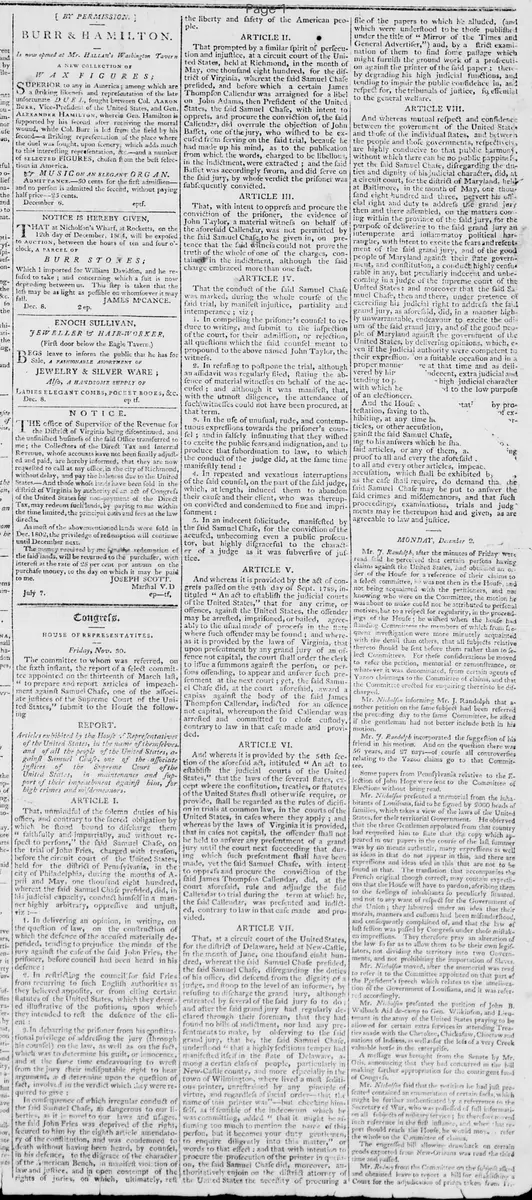
The committee to whom was referred, on the sixth instant, the report of a select committee appointed on the thirteenth of March last, "to prepare and report articles of impeachment against Samuel Chase, one of the associate justices of the Supreme Court of the United States," submit to the House the following
REPORT.
Articles exhibited by the House of Representatives of the United States, in the name of themselves and of all the people of the United States, against Samuel Chase, one of the associate justices of the Supreme Court of the United States, in maintenance and support of their impeachment against him, for high crimes and misdemeanors.
ARTICLE I.
That, unmindful of the solemn duties of his office, and contrary to the sacred obligation by which he stood bound to discharge them "faithfully and impartially, and without respect to persons," the said Samuel Chase, on the trial of John Fries, charged with treason, before the circuit court of the United States, held for the district of Pennsylvania, in the city of Philadelphia, during the months of April and May, one thousand eight hundred, whereat the said Samuel Chase presided, did, in his judicial capacity, conduct himself in a manner highly arbitrary, oppressive and unjust, viz:——
1. In delivering an opinion, in writing, on the question of law, on the construction of which the defence of the accused materially depended, tending to prejudice the minds of the jury against the case of the said John Fries, the prisoner, before counsel had been heard in his defence:
2. In restricting the counsel for said Fries from recurring to such English authorities as they believed apposite, or from citing certain statutes of the United States, which they deemed illustrative of the positions, upon which they intended to rest the defence of the client:
3. In debarring the prisoner from his constitutional privilege of addressing the jury (through his counsel) on the law, as well as on the fact, which was to determine his guilt, or innocence, and at the same time endeavouring to wrest from the jury their indisputable right to hear argument, and determine upon the question of fact, involved in the verdict which they were required to give:
In consequence of which irregular conduct of the said Samuel Chase, as dangerous to our liberties, as it is novel to our laws and usages, the said John Fries was deprived of the right, secured to him by the eighth article amendatory of the constitution, and was condemned to death without having been heard, by counsel, in his defence, to the disgrace of the character of the American Bench, a manifest violation of law and justice, and in open contempt of the rights of juries, on which, ultimately, rest the liberty and safety of the American people.
ARTICLE II.
That prompted by a similar spirit of persecution and injustice, at a circuit court of the United States, held at Richmond, in the month of May, one thousand eight hundred, for the district of Virginia, whereat the said Samuel Chase presided, and before which a certain James Thompson Callendar was arraigned for a libel on John Adams, then President of the United States, the said Samuel Chase, with intent to oppress, and procure the conviction of, the said Callendar, did overrule the objection of John Basset, one of the jury, who wished to be excused from serving on the said trial, because he had made up his mind, as to the publication from which. the words, charged to be libellous, in the indictment, were extracted; and the said Basset was accordingly sworn, and did serve on the said jury, by whose verdict the prisoner was subsequently convicted.
ARTICLE III.
That, with intent to oppress and procure the conviction of the prisoner, the evidence of John Taylor, a material witness on behalf of the aforesaid Callendar, was not permitted by the said Samuel Chase, to be given in, on pretence that the said witness could not prove the truth of the whole of one of the charges, contained in the indictment, although the said charge embraced more than one fact.
ARTICLE IV.
That the conduct of the said Samuel Chase was marked, during the whole course of the said trial, by manifest injustice, partiality and intemperance; viz;
1. In compelling the prisoner's counsel to reduce to writing, and submit to the inspection of the court, for their admission, or rejection, all questions which the said counsel meant to propound to the above named John Taylor, the witness.
2. In refusing to postpone the trial, although an affidavit was regularly filed, stating the absence of material witnesses on behalf of the accused; and although it was manifest, that, with the utmost diligence, the attendance of such witnesses could not have been procured, at that term.
3. In the use of unusual, rude, and contemptuous expressions towards the prisoner's counsel; and in falsely insinuating that they wished to excite the public fears and indignation, and to produce that subordination to law, to which the conduct of the judge did, at the same time manifestly tend:
4. In repeated and vexatious interruptions of the said counsel, on the part of the said judge, which, at length, induced them to abandon their cause and their client, who was thereupon convicted and condemned to fine and imprisonment:
5. In an indecent solicitude, manifested by the said Samuel Chase, for the conviction of the accused, unbecoming even a public prosecutor, but highly disgraceful to the character of a judge as it was subversive of justice.
ARTICLE V.
And whereas it is provided by the act of congress passed on the 24th day of Sept. 1789, entitled "An act to establish the judicial courts of the United States," that for any crime, or offence, against the United States, the offender may be arrested, imprisoned, or bailed, agreeably to the usual mode of process in the state where such offender may be found; and whereas it is provided by the laws of Virginia, that upon presentment by any grand jury of an offence not capital, the court shall order the clerk to issue a summons against the person, or persons offending, to appear and answer such presentment at the next court; yet, the said Samuel Chase did, at the court aforesaid, award a capias against the body of the said James Thompson Callendar, indicted for an offence not capital, whereupon the said Callendar was arrested and committed to close custody, contrary to law in that case made and provided.
ARTICLE VI.
And whereas it is provided by the 54th section of the aforesaid act, entitled "An act to establish the judicial courts of the United States," that the laws of the several states, except where the constitution, treaties, or statutes of the United States shall otherwise require, or provide, shall be regarded as the rules of decision in trials at common law, in the courts of the United States, in cases where they apply; and whereas by the laws of Virginia it is provided, that in cases not capital, the offender shall not be held to answer any presentment of a grand jury until the court next succeeding that during which such presentment shall have been made, yet the said Samuel Chase, with intent to oppress and procure the conviction of the said James Thompson Callendar, did, at the court aforesaid, rule and adjudge the said Callendar to trial during the term at which he, the said Callendar, was presented and indicted, contrary to law in that case made and provided.
ARTICLE VII.
That, at a circuit court of the United States, for the district of Delaware, held at New-Castle, in the month of June, one thousand eight hundred, whereat the said Samuel Chase presided, the said Samuel Chase, disregarding the duties of his office, did descend from the dignity of a judge, and stoop to the level of an informer, by refusing to discharge the grand jury, although entreated by several of the said jury so to do. and after the said grand jury had regularly declared through their foreman, that they had found no bills of indictment, nor had any presentments to make, by observing to the said grand jury, that he, the said Samuel Chase, understood "that a highly seditious temper had manifested itself in the state of Delaware, among a certain class of people, particularly in New-Castle county, and more especially in the town of Wilmington, where lived a most seditious printer, unrestrained by any principle of virtue, and regardless of social order—that the name of this printer was"—but checking himself, as if sensible of the indecorum which he was committing, added "that it might be assuming too much to mention the name of this person, but it becomes your duty gentlemen, to enquire diligently into this matter," or words to that effect : and that with intention to procure the prosecution of the printer in question, the said Samuel Chase did, moreover, authoritatively enjoin on the district attorney of the United States the necessity of procuring a file of the papers to which he alluded, (and which were understood to be those published under the title of "Mirror of the Times and General Advertiser,") and, by a strict examination of them to find some passage which might furnish the ground work of a prosecution against the printer of the said paper: thereby degrading his high judicial functions, and tending to impair the public confidence in, and respect for, the tribunals of justice, so essential to the general welfare.
ARTICLE VIII.
And whereas mutual respect and confidence between the government of the United States and those of the individual states, and between the people and those governments, respectively, are highly conducive to that public harmony, without which there can be no public happiness. yet the said Samuel Chase, disregarding the duties and dignity of his judicial character, did, at a circuit court, for the district of Maryland, held at Baltimore, in the month of May, one thousand eight hundred and three, pervert his official right and duty to address the grand jury then and there assembled, on the matters coming within the province of the said jury, for the purpose of delivering to the said grand jury an intemperate and inflammatory political harangue, with intent to excite the fears and resentment of the said grand jury, and of the good people of Maryland against their state government, and constitution, a conduct highly censurable in any, but peculiarly indecent and unbecoming in a judge of the supreme court of the United States: and moreover that the said Samuel Chase, then and there, under pretence of exercising his judicial right to address the said grand jury, as aforesaid, did, in a manner highly unwarrantable, endeavour to excite the odium of the said grand jury, and of the good people of Maryland against the government of the United States, by delivering opinions, which, even if the judicial authority were competent to their expression. on a suitable occasion and in a proper manner, were at that time and as delivered by him indecent, extra judicial and tending to prostrate the high judicial character with which he was invested, to the low purpose of an electioneer; and the House of Representatives aforesaid, by protestation, saving to themselves the liberty of exhibiting, at any time hereafter, further articles, or other accusation, against the said Samuel Chase, and also of replying to his answers which he shall make to the said articles, or any of them, and also of offering proof to all and every the aforesaid articles, and to all and every other articles, impeachment, or accusation, which shall be exhibited by them, as the case shall require, do pray that the said Samuel Chase may be put to answer the said crimes and misdemeanors, and that such proceedings, examinations, trials and judgments may be thereupon had and given, as are agreeable to law and justice.
MONDAY, December 3.
Mr. J. Randolph, after the minutes of Friday were read said he perceived that certain persons having claims against the United States, had obtained an order of the House for a reference of their claims to a select committee, he was not then in the House, and not being acquainted with the petitioners, and not knowing who were on the Committee, the motion he was about to make could not be attributed to personal motives, but to a respect for regularity, in the proceedings of the House; he wished when the house had standing Committees the members of which from frequent investigation were more minutely acquainted with the detail than others, that all subjects relative thereto should be sent before them rather than to select Committees. For these considerations he moved to refer the petition, memorial or remonstrance, of whatever it was denominated, from certain agents of Yazoo claimants to the Committee of claims, and that the Committee erected for enquiring thereinto be discharged.
Mr. Nicholson informing Mr. J. Randolph that another petition on the same subject had been referred the preceding day to the same Committee, he asked if the gentleman had not better include both in his motion.
Mr. F. Randolph incorporated the suggestion of his friend in his motion. And on the question there was 56 ayes, and 67 nays—of course all controversies relating to the Yazoo claims go to that Committee.
Some papers from Pennsylvania relative to the Election of John Hoge were sent to the Committee of Elections without being read.
Mr. Nicholson presented a memorial from the inhabitants of Louisiana, said to be signed by 2000 heads of families, which takes a view of the laws of the United States, for their territorial Government. He observed that the three Gentlemen appointed from that country had requested him to state that the copy which appeared in our papers in the course of the last summer was by no means authentic, many expressions as well as ideas in that do not appear in this, and there are expressions and ideas used in this that are not to be found in that. The translation that accompanies the French original though correct, may contain expressions that the House will have to pardon, ascribing them to the feelings of inhabitants so peculiarly situated. and not to any want of respect for the Government of the Union; they laboured under an idea that their morals, manners and customs had been misunderstood, and consequently complained of, and that the law of last session was passed by Congress under those mistaken impressions. They therefore pray an alteration of the law so far as to allow them to be their own legislators, not dividing the territory into two Governments, and not prohibiting the importation of Slaves.
Mr. Nicholson moved, after the memorial was read to refer it to the Committee appointed on that part of the President's speech which relates to the amelioration of the Government of Louisiana, and it was referred accordingly.
Mr. Nicholson presented the petition of John B. Walback Aid de-camp to Gen. Wilkinson, and Lieutenant in the army of the United States praying to be allowed for certain extra services in attending treaty made with the Cherokee, Chickasaw, Choctaw and Creek nations of Indians, as well as for the loss of a very valuable horse in the enterprize.
A message was brought from the Senate by Mr. Otis, announcing that they had concurred in the bill making farther appropriation for the contingent fund of Congress.
Mr. Nicholson said that the petition he had just presented contained an enumeration of certain facts, which might be further authenticated by a reference to the Secretary of War, who was possessed of full information all subjects of military service; he therefore moved such reference in the first instance, and when that report should reach the House, he would move to refer the whole to the Committee of claims.
The engrossed bill allowing drawback on certain goods exported from New-Orleans was read the third time and passed.
Mr. Rodney from the Committee on the subject asked and obtained leave to report a bill for establishing a Court for the adjudication of prizes taken from France.
A resolution was offered, that no person holding any office of profit or trust under the United States, or any state, or being a citizen or inhabitant of any country in Europe at war with this power, shall be capable of being elected a member of the House of Representatives. Referred to a Committee of the whole tomorrow.
A petition was presented but not read: it was stated by the Member presenting it that the petitioner had been obliged to pay duties which the law did not require, and he thereupon requests the interference of Congress to reimburse the same. Referred to the Committee of Commerce and Manufactures.
On motion of Mr. Randolph the House resolved itself into a Committee of the whole on the Report of the select Committee on the impeachment of SAMUEL CHASE, an associate Judge of the Supreme Court of the United States.
Gen. VARNUM in the Chair.
The Committee agreed to the eight articles with a small amendment to the first, and another to the 4th. They reported the same and the House adjourned.
The report on this subject will be given at length as soon as transcribed for the press.
TUESDAY, December 4.
Mr. Wilson, elected in the stead of Mr. Moore who has been appointed a member of the Senate of the United States, appeared, and being sworn to support the constitution, took his seat.
Mr. J. C. Smith presented the petition of Sally Rust of Kent in Connecticut, the only child of an old soldier, who was drowned the last year of our revolutionary war, praying to be allowed the lands due to him. Referred to the Committee of Claims.
A petition from the directors and agents of the Ohio company praying permission to lease certain lots reserved within their purchase for the support of schools and religious purposes, &c. Referred to a committee of five members.
Mr. M. Clay reported a new bill respecting the marine insurance company of Alexandria, granting the power to insure against fire. The same was twice read and referred to a committee of the whole tomorrow.
Mr. Crowninshield reported from the committee of Commerce and Manufactures on the petitions of the Library company of Philadelphia and the trustees of Princeton college for the remission of duties on certain books imported. That they have leave to withdraw their respective petitions. And on motion the House agreed to the report.
The petition of capt. Peter Landais commander of the Alliance frigate during part of our revolutionary war, praying an allowance for prize money due to him from that period. Referred to the Committee of Claims.
Mr. Clarke reported from the committee appointed on that subject that further time should be allowed to the claimants of lands in Georgia, south of Tennessee for registering their titles in the office of the Secretary of State. Referred to a committee of the whole on Thursday next.
The House then resumed the unfinished business of yesterday in relation to the impeachment of Judge Chase.
They refused to concur the amendments made yesterday in committee of the whole. So that the articles remain in the same form as reported by the select Committee.
The report was taken up article by article.
Mr. Nicholson called the yeas and nays, and was supported by the constitutional number.
The question on agreeing to the first article was accordingly taken by yeas and nays, and there appeared to be 89 in the affirmative, 34 in the negative.
The second article was also agreed to, yeas 83, nays 35.
The third article was agreed to, there being yeas 81, nays 34.
The fourth article being under consideration Mr. Elmer moved to amend the same by striking out the third and fourth sections thereof.
The amendment was not carried.
On the question to agree to the fourth article Mr. Lyon was excused from voting, he not having been in the House when the question was put. The yeas were 84, nays 34, of course the article was carried.
The fifth article was read and some objection being taken to the same, after a short discussion it was agreed to. Yeas 72, noes 45.
The sixth article was also objected to, but passed the yeas being 73, noes 42.
The seventh article was agreed to, yeas 73, noes 42.
The 8th article being before the House, a division of the question was called for, and on the first paragraph the yeas were 74, noes 39. It was agreed to.
On the second being also the last paragraph, the yeas were 78, the noes 32, and it was also agreed to.
A question on agreeing to the whole articles was carried without a division.
Mr. Nicholson moved the appointment of members by ballot for conducting the impeachment on the part of the House; but the House adjourned without coming to a decision.
What sub-type of article is it?
What keywords are associated?
What entities or persons were involved?
Where did it happen?
Domestic News Details
Primary Location
House Of Representatives
Event Date
Friday, Nov. 30. To Tuesday, December 4.
Key Persons
Outcome
all eight articles of impeachment agreed to by majority votes: article i (89-34), ii (83-35), iii (81-34), iv (84-34), v (72-45), vi (73-42), vii (73-42), viii (74-39 and 78-32). petitions on yazoo claims, louisiana memorial, and others referred to committees. bills passed or reported.
Event Details
The House received and debated a committee report presenting eight articles of impeachment against Associate Justice Samuel Chase for misconduct in trials in Philadelphia (John Fries treason case), Richmond (Callender libel), Delaware (grand jury influence), and Baltimore (political harangue). Sessions on Nov. 30, Dec. 3, and Dec. 4 included votes approving all articles. Other business: Yazoo claims referred to Committee of Claims (56-67 vote); Louisiana inhabitants' memorial for governance changes referred; various petitions (e.g., John B. Walback, Sally Rust, Ohio company, Peter Landais) referred to committees; bills on New-Orleans drawbacks passed, marine insurance reported, prize court proposed; resolution on member eligibility referred.