Thank you for visiting SNEWPapers!
Sign up free
National Gazette
Philadelphia, Philadelphia County, Pennsylvania
What is this article about?
In a letter to King Louis XVI, his brothers Louis Stanislas Xavier (Count of Provence) and Charles Philippe (Count d'Artois) express regret at being unable to return to France due to revolutionary violence and the unconstitutional changes. They renounce their rights to the crown to protect the monarchy and faithful subjects.
Clipping
OCR Quality
Full Text
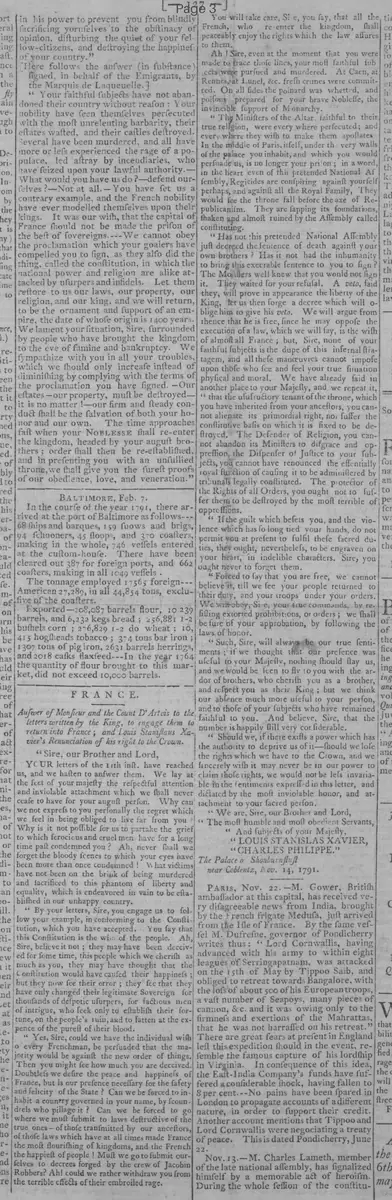
Answer of Monsieur and the Count D'Artois to the letters written by the King, to engage them to return into France; and Louis Stanislais Xavier's Renunciation of his right to the Crown.
Sire, our Brother and Lord,
Your letters of the 11th inst. have reached us, and we hasten to answer them. We lay at the feet of your majesty the respectful attention and inviolable attachment which we shall never cease to have for your august person. Why can we not express to you personally the regret which we feel in being obliged to live far from you? Why is it not possible for us to partake the grief to which ferocious and cruel men have for a long time past condemned you? Ah, never shall we forget the bloody scenes to which your eyes have been more than once condemned! What victims have not been on the brink of being murdered and sacrificed to this phantom of liberty and equality, which is endeavored in vain to be established in our unhappy country.
By your letters, Sire, you engage us to follow your example, in conforming to the Constitution, which you have accepted. You say that this Constitution is the will of the people. Ah, Sire, believe it not; they may have been deceived for some time, this people which we cherish as much as you, they may have thought that the Constitution would have caused their happiness; but they now see their error; they see that they have only changed their legitimate Sovereign for thousands of despotic usurpers, for factious men of intrigue, who seek only to establish their fortune, on the people's ruin, and to fatten at the expense of the purest of their blood.
Yes, Sire, could we have the individual wish of every Frenchman, be persuaded that the majority would be against the new order of things. Then you might see how much you are deceived. Doubtless we desire the peace and happiness of France, but is our presence necessary for the safety and felicity of the State? Can we be forced to inhabit a country governed in your name, by scoundrels who pillage it? Can we be forced to go where we must submit to laws destructive of the true ones—of those transmitted by our ancestors, of those laws which have at all times made France the most flourishing of kingdoms, and the French the happiest of people! Must we go to submit ourselves to decrees forged by the crew of Jacobin Robbers? Ah! could we rather withdraw you from the terrible effects of their embroiled rage.
You will take care, Sire, you say, that all the French, who re-enter the kingdom, shall peaceably enjoy the rights which the law assures to them. Ah! Sire, even at the moment that you were made to trace those lines, your most faithful subjects were pursued and murdered. At Caen, at Rennes, at Lunel, &c. fresh crimes were committed. On all sides the poinard was whetted, and poisons prepared for your brave Noblesse, the invincible support of Monarchy.
The Ministers of the Altar, faithful to their true religion, were every where persecuted; and every where they wish to make them apostates. In the middle of Paris, itself, under the very walls of the palace you inhabit, and which you would persuade us, is no longer your prison; in a word, in the heart even of this pretended National Assembly, Regicides are conspiring against yourself perhaps, and against all the Royal Family, They would see the throne fall before the axe of Republicanism. They are sapping its foundations, shaken and almost ruined by the Assembly called constituting.
Has not this pretended National Assembly just decreed the sentence of death against your own brothers? Has it not had the inhumanity to bring this execrable sentence to you to sign? The Ministers well knew that you would not sign it. They waited for your refusal. A veto, said they, will prove in appearance the liberty of the King, let us then forge a decree which will oblige him to give his veto. We will argue from thence that he is free, since he may oppose the execution of a law, which we will say, is the wish of almost all France; but, Sire, none of your faithful subjects is the dupe of this infernal stratagem, and all these manoeuvres cannot impose upon those who see and feel your true situation physical and moral. We have already said in another place to your Majesty, and we repeat it, that the usufructory tenant of the throne, which you have inherited from your ancestors, you cannot alienate its primordial right, nor suffer the constitutive basis on which it is fixed to be destroyed. The Defender of Religion, you cannot abandon its Ministers to disgrace and oppression, the Dispenser of Justice to your subjects, you cannot have renounced the essentially royal function of causing it to be administered by tribunals legally constituted. The protector of the Rights of all Orders, you ought not to suffer them to be destroyed by the most terrible of oppressions.
If the guilt which besets you, and the violence which has so long tied your hands, do not permit you at present to fulfil these sacred duties, they ought, nevertheless, to be engraven on your heart, in indelible characters. Sire, you ought never to forget them.
Forced to say that you are free, we cannot believe it, till we see your people returned to their duty, and your troops under your orders. We will obey, Sire, your true commands, by resisting extorted prohibitions, or orders; we shall be sure of your approbation, by following the laws of honor.
Such, Sire, will always be our true sentiments: if we thought that our presence was useful to your Majesty, nothing should stay us, and we would be seen to fly to you with the ardor of brothers, who cherish you as a brother, and respect you as their King; but we think our absence much more useful to your person, and to those of your subjects who have remained faithful to you. And believe, Sire, that the number is happily still very considerable.
Should we, if there exists a power which has the authority to deprive us of it—should we lose the rights which we have to the Crown, and we sincerely wish it may never be in our power to claim those rights, we would not be less invariable in the sentiments expressed in this letter, and dictated by the most inviolable honor, and attachment to your sacred person.
We are, Sire, our Brother and Lord,
The most humble and most obedient Servants,
And subjects of your Majesty,
LOUIS STANISLAS XAVIER,
CHARLES PHILIPPE.
What sub-type of article is it?
What keywords are associated?
What entities or persons were involved?
Where did it happen?
Foreign News Details
Primary Location
France
Event Date
Letters Of The 11th Inst.
Key Persons
Outcome
renunciation of rights to the crown by louis stanislas xavier and charles philippe; refusal to return to france amid revolutionary threats and violence against nobles and clergy.
Event Details
Louis Stanislas Xavier and Charles Philippe respond to King Louis XVI's letters urging their return, expressing attachment but refusing due to the revolutionary constitution, violence, and threats to the monarchy. They renounce their succession rights to safeguard the king's position and faithful subjects.