Thank you for visiting SNEWPapers!
Sign up free
Editorial
November 7, 1817
Alexandria Gazette & Daily Advertiser
Alexandria, Virginia
What is this article about?
The Georgetown Messenger denounces forged poetic lines from the National Intelligencer falsely attributed to Lord Byron explaining his divorce, praises his genius, and includes excerpts from a review defending his character and discussing his life and works.
Merged-components note: This is a single continued editorial article about Lord Byron, split across multiple components due to parsing.
Clipping
OCR Quality
75%
Good
Full Text
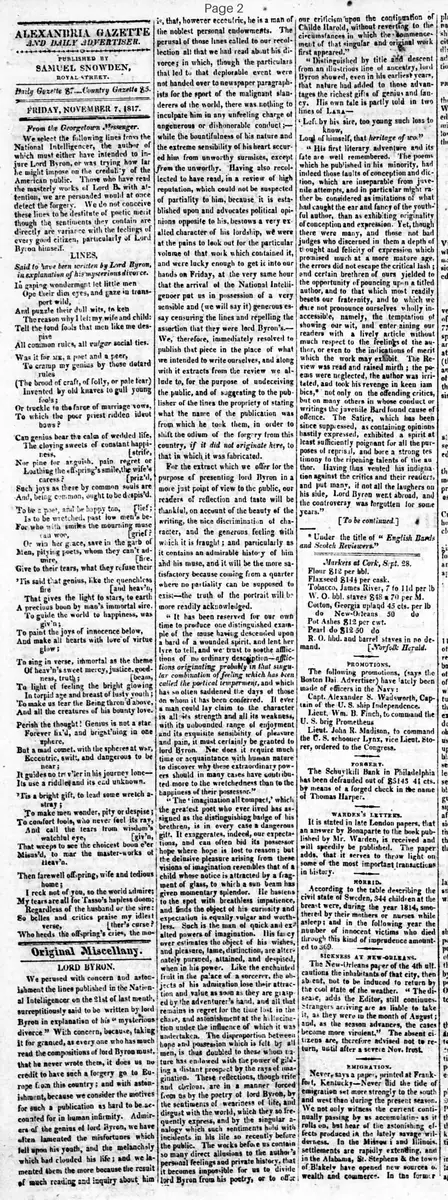
From the Georgetown Messenger.
We select the following lines from the National Intelligencer, the author of which must either have intended to injure Lord Byron, or was trying how far he might impose on the credulity of the American public. Those who have read the masterly works of Lord B. with attention, we are persuaded would at once detect the forgery. We do not conceive these lines to be destitute of poetic merit though the sentiments they contain are directly at variance with the feelings of every good citizen, particularly of Lord Byron himself.
LINES
Said to have been written by Lord Byron,
in explanation of his mysterious divorce.
In gaping wonderment let little men
Ope their dim eyes, and gaze in transport
And puzzle their dull wits, to ken
The reason why I left my wife and child:
Tell the good fools that men like me defies
All common rules, all vulgar social ties.
Was it for you, a poet and a peer,
To cramp my genius by those dotard rules
(The brood of craft, of folly, or pale fear)
Invented by old knaves to gull young fools:
Or truckle to the farce of marriage vows,
To which the poor priest-ridden idiot bows?
Can genius bear the calm of wedded life,
The cloying sweets of constant happiness,
Nor pine for anguish, pain, regret or strife,
Loathing the spring's smile, the wife's caress?
Such joys as these by common souls are prized
And, being common, ought to be despis'd.
To be a poet, and be happy too,
Is to be wretched, past low men's belief;
For when with smiles the morning spouse
End woe or grief?
Or win her grace, save in the garb of woe,
Aien, pitying poets, whom they can't admire,
Give to their tears, what they refuse their fire.
It is said that genius, like the quenchless fire
and heav'n,
That gives the light to stars, to earth and heav'n,
A precious boon by man's immortal sire,
To guile the world to happiness, was giv'n
To paint the joys of innocence below,
And make all hearts with love of virtue glow;
To sing in verse, immortal as the theme
Of heav'n's sweet mercy, justice, goodness, truth:
To light of feeling the bright glowing beam
In torpid age and breast of lascivious youth;
To make us fear the Being thron'd above,
And all the creatures of his bounty love.
Perish the thought! Genius is not a star
Forever fix'd, and brightening in one sphere,
But a mad comet, with the spheres at war,
Eccentric, swift, and dangerous to be near;
It guides no traveller in his journey lone
Its use a riddle, and its end unknown.
'Tis a bright gift, to lead some wretch astray;
To make men wonder, pity or despise;
To comfort fools, who never feel its ray,
And call the tears from wisdom's watchful eyes,
That weeps to see the choicest boon e'er giv'n,
Misus'd, to mar the master-works of heav'n.
Then farewell offspring, wife and tedious home;
I reck not of you, so the world admire;
My tears are all for Tasso's hapless doom;
Regardless of the husband or the sire:
So belles and critics praise my idlest verse,
Who heeds the offspring's cries, the mother's curse?
Original Miscellany
LORD BYRON.
We perused with concern and astonishment the lines published in the National Intelligencer on the 21st of last month, surreptitiously said to be written by lord Byron in explanation of his "mysterious divorce." With concern, because, taking it for granted, as every one who has much read the compositions of lord Byron must, that he never wrote them, it does us no credit to have such a forgery go to Europe from this country; and with astonishment, because we consider the motives for such a publication as hard to be accounted for in human infirmity. Admirers of the genius of lord Byron, we have often lamented the misfortunes which fell upon his youth, and the melancholy which had clouded his life; and we lamented them the more because the result of much reading and inquiry about him is, that, however eccentric, he is a man of the noblest personal endowments. The perusal of those lines called to our recollection all that we had read about his divorce; in which, though the particulars that led to that deplorable event were not handed over to newspaper paragraphists or the sport of the malignant slanderers of the world, there was nothing to inculpate him in any unfeeling charge of ungenerous or dishonorable conduct; while the bountifulness of his nature and the extreme sensibility of his heart secured him from unworthy surmises, except from the unworthy. Having also recollected to have read, in a review of high reputation, which could not be suspected of partiality to him, because it is established upon and advocates political opinions opposite to his, bestows a very exalted character of his lordship, we were at the pains to look out for the particular volume of that work which contained it, and were lucky enough to get it into our hands on Friday, at the very same hour that the arrival of the National Intelligencer put us in possession of a very sensible and (we will say it) generous essay censuring the lines and repelling the assertion that they were lord Byron's. We, therefore, immediately resolved to publish that piece in the place of what we intended to write ourselves, and along with it extracts from the review we allude to, for the purpose of undeceiving the public, and of suggesting to the publisher of the lines the propriety of stating what the name of the publication was from which he took them, in order to shift the odium of the forgery from this country, if it did not originate here, to that in which it was fabricated. For the extract which we offer for the purpose of presenting lord Byron in a more just point of view to the public, our readers of reflection and taste will be thankful, on account of the beauty of the writing, the nice discrimination of character, and the generous feeling with which it is fraught; and particularly as it contains an admirable history of him and his muse, and it will be the more satisfactory because coming from a quarter where no partiality can be supposed to exist-the truth of the portrait will be more readily acknowledged.
"It has been reserved for our own time to produce one distinguished example of the muse having descended upon a bard of a wounded spirit, and lent her lyre to tell, and we trust to soothe afflictions of no ordinary description-afflictions originating probably in that singular combination of feeling which has been called the poetical temperament, and which has so often saddened the days of those on whom it has been conferred. If ever a man could lay claim to the character in all its strength and all its weakness, with its unbounded range of enjoyment and its exquisite sensibility of pleasure and pain, it must certainly be granted to lord Byron. Nor does it require much time or acquaintance with human nature to discover why these extraordinary powers should in many cases have contributed more to the wretchedness than to the happiness of their possessor."
"The 'imagination all compact,' which the greatest poet who ever lived has assigned as the distinguishing badge of his brethren, is in every case a dangerous gift. It exaggerates, indeed, our expectations, and can often bid its possessor hope where hope is lost to reason; but the delusive pleasure arising from these visions of imagination resembles that of a child whose notice is attracted by a fragment of glass, to which a sun beam has given momentary splendor. He hastens to the spot with breathless impatience, and finds the object of his curiosity and expectation is equally vulgar and worthless. Such is the man of quick and exalted powers of imagination. His fancy over estimates the object of his wishes, and pleasure, fame, distinction, are alternately pursued, attained, and despised, when in his power. Like the enchanted fruit in the palace of a sorcerer, the objects of his admiration lose their attraction and value as soon as they are grasped by the adventurer's hand, and all that remains is regret for the time lost in the chase, and astonishment at the hallucination under the influence of which it was undertaken. The disproportion between hope and possession which is felt by all men, is thus doubled to those whom nature has endowed with the power of gilding a distant prospect by the rays of imagination. These reflections, though trite and obvious, are in a manner forced from us by the poetry of lord Byron, by the sentiments of weariness of life, and disgust with the world, which they so frequently express, and by the singular analogy which such sentiments hold with incidents in his life so recently before the public. The works before us contain so many direct allusions to the author's personal feelings and private history, that it becomes impossible for us to divide lord Byron from his poetry, or to offer our criticism upon the continuation of Childe Harold, without reverting to the circumstances in which the commencement of that singular and original work first appeared."
"Distinguished by title and descent from an illustrious line of ancestry, lord Byron showed, even in his earliest years, that nature had added to those advantages the richest gifts of genius and fancy. His own tale is partly told in two lines of LARA-
Left by his sire, too young such loss to know,
Lord of himself, that heritage of wo."
"His first literary adventure and its fate are well remembered. The poems which he published in his minority, had indeed those faults of conception and diction, which are inseparable from juvenile attempts, and in particular might rather be considered as imitations of what had caught the ear and fancy of the youthful author, than as exhibiting originality of conception and expression. Yet, though there were many, and those not bad judges who discerned in them a depth of thought and felicity of expression which promised much at a more mature age, the errors did not escape the critical lash; and certain brethren of ours yielded to the opportunity of pouncing upon a titled author, and to that which most readily besets our fraternity, and to which we dare not pronounce ourselves wholly inaccessible, namely, the temptation of showing our wit, and entertaining our readers with a lively article without much respect to the feelings of the author, or even to the indications of merit which the work may exhibit. The Review was read and raised mirth: the poems were neglected, the author was irritated, and took his revenge in keen iambics,** not only on the offending critics, but on many others in whose conduct or writings the juvenile Bard found cause of offence. The Satire, which has been since suppressed, as containing opinions hastily expressed, exhibited a spirit at least sufficiently poignant for all the purposes of reprisal, and bore a strong testimony to the ripening talents of the author. Having thus vented his indignation against the critics and their readers, and put many, if not all the laughers on his side, Lord Byron went abroad, and the controversy was forgotten for some years."
[To be continued.]
*Under the title of "English Bards and Scotch Reviewers."
We select the following lines from the National Intelligencer, the author of which must either have intended to injure Lord Byron, or was trying how far he might impose on the credulity of the American public. Those who have read the masterly works of Lord B. with attention, we are persuaded would at once detect the forgery. We do not conceive these lines to be destitute of poetic merit though the sentiments they contain are directly at variance with the feelings of every good citizen, particularly of Lord Byron himself.
LINES
Said to have been written by Lord Byron,
in explanation of his mysterious divorce.
In gaping wonderment let little men
Ope their dim eyes, and gaze in transport
And puzzle their dull wits, to ken
The reason why I left my wife and child:
Tell the good fools that men like me defies
All common rules, all vulgar social ties.
Was it for you, a poet and a peer,
To cramp my genius by those dotard rules
(The brood of craft, of folly, or pale fear)
Invented by old knaves to gull young fools:
Or truckle to the farce of marriage vows,
To which the poor priest-ridden idiot bows?
Can genius bear the calm of wedded life,
The cloying sweets of constant happiness,
Nor pine for anguish, pain, regret or strife,
Loathing the spring's smile, the wife's caress?
Such joys as these by common souls are prized
And, being common, ought to be despis'd.
To be a poet, and be happy too,
Is to be wretched, past low men's belief;
For when with smiles the morning spouse
End woe or grief?
Or win her grace, save in the garb of woe,
Aien, pitying poets, whom they can't admire,
Give to their tears, what they refuse their fire.
It is said that genius, like the quenchless fire
and heav'n,
That gives the light to stars, to earth and heav'n,
A precious boon by man's immortal sire,
To guile the world to happiness, was giv'n
To paint the joys of innocence below,
And make all hearts with love of virtue glow;
To sing in verse, immortal as the theme
Of heav'n's sweet mercy, justice, goodness, truth:
To light of feeling the bright glowing beam
In torpid age and breast of lascivious youth;
To make us fear the Being thron'd above,
And all the creatures of his bounty love.
Perish the thought! Genius is not a star
Forever fix'd, and brightening in one sphere,
But a mad comet, with the spheres at war,
Eccentric, swift, and dangerous to be near;
It guides no traveller in his journey lone
Its use a riddle, and its end unknown.
'Tis a bright gift, to lead some wretch astray;
To make men wonder, pity or despise;
To comfort fools, who never feel its ray,
And call the tears from wisdom's watchful eyes,
That weeps to see the choicest boon e'er giv'n,
Misus'd, to mar the master-works of heav'n.
Then farewell offspring, wife and tedious home;
I reck not of you, so the world admire;
My tears are all for Tasso's hapless doom;
Regardless of the husband or the sire:
So belles and critics praise my idlest verse,
Who heeds the offspring's cries, the mother's curse?
Original Miscellany
LORD BYRON.
We perused with concern and astonishment the lines published in the National Intelligencer on the 21st of last month, surreptitiously said to be written by lord Byron in explanation of his "mysterious divorce." With concern, because, taking it for granted, as every one who has much read the compositions of lord Byron must, that he never wrote them, it does us no credit to have such a forgery go to Europe from this country; and with astonishment, because we consider the motives for such a publication as hard to be accounted for in human infirmity. Admirers of the genius of lord Byron, we have often lamented the misfortunes which fell upon his youth, and the melancholy which had clouded his life; and we lamented them the more because the result of much reading and inquiry about him is, that, however eccentric, he is a man of the noblest personal endowments. The perusal of those lines called to our recollection all that we had read about his divorce; in which, though the particulars that led to that deplorable event were not handed over to newspaper paragraphists or the sport of the malignant slanderers of the world, there was nothing to inculpate him in any unfeeling charge of ungenerous or dishonorable conduct; while the bountifulness of his nature and the extreme sensibility of his heart secured him from unworthy surmises, except from the unworthy. Having also recollected to have read, in a review of high reputation, which could not be suspected of partiality to him, because it is established upon and advocates political opinions opposite to his, bestows a very exalted character of his lordship, we were at the pains to look out for the particular volume of that work which contained it, and were lucky enough to get it into our hands on Friday, at the very same hour that the arrival of the National Intelligencer put us in possession of a very sensible and (we will say it) generous essay censuring the lines and repelling the assertion that they were lord Byron's. We, therefore, immediately resolved to publish that piece in the place of what we intended to write ourselves, and along with it extracts from the review we allude to, for the purpose of undeceiving the public, and of suggesting to the publisher of the lines the propriety of stating what the name of the publication was from which he took them, in order to shift the odium of the forgery from this country, if it did not originate here, to that in which it was fabricated. For the extract which we offer for the purpose of presenting lord Byron in a more just point of view to the public, our readers of reflection and taste will be thankful, on account of the beauty of the writing, the nice discrimination of character, and the generous feeling with which it is fraught; and particularly as it contains an admirable history of him and his muse, and it will be the more satisfactory because coming from a quarter where no partiality can be supposed to exist-the truth of the portrait will be more readily acknowledged.
"It has been reserved for our own time to produce one distinguished example of the muse having descended upon a bard of a wounded spirit, and lent her lyre to tell, and we trust to soothe afflictions of no ordinary description-afflictions originating probably in that singular combination of feeling which has been called the poetical temperament, and which has so often saddened the days of those on whom it has been conferred. If ever a man could lay claim to the character in all its strength and all its weakness, with its unbounded range of enjoyment and its exquisite sensibility of pleasure and pain, it must certainly be granted to lord Byron. Nor does it require much time or acquaintance with human nature to discover why these extraordinary powers should in many cases have contributed more to the wretchedness than to the happiness of their possessor."
"The 'imagination all compact,' which the greatest poet who ever lived has assigned as the distinguishing badge of his brethren, is in every case a dangerous gift. It exaggerates, indeed, our expectations, and can often bid its possessor hope where hope is lost to reason; but the delusive pleasure arising from these visions of imagination resembles that of a child whose notice is attracted by a fragment of glass, to which a sun beam has given momentary splendor. He hastens to the spot with breathless impatience, and finds the object of his curiosity and expectation is equally vulgar and worthless. Such is the man of quick and exalted powers of imagination. His fancy over estimates the object of his wishes, and pleasure, fame, distinction, are alternately pursued, attained, and despised, when in his power. Like the enchanted fruit in the palace of a sorcerer, the objects of his admiration lose their attraction and value as soon as they are grasped by the adventurer's hand, and all that remains is regret for the time lost in the chase, and astonishment at the hallucination under the influence of which it was undertaken. The disproportion between hope and possession which is felt by all men, is thus doubled to those whom nature has endowed with the power of gilding a distant prospect by the rays of imagination. These reflections, though trite and obvious, are in a manner forced from us by the poetry of lord Byron, by the sentiments of weariness of life, and disgust with the world, which they so frequently express, and by the singular analogy which such sentiments hold with incidents in his life so recently before the public. The works before us contain so many direct allusions to the author's personal feelings and private history, that it becomes impossible for us to divide lord Byron from his poetry, or to offer our criticism upon the continuation of Childe Harold, without reverting to the circumstances in which the commencement of that singular and original work first appeared."
"Distinguished by title and descent from an illustrious line of ancestry, lord Byron showed, even in his earliest years, that nature had added to those advantages the richest gifts of genius and fancy. His own tale is partly told in two lines of LARA-
Left by his sire, too young such loss to know,
Lord of himself, that heritage of wo."
"His first literary adventure and its fate are well remembered. The poems which he published in his minority, had indeed those faults of conception and diction, which are inseparable from juvenile attempts, and in particular might rather be considered as imitations of what had caught the ear and fancy of the youthful author, than as exhibiting originality of conception and expression. Yet, though there were many, and those not bad judges who discerned in them a depth of thought and felicity of expression which promised much at a more mature age, the errors did not escape the critical lash; and certain brethren of ours yielded to the opportunity of pouncing upon a titled author, and to that which most readily besets our fraternity, and to which we dare not pronounce ourselves wholly inaccessible, namely, the temptation of showing our wit, and entertaining our readers with a lively article without much respect to the feelings of the author, or even to the indications of merit which the work may exhibit. The Review was read and raised mirth: the poems were neglected, the author was irritated, and took his revenge in keen iambics,** not only on the offending critics, but on many others in whose conduct or writings the juvenile Bard found cause of offence. The Satire, which has been since suppressed, as containing opinions hastily expressed, exhibited a spirit at least sufficiently poignant for all the purposes of reprisal, and bore a strong testimony to the ripening talents of the author. Having thus vented his indignation against the critics and their readers, and put many, if not all the laughers on his side, Lord Byron went abroad, and the controversy was forgotten for some years."
[To be continued.]
*Under the title of "English Bards and Scotch Reviewers."
What sub-type of article is it?
Literary Criticism
Biographical Defense
What keywords are associated?
Lord Byron
Forgery
Divorce
Poetry
Genius
Imagination
Criticism
What entities or persons were involved?
Lord Byron
National Intelligencer
Georgetown Messenger
Editorial Details
Primary Topic
Denunciation Of Forged Lines Attributed To Lord Byron And Defense Of His Character
Stance / Tone
Outraged At Forgery, Admiring Of Byron's Genius And Nobility
Key Figures
Lord Byron
National Intelligencer
Georgetown Messenger
Key Arguments
The Lines Are A Forgery Not Reflective Of Byron's Sentiments
Byron's Divorce Involved No Dishonorable Conduct
Byron Possesses Noble Personal Endowments Despite Eccentricities
Imagination In Poets Leads To Greater Wretchedness Than Happiness
Early Criticism Of Byron's Work Was Overly Harsh But He Responded Effectively