Thank you for visiting SNEWPapers!
Sign up free
Phenix Gazette
Alexandria, Virginia
What is this article about?
U.S. Congress proceedings on Monday: Senate handles memorial for steam packet incorporation and fire companies bill. House rejects Supreme Court bill, advances Washington Turnpike stock subscription with amendments, and debates Cumberland Road preservation bill on constitutional grounds.
Clipping
OCR Quality
Full Text
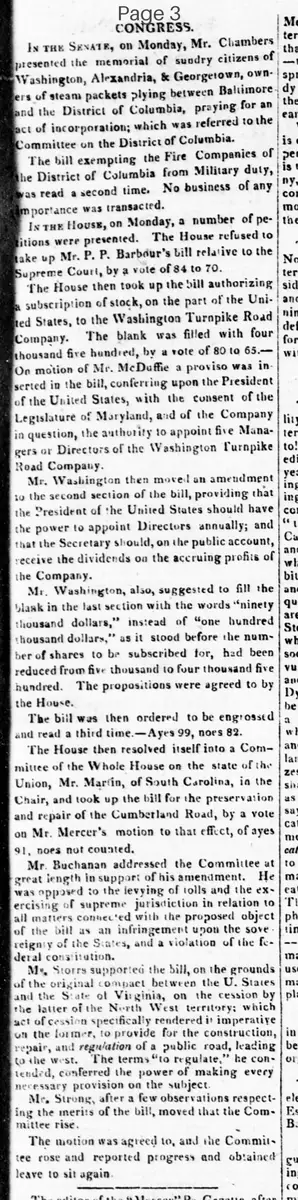
In the Senate, on Monday, Mr. Chambers presented the memorial of sundry citizens of Washington, Alexandria, & Georgetown, owners of steam packets plying between Baltimore and the District of Columbia, praying for an act of incorporation; which was referred to the Committee on the District of Columbia.
The bill exempting the Fire Companies of the District of Columbia from Military duty, was read a second time. No business of any importance was transacted.
In the House, on Monday, a number of petitions were presented. The House refused to take up Mr. P. P. Barbour's bill relative to the Supreme Court, by a vote of 84 to 70.
The House then took up the bill authorizing a subscription of stock, on the part of the United States, to the Washington Turnpike Road Company. The blank was filled with four thousand five hundred, by a vote of 80 to 65.
On motion of Mr. McDuffie a proviso was inserted in the bill, conferring upon the President of the United States, with the consent of the Legislature of Maryland, and of the Company in question, the authority to appoint five Managers or Directors of the Washington Turnpike Road Company.
Mr. Washington then moved an amendment to the second section of the bill, providing that the President of the United States should have the power to appoint Directors annually; and that the Secretary should, on the public account, receive the dividends on the accruing profits of the Company.
Mr. Washington, also, suggested to fill the blank in the last section with the words "ninety thousand dollars," instead of "one hundred thousand dollars," as it stood before the number of shares to be subscribed for, had been reduced from five thousand to four thousand five hundred. The propositions were agreed to by the House.
The bill was then ordered to be engrossed and read a third time. Ayes 99, noes 82.
The House then resolved itself into a Committee of the Whole House on the state of the Union, Mr. Martin, of South Carolina, in the Chair, and took up the bill for the preservation and repair of the Cumberland Road, by a vote on Mr. Mercer's motion to that effect, of ayes 91, noes not counted.
Mr. Buchanan addressed the Committee at great length in support of his amendment. He was opposed to the levying of tolls and the exercising of supreme jurisdiction in relation to all matters connected with the proposed object of the bill as an infringement upon the sovereignty of the States, and a violation of the federal constitution.
Mr. Storrs supported the bill, on the grounds of the original compact between the U. States and the State of Virginia, on the cession by the latter of the North West territory; which act of cession specifically rendered it imperative on the former, to provide for the construction, repair, and regulation of a public road, leading to the west. The terms "to regulate," he contended, conferred the power of making every necessary provision on the subject.
Mr. Strong, after a few observations respecting the merits of the bill, moved that the Committee rise.
The motion was agreed to, and the Committee rose and reported progress and obtained leave to sit again.
What sub-type of article is it?
What keywords are associated?
What entities or persons were involved?
Where did it happen?
Story Details
Key Persons
Location
Washington, D.C.
Event Date
On Monday
Story Details
Senate: Memorial for steam packet incorporation referred; fire companies bill read second time. House: Petitions presented; Supreme Court bill rejected 84-70; Washington Turnpike bill advanced with amendments for stock subscription of 4,500 shares ($90,000), presidential appointment of directors; engrossed 99-82. Committee debates Cumberland Road bill on constitutional issues of state sovereignty vs. federal compact with Virginia.