Thank you for visiting SNEWPapers!
Sign up free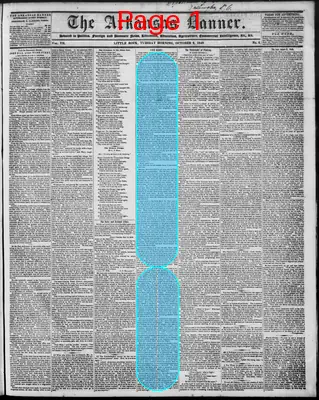
Literary
October 2, 1849
The Arkansas Banner
Little Rock, Pulaski County, Arkansas
What is this article about?
A father addresses his daughter on the eve of her marriage, reminiscing about her birth, infancy, christening, and childhood, emphasizing that the parental love she received was deeper and more profound than any romantic attachment she will know.
Clipping

OCR Quality
98%
Excellent
Full Text
Come hither, my daughter; your marriage-day is at hand; you will not be such longer the light of this old house. Sit by me, and I will once more tell you a story, as I used to do, when you were a little girl, and looked up in bright-eyed wonder at my tale.
I doubt not William has told you often enough that you are all in all to him; that no one human being ever was to another what you are to him;" that he feels for you a deeper, tenderer, purer, more disinterested devotion, than ever man felt for woman. Don't believe him. Nay, never start and turn pale, the young rascal believes what he says to be true, and that ought to be enough for you. What I mean is, that I have in my day said and felt as much for the old woman on the other side of the chimney there.
But I mean something more than that. You have yourself been the object of a deeper, tenderer, purer more disinterestedly devoted attachment than his. Now, don't grow angry, though it becomes you too, and bespeaks the sincere confiding spirit of the bride. He, too, would be in a towering passion if he heard me; and yet neither of you have cause.
You do not understand me; nor will you, nor can you, till you come to be yourself a mother.
The riddle is out, I mean that you were a person of much more consequence in the eyes of two others—eh, old dame?—that you were the object of a more profound love than you ever can be again, long, long before you knew how delightful a thing it is to repay love with love.
You have been admired, and have been told that you were admired; and, though I your father say, who ought not to say it, you are worthy to be admired. And you have been flattered—by admiration; never deny it, girl, it is human nature, and sits prettily upon a young woman. But you were welcomed home, and admired, and watched over with far more solicitude before you were twelve months old, than ever you will be again. Strange it is, but it seems to be the unwavering rule of Providence, that the warmest affection should ever be squandered upon those who are unaware of the wealth which is heaping upon them.
It was a proud and happy day that of your birth. The ways were mud, and keen hail showers, alternating with sleet, were borne on the wind, that howled and thumped round the house, as if seeking to force its way in. And the bodily suffering of your mother scarcely exceeded the mental anxiety of the rest of the household. It was a heavenly summer time when all was over: wind or weather what did heed them, when she looked proudly up at me, as I looked at you lying in her arms?
After all, any disinterested person must have thought you a strange-looking creature. You had not learned how to make use of your eyes: one was turned up to your eyebrows, and the other down to your mouth
"Now, papa
Fact, fact; ask the old woman there, if you won't believe me.
But you were beautiful in our eyes, and in those of your good grandmother. She had been passing back and forward, the whole morning, between your mother's apartment and the parlor, thinking to keep up our spirits, but sinking them rather by her agitated looks. But when she came to tell me that all was well, she could not find her voice, and she did not need to find it, for her face was radiant. You were a lamp set down amongst us to enlighten all our faces. We had lived together, and thought we loved each other; but when you were added to the family group, it was as if a new revelation; and it seemed as if we had been living coldly and heartlessly with each other. A cord was around us, drawing us into closer relationship; and you, little unconscious elf, were the talisman that worked all these wonders.
I could write a big book about the first year of your life, and yet not contrive to say all I have to say, to show how much more important a baby is, than any grown or growing person possibly can be.
You will scarcely recollect the day of your christening. That, too, was a memorable day. Mother, nurse, grandmother—I cannot well say which looked most consequential; while you, the real heroine of the occasion, took it with unparalleled sang froid: you did not even seem to mind the beautiful rich lace cap, of which there is a family tradition that your mother was christened in it too: you positively slept through the ceremony, to the great consternation of the nurse, who held it a bad omen that you did not squall. But if you thought little I thought the more; for when I turned from the marble font to the altar window, where was painted the dove hovering over the cloudy chaos it was commissioned to impregnate with light and love, I felt awed and subdued, and anxious for my baby, and yet consoled; I felt that it was your inauguration into the sorrows of life. The mystic rite was the herald of the sufferings to which humanity is heir: but it was, at the same time, the pledge that God would temper the wind to the shorn lamb.
I will not tell you how we—for she, there, went foot for foot in feeling all my joys, cares, hopes, and fears about you; as, indeed, she has been the mirror of my life for I will not say how many years, bearing half my sorrows, and redoubling all my joys. I would not have said half so much for fear of making her vain. Never praise people to their faces, girl; it spoils them; but you see she is asleep, and can't hear me. What makes the old woman's head keep nudging at that rate behind her handkerchief? Has she been listening to us all this time?
I will say nothing of our care for you even in trifles,—of the long happy walk we had one day from bazaar to bazaar, to choose playthings fit for so very young a baby,—of the utter forgetfulness of my personal dignity, with which I used to bring biscuits to the baby from town in my great-coat pocket.
You would think I was wishing to bribe you by these recollections, not to forget the old folks when you leave them. It would be unkind to do so; it would look as if I thought you could forget them.
You grew up among us like an opening flower Every day we saw something new to love and praise in you. To hear us talk, one would have thought there never had been such a baby. A strange thing it is, a child! There is a delicate beauty about it, soft eyes, and rosy cheeks, and tiny mouth. It was so pretty to see the little monkey examine our hands, one after the other, to see if they contained sugar or biscuit. And it was so engaging when it held its little mouth to be kissed. And it was sparkling, when it dived down into its nurse's arms, and hid its face in her bosom, when playfully wrung. But strangest, loveliest of all, was its appearance when it seemed to be trying to think—when the consciousness of reason and eternity seemed to be dawning upon God's own image, shrinking abashed from the glories of its own nature.
And yet, my daughter, in moments of depression, —and such moments come to all,—there was something terrible in thy childish glee. When I reflected how trifling the cause of thy delight,—the absence of any reason why it should give thee delight,—the transitory nature of the delight it itself,—I was tempted to think that all human happiness was alike unreasonable and unnatural. Life seemed to be a succession of brief bursts of ecstasy, at long intervals, gradually growing duller and duller, till it ended in inane apathy. I will not dwell on the thought. It is one which mocks us in our happiest hour, and which not reason, faith alone can dispel.
But more desolate and dangerous emotions were awakened when illness came upon thee. There is nothing on earth so painful as to witness the sufferings of a child. We cannot divine their cause or nature, and it cannot tell; the impotency of human desire to give relief is never so painfully felt. The innocence and weakness, too, of the sufferer, conjure up rebellious thoughts. My God! I know that my own sufferings are the consequences of my own sins, but what has this innocent done? It is not alone when the little creature writhes in torture that we feel these misgivings: its uncomplaining languor goes with more deadly certainty to the heart. Oh, what a relief it has been, after such a visitation, to see my child's eye brighten again, and hear its blessed clear, soft voice breathing of happiness!
It were hard to say whether thy sufferings or thy enjoyments most endeared you to me. You have been a dear good daughter to your father, and you understand the playful exaggeration of this nursery legend. And yet it is not all exaggeration.
But go; my tears are under my eyelids, and I shall make a fool of myself if I go on. You will understand me better when you repeat to a child of your own the tale your father told you the night before your marriage.
I doubt not William has told you often enough that you are all in all to him; that no one human being ever was to another what you are to him;" that he feels for you a deeper, tenderer, purer, more disinterested devotion, than ever man felt for woman. Don't believe him. Nay, never start and turn pale, the young rascal believes what he says to be true, and that ought to be enough for you. What I mean is, that I have in my day said and felt as much for the old woman on the other side of the chimney there.
But I mean something more than that. You have yourself been the object of a deeper, tenderer, purer more disinterestedly devoted attachment than his. Now, don't grow angry, though it becomes you too, and bespeaks the sincere confiding spirit of the bride. He, too, would be in a towering passion if he heard me; and yet neither of you have cause.
You do not understand me; nor will you, nor can you, till you come to be yourself a mother.
The riddle is out, I mean that you were a person of much more consequence in the eyes of two others—eh, old dame?—that you were the object of a more profound love than you ever can be again, long, long before you knew how delightful a thing it is to repay love with love.
You have been admired, and have been told that you were admired; and, though I your father say, who ought not to say it, you are worthy to be admired. And you have been flattered—by admiration; never deny it, girl, it is human nature, and sits prettily upon a young woman. But you were welcomed home, and admired, and watched over with far more solicitude before you were twelve months old, than ever you will be again. Strange it is, but it seems to be the unwavering rule of Providence, that the warmest affection should ever be squandered upon those who are unaware of the wealth which is heaping upon them.
It was a proud and happy day that of your birth. The ways were mud, and keen hail showers, alternating with sleet, were borne on the wind, that howled and thumped round the house, as if seeking to force its way in. And the bodily suffering of your mother scarcely exceeded the mental anxiety of the rest of the household. It was a heavenly summer time when all was over: wind or weather what did heed them, when she looked proudly up at me, as I looked at you lying in her arms?
After all, any disinterested person must have thought you a strange-looking creature. You had not learned how to make use of your eyes: one was turned up to your eyebrows, and the other down to your mouth
"Now, papa
Fact, fact; ask the old woman there, if you won't believe me.
But you were beautiful in our eyes, and in those of your good grandmother. She had been passing back and forward, the whole morning, between your mother's apartment and the parlor, thinking to keep up our spirits, but sinking them rather by her agitated looks. But when she came to tell me that all was well, she could not find her voice, and she did not need to find it, for her face was radiant. You were a lamp set down amongst us to enlighten all our faces. We had lived together, and thought we loved each other; but when you were added to the family group, it was as if a new revelation; and it seemed as if we had been living coldly and heartlessly with each other. A cord was around us, drawing us into closer relationship; and you, little unconscious elf, were the talisman that worked all these wonders.
I could write a big book about the first year of your life, and yet not contrive to say all I have to say, to show how much more important a baby is, than any grown or growing person possibly can be.
You will scarcely recollect the day of your christening. That, too, was a memorable day. Mother, nurse, grandmother—I cannot well say which looked most consequential; while you, the real heroine of the occasion, took it with unparalleled sang froid: you did not even seem to mind the beautiful rich lace cap, of which there is a family tradition that your mother was christened in it too: you positively slept through the ceremony, to the great consternation of the nurse, who held it a bad omen that you did not squall. But if you thought little I thought the more; for when I turned from the marble font to the altar window, where was painted the dove hovering over the cloudy chaos it was commissioned to impregnate with light and love, I felt awed and subdued, and anxious for my baby, and yet consoled; I felt that it was your inauguration into the sorrows of life. The mystic rite was the herald of the sufferings to which humanity is heir: but it was, at the same time, the pledge that God would temper the wind to the shorn lamb.
I will not tell you how we—for she, there, went foot for foot in feeling all my joys, cares, hopes, and fears about you; as, indeed, she has been the mirror of my life for I will not say how many years, bearing half my sorrows, and redoubling all my joys. I would not have said half so much for fear of making her vain. Never praise people to their faces, girl; it spoils them; but you see she is asleep, and can't hear me. What makes the old woman's head keep nudging at that rate behind her handkerchief? Has she been listening to us all this time?
I will say nothing of our care for you even in trifles,—of the long happy walk we had one day from bazaar to bazaar, to choose playthings fit for so very young a baby,—of the utter forgetfulness of my personal dignity, with which I used to bring biscuits to the baby from town in my great-coat pocket.
You would think I was wishing to bribe you by these recollections, not to forget the old folks when you leave them. It would be unkind to do so; it would look as if I thought you could forget them.
You grew up among us like an opening flower Every day we saw something new to love and praise in you. To hear us talk, one would have thought there never had been such a baby. A strange thing it is, a child! There is a delicate beauty about it, soft eyes, and rosy cheeks, and tiny mouth. It was so pretty to see the little monkey examine our hands, one after the other, to see if they contained sugar or biscuit. And it was so engaging when it held its little mouth to be kissed. And it was sparkling, when it dived down into its nurse's arms, and hid its face in her bosom, when playfully wrung. But strangest, loveliest of all, was its appearance when it seemed to be trying to think—when the consciousness of reason and eternity seemed to be dawning upon God's own image, shrinking abashed from the glories of its own nature.
And yet, my daughter, in moments of depression, —and such moments come to all,—there was something terrible in thy childish glee. When I reflected how trifling the cause of thy delight,—the absence of any reason why it should give thee delight,—the transitory nature of the delight it itself,—I was tempted to think that all human happiness was alike unreasonable and unnatural. Life seemed to be a succession of brief bursts of ecstasy, at long intervals, gradually growing duller and duller, till it ended in inane apathy. I will not dwell on the thought. It is one which mocks us in our happiest hour, and which not reason, faith alone can dispel.
But more desolate and dangerous emotions were awakened when illness came upon thee. There is nothing on earth so painful as to witness the sufferings of a child. We cannot divine their cause or nature, and it cannot tell; the impotency of human desire to give relief is never so painfully felt. The innocence and weakness, too, of the sufferer, conjure up rebellious thoughts. My God! I know that my own sufferings are the consequences of my own sins, but what has this innocent done? It is not alone when the little creature writhes in torture that we feel these misgivings: its uncomplaining languor goes with more deadly certainty to the heart. Oh, what a relief it has been, after such a visitation, to see my child's eye brighten again, and hear its blessed clear, soft voice breathing of happiness!
It were hard to say whether thy sufferings or thy enjoyments most endeared you to me. You have been a dear good daughter to your father, and you understand the playful exaggeration of this nursery legend. And yet it is not all exaggeration.
But go; my tears are under my eyelids, and I shall make a fool of myself if I go on. You will understand me better when you repeat to a child of your own the tale your father told you the night before your marriage.
What sub-type of article is it?
Essay
Soliloquy
Prose Fiction
What themes does it cover?
Love Romance
Moral Virtue
Religious
What keywords are associated?
Parental Love
Daughter Marriage
Childhood Memories
Family Bonds
Birth Reminiscence
Christening
Infant Care
Human Suffering
Literary Details
Subject
Father's Reminiscences To Daughter On The Eve Of Her Marriage
Key Lines
You Do Not Understand Me; Nor Will You, Nor Can You, Till You Come To Be Yourself A Mother.
Strange It Is, But It Seems To Be The Unwavering Rule Of Providence, That The Warmest Affection Should Ever Be Squandered Upon Those Who Are Unaware Of The Wealth Which Is Heaping Upon Them.
You Were A Lamp Set Down Amongst Us To Enlighten All Our Faces.
I Felt That It Was Your Inauguration Into The Sorrows Of Life. The Mystic Rite Was The Herald Of The Sufferings To Which Humanity Is Heir: But It Was, At The Same Time, The Pledge That God Would Temper The Wind To The Shorn Lamb.
There Is Nothing On Earth So Painful As To Witness The Sufferings Of A Child.