Thank you for visiting SNEWPapers!
Sign up free
Daily National Era
Washington, District Of Columbia
What is this article about?
Detailed report of U.S. Senate and House proceedings on January 31, 1854, focusing on debates over the Nebraska Territory bill, railroad land grants, salary increases, and other legislation, with heated exchanges between Senators Chase and Douglas.
Merged-components note: Senate and House proceedings for the same day form a coherent report on Congressional activity; merged as a single domestic news unit.
Clipping
OCR Quality
Full Text
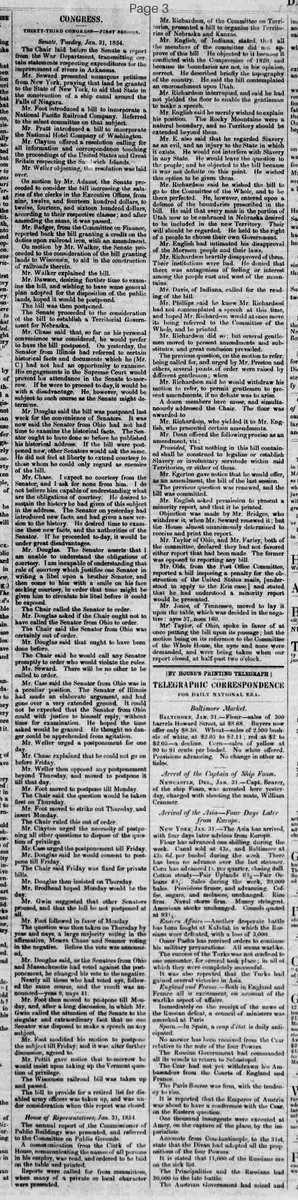
THIRTY-THIRD CONGRESS—FIRST SESSION.
Senate, Tuesday, Jan. 31, 1854.
The Chair laid before the Senate a report from the War Department, transmitting certain statements respecting expenditures for the improvement of rivers in Arkansas.
Mr. Seward presented numerous petitions from New York, praying that land be granted to the State of New York, to aid that State in the construction of a ship canal around the Falls of Niagara.
Mr. Foot introduced a bill to incorporate a National Pacific Railroad Company. Referred to the select committee on that subject.
Mr. Pratt introduced a bill to incorporate the National Hotel Company of Washington.
Mr. Clayton offered a resolution calling for all information and correspondence touching the proceedings of the United States and Great Britain respecting the Sandwich Islands. Mr. Weller objecting, the resolution was laid over.
On motion by Mr. Adams, the Senate proceeded to consider the bill increasing the salaries of the clerks in the Executive Offices, from nine, twelve, and fourteen hundred dollars, to twelve, fourteen, and sixteen hundred dollars, according to their respective classes; and after amending the same, it was passed.
Mr. Badger, from the Committee on Finance, reported back the bill granting a credit on the duties upon railroad iron, with an amendment.
On motion by Mr. Walker, the Senate proceeded to the consideration of the bill granting lands to Wisconsin, to aid in the construction of railroads therein.
Mr. Walker explained the bill. Mr. Dawson, desiring further time to examine the bill, and wishing to have some general plan adopted for the disposition of the public lands, hoped it would be postponed. The bill was then postponed.
The Senate proceeded to the consideration of the bill to establish a Territorial Government for Nebraska.
Mr. Chase said that, so far as his personal convenience was considered, he would prefer to have the bill postponed. On yesterday, the Senator from Illinois had referred to certain historical facts and documents which he (Mr. C.) had not had an opportunity to examine. His engagements in the Supreme Court would prevent his attendance in the Senate to-morrow. If he were to proceed to-day, it would be with a disadvantage. He, however, would be subject to such course as the Senate might determine.
Mr. Douglas said the bill was postponed last week for the convenience of Senators. It was now said the Senator from Ohio had not had time to examine the historical facts. The Senator ought to have done so before he published his historical address. If the bill were postponed now, other Senators would ask the same. He did not feel at liberty to extend courtesy to those whom he could only regard as enemies of the bill.
Mr. Chase. I expect no courtesy from the Senator, and I ask for none from him. I do not believe him capable of understanding what are the obligations of courtesy. He desired to sustain the history he had given of this subject in the address. The Senator on yesterday had introduced new facts, and had given a new version to the history. He desired time to examine these new facts, and the authorities of the Senator. If he proceeded to-day, it would be under great disadvantages.
Mr. Douglas. The Senator asserts that I am unable to understand the obligations of courtesy. I am incapable of understanding that rule of courtesy which justifies one Senator in writing a libel upon a brother Senator, and then come to him with a smile on his face seeking courtesy, in order that time might be given him to circulate his libel before it could be exposed.
The Chair called the Senator to order.
Mr. Douglas asked if the Chair ought not to have called the Senator from Ohio to order. The Chair said the Senator from Ohio was certainly out of order. Mr. Douglas said that ought to have been done before. The Chair said he would call any Senator promptly to order who would violate the rules.
Mr. Seward. There will be no other to be called to order.
Mr. Cass said the Senator from Ohio was in a peculiar position. The Senator of Illinois had made an elaborate argument, and had gone over a very extended ground. It could not be expected that the Senator from Ohio could with justice to himself reply, without time for examination. He hoped the time asked would be granted. He thought no danger could be apprehended from agitation.
Mr. Weller urged a postponement for one day.
Mr. Chase explained that he could not go on before Friday.
Mr. Weller then opposed any postponement beyond Thursday, and moved to postpone it till that day.
Mr. Foot moved to postpone till Monday. The Chair said the question would be taken first on Thursday.
Mr. Foot moved to strike out Thursday, and insert Monday. The Chair ruled this out of order.
Mr. Clayton urged the necessity of postponing all other questions to dispose of the question of privilege.
Mr. Cass urged the postponement till Friday.
Mr. Douglas said he would consent to postpone till Friday. The Chair said Friday was fixed for private bills. Mr. Douglas then insisted on Thursday.
Mr. Brodhead hoped Monday would be the day.
Mr. Gwin suggested that other Senators proceed, and that the bill be not postponed at all.
Mr. Foot followed in favor of Monday. The question was then taken on Thursday by yeas and nays, a large majority voting in the affirmative, Messrs. Chase and Sumner voting in the negative. Before the vote was announced,
Mr. Douglas said, as the Senators from Ohio and Massachusetts had voted against the postponement, he changed his vote to the negative. Nearly all those who had voted aye, followed the same course, and the result was announced—yeas 9, nays 41.
Mr. Foot then moved to postpone till Monday, and, after a long discussion, in which Mr. Gwin called the attention of the Senate to the singular and extraordinary fact that no one Senator was disposed to make a speech on any subject,
Mr. Foot modified his motion to postpone the subject till Friday; and it was, after further discussion, agreed to.
Mr. Pettit gave notice that to-morrow he would insist upon taking up the Vermont question of privilege.
The Wisconsin railroad bill was taken up and passed.
The bill to provide for a retired list for disabled army officers was taken up, and was under consideration when this report was closed.
House of Representatives, Jan. 31, 1854.
The annual report of the Commissioner of Public Buildings was presented, and referred to the Committee on Public Grounds.
A communication from the Clerk of the House, communicating the names of all persons in his employ, was read, and ordered to be laid on the table and printed.
Reports were called for from committees, when many of a private or local character were presented.
Mr. Richardson, of the Committee on Territories, presented a bill to organize the Territories of Nebraska and Kansas.
Mr. English, of Indiana, stated, that all the members of the committee did not approve of this bill. He objected to it because it conflicted with the Compromise of 1820, and because its boundaries are not, in his opinion, correct. He described briefly the topography of the country. He said the bill contemplated an encroachment upon Utah.
Mr. Richardson interrupted, and said he had not yielded the floor to enable the gentleman to make a speech.
Mr. English said he merely wished to explain his position. The Rocky Mountains were a natural boundary, and no Territory should be extended beyond them.
Mr. E. also said that he regarded Slavery as an evil, and an injury to the State in which it exists. He would not interfere with Slavery in any State. He would leave the question to the people; and he objected to the bill because it was not definite on this point. He wished this option to be given them.
Mr. Richardson said he wished the bill to go to the Committee of the Whole, and to be there perfected. He, however, entered upon a defence of the boundaries prescribed in the bill. He said that every man in the portion of Utah now to be embraced in Nebraska desired to be included in the new Territory. Their will should be regarded. He held to the right of a people to choose their own Government.
Mr. English had intimated his disapproval of the Mormon people and their laws.
Mr. Richardson heartily disapproved of them. Their institutions were bad. He denied that there was antagonism of feeling or interest among the people east and west of the mountains.
Mr. Davis, of Indiana, called for the reading of the bill.
Mr. Phillips said he knew Mr. Richardson had not contemplated a speech at this time, and hoped Mr. Richardson would at once move its being referred to the Committee of the Whole, and be printed.
Mr. Richardson did so; but several gentlemen moved to present amendments and substitutes, and great confusion prevailed.
The previous question, on the motion to refer, being called for, and urged by Mr. Preston and others, several points of order were raised by different gentlemen; when
Mr. Richardson said he would withdraw his motion to refer, to permit gentlemen to present amendments, if no debate was to arise.
A dozen members here arose, and simultaneously addressed the Chair. The floor was awarded to Mr. Richardson, who yielded it to Mr. English, who presented certain amendments.
Mr. Dean offered the following proviso as an amendment, viz:
Provided, That nothing in this bill contained shall be construed to legalize or establish Slavery or involuntary servitude within said Territories, or either of them.
Mr. Egerton gave notice that he would offer, as an amendment, the bill of the last session.
The previous question was renewed, and the bill was committed.
Mr. English asked permission to present a minority report, and that it be printed. Objection was made by Mr. Bridges, who withdrew it, when Mr. Seward renewed it; but the House almost unanimously determined to receive and print the report.
Mr. Taylor of Ohio, and Mr. Farley, both of the committee, declared they had not favored either report that had been made. The former was opposed to reporting any bill.
Mr. Olds, from the Post Office Committee, reported a bill imposing a penalty for the obstruction of the United States mails, (understood to apply to the Erie case,) and stated that he had understood a minority report would be presented.
Mr. Jones, of Tennessee, moved to lay it upon the table, which was decided in the negative: ayes 57, noes 160.
Mr. Taylor, of Ohio, spoke in favor of at once putting the bill upon its passage; but the motion being on its reference to the Committee of the Whole House, the ayes and noes were demanded, and were being taken when our report closed, at half-past two o'clock.
What sub-type of article is it?
What keywords are associated?
What entities or persons were involved?
Where did it happen?
Domestic News Details
Primary Location
Washington
Event Date
Tuesday, Jan. 31, 1854
Key Persons
Outcome
nebraska bill postponed to friday; wisconsin railroad bill passed; clerks' salaries increased and bill passed; other bills referred or under consideration; house bill on nebraska and kansas committed with amendments proposed on slavery; mail obstruction bill not tabled.
Event Details
The Senate discussed reports, petitions, and bills including river improvements in Arkansas, Niagara ship canal, National Pacific Railroad, National Hotel Company, Sandwich Islands correspondence, clerks' salary increases (passed), railroad iron duties, Wisconsin railroad lands (postponed then passed), and Nebraska Territory government (debated heatedly between Chase and Douglas, postponed to Friday). The House presented reports, a bill to organize Nebraska and Kansas Territories (debated on boundaries, slavery, Mormon issues; committed with amendments), and a bill on mail obstruction penalties (under consideration).