Thank you for visiting SNEWPapers!
Sign up free
The New Hampshire Gazette
Portsmouth, Rockingham County, New Hampshire
What is this article about?
Abstract of Edmund Randolph's vindication following suspicions from intercepted letter by French minister Joseph Fauchet, leading to his resignation as U.S. Secretary of State in August 1795. Includes Washington's response, Randolph's pursuit of clarification from Fauchet, and excerpts from Fauchet's dispatches denying any improper dealings.
Merged-components note: Continuous narrative article on Randolph's Vindication spanning pages 1 and 2, relabeled to 'story' as it is a full narrative article despite international elements.
Clippings
1 of 2
OCR Quality
Full Text
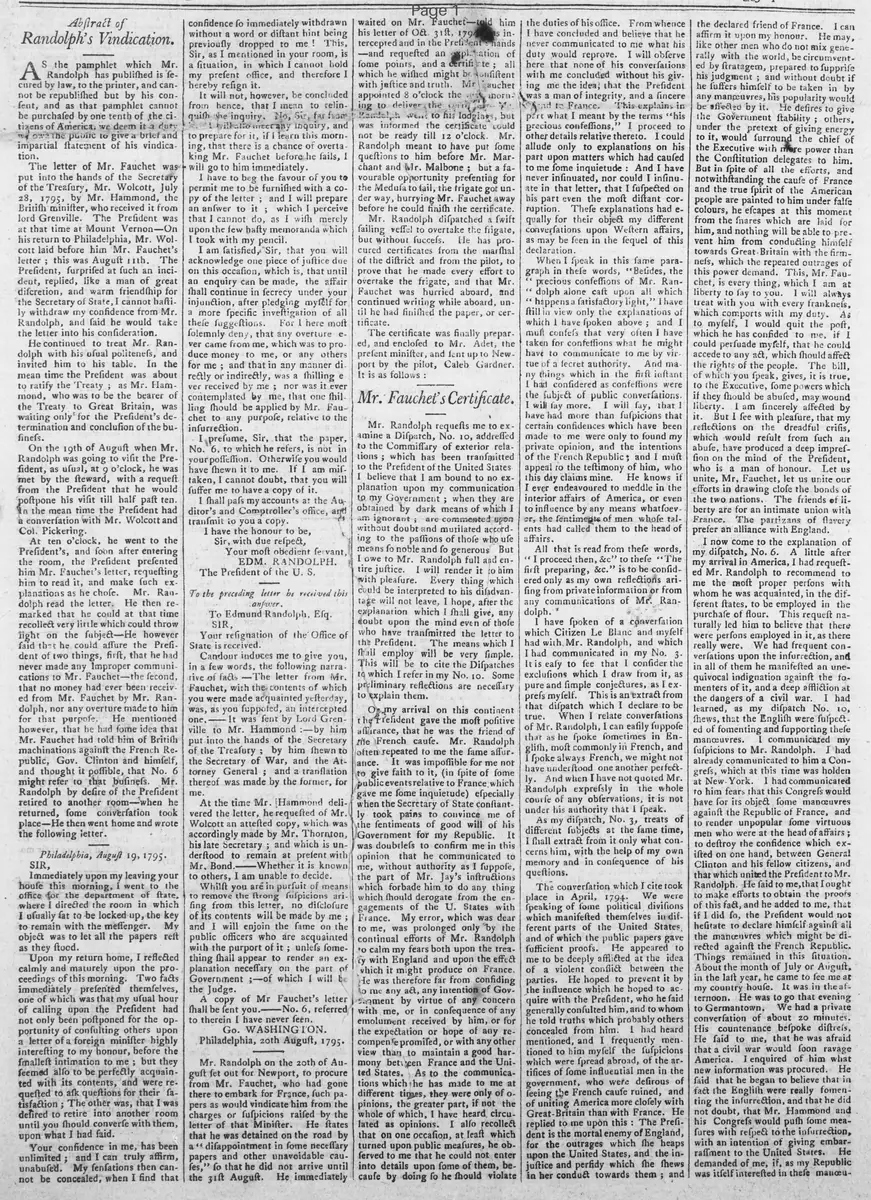
As the pamphlet which Mr. Randolph has published is secured by law, to the printer, and cannot be republished but by his consent, and as that pamphlet cannot be purchased by one tenth of the citizens of America, we deem it a duty we owe the public to give a brief and impartial statement of his vindication.
The letter of Mr. Fauchet was put into the hands of the Secretary of the Treasury, Mr. Wolcott, July 28, 1795, by Mr. Hammond, the British minister, who received it from Lord Grenville. The President was at that time at Mount Vernon. On his return to Philadelphia, Mr. Wolcott laid before him Mr. Fauchet's letter; this was August 1st. The President, surprised at such an incident, replied, like a man of great discretion, and warm friendship for the Secretary of State, I cannot hastily withdraw my confidence from Mr. Randolph, and said he would take the letter into his consideration.
He continued to treat Mr. Randolph with his usual politeness, and invited him to his table. In the mean time the President was about to ratify the Treaty; as Mr. Hammond, who was to be the bearer of the Treaty to Great Britain, was waiting only for the President's determination and conclusion of the business.
On the 19th of August when Mr. Randolph was going to visit the President, as usual, at 9 o'clock, he was met by the steward, with a request from the President that he would postpone his visit till half past ten.
In the mean time the President had a conversation with Mr. Wolcott and Col. Pickering.
At ten o'clock, he went to the President's, and soon after entering the room, the President presented him Mr. Fauchet's letter, requesting him to read it, and make such explanations as he chose. Mr. Randolph read the letter. He then remarked that he could at that time recollect very little which could throw light on the subject. He however said that he could assure the President of two things, first, that he had never made any improper communications to Mr. Fauchet—the second, that no money had ever been received from Mr. Fauchet by Mr. Randolph, nor any overture made to him for that purpose. He mentioned however, that he had some idea that Mr. Fauchet had told him of British machinations against the French Republic, Gov. Clinton and himself, and thought it possible, that No. 6 might refer to that business. Mr. Randolph by desire of the President retired to another room—when he returned, some conversation took place—He then went home and wrote the following letter.
Philadelphia, August 19, 1795.
SIR,
Immediately upon my leaving your house this morning, I went to the office for the department of state, where I directed the room in which I usually sit to be locked up, the key to remain with the messenger. My object was to let all the papers rest as they stood.
Upon my return home, I reflected calmly and maturely upon the proceedings of this morning. Two facts immediately presented themselves, one of which was that my usual hour of calling upon the President had not only been postponed for the opportunity of consulting others upon a letter of a foreign minister highly interesting to my honour, before the smallest intimation to me; but they seemed also to be perfectly acquainted with its contents, and were requested to ask questions for their satisfaction; The other was, that I was desired to retire into another room until you should converse with them, upon what I had said.
Your confidence in me, has been unlimited; and I can truly affirm, un abused. My sensations then cannot be concealed, when I find that confidence so immediately withdrawn without a word or distant hint being previously dropped to me! This, Sir, as I mentioned in your room, is a situation, in which I cannot hold my present office. and therefore I hereby resign it.
It will not, however, be concluded from hence, that I mean to relinquish the inquiry. No, Sir, far from it. I will also pursue any inquiry, and to prepare for it, if I learn this morning, that there is a chance of overtaking Mr. Fauchet before he sails. will go to him immediately.
I have to beg the favour of you to permit me to be furnished with a copy of the letter; and I will prepare an answer to it; which I perceive that I cannot do, as I wish merely upon the few hasty memoranda which I took with my pencil.
I am satisfied, Sir, that you will acknowledge one piece of justice due on this occasion, which is, that until an enquiry can be made, the affair shall continue in secrecy under your injunction, after pledging myself for a more specific investigation of all these suggestions. For I here most solemnly deny, that any overture ever came from me, which was to produce money to me, or any others for me; and that in any manner directly or indirectly, was a shilling ever received by me; nor was it ever contemplated by me, that one shilling should be applied by Mr. Fauchet to any purpose, relative to the insurrection.
I presume, Sir, that the paper, No. 6, to which he refers, is not in your possession. Otherwise you would have shewn it to me. If I am mistaken, I cannot doubt, that you will suffer me to have a copy of it.
I shall pass my accounts at the Auditor's and Comptroller's office, and transmit to you a copy.
I have the honour to be,
Sir, with due respect,
Your most obedient servant,
EDM. RANDOLPH.
The President of the U. S.
To the preceding letter he received this answer.
To Edmund Randolph, Esq
SIR,
Your resignation of the Office of State is received.
Candour induces me to give you, in a few words, the following narrative of facts -The letter from Mr. Fauchet, with the contents of which you were made acquainted yesterday, was, as you supposed, an intercepted one.-- It was sent by Lord Grenville to Mr. Hammond :-by him put into the hands of the Secretary of the Treasury; by him shewn to the Secretary of War, and the Attorney General; and a translation thereof was made by the former, for me.
At the time Mr. Hammond delivered the letter, he requested of Mr. Wolcott an attested copy, which was accordingly made by Mr. Thornton, his late Secretary; and which is understood to remain at present with Mr, Bond.--Whether it is known to others, I am unable to decide.
Whilst you are in pursuit of means to remove the strong suspicions arising from this letter, no disclosure of its contents will be made by me; and I will enjoin the same on the public officers who are acquainted with the purport of it; unless something shall appear to render an explanation necessary on the part of Government ;-of which I will be the Judge.
A copy of Mr Fauchet's letter shall be sent you.--No. 6, referred to therein I have never seen.
Go. WASHINGTON
Philadelphia, 20th August, 1795.
Mr. Randolph on the 20th of August set out for Newport, to procure from Mr. Fauchet, who had gone there to embark for France, such papers as would vindicate him from the charges or suspicions raised by the letter of that Minister. He states that he was detained on the road by a disappointment in some necessary papers and other unavoidable causes, so that he did not arrive until the 31st August. He immediately waited on Mr. Fauchet—told him his letter of Oct. 31st, 1794 was intercepted and in the President's hands -and requested an explanation of some points, and a certificate : all which he wished might be consistent with justice and truth. Mr. Fauchet appointed 8 o'clock the morning to deliver the writing ..
Versus. I could not by the means of some correspondents procure some information of what was passing. I answered him that I believed I could. He replied on this, that having formed many connections by the means of flour contracts, three or four persons among the different contractors might, by talents, energy, and some influence, procure the necessary information, and save America from a civil war, by proving that England interfered in the troubles of the West. I do not recollect that he gave to me at that time any details upon the manner, in which this discovery would produce this last effect. But I perfectly recollect to have heard it said by some person or other, that the insurgents would be abandoned by the greatest number of those whom they believed to be on their side: and that the militia would march with cheerfulness, if it were proved that the English were at the bottom of those manoeuvres. I think therefore, that this was probably the manner in which he conceived that things would be settled; and that he thought that the insurrection would cease from the want of support.
At the moment of his mounting his horse, he observed to me, that the man, whom I might be able to employ, might be debtors of English merchants; that in this case, they might perhaps be exposed, on the slightest movement which they should make in this important affair, to see themselves harassed by process, and even arrested by the pursuits of their creditors. He asked me if the payments of the sums which were due to them by virtue of the existing contracts, would not be sufficiently early to render these individuals, independent of British persecution. I confess, that this proposition, to obtain this intelligence, surprised me. I was astonished that the government itself did not procure for itself information so precious. And I made the reflections, contained in my letter on this affair, because I believed, and do still believe, that all the citizens in the United States, ought to endeavour to furnish intelligence so important without being stopped by the English persecution; and because I moreover thought, when I committed my reflections to paper, that it was proposed to obtain the foregoing intelligence, by assisting with loans those who had contracted with me. But now calling to mind all the circumstances to which the questions of Mr. Randolph called my attention, I have an intimate conviction that I was mistaken in the propositions which I supposed to have been made to me.
I declare moreover that no name nor sum was mentioned to me: that Mr. Randolph never received, either directly or indirectly, by himself or by another for his use, one shilling from myself, by my order, or, according to my knowledge, hearsay or belief, from any other public officer of France. I declare he never made to me in this respect a single overture; and that no part of the above circumstance has the least relation to him personally. Farther I solemnly declare, that from the time of my arrival I have repeated, when an opportunity has presented itself, and without doubt often in the presence of Mr. Randolph, that the morals of my nation, and the candour of my government severely forbid the use of money in any circumstances which could not be publicly avowed.
Signed,
JOSEPH FAUCHET.
I the undersigned Peter Augustus Adet, Minister Plenipotentiary of the French Republic, certify that the foregoing Copy is absolutely conformable to the declaration which citizen Fauchet, my predecessor, has written and signed with his own hand, and which he has sent me to be lodged in the Archives of the French Legation, and in order that a copy conformable thereto may be delivered to Mr. Randolph.
In testimony of which I have signed these Presents at Philadelphia, on the 5th complementary day, in the 3d year of the French Republic, one and indivisible, September 27, 1795. (Old Style.)
P. A. ADET.
Extract from the Political Dispatch, No. 3, of JOSEPH FAUCHET, to the Minister of Foreign Affairs.
"When the Secretary of State appeared to open himself without reserve. He imparted to me the intestine divisions which were rumbling in the United States. The idea of an approaching commotion affected him deeply. He hoped to prevent it, by the ascendancy which he daily acquired over the mind of the President, who consulted him in all affairs and to whom he told the truth, which his colleagues disguised from him.
"The President of the United States says he, is the mortal enemy of England, and the friend of France. I can affirm it upon my honor. But, not mixing with the world, he may be circumvented by the dark manoeuvres of some men, who wind themselves in an hundred ways to draw him into measures which will cause him to lose all his popularity. Under the pretext of giving energy to government, they would absolutely make a monarch of him. They deceive him, as to the true spirit of the people, as well as upon the affairs of France. I am sure, that at this moment he escapes from them, and that in all these perfidious manoeuvres they have not been able to dissuade him from pronouncing with vigor against the Ministry of England. He has--but it is impossible for me, in conscience, to make you this confession. I should betray the duties of my office. Every thing which I can say to you is, that it is important for our two nations that you continue to visit him frequently--He will be touched with the proofs of friendship which you shall testify to him; and I am sure, that this will be an infallible means of causing them to be valued. I would quit the post which he has confided to me, if he could be brought to make any attempt upon the rights of the people. A bill has passed the house of representatives, which wounds liberty. They have at least taken away
the article which prevents the sale of the French prizes in our ports. My heart is troubled by it. But I have seen with pleasure, that my reflections on this subject, upon the dreadful crisis which would result from an abuse of it, have made a deep impression upon the mind, I will even say, upon the heart, of the President, who is an honorable man. Let us unite, Mr. Fauchet, to draw our two nations closer together. Those who love liberty are for fraternizing with the French Republic; the partisans of slavery prefer an alliance with England.
"I, he said to me, (in speaking of the treaty of Jay) that there is no question in his mission, but to demand a solemn reparation for the spoliations which our commerce has experienced on the part of England; and to give you a proof, that Mr. Jay cannot enter into a negotiation contrary to what we owe to France, I will give you the part of the instructions which concern it.
"Although the following note which I have written in his own hand, with a promise to burn it, be little important, I annex it hereto.
"If the English ministry shall insinuate, that the whole or any part of these instructions should appear to be influenced by a supposed predilection in favor of France, you will arrest the subject as being foreign to the present question. It is what the English nation has no right to object to; because we are free in our sentiments, and independent in our government."
"The following case is to be unchangeable. As there is no doubt, that the English ministry will endeavour to detach us from France, you will inform them of the firm determination of the government of the United States, not to deviate from our treaties, or our engagements with France."
Extract from the Political Dispatch, No. 6, of Citizen Fauchet; Minister Plenipotentiary of the French Republic to the United States.
"Scarce was the commotion known, when the Secretary of State came to my house.--All his countenance was grief. He requested of me a private conversation. It is all over, he said to me. A civil war is about to ravage our unhappy country. Four men by their talents, their influence, and their energy may save it. But debtors of English merchants, they will be deprived of their liberty, if they take the smallest step.--Could you lend them instantaneously funds sufficient to shelter them from English persecution? This enquiry astonished me much, It was impossible for me to make a satisfactory answer. -You know my want of power, and my defect of pecuniary means. I shall draw myself from the affair by some common place remarks, and by throwing myself on the pure and unalterable principles of the Republic.
"I have never since heard of propositions of this nature."
* The word affirm, appears to have been omitted in the certified copy.
(To be continued.)
What sub-type of article is it?
What themes does it cover?
What keywords are associated?
What entities or persons were involved?
Where did it happen?
Story Details
Key Persons
Location
Philadelphia
Event Date
1795 07 28 To 1795 09 27
Story Details
Intercepted letter from French minister Fauchet raises suspicions of improper communications and financial dealings with U.S. Secretary of State Randolph regarding the Whiskey Insurrection; Randolph resigns, seeks clarification from Fauchet, who denies any overtures or payments in a certified declaration; includes excerpts from Fauchet's dispatches detailing conversations with Randolph.