Thank you for visiting SNEWPapers!
Sign up free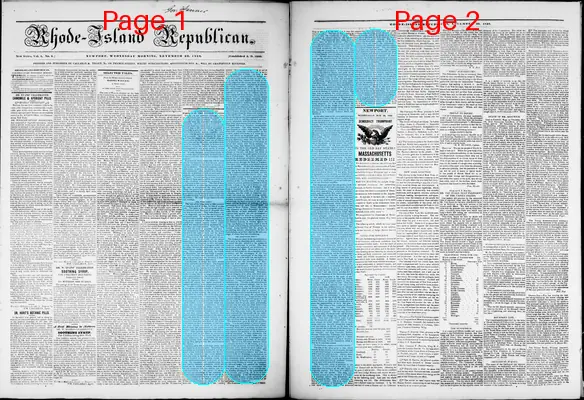
The Rhode Island Republican
Newport, Newport County, Rhode Island
What is this article about?
This editorial from the Boston Quarterly Review argues that U.S. political parties reflect human progress: Democrats as the forward-looking, patriotic party of man's supremacy, universal suffrage, and liberty; Whigs as retrograde supporters of commercial capital, tied to foreign credit systems like England's Bank, prioritizing money over humanity. It traces historical roles and predicts Democratic dominance.
Merged-components note: Continuation of the editorial 'PARTIES IN THE UNITED STATES' across page 1 and 2, based on sequential text content and reading order.
Clippings
1 of 2
OCR Quality
Full Text
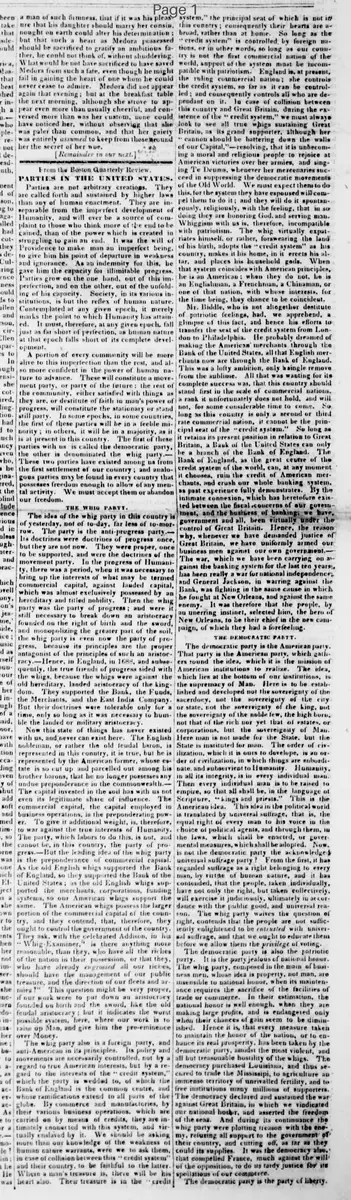
PARTIES IN THE UNITED STATES.
Parties are not arbitrary creations. They are called forth and sustained by higher laws than any of human enactment. They are inseparable from the imperfect development of Humanity, and will ever be a source of complaint to those who think more of the end to be gained, than of the power which is created in struggling to gain an end. It was the will of Providence to make man an imperfect being, to give him his point of departure in weakness and ignorance. As an indemnity for this, he gave him the capacity for illimitable progress. Parties grow on the one hand, out of this imperfection, and on the other, out of the unfolding of his capacity. Society, in its various institutions, is but the reflex of human nature. Contemplated at any given epoch, it merely marks the point to which Humanity has attained. It must, therefore, at any given epoch, fall just as far short of perfection, as human nature at that epoch falls short of its complete development.
A portion of every community will be more alive to this imperfection than the rest, and also more confident in the power of human nature to advance. These will constitute a movement party, or party of the future: the rest of the community, either satisfied with things as they are, or destitute of faith in man's power of progress, will constitute the stationary or stand still party. In some epochs, in some countries, the first of these parties will be in a feeble minority; in others, it will be in a majority, as it is at present in this country. The first of these parties with us is called the democratic party, the other is denominated the whig party.—These two parties have existed among us from the first settlement of our country; and analogous parties may be found in every country that possesses freedom enough to allow of any mental activity. We must accept them or abandon our freedom.
THE WHIG PARTY.
The idea of the whig party in this country is of yesterday, not of to-day, far less of to-morrow. The party is the anti-progress party.—Its doctrines were doctrines of progress once, but they are not now. They were proper, once to be supported, and were the doctrines of the movement party. In the progress of Humanity, there was a period, when it was necessary to bring up the interests of what may be termed commercial capital, against landed capital, which was almost exclusively possessed by an hereditary and titled nobility. Then the whig party was the party of progress; and were it still necessary to break down an aristocracy founded on the right of birth and the sword, and monopolizing the greater part of the soil, the whig party is even now the party of progress, because its principles are the proper antagonist of the principles of such an aristocracy.—Hence, in England, in 1688, and subsequently, the true friends of progress sided with the whigs, because the whigs were against the old hereditary, landed aristocracy of the kingdom. They supported the Bank, the Funds, the Merchants, and the East India Company. But their doctrines were tolerable only for a time, only so long as it was necessary to humble the landed or military aristocracy.
Now this state of things has never existed with us, and never can exist here. The English nobleman, or rather the old feudal baron, is represented in this country, it is true, but he is represented by the American farmer, whose estate is so cut up and parcelled out among his brother barons, that he no longer possesses any undue preponderance in the commonwealth.—The capital invested in the soil has with us not even its legitimate share of influence. The commercial capital, the capital employed in business operations, is the preponderating power. To give it additional weight, is, therefore, to war against the true interests of Humanity. The party, which labors to do this, is not, and cannot be, in this country, the party of progress.—But the leading idea of the whig party is the preponderance of commercial capital.
As the old English whigs supported the Bank of England, so they supported the Bank of the United States; as the old English whigs supported the merchants, corporations, funding systems, so our American whigs support the same. The American whigs possess the larger portion of the commercial capital of the country, and they contend, that, therefore, they ought to control the government of the country. They ask, with the celebrated Addison, in his "Whig-Examiner," is there anything more reasonable, than they, who have all the riches of the nation in their possession, or that they, who have already engrossed all our riches, should have the management of our public treasure, and the direction of our fleets and armies?" This question might be very proper, if our work were to put down an aristocracy founded on birth and the sword, like the old feudal aristocracy; but it indicates the worst possible system, here, where our work is to raise up Man, and give him the pre-eminence over Money.
The whig party also is a foreign party, and anti-American in its principles. Its policy and movements are necessarily controlled, not by a regard to true American interests, but by a regard to the interests of the "credit system," which the party is wedded to, of which the Bank of England is the common centre, and whose ramifications extend to all parts of the globe. By commerce and manufactures, by their various business operations, which are carried on by means of credits, they are intimately connected with this system, and virtually enslaved by it. We should be asking more than our knowledge of the weakness of human nature warrants, were we to ask them, in case of collision between this "credit system" and their country, to be faithful to the latter. Where a man's treasure is, there will be his heart also. Their treasure is in the "credit system," the principal seat of which is not in this country; consequently their hearts are abroad, rather than at home. So long as the "credit system" is controlled by foreign nations, or in other words, so long as our country is not the first commercial nation of the world, support of the system must be incompatible with patriotism. England is, at present, the ruling commercial nation; she controls the credit system, so far as it can be controlled; and consequently controls all who are dependent on it. In case of collision between this country and Great Britain, during the existence of the "credit system," we must always look to see all true whigs sustaining Great Britain, as its grand supporter, though her "cannon should be battering down the walls of our Capital,"—resolving, that it is unbecoming a moral and religious people to rejoice at American victories over her armies, and singing Te Deums, whenever her mercenaries succeed in suppressing the democratic movements of the Old World. We must expect them to do this, for the system they have espoused will compel them to do it; and they will do it spontaneously, religiously, with the feeling, that in so doing they are honoring God, and serving man.
Whiggism with us is, therefore, incompatible with patriotism. The whig virtually expatriates himself, or rather, forswearing the land of his birth, adopts the "credit system" as his country, makes it his home, in it erects his altar, and places his household gods. When that system coincides with American principles, he is an American: when they do not, he is an Englishman, a Frenchman, a Chinaman, or one of that nation, with whose interests, for the time being, they chance to be coincident.
Mr. Biddle, who is not altogether destitute of patriotic feelings, had, we apprehend, a glimpse of this fact, and hence his efforts to transfer the seat of the credit system from London to Philadelphia. He probably dreamed of making the American merchants through the Bank of the United States, all that English merchants now are through the Bank of England. This was a lofty ambition, only a single remove from the sublime. All that was wanting for its complete success was, that this country should stand first in the scale of commercial nations, a rank it unfortunately does not hold, and will not, for some considerable time to come. So long as this country is only a second or third rate commercial nation, it cannot be the principal seat of the "credit system." So long as it retains its present position in relation to Great Britain, a Bank of the United States can only be a branch of the Bank of England. The Bank of England, as the great centre of the credit system of the world, can, at any moment it chooses, ruin the credit of American merchants, and crush our whole banking system, as past experience fully demonstrates. By the intimate connexion, which has heretofore existed between the fiscal concerns of our government, and the business of banking, we have, government and all, been virtually under the control of Great Britain. Hence, the reason why, whenever we have demanded justice of Great Britain, we have uniformly armed our business men against our own government.—The war, which we have been carrying on against the banking system for the last ten years, has been really a war for national independence: and General Jackson, in warring against the Bank, was fighting in the same cause in which he fought at New Orleans, and against the same enemy. It was therefore that the people, by an unerring instinct, selected him, the hero of New Orleans, to be their chief in the new campaign, of which they had a forefeeling.
THE DEMOCRATIC PARTY.
The democratic party is the American party. That party in the American party, which gathers round the idea, which it is the mission of American institutions to realize. The idea, which lies at the bottom of our institutions, is the supremacy of Man. Here is to be established and developed not the sovereignty of the sacerdocy, not the sovereignty of the city or state, not the sovereignty of the king, not the sovereignty of the noble few, the high born, not that of the rich nor yet that of estates, or corporations, but the sovereignty of Man. Here man is not made for the State, but the State is instituted for man. The order of civilization, which it is ours to develope, is an order of civilization, in which things are subordinate and subservient to Humanity. Humanity, in all its integrity, is in every individual man. Then every individual man is to be raised to empire, so that all shall be, in the language of Scripture, "kings and priests." This is the American idea. This idea in the political world is translated by universal suffrage, that is, the equal right of every man to his voice in the choice of political agents, and through them, "the laws, which shall be enacted, or governmental measures, which shall be adopted. Now, is not the democratic party the acknowledged universal suffrage party? From the first, it has regarded suffrage as a right belonging to every man, by virtue of human nature, and it has contended, that the people, taken individually, have not only the right, but taken collectively, will exercise it judiciously, ultimately in accordance with the public good, and universal reason. The whig party waives the question of right, contends that the people are not sufficiently enlightened to be entrusted with universal suffrage, and that we ought to educate them before we allow them the privilege of voting.
The democratic party is also the patriotic party. It is the party jealous of national honor. The whig party, composed in the main of business men, whose idea is property, not man, are insensible to national honor, when its maintenance requires the sacrifice of the facilities of trade or commerce. In their estimation, the national honor is well enough, when they are making large profits, and is endangered only when their chances of gain seem to be diminished. Hence it is, that every measure taken to maintain the honor of the nation, or to enhance its real prosperity, has been taken by the democratic party, amidst the most violent, and all but treasonable hostility of the whigs. The democracy purchased Louisiana, and thus secured to trade the Mississippi, to agriculture an immense territory of unrivalled fertility, and to free institutions many millions of supporters. The democracy declared and sustained the war against Great Britain, in which we vindicated our national honor, and asserted the freedom of the seas. And during its continuance the whig party were plotting treason with the enemy, refusing all support to the government of their country, and cutting off, as far as they could its supplies. It was the democracy also, that compelled France, much against the will of the opposition, to do us tardy justice for its spoliations of our commerce.
The democratic party is the party of liberty. This is involved in the fact, that it was the American party. The idea of this country is, we have said, the supremacy of man. This supremacy is attained only by the broadest freedom. The American idea, under another aspect, then, is that of liberty. The truly American party always rallies around the quickening idea of liberty. No man can have the hardihood to pretend that liberty is the idea the whigs are struggling to bring out. The whig party is not particularly anxious to sustain or extend liberty, even according to its own account. Its sole objects, taken as its own witness, are the preservation of the Union of the States, and the support of the credit system. In this, it is true to itself. It is the business party of the country, and it is, and must be true to its idea. The Union of the States was, and is desirable, almost solely on account of the interests of trade and commerce. It facilitates trade between the different States, and gives us an imposing aspect, which favors our foreign commerce. Take away the aid which the Union of the States gives to trade and commerce, and the whigs would estimate its value somewhat below par. Their cry about the preservation of the Union, does not, then, proceed from their anxiety to maintain freedom, but to preserve certain advantages to trade. It is in relation to its bearing on business operations, that they wish to sustain the credit system. So that their dominant idea, according to their own showing, is the preservation or increase of facilities for business operations. They pursue business of course, for the purpose of accumulating property. So in the last analysis the dominant idea of the whig is not Man, but Property; and the contest between them and the democracy was rightly declared by Mr. Benton to be a contest between MAN and MONEY.
As the whig party is the party seeking to give predominance not to the idea of freedom, but to the idea of property, the protection of which Locke declares to be the end of government, it follows, that the democratic party is the party of freedom, or else we have no such party in this country. Its history proves that it is. In all controversies, it takes the side of liberty. In the convention which framed the Federal Constitution, it opposed centralism, and defended State rights. In the conventions which have framed our State constitutions, it has always favored those clauses, which leave the most liberty to the people; and best protect the rights of the individual. In the great struggle between the aristocratic and democratic elements of European society, which broke out in the French Revolution, and which has been continued, with various success, even to our own times, it has always sympathized with the people, and rejoiced in their successes. Its sympathies were with France, so long as France represented the democracy; while the whigs, or federalists, sympathized with England, as the representative of the aristocracy. In the late unsuccessful struggle of the Canadians for independence, the democratic party has been true to its idea of liberty. It has given them its sympathies and its prayers, and trusts yet to see the Canadas a free and independent nation. The day of emancipation yet lingers, but it will come, and we shall have a great and noble people for our Northern neighbor.
The democratic party has always been faithful to freedom of mind and conscience, the basis of all freedom. It has always opposed everything even approaching a religious establishment, and contended, that man's intercourse with his Maker should be free and voluntary. It has opposed all test laws, and uniformly frowned upon every effort to molest a man for his opinions. It inserted in the Federal Constitution the amendments, which forbid Congress to establish a religion, or to pass any law prohibiting freedom of speech, or of the press. It opposed the elder Adams and his party, because, in their Alien and Sedition Laws, they proved themselves the enemies of free thought and free utterance; and it raised Thomas Jefferson to the Presidential chair, because he was the unflinching friend of freedom of mind. It has always said, with Milton, "Let truth and falsehood grapple. Who ever knew truth put to the worse in free and open encounter? Her confuting is the best and surest suppressing."
The democratic party is the Christian party. Christianity is a revelation of God's mercy to man. It is always on the side of Freedom and Humanity. It addresses man as endowed with the capacity to judge of himself what is or is not right. Democracy is based on the fact, that man does really possess this capacity. Christianity, by addressing itself to all men necessarily recognizes this capacity in every man; democracy, by defending universal suffrage, does the same. Christianity values man for his simple humanity, not for his trappings, the accidents of birth, wealth, or position: so does democracy. Christianity aside from its design to fit the individual for communion with the blest after death, seeks to introduce a new order of things on the earth, to exalt the humble, abash the proud, to establish the reign of justice, and enable every man to "sit under his own vine and fig-tree, with none to molest or make afraid;" and who knows not that this is the aim and tendency of the democratic party!
The democratic party is the party of progress.--This is involved in what has already been said. A party gathers round an idea, or principle, which is its life, its soul. That idea can never abandon, and live; nor can it ever receive a new idea, without losing its identity. If left to itself, it will unfold, exhaust its idea; and having done this, it dies. Thus, English whiggism, having exhausted its original idea, having found its euthanasia, in the Reform Bill, has gone the way of all the earth, and is suffered to lie in state still, merely because neither Tories nor Radicals are prepared to assume the responsibility of heirs, and give it burial. The whigs in this country are demonstrating the same law. The idea, around which they gather, is offensive to a majority of the American people. This the more discerning of our whig friends perceive, and therefore, they would fain change the doctrines of the party. They have even tried to make it pass for the democratic party. Vain efforts! They may change its name, receive into its ranks many, who once thought themselves republicans, and submit to be led on by men, who once enjoyed the confidence of the democracy; but nothing can change its character: its identity remains; and your Lincolns, Seldens, Duanes, Verplancks, Tallmades, and Riveses, who generously undertake to give it a democratic aspect, can change nothing in its principles or direction, but are themselves swept away by its resistless current,
"To that bourne, whence no traveller returns."
The idea of the whig party is one, which cannot, in this country, rise to empire, because it is not broad enough to comprehend the work which God has given us to do. Always, therefore, will it be in the minority, or if not absolutely in the minority, so torn by intestine divisions, and so destitute of "available" leaders, that it must uniformly fail of success.
The democratic party is governed by the same law. It can receive no new idea, and it must share the fortunes of the idea which it originally started. But there is a difference between the two parties. The whig party gathered around an idea, which is of a limited and transient nature; the democratic party rallied round an idea, which is universal, immutable, and eternal. The whig seized upon one of the accidents of Humanity, the democrat upon Humanity itself. The democrat planted himself in the centre of the vast globe of Humanity, the whig placed himself on the circumference, where he hangs as a foreign substance, and from which he must be thrown the moment the globe revolves. The great idea of the democratic party is, as we have shown, under one aspect, the supremacy of man over his accidents, under another aspect, the reign of Eternal Justice. The two aspects are, in fact, one and the same. The mission of the democratic party is to unfold the great idea of Justice, and reduce it to practice in all man's social and political relations. It stands therefore, not as the representative of a fraction of the race, but of the race itself, and, therefore, like the race, it is immortal. This great idea of justice the party is destined to realize. From this work it cannot withdraw itself, even if it would. Its leaders may be false to it, and seek to betray it; but it leaves them by the way, and with or without new leaders, continues its march. No matter how high a rank a man may have held in its estimation, the moment he proves false to the mission of the party, he is left, though leaving him be like plucking out a right eye, or cutting off a right hand. Nothing from within can betray it or divert it from its onward course. Many of the most active members of the whig party were once in its ranks, but it has not missed them. It is never in want of a man competent to lead on its forces, nor of an "available" candidate for its suffrages. A panic may now and then occur, and produce a momentary confusion, but it instantly recovers itself, re-establishes order, and takes up its line of march, ready to grapple with any force it may meet.
What sub-type of article is it?
What keywords are associated?
What entities or persons were involved?
Editorial Details
Primary Topic
Analysis Of Whig And Democratic Parties As Forces Of Progress And Reaction In America
Stance / Tone
Strongly Pro Democratic, Portraying It As The Party Of Progress, Liberty, And Patriotism; Anti Whig As Anti Progressive And Foreign Influenced
Key Figures
Key Arguments