Thank you for visiting SNEWPapers!
Sign up free
The Kimball Graphic
Kimball, Brule County, South Dakota
What is this article about?
Description of the British Indian army's composition, strength, pay, pensions, and structure, highlighting native regiments of diverse nationalities to prevent mutiny and the superiority of Ghorkas.
Clipping
OCR Quality
Full Text
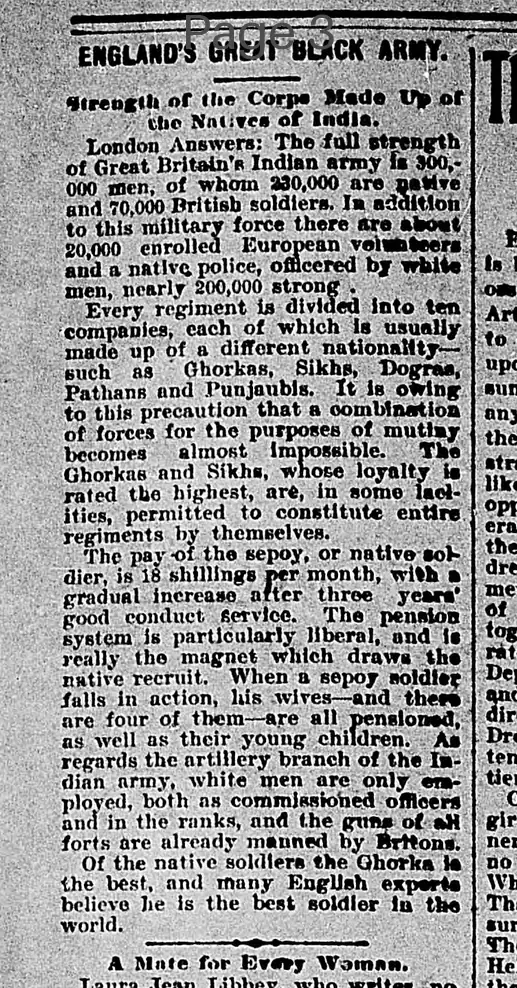
London Answers: The full strength of Great Britain's Indian army is 200,000 men, of whom 130,000 are native and 70,000 British soldiers. In addition to 20,000 enrolled European volunteers, this military force, there are a native police, officered by British men, nearly 200,000 strong. Every regiment is divided into ten companies, each of which is usually made up of a different nationality such as Ghorkas, Sikhs, Dogras, Pathans and Punjabis. It is owing to this precaution that a combination of forces for the purposes of mutiny becomes almost impossible. Ghorkas and Sikhs, whose loyalty is rated the highest, are, in some localities, permitted to constitute entire regiments by themselves.
The pay of the sepoy, or native soldier, is 18 shillings per month, with gradual increase after three years good conduct service. The pension system is particularly liberal, and is really the magnet which draws the native recruit. When a sepoy soldier falls in action, his wives—and there are four of them—are all pensioned as well as their young children.
As regards the artillery branch of the Indian army, white men are only employed, both as commissioned officers and in the ranks, and the guns of hill forts are already manned by British. Of the native soldiers the Ghorkas are the best, and many English experts believe he is the best soldier in the world.
What sub-type of article is it?
What keywords are associated?
Where did it happen?
Foreign News Details
Primary Location
India
Event Details
The British Indian army totals 200,000 men: 130,000 native, 70,000 British, plus 20,000 European volunteers and a 200,000-strong native police officered by British. Regiments mix nationalities like Ghorkas, Sikhs, Dogras, Pathans, Punjabis to prevent mutiny; loyal Ghorkas and Sikhs may form full regiments. Sepoy pay is 18 shillings monthly, increasing after three years; liberal pensions attract recruits, including for up to four wives and children if killed. Artillery uses only white men; Ghorkas considered the world's best native soldiers by English experts.