Thank you for visiting SNEWPapers!
Sign up free
The Patowmac Guardian, And Berkeley Advertiser
Martinsburg, Shepherdstown, Berkeley County, Jefferson County, West Virginia
What is this article about?
General Dumouriez issues manifesto from St. Amand on April 2 defending his services since 1789, accusing Convention leaders like Marat, Robespierre, and Pache of crimes, disbanding army by neglect, and provoking war; he announces arresting four commissioners and war minister Bournonville on April 1 per Convention decree, arranging armistice with Imperialists, and marching on Paris to restore 1789 constitution and end anarchy. Prince de Cobourg proclaims support on April 5 from Mons, offering to join forces to restore constitutional king and constitution, promising no conquests or disorders. Cobourg revokes on April 9, renewing war but maintaining troop discipline. National Convention sessions April 2-12 report Nantes sally success, Toulon denunciation of Paoli, Dumouriez's defiant letters from Tournay and St. Amand complaining of desertions (7-8000 men lost), poor army state, and proposing rewards against Convention; commissioners' letters from Valenciennes detail mass desertions starting April 4, Dumouriez fleeing by swimming river, army rejoining Republic under Dampierre, arrests of traitors, recapture of artillery (80 pieces, 500 wagons) and treasure; Biron's letter on repulsing enemy at Brain camp March 28 despite snow; motion to bring captured officers to Paris suspended; address to Belgic army denouncing Dumouriez and rallying troops; decree holding Bourbon family as hostages at Marseilles.
Merged-components note: These three components form a single continuous foreign news article compiling dispatches and reports from the French Revolution, including Dumourier's declaration, responses, and National Convention proceedings, spanning pages 1-3 with sequential reading orders.
Clippings
1 of 3
OCR Quality
Full Text
This is Event 1 of 2. The full text below covers all events in this component.
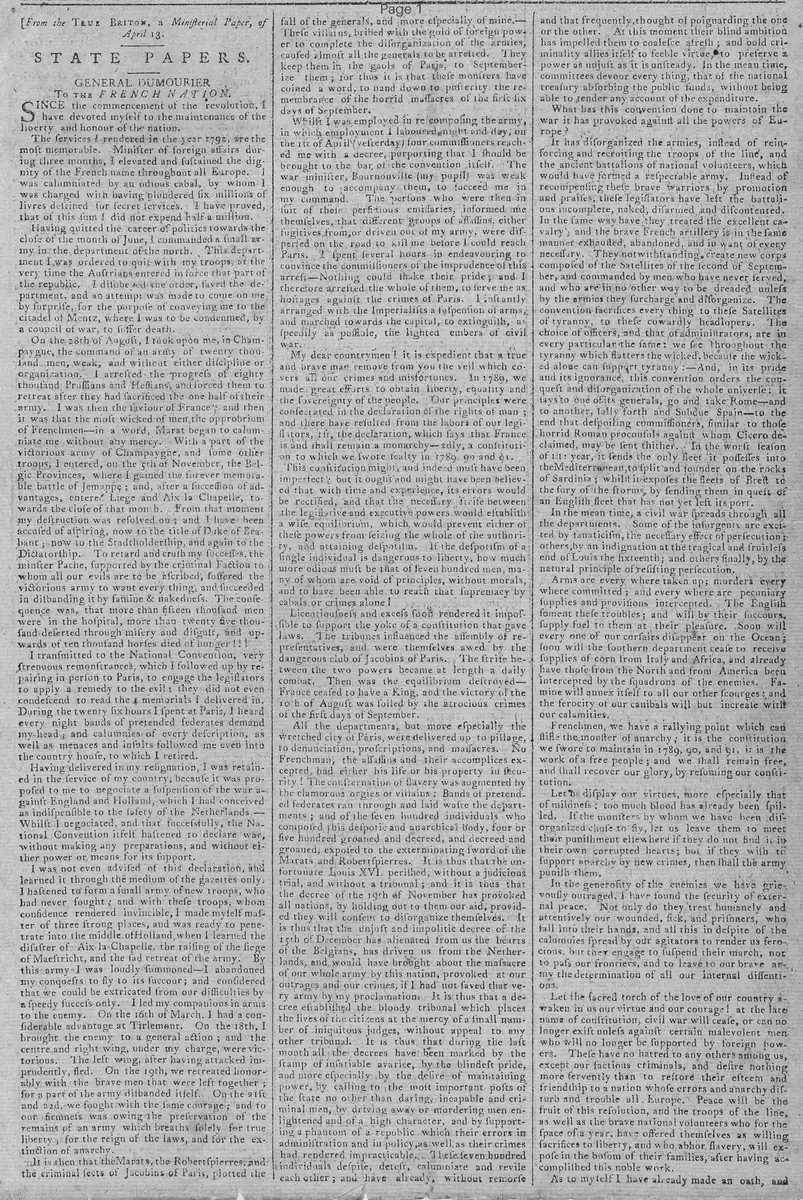
STATE PAPERS.
GENERAL DUMOURIER
TO THE FRENCH NATION.
Since the commencement of the revolution, I have devoted myself to the maintenance of the liberty and honour of the nation. The services I rendered in the year 1789, are the most memorable. Minister of foreign affairs during three months, I elevated and sustained the dignity of the French name throughout all Europe. I was calumniated by an odious cabal, by whom I was charged with having plundered six millions of livres destined for Secret services. I have proved, that of this sum I did not expend half a million. Having quitted the career of politics towards the close of the month of June, I commanded a small army in the department of the north. This department I was ordered to quit with my troops, at the very time the Austrians entered in force that part of the republic. I disobeyed the order, saved the department, and an attempt was made to come on me by surprise, for the purpose of conveying me to the citadel of Mentz, where I was to be condemned, by a council of war, to suffer death.
On the 28th of August, I took upon me, in Champagne, the command of an army of twenty thousand men, weak, and without either discipline or organization. I arrested the progress of eighty thousand Prussians and Austrians, and forced them to retreat after they had sacrificed the one half of their army. I was then the saviour of France; and then it was that the most wicked of men, the opprobrium of Frenchmen—in a word, Marat began to calumniate me without any mercy. With a part of the victorious army of Champagne, and some other troops, I entered, on the 6th of November, the Belgic Provinces, where I gained the forever memorable battle of Jemappes; and, after a succession of advantages, entered Liege and Aix la Chapelle, towards the close of that month. From that moment my destruction was resolved on; and I have been accused of aspiring, now to the title of Duke of Brabant; now to the Stadtholdership, and again to the Dictatorship. To retard and crush my successes, the minister Pache, supported by the criminal Faction to whom all our evils are to be ascribed, suffered the victorious army to want every thing, and succeeded in disbanding it by famine & nakedness. The consequence was, that more than fifteen thousand men were in the hospital, more than twenty five thousand deserted through misery and disgust, and upwards of ten thousand horses died of hunger!!!
I transmitted to the National Convention, very strenuous remonstrances, which I followed up by repairing in person to Paris, to engage the legislators to apply a remedy to the evils; they did not even condescend to read the four memorials I delivered in. During the twenty six hours I spent at Paris, I heard every night bands of pretended federates demand my head; and calumnies of every description, as well as menaces and insults followed me even into the country house, to which I retired.
Having delivered in my resignation, I was retained in the service of my country; because it was proposed to me to negotiate a suspension of the war against England and Holland, which I had conceived as indispensable to the safety of the Netherlands. Whilst I negotiated, and that successfully, the National Convention itself hastened to declare war, without making any preparations, and without either power or means for its support.
I was not even advised of this declaration, and learned it through the medium of the gazettes only: I hastened to form a small army of new troops, who had never fought; and with these troops, whom confidence rendered invincible, I made myself master of three strong places; and was ready to penetrate into the middle of Holland, when I learned the disaster of Aix-la-Chapelle, the raising of the siege of Maestricht, and the sad retreat of the army. By this army I was loudly summoned—I abandoned my conquests to fly to its succour; and considered that we could be extricated from our difficulties by a speedy success only. I led my companions in arms to the enemy. On the 16th of March, I had a considerable advantage at Tirlemont. On the 18th, I brought the enemy to a general action; and the centre and right wing, under my charge, were victorious. The left wing, after having attacked imprudently, fled. On the 19th, we retreated honourably with the brave men that were left together: for a part of the army disbanded itself. On the 21st and 22d, we fought with the same courage; and to our firmness was owing the preservation of the remains of an army which breathes solely for true liberty; for the reign of the laws, and for the extinction of anarchy.
It is then that the Marats, the Robespierres, and the criminal sects of Jacobins of Paris, plotted the fall of the generals, and more especially of mine. These villains, bribed with the gold of foreign powers to complete the disorganization of the armies, caused almost all the generals to be arrested. They keep them in the gaols of Paris, to 'septembrise' them; for thus it is that these monsters have coined a word, to hand down to posterity the remembrance of the horrid massacres of the first six days of September.
Whilst I was employed in re-composing the army, in which employment I laboured, night and day; on the 1st of April (yesterday) four commissioners reached me with a decree, purporting that I should be brought to the bar of the convention itself. The war minister, Bournonville (my pupil) was weak enough to accompany them, to succeed me in my command. The persons who were then in suit of these perfidious emissaries, informed me themselves, that different groups of assassins, either fugitives from, or driven out of my army, were dispersed on the road to kill me before I could reach Paris. I spent several hours in endeavouring to convince the commissioners of the imprudence of this arrest—Nothing could shake their pride; and I therefore arrested the whole of them, to serve me as hostages against the crimes of Paris. Instantly arranged with the Imperialists a suspension of arms, and marched towards the capital, to extinguish, as speedily as possible, the lighted embers of civil war.
My dear countrymen! it is expedient that a true and brave man remove from you the veil which covers all our crimes and misfortunes. In 1789, we made great efforts to obtain liberty, equality and the sovereignty of the people. Our principles were consecrated in the declaration of the rights of man; and there have resulted from the labors of our legislators, 1st, the declaration, which says that France is and shall remain a monarchy—2dly, a constitution to which we swore fealty in 1789. This constitution might, and indeed must have been imperfect: but it ought and might have been believed that with time and experience, its errors would be rectified, and that the necessary truce between the legislative and executive powers would establish a wise equilibrium, which would prevent either of these powers from seizing the whole of the authority, and attaining despotism. If the despotism of a single individual is dangerous to liberty, how much more odious must be that of seven hundred men, many of whom are void of principles, without morals, and to have been able to reach that supremacy by cabals or crimes alone!
Licentiousness and excess soon rendered it impossible to support the yoke of a constitution that gave laws. The tribunes influenced the assembly of representatives, and were themselves awed by the dangerous club of Jacobins of Paris. The strife between the two powers became at length a daily combat. Then was the equilibrium destroyed—France ceased to have a King, and the victory of the 10th of August was foiled by the atrocious crimes of the first days of September.
All the departments, but more especially the wretched city of Paris, were delivered up to pillage, to denunciation, proscriptions, and massacres. No Frenchman, the assassins and their accomplices excepted, had either his life or his property in security! The consternation of slavery was augmented by the clamorous orgies of villains: Bands of pretended federates ran through and laid waste the departments; and of the seven hundred individuals who composed this despotic and anarchical body, four or five hundred groaned and decreed, and decreed and groaned; exposed to the exterminating sword of the Marats and Robespierres. It is thus that the unfortunate Louis XVI. perished; without a judicious trial, and without a tribunal; and it is thus that the decree of the 19th of November has provoked all nations, by holding out to them our aid, provided they will consent to disorganize themselves. It is thus that the unjust and impolitic decree of the 15th of December has alienated from us the hearts of the Belgians, has driven us from the Netherlands, and would have brought about the massacre of our whole army by this nation, provoked at our outrages and our crimes, if I had not saved that very army by my proclamations. It is thus that a decree established the bloody tribunal which places the lives of the citizens at the mercy of a small number of iniquitous judges, without appeal to any other tribunal: It is thus that during the last month all the decrees have been marked by the stamp of insatiate avarice, by the blindest pride, and more especially by the desire of maintaining power, by calling to the most important posts of the state no other than daring, incapable and criminal men, by driving away or murdering men enlightened and of a high character, and by supporting a phantom of a republic, which their errors in administration and in policy, as well as their crimes had rendered impracticable. These seven hundred individuals despise, detest, calumniate and revile each other; and have already, without remorse and that frequently, thought of poignarding the one or the other. At this moment their blind ambition has impelled them to coalesce afresh: and bold criminality allies itself to feeble virtue, to preserve a power as unjust as it is unsteady. In the mean time, committees devour every thing, that of the national treasury absorbing the public funds, without being able to render any account of the expenditure.
What has this convention done to maintain the war it has provoked against all the powers of Europe?
It has disorganized the armies, instead of reinforcing and recruiting the troops of the line, and the ancient battalions of national volunteers, which would have formed a respectable army. Instead of recompensing these brave warriors, by promotion and praises, these legislators have left the battalions incomplete, naked, disarmed and discontented. In the same way have they treated the excellent cavalry: and the brave French artillery is in the same manner exhausted, abandoned, and in want of every necessary. They notwithstanding create new corps composed of the Satellites of the second of September, and commanded by men who have never served, and who are in no other way to be dreaded unless by the armies they surcharge and disorganize. The convention sacrifices every thing to these Satellites of tyranny, to these cowardly headlongers. The choice of officers, and that of administrators, are in every particular the same: we see throughout the tyranny which flatters the wicked, because the wicked alone can support tyranny:—And, in its pride and its ignorance, this convention orders the conquest and disorganization of the whole universe: it says to one of its generals, go and take Rome—and to another, sally forth and subdue Spain—to the end that despoiling commissioners, similar to those horrid Roman proconsuls against whom Cicero declaimed, may be sent thither. In the worst season of this year, it sends the only fleet it possesses into the Mediterranean, to split and founder on the rocks of Sardinia; whilst it exposes the fleets of Brest to the fury of the storms, by sending them in quest of an English fleet that has not yet left its port.
In the mean time, a civil war spreads through all the departments. Some of the insurgents are excited by fanaticism, the necessary effect of persecution: others, by an indignation at the tragical and fruitless end of Louis the Sixteenth: and others finally, by the natural principle of resisting persecution.
Arms are every where taken up; murders every where committed; and every where are pecuniary supplies and provisions intercepted. The English foment these troubles: and will by their succours, supply fuel to them at their pleasure. Soon will every one of our corsairs disappear on the Ocean: soon will the southern department cease to receive supplies of corn from Italy and Africa, and already have those from the North and from America been intercepted by the squadrons of the enemies. Famine will annex itself to all our other scourges: and the ferocity of our cannibals will but increase with our calamities.
Frenchmen, we have a rallying point which can stifle the monster of anarchy: it is the constitution we swore to maintain in 1789. Go, and be it: it is the work of a free people; and we shall remain free, and shall recover our glory, by resuming our constitution.
Let us display our virtues, more especially that of mildness: too much blood has already been spilt. If the monsters by whom we have been dis-organized choose to fly, let us leave them to meet their punishment elsewhere if they do not find it in their own corrupted hearts: but if they wish to support anarchy by new crimes, then shall the army punish them.
In the generosity of the enemies we have grievously outraged, I have found the security of external peace. Not only do they treat humanely and attentively our wounded, sick, and prisoners, who fall into their hands, and all this in despite of the calumnies spread by our agitators to render us ferocious, but they engage to suspend their march, not to pass our frontiers, and to leave to our brave army the determination of all our internal dissensions.
Let the sacred torch of the love of our country awaken in us our virtue and our courage! At the late name of constitution, civil war will cease, or can no longer exist unless against certain malevolent men who will no longer be supported by foreign powers. These have no hatred to any others among us, except our factious criminals, and desire nothing more fervently than to restore their esteem and friendship to a nation whose errors and anarchy disturb and trouble all Europe. Peace will be the fruit of this resolution, and the troops of the line, as well as the brave national volunteers who for the space of a year, have offered themselves as willing sacrifices to liberty, and who abhor slavery, will repose in the bosom of their families, after having accomplished this noble work.
As to myself I have already made an oath, and
I repeat it before the whole nation, and in the presence of all Europe, that immediately after having effected the safety of my country by the re-establishment of the constitution, of peace and good order, I shall abandon every public function, and shall seek in solitude the enjoyment of the happiness of my fellow citizens.
The general in chief of the French Army,
DUMOURIER.
Baths of St. Amand, April 2, 1793.
The Mareschal Prince of Saxe-Cobourg, General in Chief of the armies of his Majesty the Emperor and of the Empire,
TO THE FRENCH.
The General in Chief Dumourier has communicated to me his Declaration to the French Nation. In it I find the sentiments and principles of a virtuous man, who truly loves his country, and who wishes to put an end to the calamities and anarchy by which it is devastated, by procuring for it the happiness of a Constitution and a wise and permanent Government. I know this also to be the unanimous wish of all the sovereigns whom some factious persons have armed against France, and particularly that of his Majesty the Emperor, and his Prussian Majesty.
Filled at this moment with esteem for the bulk of so great and generous a nation, to whom the immutable principles of honour and justice were held sacred, until, by the repetition of outrages, disorders and impostures, that part of it has been estranged and corrupted, which, under the mask of humanity and of patriotism, speaks of nothing but Assassinations and Poignards.
Knowing also that this is the wish of all virtuous people in France.
Profoundly penetrated with these great truths, and desiring nothing but the prosperity and glory of a Country torn by so many convulsions and misfortunes:
I declare by the present Proclamation, that I will support, by all the force in my power, the generous and beneficent intentions of the General in Chief Dumourier, and his brave army.
I declare besides, that, having lately fought us on several occasions as a valiant, intrepid and generous enemy, I will join a part of my Troops, should General Dumourier desire, or even all my army to that of France, to co-operate as friends and companions in arms worthy of reciprocal esteem, so as to restore to France her constitutional king, the constitution she has chosen, and, as a necessary consequence, the means of perfecting it, if the nation should find it imperfect;—thus to restore to France, as well as to the rest of Europe, peace, confidence, tranquility and happiness. I therefore declare on my word of honor,—that I will not enter the territory of France to make conquests, but simply and purely for the purposes above mentioned.
I further declare upon my word of honor, that should the military operations require one or more fortresses to be given up to my troops, I will keep them merely as a sacred trust; and I engage, in the most express positive terms, to restore them, as soon as the government which shall be established in France, to the brave general with whom I am about to make a common cause, shall demand such a concession. I also declare, that I will give the most strict orders, and will take the most vigorous and effectual measures that my troops shall not commit the least disorder; not allowing the smallest exaction or violence; and respecting, every where on the territory of France, persons and property. Any one belonging to my army, who shall disobey my orders to this effect, shall be immediately punished with the most ignominious death.
Given at the Head-Quarters at Mons, the 5th of April, 1793.
THE PRINCE DE COBOURG.
The Mareschal Prince of SAXE COBOURG, General and Commander in Chief of the Armies of his Majesty the Emperor, and of the Empire, to THE FRENCH.
The declaration which I made from my head quarters at Mons, dated the 5th of April, 1793, is a public testimony of my personal sentiments to restore, as soon as possible, peace and tranquility to Europe. In it I manifested, in a sincere and open manner, my particular desire that the French nation might have a solid and durable government, founded on the unshaken basis of justice and humanity, which might ensure peace to Europe, and happiness to France.
Now that the result of this declaration is so opposite to the effects it ought to have produced, and which proves but too plainly that the sentiments which have dictated it have been misunderstood, it only remains for me to revoke it entirely, and to declare formally, that the state of war which subsists between the court of Vienna and the combined powers, and France, is from this moment unhappily renewed.
I find myself, therefore, forced, by the predominating influence of the circumstances which the most guilty men persist in directing to the overthrow and destruction of their country, to annul entirely my former declaration, and to make known, that a state of war, so unfortunate, being renewed, I have given the necessary orders for commencing it, in concert with the allied powers, with all the energy and vigor of which victorious armies are capable.
The cessation of the armistice is the first hostile step that the unfortunate combination of events has forced me to take. There will, therefore, only subsist of my former declaration, the inviolable engagement, which I again renew with pleasure, that the most exact discipline will be observed and maintained by my army upon the French territory, and that every breach thereof will be punished with the utmost rigor.
The sincerity and loyalty which at all times have been the principle of my actions, oblige me to give to this new address to the French nation all the publicity of which it is susceptible, to leave no doubt of the consequences that may result from it.
Given at the head quarters at Mons, the 9th of April, 1793.
THE PRINCE DE COBOURG.
NATIONAL CONVENTION
Tuesday, April 2.
THE commissioners of the convention at Rochelle, announced, that the people of Nantes had made a successful sally against the revolters; 1200 were killed upon the spot, and as many made prisoners.
The popular society of Toulon denounced general Paoli as a supporter of despotism, who, in concert with the administrators of the department, had inflicted every kind of hardship upon the patriots, at the same time favouring the emigrants and the refractory priests. They demanded, that his head should fall under the avenging sword of the law.
In a letter, dated Tournay, March 29, Dumourier answered the commissioners who summoned him to Lisle, "I cannot go to you at a moment when the enemy is cutting me off from every retreat :— at my left is Clairfayt, at Ath is Prince Charles.— I will not enter Lisle but to purge that place of the traitors who infest it. 'Above all, I consider my head as too precious to be given up to an arbitrary tribunal."
In another letter, of the same date, he demands a severe law against the deserters: he deplores the loss of 7 or 8000 men, comprising the garrisons of Breda and Gertruydenberg : he proposes the brightest rewards to them, if they will assist him to destroy the convention.
In another letter of the 30th, the General announced to Bournonville, that the position of his army was bad ; that it would be ruined by desertion, for the volunteers were eager to return to France.
The officers, disgusted with the service, talked of resigning. The troops of the line only were to be depended upon; they only had discipline, and were fit to be opposed to the enemy.
In another of the 31st, from St. Amand, he says he was apprised by an Austrian officer, who came to him to inform him of the capitulation of Breda and Gertruydenberg, that many of his hussars, as well as troops of the line and volunteers, had deserted : 50,000 Germans, Dutch, Prussians, and Hanoverians, threatened the frontier next to Paris. His best soldiers were either dead, wounded, or had deserted ; it was pretended to replace them by recruits without arms and without spirit. He was without subsistence. The departments were in consternation ; many differed in opinion, and all were without confidence.
The commissioners wrote to him from Lisle, on the same day, to cover that city with a camp of 15,000 men—He represented the impossibility of it.
Friday, April 5.
Thouriot made the motion, that all the superior officers taken prisoners should be brought to Paris, that they might answer with their heads for the lives of the commissioners, and of the minister at war, so infamously put into the hands of the enemy by Dumourier. This motion had been decreed, but on the motion of Mallarme, it was agreed to suspend the execution until the committee of national safety should make their report.
A letter was read from Gen. Biron, stating, that though the snow lay a foot deep on the ground, the enemy had attacked the camp of Brain on the 28th of March. They were vigorously repulsed; their loss must have been considerable, if he might judge from the quantity of blood, of hats, and of fusils left on the field.
Saturday, April 6.
A letter was read from the commissioners of the northern army, of which the following is a copy.
Valenciennes, April 4, three o'clock in the afternoon.
"Citizens, our colleagues, yesterday and to-day, many battalions have come in to range themselves under the Standard of the republic. The traitor Dumourier was left by the third battalion of Yonne, at Saint Amand. He saved himself by swimming the river.
"This instant we learn that the army marches to attack Valenciennes, commanded by the traitor.— To avoid all surprise we send you this dispatch by two different routes. We are forming a camp at Famars, but we want camp equipage. The republican army increases every quarter of an hour. The battalions bring few effects with them, because they are obliged to conceal themselves ; if they durst avow themselves the army of Dumourier would speedily be annihilated. We have conferred the command of the army provisionally on General Dampierre, who appears to us every way deserving of it.
"At this instant, 5 o'clock in the evening, the army of Dumourier is no more to be seen. We presume that it is a false rumour. We harangue the battalions as they arrive, and we often see tears of joy start from their eyes at their having escaped the toils of the traitor. Several persons have been arrested with uncivic cockades—you may believe that their process was not long. We have also arrested a secretary of Dumourier, and he is this moment under examination.
"Six o'clock. They just announce to us that Dumourier has emigrated. The third battalion of Yonne took an oath that they would assassinate every traitor. This oath was their own proper act; it was the product of patriotism. All the neighbouring places are in very good order. You will easily pardon the derangement of our letter. We act and we write in the open air."
(Signed)
BELLEGARDE,
COCHON and
LEQUINIO,
Commissioners of the Convention."
"I am informed, said a member of the north, that yesterday three regiments of cavalry and two of infantry, have abandoned the standard of the traitor : and that between Quesnoy and Valenciennes, we have already 30,000 fighting men."
The sitting being resumed at nine at night, the following letters were read :
Valenciennes, April 5, 3 at night.
"Citizens, our colleagues, our country is saved; the camp of Maulde is disbanding, and almost all coming in to us.
"It is to be hoped, that to morrow Dumourier will be the general of an army composed of two or three dozen officers, without soldiers or cannon.— The first entry of artillery consisted of 80 pieces of cannon, as we have already stated, 500 artillery waggons, 700 gunners, and 700 auxiliaries. It is the heavy artillery of St. Amand. Citizen Songis Lieut. Col. of artillery, sub-director of the Park, commanded this important portion of our means of defence. Dumourier had sent orders this morning to conduct this artillery to Maulde.
"Half an hour past 8.—We were informed, that the treasure in question is re-taken. The light artillery is come in, but we know not the details.— The artillery of Maulde is still on the road, but will arrive in a few hours.
"The commissioners add, that if Gen. Ferrand had been less honorable, they must now have been in the power of the enemy, Dumourier having given orders for taking them.— The 4 commissioners and Bournonville had been carried from Mons to Brussels, and thence to Maestricht. Bournonville having attempted to resist, had received several wounds with a sabre.
"Nine at night—Dumourier, Valence, Egalite, the two Thouvenots, and several other officers, the Commissary General Soliva, and the greater part of the hussars of Bercheny, are gone over to the enemy ; all the rest are ours. Gen. Dietman, who is just come into our office, with several officers and soldiers, assure us of this. Such is the catastrophe of the piece. We have only to replace our camp equipage, and to restore order in this army, disbanded and flocking hither detachment on detachment : but the intelligence and activity of Gen. Dampierre, whom we have appointed provisionally General in Chief of the division from Valenciennes, will retrieve us from these difficulties.
"Adjutant General Cherin, who was arrested on the 3d by Dumourier's orders, was fortunate enough to elude the guards, and we hope to see him still, for he is an active and intelligent patriot.
"We are informed, but not with certainty, that the enemy are marching in two columns against Conde."
(Signed) The Commissioners to the Army of the North.
"C. COCHON.
"M. BELLEGARDE,
"LEQUINIO."
P. S. "Citizen Becker, Aid-de-Camp to Gen. Dietmann, has just informed us of the arrival of the army of the Ardennes, consisting of 20 battalions, troops of the line and volunteers, with their park of artillery and camp equipage. He tells us, that Dumourier passed through the camp about 10 in the morning, with Lieut. Col. Delatour, and several dragoons; that he called out aloud, that the army ought to follow him; that in a little time they should have a king and laws; that they were now in anarchy, and that the Convention kept them in want of all necessaries.
"After the departure of Dumourier, Becker explained to the division, that he wished to delude them. The two battalions of Paris began to strike their tents, and take possession of the artillery ; all the battalions of volunteers followed their example, and marched for Valenciennes ! the troops of the line did the same. Becker also ordered to the same place, the 58th regiment, cantoned at St. Amand. Dumourier's head quarters are at an Austrian village to the left of the camp of Maulde."
Decreed, on the motion of Fonfrède, that all the members of the Bourbon family, without distinction, be kept as hostages for the safety of Bournonville and the commissioners ; and ordered, that the commission of public safety point out the place where these hostages shall be kept, except the prisoners in the Temple, who are not to be removed from Paris.
The National Convention, on the first accounts of Dumourier's conduct, proposed the following address to the Belgic army.
"DUMOURIER has betrayed his country; that conspirator, for whom your valour has heretofore obtained triumphs, the glory of which he attributed to himself, now only seeks to make you suffer defeats, of which he will let the shame light on you. He attempts to turn against liberty the arms that you took up only against tyranny. What, you, Frenchmen, to threaten your country! You to march against your friends, your brothers, your wives, and your children! No; you are not capable of that most atrocious of crimes ; the champions of liberty cannot all at once have become the wretched satellites of an ambitious villain. Is it not at the voice of your country in danger, that you marched and conquered ? Is it not she that still demands your
Strength and your arms; her sacred voice shall vibrate to the bottom of your hearts; you will recollect your triumphs, and burn together fresh laurels. So judge of you the representatives of the nation, whose confidence and esteem you possess. They know you better than the perfidious chief who deceives you, in order to debase and destroy you. His audacious hand has violated the sovereignty of the people, in seizing those its representatives, whom the National Convention had sent to you. His crime is known; he wants to give us a king; his name is devoted to infamy; his head to the scaffold: avenge your glory and your country; give up the traitor; a civic crown is the reward that awaits you. French soldiers, if there could be among you men who did not remain faithful by the horror of treason, let them at least learn to be faithful by the fear of punishment. You are only the advanced guard of the nation; the is whole and entire behind you, ready to protect with her power those who know how to serve her, and to crush with her thunder those who dare to be rebellious.
"The traitor Dumourier has calumniated Paris, to enrage you against that city which has been the cradle, and ought to be the support of freedom. Paris is tranquil and watches for the security of the representatives of the people, respects the laws, is ready to march her republican bands: he has represented the National Convention as divided into two factions: he has taken advantage of some debates, which the ardent love of liberty, always jealous, especially in times of revolution, naturally exists among men charged with the interest of a great people, republican soldiers; it is an act for perfidy on his part, to make you the blind instruments both of the annihilation of the Convention, and re-establishment of royalty: The National Convention is one, as well as the nation; it will maintain the indivisibility of the republic; it rallies round the standard of liberty, and will carry it, if need be, into your ranks: it unanimously takes an oath to die with you, or to exterminate conspirators, tyrants and their followers."
Tuesday, April 9.
The Committee of public safety reported that the members of the Bourbon family should be detained as hostages at Varennes, until the close of the civil war, which now agitated several of the departments. After some discussion, Marseilles was adopted as the place of their imprisonment.
Wednesday, April 10.
A letter from the commissioners at Valenciennes, dated the 7th inst. stated, that the whole of the northern army, had deserted the standard of Dumourier, and had ranged themselves under that of the republic at the camp near Valenciennes, at Lille, Douay, &c. Those who continued with Dumourier consisted of the greater part of the Hussars of Berchiny, and the Dragoons of the 3d regiment.
Friday, April 12.
A letter was read from the Marshal de Camp Stetenhoffen, stating that Dumourier had repaired to the camp of Maulde on the 5th instant, under the protection of the enemy's cavalry. He proceeded from thence to Tournay, where the Austrians have their Head Quarters, there to concert measures. Dumourier's project, the letter added, was to proceed in a direct way to Paris, without stopping at the places on the frontiers.
The courier who accompanied the commissioners addressed Dumourier by the title of citizen -- "Whom do you call citizen? (said the other) it is an appellation which in France belongs to scoundrels only." Dumourier then ordered him to be chastised with the flat side of a sabre.
MONS, April 11.
Since the Austrian troops have left this place, our Bourgeois have mounted guard and have declared open war against the Jacobins, several of whom they have arrested. On the night of the 8th, they seized on the ci-devant Grand Pensioner, Hamalt, suspected of having assisted the Clubbists with his counsels. The latter defended himself, killed one of the Bourgeois with a pistol-shot, and wounded another.
April 12.
The Imperial army are at this moment before Maubeuge, Conde, and Valenciennes. Parks of heavy artillery arrive unremittingly, a circumstance which announces an almost immediate action. The head quarters are at Quievrain.
HARWICH, April 15.
Last night, after post, the Dolphin packet, Capt. Flyn, arrived from Helvoetsluys, with the Dutch mail. An insurrection has certainly taken place at Paris, which terminated in a general massacre; it is said no less than 30,000 were victims.
LONDON,
April 18. Lord Hood will set off for Spithead on Sunday next, in order to take the command of the fleet.
Yesterday dispatches were received at the secretary of state's office from the court of Portugal, which contain an account of six Spanish men of war being at the Tagus, and were preparing to go on a cruise the 8th instant.
April 19. When the Prussian troops took possession of Dantzick, the populace, with a few Polish soldiers, seized some cannon that were upon the ramparts, and fired upon them. The Prussians returned the fire, and a number were killed and wounded on both sides. It was some hours before tranquility was restored.
The French since the capture of Mentz have added considerably to its strength. They have spent twenty millions on the fortifications which are now tripled at the most probable approaches: so that, were not their affairs in so deplorable a rate, they might make a resolute stand in that city. Prince Hohenlohe is to be entrusted with the siege at the head of 40,000 Austrians; while the King of Prussia is to advance into the French territories. He is said to be impatient to regain the credit, which his arms so unaccountably lost during the last campaign.
When the French commissioners were brought into the presence of the Austrian general, one of them persisted in keeping on his hat. He was given to understand that there was no equality there, and his hat was struck off by one of the attendants.
Large bodies of Emigrants are daily embarking for Ostend, to serve in the army of the Prince de Conde, as well as in that of the Prince de Saxe Cobourg.
It is expected that Dunkirk will be attacked on the 20th instant. The Guards were to march to Nieuport and Furnes this day or to morrow. It is said there are only 60 regular troops in Dunkirk.
The French are so completely blocked up at Dunkirk by our cruisers, that not a privateer or gun boat has made its appearance in the channel for many days past.
The Municipality of Dunkirk is said to have prohibited all further intercourse between that port and Ostend. In this case it will become difficult to procure the French Gazettes.
A privateer belonging to Guernsey has taken and sent into Falmouth a French ship, laden with indigo, valued at 40,000l.
A Liverpool privateer, belonging to Mr. Tarleton of that place, has taken and sent in a French West-Indiaman, valued at 32,000l.
The French Gendarmerie, who were at Breda, are arrived at Lille with their artillery, arms and baggage. The rest of the garrison, with that of Gertruydenberg, took a different route; but whether to join Dumourier or not, is yet not known.
The right column of the Prince de Cobourg's army, is marching towards Valenciennes. At the moment I am writing it is believed that the town is in possession of the Austrians.
Yesterday it was rumoured, upon the authority of private letters from Holland and Ostend, that on the 5th instant, a dreadful massacre had taken place at Paris. The Jacobins, inflamed to madness at the account of Dumourier's conduct in having imprisoned the commissioners, and set off at the head of his army on his march to Paris to re-establish the Monarchy of France, vowed vengeance against all whom they considered as enemies, secret or avowed, of the Republic. Armed with their instruments of assassination which Marat had recommended a few days before to their use, they had sallied forth, and again deluged the streets of Paris with blood! It is with agony we relate that the account adds, that the Queen and Dauphin were amongst the number of the massacred!
What sub-type of article is it?
What keywords are associated?
What entities or persons were involved?
Where did it happen?
Foreign News Details
Primary Location
Northern France And Belgium
Event Date
April 2 12, 1793
Key Persons
Outcome
dumouriez's army largely deserts back to the republic, with battalions, artillery, and treasure rejoining; dumouriez and select officers flee to austrians; 1200 revolters killed and 1200 captured in nantes sally; commissioners and bournonville rescued, latter wounded by sabre; bourbons detained as hostages; earlier army losses: over 15,000 in hospital, 25,000 deserted, 10,000 horses died from hunger
Event Details
General Dumouriez issues manifesto from St. Amand on April 2 defending his services since 1789, accusing Convention leaders like Marat, Robespierre, and Pache of crimes, disbanding army by neglect, and provoking war; he announces arresting four commissioners and war minister Bournonville on April 1 per Convention decree, arranging armistice with Imperialists, and marching on Paris to restore 1789 constitution and end anarchy. Prince de Cobourg proclaims support on April 5 from Mons, offering to join forces to restore constitutional king and constitution, promising no conquests or disorders. Cobourg revokes on April 9, renewing war but maintaining troop discipline. National Convention sessions April 2-12 report Nantes sally success, Toulon denunciation of Paoli, Dumouriez's defiant letters from Tournay and St. Amand complaining of desertions (7-8000 men lost), poor army state, and proposing rewards against Convention; commissioners' letters from Valenciennes detail mass desertions starting April 4, Dumouriez fleeing by swimming river, army rejoining Republic under Dampierre, arrests of traitors, recapture of artillery (80 pieces, 500 wagons) and treasure; Biron's letter on repulsing enemy at Brain camp March 28 despite snow; motion to bring captured officers to Paris suspended; address to Belgic army denouncing Dumouriez and rallying troops; decree holding Bourbon family as hostages at Marseilles.