Thank you for visiting SNEWPapers!
Sign up free
The Chicago Star
Chicago, Cook County, Illinois
What is this article about?
Chicago Mayor Kennelly promises local rent controls to match federal protections as they expire, advising tenants against signing leases with 15% hikes. Tenants refuse increases, backed by aldermen and groups pressuring Governor Green to enable city controls; legal options for challenges outlined.
Clipping
OCR Quality
Full Text
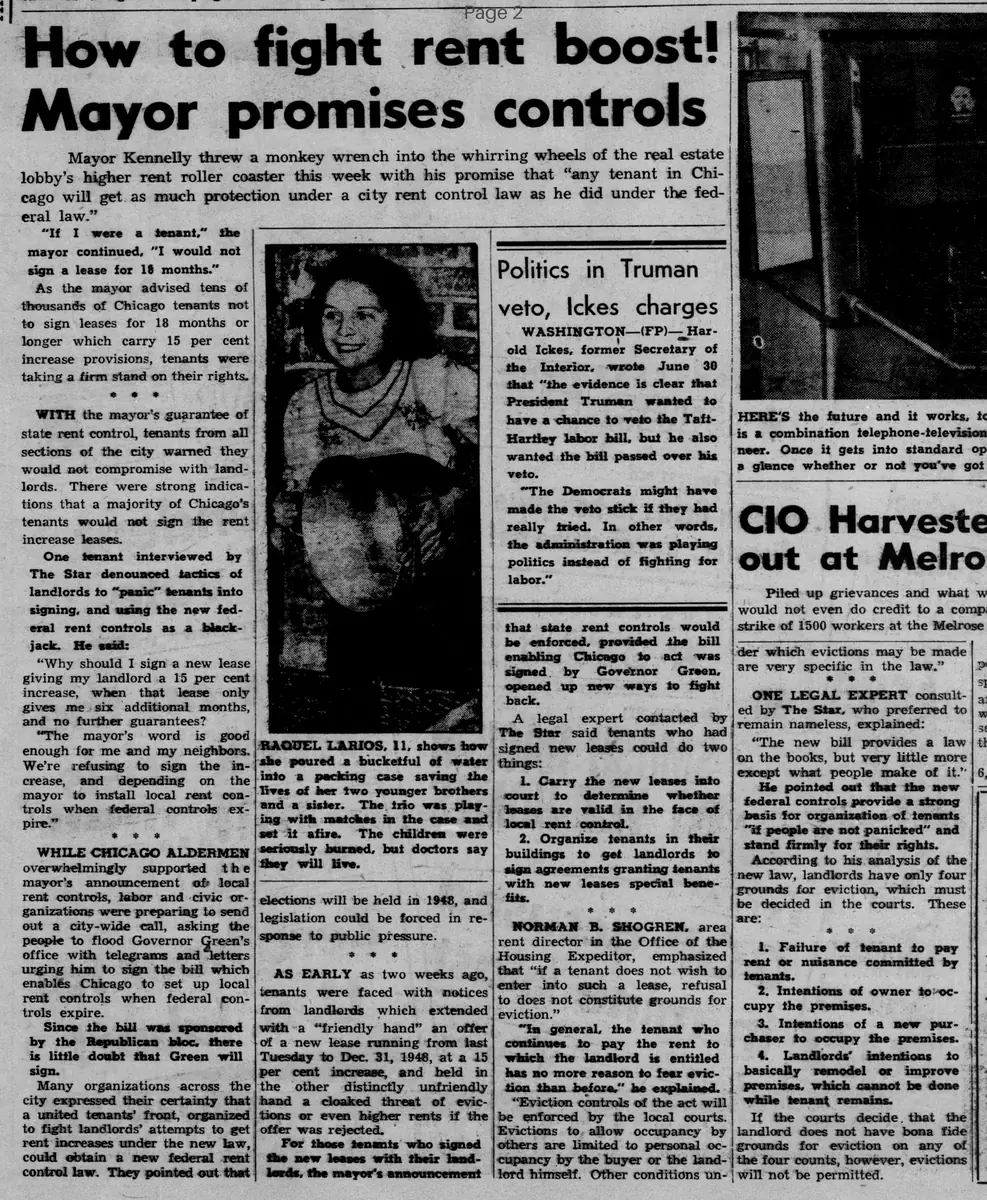
Mayor promises controls
Mayor Kennelly threw a monkey wrench into the whirring wheels of the real estate lobby's higher rent roller coaster this week with his promise that "any tenant in Chicago will get as much protection under a city rent control law as he did under the federal law."
"If I were a tenant," the mayor continued, "I would not sign a lease for 18 months."
As the mayor advised tens of thousands of Chicago tenants not to sign leases for 18 months or longer which carry 15 per cent increase provisions, tenants were taking a firm stand on their rights.
WITH the mayor's guarantee of state rent control, tenants from all sections of the city warned they would not compromise with landlords. There were strong indications that a majority of Chicago's tenants would not sign the rent increase leases.
One tenant interviewed by The Star denounced tactics of landlords to "panic" tenants into signing, and using the new federal rent controls as a black-jack. He said:
"Why should I sign a new lease giving my landlord a 15 per cent increase, when that lease only gives me six additional months, and no further guarantees?
"The mayor's word is good enough for me and my neighbors. We're refusing to sign the increase, and depending on the mayor to install local rent controls when federal controls expire."
WHILE CHICAGO ALDERMEN overwhelmingly supported the mayor's announcement of local rent controls, labor and civic organizations were preparing to send out a city-wide call, asking the people to flood Governor Green's office with telegrams and letters urging him to sign the bill which enables Chicago to set up local rent controls when federal controls expire.
Since the bill was sponsored by the Republican bloc, there is little doubt that Green will sign.
Many organizations across the city expressed their certainty that a united tenants' front, organized to fight landlords' attempts to get rent increases under the new law, could obtain a new federal rent control law. They pointed out that elections will be held in 1948, and legislation could be forced in response to public pressure.
AS EARLY as two weeks ago, tenants were faced with notices from landlords which extended with a "friendly hand" an offer of a new lease running from last Tuesday to Dec. 31, 1948, at a 15 per cent increase, and held in the other distinctly unfriendly hand a cloaked threat of evictions or even higher rents if the offer was rejected.
For those tenants who signed the new leases with their landlords, the mayor's announcement
that state rent controls would be enforced, provided the bill enabling Chicago to act was signed by Governor Green, opened up new ways to fight back.
A legal expert contacted by The Star said tenants who had signed new leases could do two things:
1. Carry the new leases into court to determine whether leases are valid in the face of local rent control.
2. Organize tenants in their buildings to get landlords to sign agreements granting tenants with new leases special benefits.
NORMAN B. SHOGREN, area rent director in the Office of the Housing Expediter, emphasized that if a tenant does not wish to enter into such a lease, refusal to do so does not constitute grounds for eviction.
"In general, the tenant who continues to pay the rent to which the landlord is entitled has no more reason to fear eviction than before," he explained.
"Eviction controls of the act will be enforced by the local courts.
Evictions to allow occupancy by others are limited to personal occupancy by the buyer or the landlord himself. Other conditions under which evictions may be made are very specific in the law."
ONE LEGAL EXPERT consulted by The Star, who preferred to remain nameless, explained:
"The new bill provides a law on the books, but very little more except what people make of it."
He pointed out that the new federal controls provide a strong basis for organization of tenants "if people are not panicked" and stand firmly for their rights.
According to his analysis of the new law, landlords have only four grounds for eviction, which must be decided in the courts. These are:
1. Failure of tenant to pay rent or nuisance committed by tenants.
2. Intentions of owner to occupy the premises.
3. Intentions of a new purchaser to occupy the premises.
4. Landlords' intentions to basically remodel or improve premises, which cannot be done while tenant remains.
If the courts decide that the landlord does not have bona fide grounds for eviction on any of the four counts, however, evictions will not be permitted.
What sub-type of article is it?
What keywords are associated?
What entities or persons were involved?
Where did it happen?
Domestic News Details
Primary Location
Chicago
Event Date
This Week
Key Persons
Outcome
tenants refusing to sign leases with 15% increases; promise of local rent controls upon federal expiration; potential court challenges to signed leases; limited eviction grounds for landlords.
Event Details
Mayor Kennelly promised local rent controls in Chicago equivalent to federal protections, advising tenants not to sign 18-month leases with 15% increases. Tenants across the city are refusing to sign, supported by aldermen and organizations urging Governor Green to sign enabling bill. Legal experts outline ways to challenge leases and limit evictions to specific grounds.