Thank you for visiting SNEWPapers!
Sign up free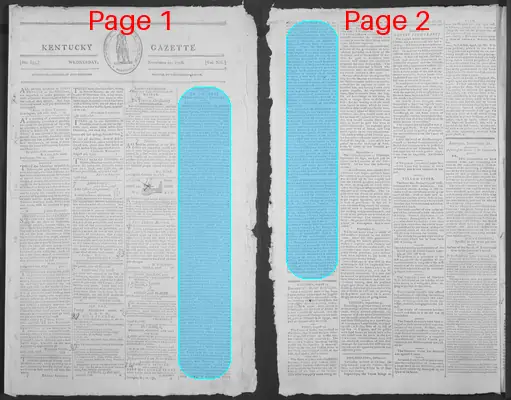
The Kentucky Gazette
Lexington, Fayette County, Kentucky
What is this article about?
Timoleon defends U.S. neutrality in European conflicts and forbearance toward France despite Minister Genet's provocative actions, such as fitting out privateers in U.S. ports. Highlights U.S. hospitality to French refugees and debt payments, contrasting with French duplicity revealed in Genet's instructions to entangle America in war with Britain.
Merged-components note: Continuation of the 'TIMOLEON No. IV' editorial across pages.
Clippings
1 of 2
OCR Quality
Full Text
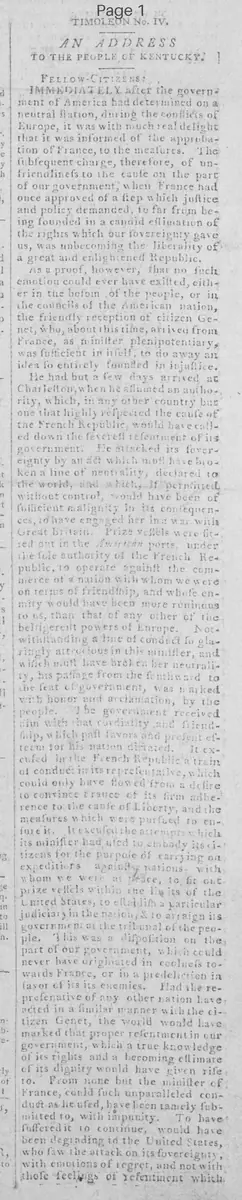
AN ADDRESS
TO THE PEOPLE OF KENTUCKY.
Fellow-Citizens:
IMMEDIATELY after the government of America had determined on a neutral station, during the conflicts of Europe, it was with much real delight that it was informed of the approbation of France, to the measures. The subsequent charge, therefore, of unfriendliness to the cause on the part of our government, when France had once approved of a step which justice and policy demanded, so far from being founded in a candid estimation of the rights which our sovereignty gave us, was unbecoming the liberality of a great and enlightened Republic.
As a proof, however, that no such emotion could ever have existed, either in the bosom of the people, or in the councils of the American nation, the friendly reception of citizen Genet, who, about this time, arrived from France, as minister plenipotentiary, was sufficient in itself, to do away an idea so entirely founded in injustice.
He had but a few days arrived at Charleston, when he assumed an authority, which, in any other country but one that highly respected the cause of the French republic, would have called down the severest resentment of its government. He assailed its sovereignty by an act which must have broken a line of neutrality, declared to the world, and which, if permitted without controul, would have been of sufficient malignity in its consequences, to have engaged her in war, with Great Britain. Prize vessels were fitted out in the American ports, under the false authority of the French Republic, to operate against the commerce of a nation with whom we were on terms of friendship, and whose enmity would have been more ruinous to us, than that of any other of the belligerent powers of Europe. Notwithstanding a line of conduct so glaringly atrocious in this minister, and which must have broken her neutrality, his passage from the southward to the seat of government, was marked with honor and acclamation, by the people. The government received him with that cordiality and friendship, which past favors and present esteem for his nation dictated. It excused to the French Republic a train of conduct in its representative, which could only have sprung from a desire to convince France of its firm adherence to the cause of Liberty, and the measures which were pursued to ensure it. It excused the attempts which its minister had used to embody its citizens for the purpose of carrying on expeditions against nations with whom we were at peace, to fit out prize vessels within the limits of the United States, to establish a particular judiciary in the nation, to arraign its government at the tribunal of the people. This was a disposition on the part of our government, which could never have originated in coolness towards France, or in a predilection in favor of its enemies. Had the representative of any other nation have acted in a similar manner with the citizen Genet, the world would have marked that proper resentment in our government, which a true knowledge of its rights and a becoming estimate of its dignity would have given rise to. From none but the minister of France, could such unparalleled conduct as he used, have been tamely submitted to, with impunity. To have suffered it to continue, would have been degrading to the United States, who saw the attack on its sovereignty, with emotions of regret, and not with those feelings of resentment which might lead to a future war with the nation which had delegated him. The consequent desire on the part of America, that the functions of this minister should be suspended, was, however acceded to by France, with that apparent forbearance, the motive of which, could not long remain concealed. When the instructions of Genet were afterwards published at Philadelphia with what astonishment must the world, and particularly the American government have viewed the duplicity of the French Republic? The purport of these credentials were that he should do all in his power by intrigue by stratagem and open machination to involve these United States in a war with Britain. The president, however. at the same time that his firmness detected and exposed this hypocritical and criminal conduct in the French government his moderation and forbearance evinced the highest examples of attachment to a people who deserved the severest inflictions of resentment. instead of frequent manifestations of friendship and respect.
At this period the endeavors of the United States, to pay up a large and accumulating national debt to France, was evinced with all the promptitude which the situation of the Republic required. The misfortunes of St. Domingo were also objects which attracted the humanity and beneficence of America to the people of that colony, and to the government of the Republic to which they were in subordination They were attended to with real sympathy, and alleviated by every friendly assistance which its inhabitants required at our hands. Provisions were granted in abundance, large contributions were made to those who had fled to our country for safety, from one end of the continent to the other, and every decent respect were paid them, which could either be inspired by private misfortune or public friendship towards the mother country.
However unworthily the United States must have estimated the antecedent conduct of the French Republic. these remarkable instances of hospitality and forbearance, on the part of our government and our citizens, are fully sufficient, with the dispassionate mind to do away the charge of unfriendliness, attributed to America. She appears upon this occasion to have been governed by the most amiable maxim of the Christian philosophy, in rewarding the hypocrisy and ingratitude of her enemy, with the purest manifestations of repeated good deeds The successes of France were received with joy and acclamation, her struggle for Liberty approved of with general expressions of enthusiastic regard, the miseries of her unfortunate citizens listened to with emotions of sympathy and alleviated with the most generous liberality : at a moment when the inhospitable desire to bring down upon her all the misfortune of war, glowed with violence, inspired by a mistaken policy, in the bosom of its government. who can view this contrast of conduct and disposition in the two Republics. without being shocked at the ingratitude of the one, and feeling every sentiment of esteem for the other?
TIMOLEON.
(To be continued)
What sub-type of article is it?
What keywords are associated?
What entities or persons were involved?
Editorial Details
Primary Topic
U.S. Neutrality And Forbearance Toward France Amid Genet's Provocations
Stance / Tone
Defensive Of U.S. Policy, Critical Of French Duplicity
Key Figures
Key Arguments