Thank you for visiting SNEWPapers!
Sign up free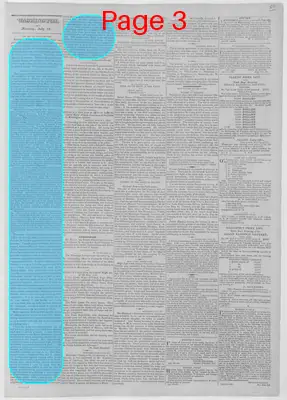
Daily National Intelligencer
Washington, District Of Columbia
What is this article about?
A controversial letter from a Director of the Bank of the United States to a Manchester friend, detailing severe economic distress, commercial failures, a recent theatre fire, and rising crime in Philadelphia, is published in the London Courier and republished locally, prompting debate on its authenticity and implications for free expression.
Clipping
OCR Quality
Full Text
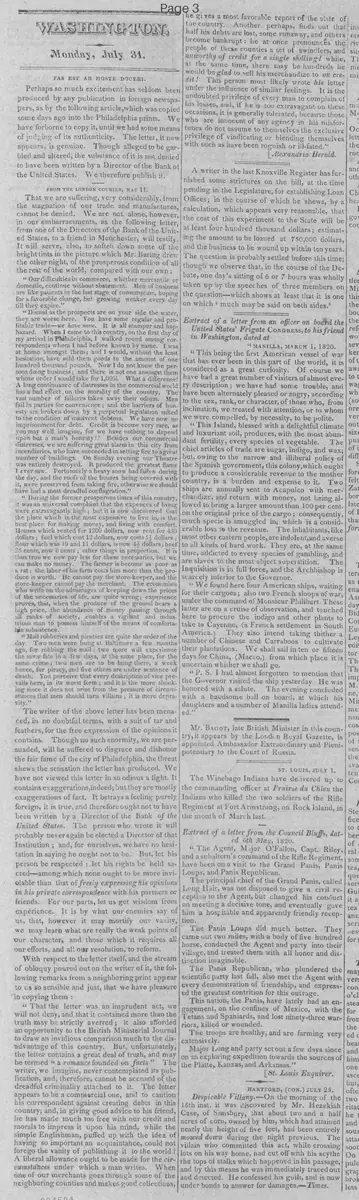
FAS EST AB HOSTE DOCERI.
Perhaps so much excitement has seldom been produced by any publication in foreign newspapers, as by the following article, which was copied some days ago into the Philadelphia prints. We have forborne to copy it, until we had some means of judging of its authenticity. The letter, it now appears, is genuine. Though alleged to be garbled and altered, the substance of it is not denied to have been written by a Director of the Bank of the United States. We therefore publish it.
FROM THE LONDON COURIER, MAY 11
That we are suffering, very considerably, from the stagnation of our trade and manufactures, cannot be denied. We are not alone, however, in our embarrassments, as the following letter, from one of the Directors of the Bank of the United States, to a friend in Manchester, will testify. It will serve, also, to soften down some of the bright tints in the picture which Mr. Baring drew the other night, of the prosperous condition of all the rest of the world, compared with our own:
"Our difficulties in commerce, whether mercantile or domestic, continue without abatement. Men of business are like patients in the last stage of consumption, hoping for a favorable change, but growing weaker every day till they expire."
"Dismal as the prospects are on your side the water, they are worse here. You have some regular and profitable trade—we have none. It is all scamper and hap-hazard. When I came to this country, on the first day of my arrival in Philadelphia, I walked round among correspondents whom I had before known by name. I was at home amongst them; and I would, without the least hesitation, have sold them goods to the amount of one hundred thousand pounds. Now I do not know the persons doing business; and there is not one amongst them whose order I would take for 1000l. What a difference!
A long continuance of distresses in the commercial world has a bad effect on the morality of the country. The vast number of failures takes away their odium. Men fail in parties for convenience; and the barriers of honesty are broken down by a perpetual legislation suited to the condition of insolvent debtors. We have now no imprisonment for debt. Credit is become very rare, as you may well imagine, for we have nothing to depend upon but a man's honesty!! Besides our commercial distresses, we are suffering great alarm in this city from incendiaries, who have succeeded in setting fire to a great number of buildings. On Sunday evening our Theatre was entirely destroyed. It produced the greatest flame I ever saw. Fortunately a heavy snow had fallen during the day, and the roofs of the houses being covered with it, were preserved from taking fire, otherwise we should have had a most dreadful conflagration."
"During the former prosperous times of this country, it was an universal complaint that the expences of living were extravagantly high; but it is now discovered that the place which is the most expensive to live in, is the best place for making money, and living with comfort. Houses which rented for 1200 dollars, now rent for 450 dollars; fuel which cost 12 dollars, now costs 5 dollars: flour which was 10 and 11 dollars, is now 4 dollars; beef 25 cents, now 8 cents; other things in proportion. It is thus true we now pay less for these necessaries, but we can make no money. The farmer is become as poor as a rat; the labor of his farm costs him more than the produce is worth. He cannot pay the store-keeper, and the store-keeper cannot pay the merchant. The economists who write on the advantages of keeping down the prices of the necessaries of life, are quite wrong; experience proves, that, when the produce of the ground bears a high price, the abundance of money passing through all ranks of society, enables a vigilant and industrious man to possess himself of the means of comfortable subsistence."
"Mail robberies and piracies are quite the order of the day. Two men were hung at Baltimore a few months ago, for robbing the mail; two more will experience the same fate in a few days, at the same place, for the same crime; two men are to be hung there, a week hence, for piracy, and five others are under sentence of death. You perceive that every description of vice prevails here, in its worst form; and it is the more shocking since it does not arise from the pressure of circumstances that men should turn villains; it is mere depravity."
The writer of the above letter has been menaced, in no doubtful terms, with a suit of tar and feathers, for the free expression of the opinions it contains. Though no such enormity, we are persuaded, will be suffered to disgrace and dishonor the fair fame of the city of Philadelphia, the threat shews the sensation the letter has produced. We have not viewed this letter in so odious a light. It contains exaggerations, indeed; but they are mostly exaggerations of fact. It betrays a feeling purely foreign, it is true, and therefore ought not to have been written by a Director of the Bank of the United States. The person who wrote it will probably never again be elected a Director of that Institution; and, for ourselves, we have no hesitation in saying he ought not to be. But, let his person be respected: let his rights be held sacred—among which none ought to be more inviolable than that of freely expressing his opinions in his private correspondence with his partners or friends. For our parts, let us get wisdom from experience. It is by what our enemies say of us, that, however it may mortify our vanity, we may learn what are really the weak points of our character, and those which it requires all our efforts, and all our resolution, to reform.
With respect to the letter itself, and the stream of obloquy poured out on the writer of it, the following remarks from a neighboring print appear to us so sensible and just, that we have pleasure in copying them:
"That the letter was an imprudent act, we will not deny, and that it contained more than the truth may be strictly averred; it also afforded an opportunity to the British Ministerial Journal to draw an invidious comparison much to the disadvantage of this country. But, unfortunately, the letter contains a great deal of truth, and may be termed 'a romance founded on facts.' The writer, we imagine, never contemplated its publication, and, therefore, cannot be accused of the dreadful criminality attached to it. The letter appears to be a commercial one, and to caution his correspondent against creating debts in this country; and, in giving good advice to his friend, he has made much too free with our credit and morals to impress it upon his mind, while the simple Englishman, puffed up with the idea of having so important an acquaintance, could not forego the vanity of publishing it to the world!
A liberal allowance ought to be made for the circumstances under which a man writes. When one of our merchants goes through some of the neighboring counties and makes good collections, he gives a most favorable report of the state of the country. Another, perhaps, finds out that half his debts are lost, some runaway, and others become bankrupt: he at once pronounces the people of these counties a set of swindlers, and unworthy of credit for a single shilling! while, at the same time, there may be hundreds he would be glad to sell his merchandize to on credit! This person most likely wrote his letter under the influence of similar feelings. It is the undoubted privilege of every man to complain of his losses, and, if he is too extravagant on these occasions, it is generally tolerated, because those who are innocent of any agency in his misfortunes do not assume to themselves the exclusive privilege of vindicating or blending themselves with such as have been roguish or ill-fated."
What sub-type of article is it?
What keywords are associated?
What entities or persons were involved?
Where did it happen?
Domestic News Details
Primary Location
Philadelphia
Event Date
Monday, July 31
Key Persons
Outcome
theatre entirely destroyed by fire; no deaths mentioned; threats of tar and feathers against the writer; two men hanged in baltimore for mail robbery; two more to be hanged soon for same; two to be hanged for piracy; five under sentence of death.
Event Details
A letter from a Director of the Bank of the United States to a friend in Manchester describes ongoing commercial distress, moral decline due to failures and lack of imprisonment for debt, alarm from incendiaries including the destruction of the city theatre on Sunday evening, falling prices of necessities without ability to make money, farmer poverty, and prevalence of mail robberies and piracies attributed to depravity. The letter's publication in the London Courier and Philadelphia papers causes excitement and threats against the writer, but the article defends free expression while criticizing the imprudence.