Thank you for visiting SNEWPapers!
Sign up free
Story
November 17, 1898
The Evening Times
Washington, District Of Columbia
What is this article about?
Engineer Granville Kimball defends Lt. Cmdr. Harris's abandonment of the storm-damaged Spanish cruiser Maria Teresa on Nov. 1, praising rescue efforts by the USS Leonidas and others amid high seas and gale winds. (187 chars)
Clipping
OCR Quality
98%
Excellent
Full Text
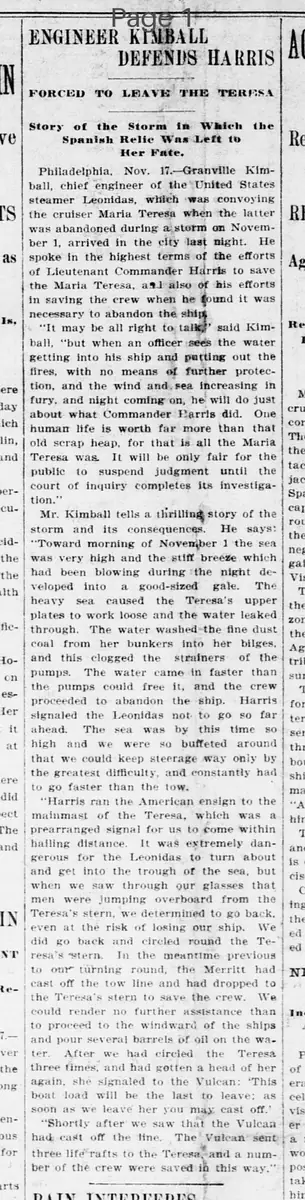
ENGINEER KIMBALL DEFENDS HARRIS
FORCED TO LEAVE THE TERESA
Story of the Storm in Which the Spanish Relic Was Left to Her Fate.
Philadelphia, Nov. 17.-Granville Kimball, chief engineer of the United States steamer Leonidas, which was convoying the cruiser Maria Teresa when the latter was abandoned during a storm on November 1, arrived in the city last night. He spoke in the highest terms of the efforts of Lieutenant Commander Harris to save the Maria Teresa, as also of his efforts in saving the crew when he found it was necessary to abandon the ship.
"It may be all right to talk," said Kimball, "but when an officer sees the water getting into his ship and putting out the fires, with no means of further protection, and the wind and sea increasing in fury, and night coming on, he will do just about what Commander Harris did. One human life is worth far more than that old scrap heap, for that is all the Maria Teresa was. It will be only fair for the public to suspend judgment until the court of inquiry completes its investigation."
Mr. Kimball tells a thrilling story of the storm and its consequences. He says:
"Toward morning of November 1 the sea was very high and the stiff breeze which had been blowing during the night developed into a good-sized gale. The heavy sea caused the Teresa's upper plates to work loose and the water leaked through. The water washed the fine dust coal from her bunkers into her bilges, and this clogged the strainers of the pumps. The water came in faster than the pumps could free it, and the crew proceeded to abandon the ship. Harris signaled the Leonidas not to go so far ahead. The sea was by this time so high and we were so buffeted around that we could keep steerage way only by the greatest difficulty, and constantly had to go faster than the tow.
"Harris ran the American ensign to the mainmast of the Teresa, which was a prearranged signal for us to come within hailing distance. It was extremely dangerous for the Leonidas to turn about and get into the trough of the sea, but when we saw through our glasses that men were jumping overboard from the Teresa's stern, we determined to go back, even at the risk of losing our ship. We did go back and circled round the Teresa's stern. In the meantime previous to our turning round, the Merritt had cast off the tow line and had dropped to the Teresa's stern to save the crew. We could render no further assistance than to proceed to the windward of the ships and pour several barrels of oil on the water. After we had circled the Teresa three times, and had gotten a head of her again, she signaled to the Vulcan: 'This boat load will be the last to leave: as soon as we leave her you may cast off.'
"Shortly after we saw that the Vulcan had cast off the line. The Vulcan sent three life rafts to the Teresa, and a number of the crew were saved in this way."
FORCED TO LEAVE THE TERESA
Story of the Storm in Which the Spanish Relic Was Left to Her Fate.
Philadelphia, Nov. 17.-Granville Kimball, chief engineer of the United States steamer Leonidas, which was convoying the cruiser Maria Teresa when the latter was abandoned during a storm on November 1, arrived in the city last night. He spoke in the highest terms of the efforts of Lieutenant Commander Harris to save the Maria Teresa, as also of his efforts in saving the crew when he found it was necessary to abandon the ship.
"It may be all right to talk," said Kimball, "but when an officer sees the water getting into his ship and putting out the fires, with no means of further protection, and the wind and sea increasing in fury, and night coming on, he will do just about what Commander Harris did. One human life is worth far more than that old scrap heap, for that is all the Maria Teresa was. It will be only fair for the public to suspend judgment until the court of inquiry completes its investigation."
Mr. Kimball tells a thrilling story of the storm and its consequences. He says:
"Toward morning of November 1 the sea was very high and the stiff breeze which had been blowing during the night developed into a good-sized gale. The heavy sea caused the Teresa's upper plates to work loose and the water leaked through. The water washed the fine dust coal from her bunkers into her bilges, and this clogged the strainers of the pumps. The water came in faster than the pumps could free it, and the crew proceeded to abandon the ship. Harris signaled the Leonidas not to go so far ahead. The sea was by this time so high and we were so buffeted around that we could keep steerage way only by the greatest difficulty, and constantly had to go faster than the tow.
"Harris ran the American ensign to the mainmast of the Teresa, which was a prearranged signal for us to come within hailing distance. It was extremely dangerous for the Leonidas to turn about and get into the trough of the sea, but when we saw through our glasses that men were jumping overboard from the Teresa's stern, we determined to go back, even at the risk of losing our ship. We did go back and circled round the Teresa's stern. In the meantime previous to our turning round, the Merritt had cast off the tow line and had dropped to the Teresa's stern to save the crew. We could render no further assistance than to proceed to the windward of the ships and pour several barrels of oil on the water. After we had circled the Teresa three times, and had gotten a head of her again, she signaled to the Vulcan: 'This boat load will be the last to leave: as soon as we leave her you may cast off.'
"Shortly after we saw that the Vulcan had cast off the line. The Vulcan sent three life rafts to the Teresa, and a number of the crew were saved in this way."
What sub-type of article is it?
Historical Event
Disaster
Heroic Act
What themes does it cover?
Bravery Heroism
Misfortune
Justice
What keywords are associated?
Storm Abandonment
Ship Rescue
Maria Teresa
Naval Convoy
Crew Evacuation
What entities or persons were involved?
Granville Kimball
Lieutenant Commander Harris
Where did it happen?
At Sea
Story Details
Key Persons
Granville Kimball
Lieutenant Commander Harris
Location
At Sea
Event Date
November 1
Story Details
Granville Kimball, chief engineer of the USS Leonidas, defends Lieutenant Commander Harris's decision to abandon the damaged Spanish cruiser Maria Teresa during a gale on November 1. The ship leaked due to loose plates and clogged pumps, forcing the crew to evacuate. The Leonidas and other vessels assisted in rescuing the crew despite dangerous conditions.