Thank you for visiting SNEWPapers!
Sign up free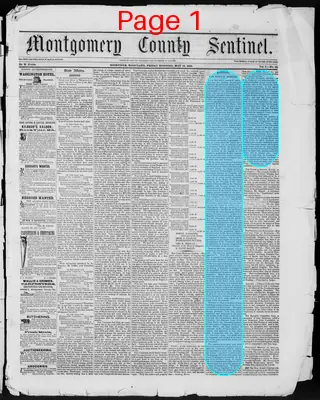
Editorial
May 18, 1860
Montgomery County Sentinel
Rockville, Gaithersburg, Montgomery County, Maryland
What is this article about?
Editorial critiques Northern 'squatter sovereignty' interpretation of 1856 Democratic platform, defending Southern view that territories are open to slaveholders per Supreme Court, urging party unity on constitutional rights ahead of Charleston Convention.
Clipping
OCR Quality
98%
Excellent
Full Text
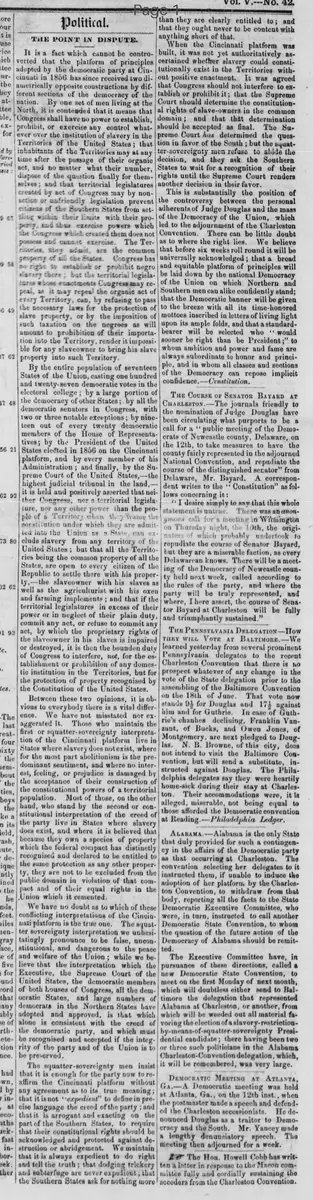
Political.
THE POINT IN DISPUTE.
It is a fact which cannot be controverted that the platform of principles adopted by the democratic party at Cincinnati in 1856 has since received two diametrically opposite constructions by different sections of the democracy of the nation. By one set of men living at the North, it is contended that it means that Congress shall have no power to establish, prohibit, or exercise any control whatever over the institution of slavery in the Territories of the United States; that inhabitants of the Territories may at any time after the passage of their organic act, and no matter what their number, dispose of the question finally for themselves; and that territorial legislatures created by act of Congress may by non-action or unfriendly legislation prevent citizens of the Southern States from settling within their limits with their property. and thus exercise powers which the Congress which created them does not possess and cannot exercise. The Territories, they admit, are the common property of all the States. Congress has no rights to establish or prohibit negro slavery there : but the territorial legislatures whose enactments Congress may repeal, as it may repeal the organic act of every Territory, can, by refusing to pass the necessary laws for the protection of slave property, or by the imposition of such taxation on the negroes as will amount to prohibition of their importation into the Territory, render it impossible for any slaveowner to bring his slave property into such Territory.
By the entire population of seventeen States of the Union, casting one hundred and twenty-seven democratic votes in the electoral college; by a large portion of the democracy of other States; by all the democratic senators in Congress, with two or three notable exceptions; by nineteen out of every twenty democratic members of the House of Representatives; by the President of the United States elected in 1856 on the Cincinnati platform, and by every member of his Administration; and finally, by the Supreme Court of the United States,—the highest judicial tribunal in the land,— it is held and positively asserted that neither Congress, nor a territorial legislature, nor any other power than the people of a Territory when they frame the constitution under which they are admitted into the Union as a State, can exclude slavery from any territory of the United States; but that all the Territories being the common property of all the States, are open to every citizen of the Republic to settle there with his property,—the slaveowner with his slaves as well as the agriculturist with his oxen and farming implements ; and that if the territorial legislatures in excess of their power or in neglect of their plain duty, commit any act, or refuse to commit any act, by which the proprietary rights of the slaveowner in his slaves is impaired or destroyed, it is then the bounden duty of Congress to interfere, not, for the establishment or prohibition of any domestic institution in the Territories, but for the protection of property recognised by the Constitution of the United States.
Between these two opinions, it is obvious to everybody there is a vital difference. We have not misstated nor exaggerated it. Those who maintain the first or squatter-sovereignty interpretation of the Cincinnati platform live in States where slavery does not exist, where for the most part abolitionism is the predominant sentiment, and where no interest, feeling, or prejudice is damaged by the acceptance of their construction of the constitutional powers of a territorial population. Most of those, on the other hand, who stand by the second or constitutional interpretation of the creed of the party live in States where slavery does exist, and where it is believed that because they own a species of property which the federal compact has distinctly recognised and declared to be entitled to the same protection as any other property, they are not to be excluded from the public domain in violation of that compact and of their equal rights in the Union which it cemented.
We have no doubt as to which of these conflicting interpretations of the Cincinnati platform is the true one. The squatter sovereignty interpretation we unhesitatingly pronounce to be false, unconstitutional, and dangerous to the peace and welfare of the Union; while we believe that the interpretation which the Executive, the Supreme Court of the United States, the democratic members of both houses of Congress, all the democratic States, and large numbers of democrats in the Northern States have adopted and approved, is that which alone is consistent with the creed of the democratic party, and which must be recognised and accepted if the integrity of the party and of the Union is to be preserved.
The squatter-sovereignty men insist that it is enough for the party now to re-affirm the Cincinnati platform without any agreement as to its true meaning; that it is not "expedient" to define in precise language the creed of the party ; and that it is arrogant and exacting on the part of the Southern States, to require that their constitutional rights should be acknowledged and protected against destruction or abridgement. We maintain that it is always expedient to do right and tell the truth; that dodging trickery and subterfuge are never expedient; that the Southern States ask for nothing more than they are clearly entitled to; and that they ought never to be content with anything short of that.
When the Cincinnati platform was built, it was not yet authoritatively ascertained whether slavery could constitutionally exist in the Territories without positive enactment. It was agreed that Congress should not interfere to establish or prohibit it; that the Supreme Court should determine the constitutional rights of slave-owners in the common domain; and that that determination should be accepted as final. The Supreme Court has determined the question in favor of the South ; but the squatter-sovereignty men refuse to abide the decision, and they ask the Southern States to wait for a recognition of their rights until the Supreme Court renders another decision in their favor.
This is substantially the position of the controversy between the personal adherents of Judge Douglas and the mass of the Democracy of the Union, which led to the adjournment of the Charleston Convention. There can be little doubt as to where the right lies. We believe that before six weeks roll round it will be universally acknowledged; that a broad and equitable platform of principles will be laid down by the national Democracy of the Union on which Northern and Southern men can alike confidently stand; that the Democratic banner will be given to the breeze with all its time-honored mottoes inscribed in letters of living light upon its ample folds, and that a standard-bearer will be selected who "would sooner be right than be President;" to whom ambition and power and fame are always subordinate to honor and principle, and in whom all classes and sections of the Democracy can repose implicit confidence.—Constitution.
THE POINT IN DISPUTE.
It is a fact which cannot be controverted that the platform of principles adopted by the democratic party at Cincinnati in 1856 has since received two diametrically opposite constructions by different sections of the democracy of the nation. By one set of men living at the North, it is contended that it means that Congress shall have no power to establish, prohibit, or exercise any control whatever over the institution of slavery in the Territories of the United States; that inhabitants of the Territories may at any time after the passage of their organic act, and no matter what their number, dispose of the question finally for themselves; and that territorial legislatures created by act of Congress may by non-action or unfriendly legislation prevent citizens of the Southern States from settling within their limits with their property. and thus exercise powers which the Congress which created them does not possess and cannot exercise. The Territories, they admit, are the common property of all the States. Congress has no rights to establish or prohibit negro slavery there : but the territorial legislatures whose enactments Congress may repeal, as it may repeal the organic act of every Territory, can, by refusing to pass the necessary laws for the protection of slave property, or by the imposition of such taxation on the negroes as will amount to prohibition of their importation into the Territory, render it impossible for any slaveowner to bring his slave property into such Territory.
By the entire population of seventeen States of the Union, casting one hundred and twenty-seven democratic votes in the electoral college; by a large portion of the democracy of other States; by all the democratic senators in Congress, with two or three notable exceptions; by nineteen out of every twenty democratic members of the House of Representatives; by the President of the United States elected in 1856 on the Cincinnati platform, and by every member of his Administration; and finally, by the Supreme Court of the United States,—the highest judicial tribunal in the land,— it is held and positively asserted that neither Congress, nor a territorial legislature, nor any other power than the people of a Territory when they frame the constitution under which they are admitted into the Union as a State, can exclude slavery from any territory of the United States; but that all the Territories being the common property of all the States, are open to every citizen of the Republic to settle there with his property,—the slaveowner with his slaves as well as the agriculturist with his oxen and farming implements ; and that if the territorial legislatures in excess of their power or in neglect of their plain duty, commit any act, or refuse to commit any act, by which the proprietary rights of the slaveowner in his slaves is impaired or destroyed, it is then the bounden duty of Congress to interfere, not, for the establishment or prohibition of any domestic institution in the Territories, but for the protection of property recognised by the Constitution of the United States.
Between these two opinions, it is obvious to everybody there is a vital difference. We have not misstated nor exaggerated it. Those who maintain the first or squatter-sovereignty interpretation of the Cincinnati platform live in States where slavery does not exist, where for the most part abolitionism is the predominant sentiment, and where no interest, feeling, or prejudice is damaged by the acceptance of their construction of the constitutional powers of a territorial population. Most of those, on the other hand, who stand by the second or constitutional interpretation of the creed of the party live in States where slavery does exist, and where it is believed that because they own a species of property which the federal compact has distinctly recognised and declared to be entitled to the same protection as any other property, they are not to be excluded from the public domain in violation of that compact and of their equal rights in the Union which it cemented.
We have no doubt as to which of these conflicting interpretations of the Cincinnati platform is the true one. The squatter sovereignty interpretation we unhesitatingly pronounce to be false, unconstitutional, and dangerous to the peace and welfare of the Union; while we believe that the interpretation which the Executive, the Supreme Court of the United States, the democratic members of both houses of Congress, all the democratic States, and large numbers of democrats in the Northern States have adopted and approved, is that which alone is consistent with the creed of the democratic party, and which must be recognised and accepted if the integrity of the party and of the Union is to be preserved.
The squatter-sovereignty men insist that it is enough for the party now to re-affirm the Cincinnati platform without any agreement as to its true meaning; that it is not "expedient" to define in precise language the creed of the party ; and that it is arrogant and exacting on the part of the Southern States, to require that their constitutional rights should be acknowledged and protected against destruction or abridgement. We maintain that it is always expedient to do right and tell the truth; that dodging trickery and subterfuge are never expedient; that the Southern States ask for nothing more than they are clearly entitled to; and that they ought never to be content with anything short of that.
When the Cincinnati platform was built, it was not yet authoritatively ascertained whether slavery could constitutionally exist in the Territories without positive enactment. It was agreed that Congress should not interfere to establish or prohibit it; that the Supreme Court should determine the constitutional rights of slave-owners in the common domain; and that that determination should be accepted as final. The Supreme Court has determined the question in favor of the South ; but the squatter-sovereignty men refuse to abide the decision, and they ask the Southern States to wait for a recognition of their rights until the Supreme Court renders another decision in their favor.
This is substantially the position of the controversy between the personal adherents of Judge Douglas and the mass of the Democracy of the Union, which led to the adjournment of the Charleston Convention. There can be little doubt as to where the right lies. We believe that before six weeks roll round it will be universally acknowledged; that a broad and equitable platform of principles will be laid down by the national Democracy of the Union on which Northern and Southern men can alike confidently stand; that the Democratic banner will be given to the breeze with all its time-honored mottoes inscribed in letters of living light upon its ample folds, and that a standard-bearer will be selected who "would sooner be right than be President;" to whom ambition and power and fame are always subordinate to honor and principle, and in whom all classes and sections of the Democracy can repose implicit confidence.—Constitution.
What sub-type of article is it?
Partisan Politics
Constitutional
Slavery Abolition
What keywords are associated?
Cincinnati Platform
Squatter Sovereignty
Slavery Territories
Democratic Split
Supreme Court Decision
Charleston Convention
What entities or persons were involved?
Democratic Party
Cincinnati Platform
Supreme Court
President Buchanan
Judge Douglas
Southern States
Northern Democrats
Charleston Convention
Editorial Details
Primary Topic
Dispute Over Cincinnati Platform Interpretation On Slavery In Territories
Stance / Tone
Strongly Supportive Of Southern Constitutional Interpretation Against Squatter Sovereignty
Key Figures
Democratic Party
Cincinnati Platform
Supreme Court
President Buchanan
Judge Douglas
Southern States
Northern Democrats
Charleston Convention
Key Arguments
Northern Democrats Interpret Platform As Allowing Territorial Legislatures To Hinder Slavery
Southern Democrats And Authorities Hold That Only State Constitution Can Exclude Slavery
Squatter Sovereignty Is Unconstitutional And Dangerous
Supreme Court Decision Favors Slaveholders' Rights
Party Must Affirm True Meaning To Preserve Unity
Southern States Entitled To Equal Protection Of Slave Property