Thank you for visiting SNEWPapers!
Sign up free
Gazette Of The United States
New York, New York County, New York
What is this article about?
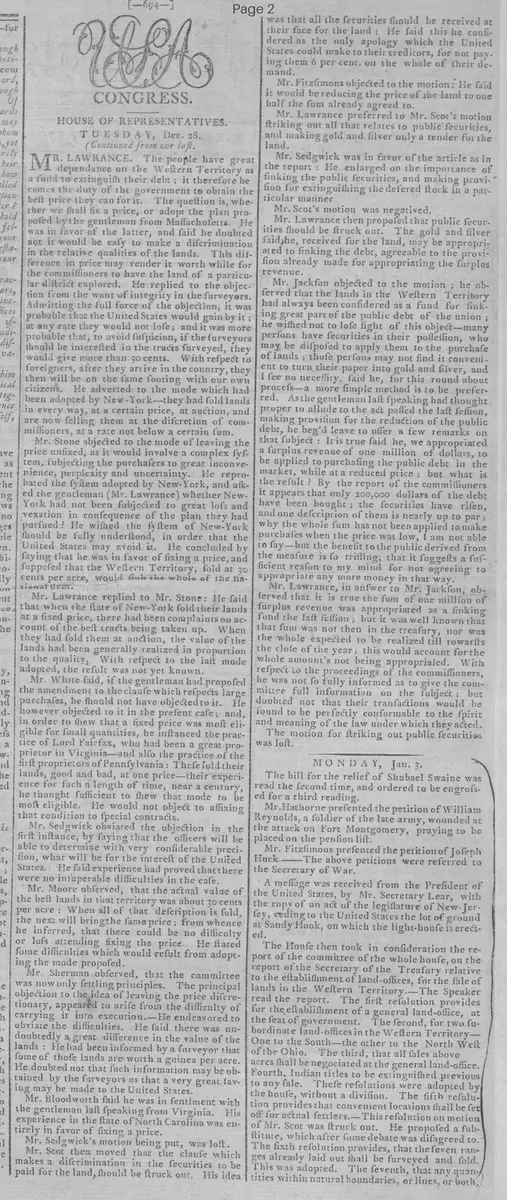
Debates in the U.S. House of Representatives on Dec. 28, 1789, Jan. 3, and Jan. 4, 1790, regarding the sale of Western Territory lands, including pricing, payment in public securities, establishment of land offices, and adoption of resolutions. Additional proceedings include reading bills, presenting petitions for pensions, and receiving a message from the President.
Merged-components note: Merged continuation of House of Representatives proceedings on Western Territory land sales across pages 2 and 3.
Clippings
1 of 2
OCR Quality
Full Text
TUESDAY, Dec. 28.
(Continued from our last.)
Mr. LAWRANCE. The people have great dependance on the Western Territory as a fund to extinguish their debt; it therefore becomes the duty of the government to obtain the best price they can for it. The question is, whether we shall fix a price, or adopt the plan proposed by the gentleman from Massachusetts. He was in favor of the latter, and said he doubted not it would be easy to make a discrimination in the relative qualities of the lands. This difference in price may render it worth while for the commissioners to have the land of a particular district explored. He replied to the objection from the want of integrity in the surveyors. Admitting the full force of the objection, it was probable that the United States would gain by it; at any rate they would not lose; and it was more probable that, to avoid suspicion, if the surveyors should be interested in the tracts surveyed, they would give more than 30 cents. With respect to foreigners, after they arrive in the country, they then will be on the same footing with our own citizens. He adverted to the mode which had been adopted by New-York—they had sold lands in every way, at a certain price, at auction, and are now selling them at the discretion of commissioners, at a rate not below a certain sum.
Mr. Stone objected to the mode of leaving the price unfixed, as it would involve a complex system, subjecting the purchasers to great inconvenience, perplexity and uncertainty. He reprobated the system adopted by New-York, and asked the gentleman (Mr. Lawrance) whether New-York had not been subjected to great loss and vexation in consequence of the plan they had pursued? He wished the system of New-York should be fully understood, in order that the United States may avoid it. He concluded by saying that he was in favor of fixing a price, and supposed that the Western Territory, sold at 30 cents per acre, would sink the whole of the national debt.
Mr. Lawrance replied to Mr. Stone: He said that when the state of New-York sold their lands at a fixed price, there had been complaints on account of the best tracts being taken up. When they had sold them at auction, the value of the lands had been generally realized in proportion to the quality. With respect to the last mode adopted, the result was not yet known.
Mr. White said, if the gentleman had proposed the amendment to the clause which respects large purchases, he should not have objected to it. He however objected to it in the present case; and, in order to shew that a fixed price was most eligible for small quantities, he instanced the practice of Lord Fairfax, who had been a great proprietor in Virginia and also the practice of the first proprietors of Pennsylvania: These sold their lands, good and bad, at one price—their experience for such a length of time, near a century, he thought sufficient to shew that mode to be most eligible. He would not object to affixing that condition to special contracts.
Mr. Sedgwick obviated the objection in the first instance, by saying that the officers will be able to determine with very considerable precision, what will be for the interest of the United States. He said experience had proved that there were no insuperable difficulties in the case.
Mr. Moore observed, that the actual value of the best lands in that territory was about 30 cents per acre: When all of that description is sold, the next will bring the same price; from whence he inferred, that there could be no difficulty or loss attending fixing the price. He stated some difficulties which would result from adopting the mode proposed.
Mr. Sherman observed, that the committee was now only settling principles. The principal objection to the idea of leaving the price discretionary, appeared to arise from the difficulty of carrying it into execution. He endeavored to obviate the difficulties. He said there was undoubtedly a great difference in the value of the lands: He had been informed by a surveyor that some of those lands are worth a guinea per acre. He doubted not that such information may be obtained by the surveyors as that a very great saving may be made to the United States.
Mr. Bloodworth said he was in sentiment with the gentleman last speaking from Virginia. His experience in the state of North Carolina was entirely in favor of fixing a price.
Mr. Sedgwick's motion being put, was lost.
Mr. Scott then moved that the clause which makes a discrimination in the securities to be paid for the land, should be struck out. His idea was that all the securities should be received at their face for the land: He said this he considered as the only apology which the United States could make to their creditors, for not paying them 6 per cent. on the whole of their demand.
Mr. Fitzsimons objected to the motion: He said it would be reducing the price of the land to one half the sum already agreed to.
Mr. Lawrance preferred to Mr. Scott's motion striking out all that relates to public securities, and making gold and silver only a tender for the land.
Mr. Sedgwick was in favor of the article as in the report: He enlarged on the importance of sinking the public securities, and making provision for extinguishing the deferred stock in a particular manner. Mr. Scott's motion was negatived.
Mr. Lawrance then proposed that public securities should be struck out. The gold and silver, said he, received for the land, may be appropriated to sinking the debt, agreeable to the provision already made for appropriating the surplus revenue.
Mr. Jackson objected to the motion; he observed that the lands in the Western Territory had always been considered as a fund for sinking great part of the public debt of the union; he wished not to lose sight of this object—many persons have securities in their possession, who may be disposed to apply them to the purchase of lands; those persons may not find it convenient to turn their paper into gold and silver, and I see no necessity, said he, for this round about process—a more simple method is to be preferred. As the gentleman last speaking had thought proper to allude to the act passed the last session, making provision for the reduction of the public debt, he beg'd leave to offer a few remarks on that subject: It is true, said he, we appropriated a surplus revenue of one million of dollars, to be applied to purchasing the public debt in the market, while at a reduced price; but what is the result? By the report of the commissioners it appears that only 200,000 dollars of the debt have been bought; the securities have risen, and one description of them is nearly up to par; why the whole sum has not been applied to make purchases when the price was low, I am not able to say—but the benefit to the public derived from the measure is so trifling, that it suggests a sufficient reason to my mind for not agreeing to appropriate any more money in that way.
Mr. Lawrance, in answer to Mr. Jackson, observed that it is true the sum of one million of surplus revenue was appropriated as a sinking fund the last session; but it was well known that that sum was not then in the treasury, nor was the whole expected to be realized till towards the close of this year; this would account for the whole amount's not being appropriated. With respect to the proceedings of the commissioners, he was not so fully informed as to give the committee full information on the subject; but doubted not that their transactions would be found to be perfectly conformable to the spirit and meaning of the law under which they acted.
The motion for striking out public securities was lost.
MONDAY, Jan. 3.
The bill for the relief of Shubael Swaine was read the second time, and ordered to be engrossed for a third reading.
Mr. Hathorne presented the petition of William Reynolds, a soldier of the late army, wounded at the attack on Fort Montgomery, praying to be placed on the pension list.
Mr. Fitzsimons presented the petition of Joseph Huck.—The above petitions were referred to the Secretary of War.
A message was received from the President of the United States, by Mr. Secretary Lear, with the copy of an act of the legislature of New-Jersey, ceding to the United States the lot of ground at Sandy Hook, on which the light-house is erected.
The House then took in consideration the report of the committee of the whole house, on the report of the Secretary of the Treasury relative to the establishment of land-offices, for the sale of lands in the Western Territory.—The Speaker read the report. The first resolution provides for the establishment of a general land-office, at the seat of government. The second, for two subordinate land-offices in the Western Territory— One to the South—the other to the North West of the Ohio. The third, that all sales above 1000 acres shall be negotiated at the general land-office. Fourth, Indian titles to be extinguished previous to any sale. These resolutions were adopted by the house, without a division. The fifth resolution provides that convenient locations shall be set off for actual settlers.—This resolution on motion of Mr. Scott was struck out. He proposed a substitute, which after one debate was disagreed to. The sixth resolution provides, that the seven ranges already laid out shall be surveyed and sold. This was adopted. The seventh, that any quantities within natural boundaries, or lines, or both,
may be sold. This was agreed to with an addition proposed by Mr. Burke, that for every chain surveyed and sold on the bank of a navigable river, the purchaser shall be obliged to take chains back. The eighth resolution states, that the price of the land shall be 30 cents per acre, to be paid in gold or silver, or in the public securities, estimating the 6 per cents at par with specie—and those of an inferior value, at a proportionate rate.
Mr. Boudinot proposed that this resolution should be altered, so that all the securities should be received in payment for the land, as at par. He stated sundry objections to the discrimination between the several denominations of the securities, and urged the justice of making all an equal tender for the land. By this means the United States will do some justice, said he, to the public creditors, in respect to the deferred part of the debt; besides it will conduce more rapidly to sinking the public debt, and expedite the selling of large quantities of the land. He moved an amendment to this purport—this was seconded by Mr. Steele, and supported by Mr. Lee.
Mr. Livermore was in favor of selling the land for deferred stock and 3 per cents only.
Mr. Fitzsimons, Mr. Sedgwick, Mr. Smith, S. C. and Mr. Seney, were opposed to Mr. Boudinot's motion. They considered it as interfering with the funding system—it would open the doors to speculation, and in its effects would be giving a douceur to persons to whom the United States are under no special obligations whatever.
Mr. Boudinot's proposition so far obtained, as to alter the resolution, to read that gold and silver or public securities, [without discrimination] should be received in payment for the land.
A motion to strike out 30 cents was negatived.
Adjourned.
TUESDAY, Jan. 4.
A petition from sundry inhabitants of Washington County, in the state of New-York, respecting a certain J. Younglove, who, by an act passed the last session of Congress, is placed on the pension list, without any just pretensions to the benefit of that provision, was presented by Mr. Sylvester, read, and referred to a select committee.
Mr. Ames presented the petition of Andrew Colton, and Lydia his wife, who had been the widow of a Capt. White, of the Continental army, killed at the siege of York Town, praying for commutation or half-pay on account of her late husband.
Mr. Parker presented the memorial of Joseph Anderson.
Mr. Vining presented the memorial of Ebenezer Smith, a late surgeon in the American army.
—The above memorials and petition were referred to the Secretary of War.
The house this day finished the consideration of the report of the committee of the whole, on the subject of the land-office.
The eighth resolution, as amended yesterday, occasioned the principal part of the debate.
A motion offered by Mr. Sedgwick for striking out "gold and silver and public securities," after some opposition, obtained—and the resolution now stands simply thus, the price of the land shall be 30 cents per acre.
The remaining resolutions were agreed to, with very few amendments and a committee consisting of Mr. Scott, Mr. White and Mr. Bloodworth was appointed to bring in a bill pursuant to the report.
Mr. Wadsworth of the committee appointed for the purpose, reported the new militia bill, which was read the first time.
A letter was communicated from the Treasurer of the United States, accompanying his accounts—which were laid on the table.
Adjourned.
What sub-type of article is it?
What keywords are associated?
What entities or persons were involved?
Domestic News Details
Event Date
Tuesday, Dec. 28; Monday, Jan. 3; Tuesday, Jan. 4
Key Persons
Outcome
motions on discretionary pricing and striking securities lost; resolutions adopted for land offices, sales at 30 cents per acre in gold/silver; petitions referred; bill for shubael swaine advanced; militia bill reported; new jersey lighthouse cession received.
Event Details
Debate on Western Territory land sales: fixed vs. variable pricing, payment in public securities vs. specie, establishment of land offices, extinguishing Indian titles, surveying ranges, and accommodations for settlers. Petitions for pensions and relief from veterans and widows presented and referred. Message from President on New Jersey land cession. Resolutions passed with amendments; committee appointed for land bill; new militia bill introduced.