Thank you for visiting SNEWPapers!
Sign up free
The New Hampshire Gazette
Portsmouth, Rockingham County, New Hampshire
What is this article about?
US diplomats William Pinkney in London and John Armstrong in Paris exchange correspondence in early 1810 on British blockades predating the 1807 Berlin Decree, seeking revocations to prompt French annulment. British responses affirm some blockades remain in force. Armstrong also addresses French seizure of American cargoes in Spain.
Merged-components note: Merging as this is a continuation of the official correspondence between Pinkney and Wellesley on blockades.
Clipping
OCR Quality
Full Text
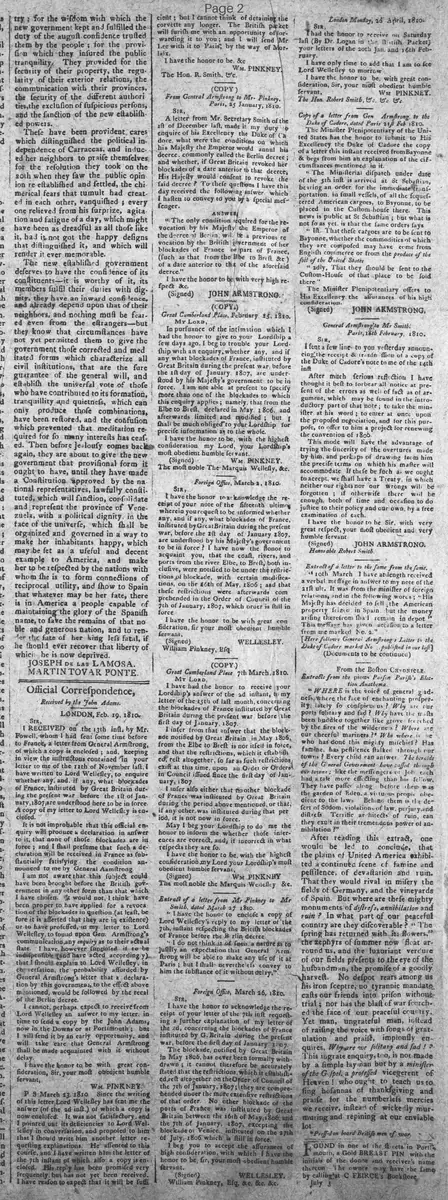
Received by the John Adams.
LONDON, Feb. 19, 1810
SIR,
I RECEIVED on the 13th inst. by Mr. Powell, whom I had sent some time before to France, a letter from General Armstrong, of which a copy is enclosed; and, keeping in view the instructions contained in your letter to me of the 8th of November last, I have written to Lord Wellesley, to enquire whether any, and, if any, what blockades of France, instituted by Great Britain during the present war before the 1st of January, 1807, are understood here to be in force. A copy of my letter to Lord Wellesley is enclosed.
It is not improbable that this official enquiry will produce a declaration in answer to it, that none of those blockades are in force; and I shall presume that such a declaration will be received in France as substantially satisfying the condition announced to me by General Armstrong.
I am not aware that this subject could have been brought before the British government in any other form than that which I have chosen. It would not, I think, have been proper to have applied for a revocation of the blockades in question (at least, before it is asserted that they are in existence) or to have proceeded, in my letter to Lord Wellesley, to found upon Gen. Armstrong's communication, any enquiry as to their actual state. I have, however, supposed it to be indispensable and have acted accordingly, that I should explain to Lord Wellesley, in conversation, the probability afforded by General Armstrong's letter that a declaration by this government, to the effect above mentioned, would be followed by the recall of the Berlin decree.
I cannot, perhaps, expect to receive from Lord Wellesley an answer to my letter, in time to send a copy by the John Adams, now in the Downs or at Portsmouth; but I will send it by an early opportunity, and will take care that General Armstrong shall be made acquainted with it without delay.
I have the honor to be with great consideration, Sir, your most obedient humble servant,
WM. PINKNEY.
P. S. March 22, 1810. Since the writing of this letter Lord Wellesley has sent me the answer (of the 2d inst.) of which a copy is now enclosed. It was not satisfactory, and I pointed out its deficiencies to Lord Wellesley in conversation, and proposed to him that I should write him another letter requesting explanations. He assented to this course, and I have written him the letter of the 9th instant of which also a copy is enclosed. His reply has been promised very frequently but has not yet been received. I have reason to expect that it will be satisfactory; but I cannot think of detaining the corvette any longer. The British packet will furnish me with an opportunity of forwarding it to you; and I will send Mr. Lee with it to Paris, by the way of Morlaix.
I have the honor to be, &c.
WM. PINKNEY
The Hon. R. Smith, Sec. &c. &c.
(COPY)
From General Armstrong to Mr. Pinkney
Paris, 25 January, 1810.
SIR,
A letter from Mr. Secretary Smith of the 8th of December last, made it my duty to enquire of his Excellency the Duke of Cadore, what were the conditions on which his Majesty the Emperor would annul his decree, commonly called the Berlin decree; and whether, if Great Britain revoked her blockades of a date anterior to that decree, His Majesty would consent to revoke the said decree? To these questions I have this day received the following answer which I hasten to convey to you by a special messenger.
ANSWER
"The only condition required for the revocation by his Majesty the Emperor of the decree of Berlin, will be a previous revocation by the British government of her blockades of France or part of France, (such as that from the Elbe to Brest, &c.) of a date anterior to that of the aforesaid decree."
I have the honor to be with very high respect, &c.
(Signed)
JOHN ARMSTRONG.
(COPY)
Great Cumberland Place, February 15, 1810.
My Lord,
In pursuance of the intimation which I had the honor to give to your Lordship a few days ago, I beg to trouble your Lordship with an enquiry, whether any, and if any, what blockades of France, instituted by Great Britain during the present war, before the 1st day of January, 1807, are understood by his Majesty's government to be in force. I am not able at present to specify more than one of the blockades to which this enquiry applies; namely, that from the Elbe to Brest, declared in May, 1806, and afterwards limited and modified; but I shall be much obliged to your Lordship for precise information as to the whole.
I have the honor to be, with the highest consideration, my Lord, your Lordship's most obedient humble servant.
(Signed)
WM. PINKNEY.
The most noble The Marquis Wellesley, &c.
Foreign Office, March 2, 1810.
SIR,
I have the honor to acknowledge the receipt of your note of the 15th ultimo wherein you request to be informed whether any, and if any, what blockades of France, instituted by Great Britain during the present war, before the 1st day of January 1807, are understood by his Majesty's government to be in force? I have now the honor to acquaint you, that the coast, rivers, and ports from the river Elbe, to Brest, both inclusive, were notified to be under the restrictions of blockade, with certain modifications, on the 16th of May, 1806; and that these restrictions were afterwards comprehended in the Order of Council of the 7th of January, 1807, which order is still in force.
I have the honor to be with great consideration, Sir, your most obedient humble servant,
(Signed)
WELLESLEY.
William Pinkney, Esq.
(COPY)
Great Cumberland Place, 7th March, 1810.
My Lord,
I have had the honor to receive your Lordship's answer of the 2d instant, to my letter of the 15th of last month, concerning the blockades of France instituted by Great Britain during the present war before the first day of January, 1807.
I infer from that answer that the blockade notified by Great Britain in May 1806, from the Elbe to Brest is not itself in force, and that the restrictions, which it established, rest altogether, so far as such restrictions exist at this time, upon an Order or Orders in Council issued since the first day of January, 1807.
I infer also either that no other blockade of France was instituted by Great Britain during the period above mentioned, or that, if any other was instituted during that period, it is not now in force.
May I beg your Lordship to do me the honor to inform me whether these inferences are correct, and, if incorrect, in what respects they are so.
I have the honor to be, with the highest consideration, my Lord, your Lordship's most obedient humble servant,
(Signed)
WM. PINKNEY
The most noble the Marquis Wellesley, &c.
Extract of a letter from Mr. Pinkney to Mr. Smith, dated March 27, 1810.
"I have the honor to enclose a copy of Lord Wellesley's reply to my letter of the 7th instant respecting the British blockades of France before the Berlin decree.
"I do not think it of such a nature as to justify an expectation that General Armstrong will be able to make any use of it at Paris; but I shall nevertheless convey to him the substance of it without delay."
Foreign Office, March 26, 1810.
SIR,
I have the honor to acknowledge the receipt of your letter of the 7th inst. requesting a further explanation of my letter of the 2d, concerning the blockades of France instituted by Great Britain during the present war, before the 1st day of January 1807.
The blockade, notified by Great Britain in May 1806, has never been formally withdrawn; it cannot therefore be accurately stated that the restrictions, which it established, rest altogether on the Order of Council of the 7th of January, 1807; they are comprehended under the more extensive restrictions of that order. No other blockade of the ports of France was instituted by Great Britain between the 16th of May, 1806, and the 7th of January, 1807, excepting the blockade of Venice, instituted on the 27th of July, 1806, which is still in force.
I beg you to accept the assurances of high consideration, with which I have the honor to be, Sir, your most obedient humble servant,
(Signed)
WELLESLEY.
William Pinkney, Esq. &c. &c. &c.
London, Monday, 2d April, 1810
SIR,
I had the honor to receive on Saturday last (by Dr. Logan in the British Packet) your letters of the 20th Jan. and 26th February.
I have only time to add that I am to see Lord Wellesley tomorrow.
I have the honor to be, with great consideration, Sir, your most obedient humble servant,
Wm. PINKNEY.
The Hon. Robert Smith, Sec. &c. &c.
Copy of a letter from Gen. Armstrong to the Duke of Cadore, dated Paris, 21 Feb. 1810.
The Minister Plenipotentiary of the United States has the honor to submit to His Excellency the Duke of Cadore the copy of a letter this instant received from Bayonne & begs from him an explanation of the circumstances mentioned in it.
"The Ministerial dispatch under date of the 2d inst. is arrived at St. Sebastian, bearing an order for the immediate transportation, in small vessels, of all the sequestered American cargoes, to Bayonne, to be placed in the Custom-house there. This news is public at St. Sebastian; but what is not so as yet, is that the same orders says
"1st. That these cargoes are to be sent to Bayonne, whether the commodities of which they are composed may have come from English commerce or from the produce of the soil of the United States.
"2dly, That they should be sent to the Custom-House of that place to be sold there."
The Minister Plenipotentiary offers to His Excellency the assurances of his high consideration.
(Signed)
JOHN ARMSTRONG.
General Armstrong to Mr. Smith:
Paris, 18th February, 1810.
SIR,
I sent a few lines to you yesterday announcing the receipt & transmission of a copy of the Duke of Cadore's note to me of the 14th inst.
After much serious reflection I have thought it best to forbear all notice at present of the errors as well of fact as of argument, which may be found in the introductory part of that note; to take the minister at his word; to enter at once upon the proposed negotiation, and for this purpose, to offer to him a project for renewing the convention of 1800.
This mode will have the advantage of trying the sincerity of the overtures made by him, and perhaps of drawing from him the precise terms on which his master will accommodate. If these be such as we ought to accept, we shall have a Treaty, in which neither our rights nor our wrongs will be forgotten; if otherwise there will be enough, both of time and occasion to do justice to their policy and our own, by a free examination of each.
I have the honor to be, Sir, with very great respect, your most obedient and very humble servant.
(Signed)
JOHN ARMSTRONG.
Honorable Robert Smith.
Extract of a letter to the same from the same.
10th March. I have at length received a verbal message in answer to my note of the 1st ult. It was from the minister of foreign relations, and in the following words: "His Majesty has decided to sell the American property seized in Spain, but the money arising therefrom shall remain in depot."
This increase has given occasion to a letter from me marked No. 2.
Here follows General Armstrong's Letter to the Duke of Cadore marked No. published in our last.
(Documents to be continued)
What sub-type of article is it?
What keywords are associated?
What entities or persons were involved?
Where did it happen?
Foreign News Details
Primary Location
London, Paris
Event Date
January To April 1810
Key Persons
Outcome
british blockades from 1806 (elbe to brest and venice) confirmed still in force or comprehended in later orders; french condition for revoking berlin decree unmet; american cargoes in spain to be transported to bayonne for sale, proceeds in depot; ongoing negotiations for us-france treaty renewal.
Event Details
US Minister Pinkney in London inquires of British Foreign Secretary Wellesley about pre-1807 blockades of France to assess if their revocation could lead to French annulment of the Berlin Decree, as conditioned by French Foreign Minister Cadore via Armstrong in Paris. Wellesley's responses clarify blockades remain effective. Armstrong addresses French seizure and sale of American properties in Spain and proposes renewing the 1800 US-France convention.