Thank you for visiting SNEWPapers!
Sign up free
Story
March 27, 1925
Union Labor Bulletin
Little Rock, Pulaski County, Arkansas
What is this article about?
Article advises planting cultivated blackberries in the South, detailing soil needs, planting methods, spacing, fertilizing, pruning for bushy growth, and varieties like Lawton for Southwest and Early Harvest for Southeast.
Clipping
OCR Quality
100%
Excellent
Full Text
EVERY HOME SHOULD
PLANT BLACKBERRIES.
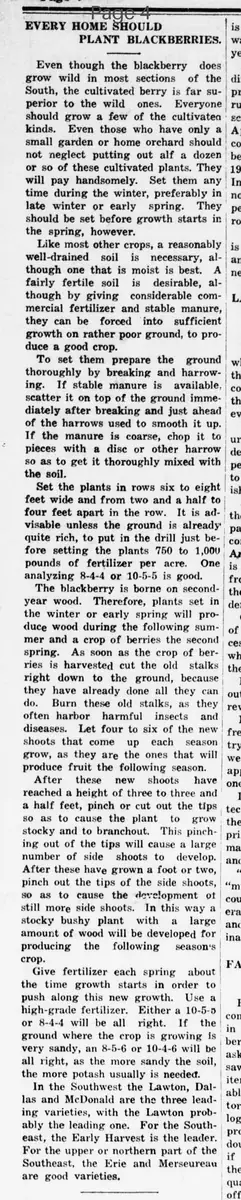
Even though the blackberry does grow wild in most sections of the South, the cultivated berry is far superior to the wild ones. Everyone should grow a few of the cultivated kinds. Even those who have only a small garden or home orchard should not neglect putting out half a dozen or so of these cultivated plants. They will pay handsomely. Set them any time during the winter, preferably in late winter or early spring. They should be set before growth starts in the spring, however.
Like most other crops, a reasonably well-drained soil is necessary, although one that is moist is best. A fairly fertile soil is desirable, although by giving considerable commercial fertilizer and stable manure, they can be forced into sufficient growth on rather poor ground, to produce a good crop.
To set them prepare the ground thoroughly by breaking and harrowing. If stable manure is available, scatter it on top of the ground immediately after breaking and just ahead of the harrows used to smooth it up. If the manure is coarse, chop it to pieces with a disc or other harrow so as to get it thoroughly mixed with the soil.
Set the plants in rows six to eight feet wide and from two and a half to four feet apart in the row. It is advisable unless the ground is already quite rich, to put in the drill just before setting the plants 750 to 1,000 pounds of fertilizer per acre. One analyzing 8-4-4 or 10-5-5 is good.
The blackberry is borne on second-year wood. Therefore, plants set in the winter or early spring will produce wood during the following summer and a crop of berries the second spring. As soon as the crop of berries is harvested cut the old stalks right down to the ground, because they have already done all they can do. Burn these old stalks, as they often harbor harmful insects and diseases. Let four to six of the new shoots that come up each season grow, as they are the ones that will produce fruit the following season.
After these new shoots have reached a height of three to three and a half feet, pinch or cut out the tips so as to cause the plant to grow stocky and to branch out. This pinching out of the tips will cause a large number of side shoots to develop. After these have grown a foot or two, pinch out the tips of the side shoots, so as to cause the development of still more side shoots. In this way a stocky bushy plant with a large amount of wood will be developed for producing the following season's crop.
Give fertilizer each spring about the time growth starts in order to push along this new growth. Use a high-grade fertilizer. Either a 10-5-5 or 8-4-4 will be all right. If the ground where the crop is growing is very sandy, an 8-5-6 or 10-4-6 will be all right, as the more sandy the soil, the more potash usually is needed.
In the Southwest the Lawton, Dallas and McDonald are the three leading varieties, with the Lawton probably the leading one. For the Southeast, the Early Harvest is the leader. For the upper or northern part of the Southeast, the Erie and Merseureau are good varieties.
PLANT BLACKBERRIES.
Even though the blackberry does grow wild in most sections of the South, the cultivated berry is far superior to the wild ones. Everyone should grow a few of the cultivated kinds. Even those who have only a small garden or home orchard should not neglect putting out half a dozen or so of these cultivated plants. They will pay handsomely. Set them any time during the winter, preferably in late winter or early spring. They should be set before growth starts in the spring, however.
Like most other crops, a reasonably well-drained soil is necessary, although one that is moist is best. A fairly fertile soil is desirable, although by giving considerable commercial fertilizer and stable manure, they can be forced into sufficient growth on rather poor ground, to produce a good crop.
To set them prepare the ground thoroughly by breaking and harrowing. If stable manure is available, scatter it on top of the ground immediately after breaking and just ahead of the harrows used to smooth it up. If the manure is coarse, chop it to pieces with a disc or other harrow so as to get it thoroughly mixed with the soil.
Set the plants in rows six to eight feet wide and from two and a half to four feet apart in the row. It is advisable unless the ground is already quite rich, to put in the drill just before setting the plants 750 to 1,000 pounds of fertilizer per acre. One analyzing 8-4-4 or 10-5-5 is good.
The blackberry is borne on second-year wood. Therefore, plants set in the winter or early spring will produce wood during the following summer and a crop of berries the second spring. As soon as the crop of berries is harvested cut the old stalks right down to the ground, because they have already done all they can do. Burn these old stalks, as they often harbor harmful insects and diseases. Let four to six of the new shoots that come up each season grow, as they are the ones that will produce fruit the following season.
After these new shoots have reached a height of three to three and a half feet, pinch or cut out the tips so as to cause the plant to grow stocky and to branch out. This pinching out of the tips will cause a large number of side shoots to develop. After these have grown a foot or two, pinch out the tips of the side shoots, so as to cause the development of still more side shoots. In this way a stocky bushy plant with a large amount of wood will be developed for producing the following season's crop.
Give fertilizer each spring about the time growth starts in order to push along this new growth. Use a high-grade fertilizer. Either a 10-5-5 or 8-4-4 will be all right. If the ground where the crop is growing is very sandy, an 8-5-6 or 10-4-6 will be all right, as the more sandy the soil, the more potash usually is needed.
In the Southwest the Lawton, Dallas and McDonald are the three leading varieties, with the Lawton probably the leading one. For the Southeast, the Early Harvest is the leader. For the upper or northern part of the Southeast, the Erie and Merseureau are good varieties.
What sub-type of article is it?
Agricultural Advice
Gardening Guide
What keywords are associated?
Blackberry Planting
Cultivated Varieties
Soil Preparation
Fertilizer Use
Pruning Techniques
Regional Varieties
Where did it happen?
South, Southwest, Southeast
Story Details
Location
South, Southwest, Southeast
Story Details
Advice on planting and cultivating blackberries, including soil preparation, spacing, fertilizing, pruning, and recommended varieties for different regions.