Thank you for visiting SNEWPapers!
Sign up free
Daily National Intelligencer
Washington, District Of Columbia
What is this article about?
The U.S. Supreme Court ruled in Evans v. Eaton on patent rights for Oliver Evans' improved Hopper Boy and flour machinery, affirming broad patent coverage, evidence rules, and federal jurisdiction. Decision by Chief Justice Marshall.
Clipping
OCR Quality
Full Text
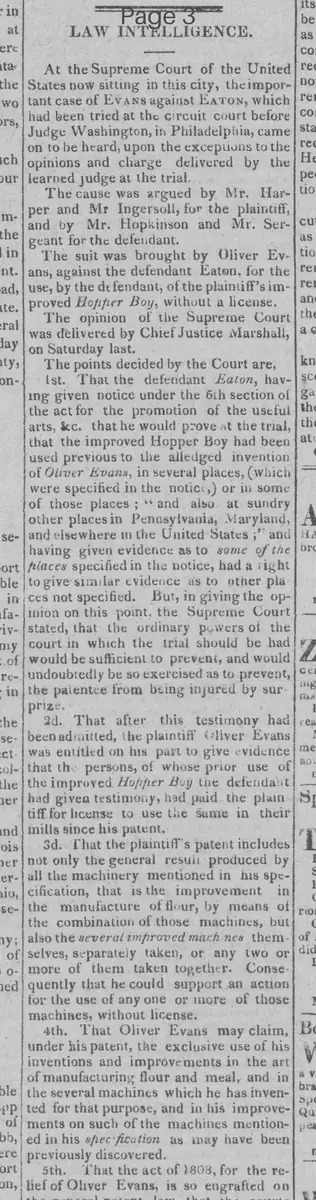
At the Supreme Court of the United States now sitting in this city, the important case of Evans against Eaton, which had been tried at the circuit court before Judge Washington, in Philadelphia, came on to be heard, upon the exceptions to the opinions and charge delivered by the learned judge at the trial.
The cause was argued by Mr. Harper and Mr. Ingersoll, for the plaintiff, and by Mr. Hopkinson and Mr. Sergeant for the defendant.
The suit was brought by Oliver Evans, against the defendant Eaton, for the use, by the defendant, of the plaintiff's improved Hopper Boy, without a license.
The opinion of the Supreme Court was delivered by Chief Justice Marshall on Saturday last.
The points decided by the Court are,
1st. That the defendant Eaton, having given notice under the 6th section of the act for the promotion of the useful arts, &c. that he would prove at the trial, that the improved Hopper Boy had been used previous to the alleged invention of Oliver Evans, in several places, (which were specified in the notice,) or in some of those places; "and also at sundry other places in Pennsylvania, Maryland, and elsewhere in the United States;" and having given evidence as to some of the places specified in the notice, had a right to give similar evidence as to other places not specified. But, in giving the opinion on this point, the Supreme Court stated, that the ordinary powers of the court in which the trial should be had would be sufficient to prevent, and would undoubtedly be so exercised as to prevent, the patentee from being injured by surprise.
2d. That after this testimony had been admitted, the plaintiff Oliver Evans was entitled on his part to give evidence that the persons, of whose prior use of the improved Hopper Boy the defendant had given testimony, had paid the plaintiff for license to use the Same in their mills since his patent.
3d. That the plaintiff's patent includes not only the general result produced by all the machinery mentioned in his specification, that is the improvement in the manufacture of flour, by means of the combination of those machines, but also the several improved machines themselves, separately taken, or any two or more of them taken together. Consequently that he could support an action for the use of any one or more of those machines, without license.
4th. That Oliver Evans may claim, under his patent, the exclusive use of his inventions and improvements in the art of manufacturing flour and meal, and in the several machines which he has invented for that purpose, and in his improvements on such of the machines mentioned in his specification as may have been previously discovered.
5th. That the act of 1808, for the relief of Oliver Evans, is so engrafted on the general patent law, that the courts of the United States have jurisdiction of all suits brought by him for alleged infringements of his patent.
What sub-type of article is it?
What keywords are associated?
What entities or persons were involved?
Where did it happen?
Domestic News Details
Primary Location
This City
Event Date
Saturday Last
Key Persons
Outcome
the supreme court decided five points in favor of the plaintiff oliver evans regarding his patent rights, including the scope of the patent, admissibility of evidence, and jurisdiction under the act of 1808.
Event Details
The Supreme Court heard the case of Evans against Eaton on exceptions to the circuit court's opinions. The suit involved Eaton's use of Evans' improved Hopper Boy without a license. Arguments were made by Harper and Ingersoll for the plaintiff, and Hopkinson and Sergeant for the defendant. Chief Justice Marshall delivered the opinion, deciding on evidence admissibility, patent scope, and jurisdiction.