Thank you for visiting SNEWPapers!
Sign up free
The Salt Lake Herald
Salt Lake City, Salt Lake County, Utah
What is this article about?
U.S. Senate debates appropriation of $500,000 for enforcing Chinese Exclusion Act (Geary Act). Sen. Dolph defends registration; critics like Sens. White, Gray, and others discuss treaty violations and constitutionality. Bill referred to Foreign Relations Committee. Voorhees proposes earlier sessions; direct senator election resolution introduced.
Merged-components note: Single continuous article on Senate debate over Chinese Exclusion Acts; text flows seamlessly across components.
Clipping
OCR Quality
Full Text
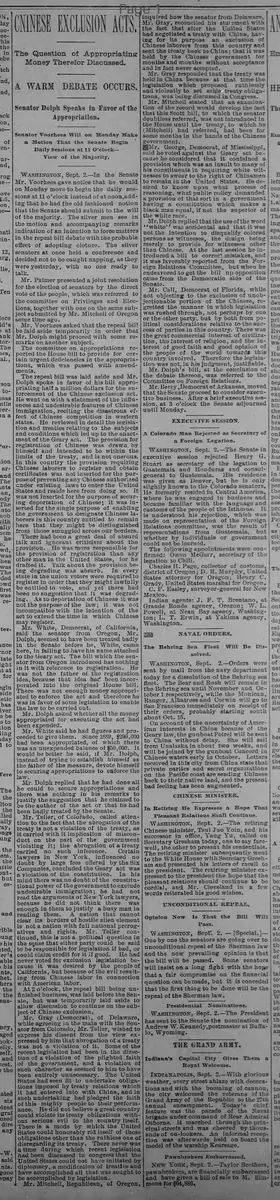
The Question of Appropriating
Money Therefor Discussed.
A WARM
DEBATE OCCURS.
Senator Dolph Speaks in Favor of the
Appropriation.
Senator Voorhees Will on Monday Make
a Motion That the Senate Begin
Daily Sessions at 11 O'clock-
View of the Majority.
WASHINGTON. Sept. 2.-In the Senate
Mr. Voorhees gave notice that he would
on Monday move to begin the daily sessions
at 11 o'clock instead of at noon, adding
that he had the old fashioned notion
that the Senate should submit to the will
of the majority. The silver men see in
the motion and accompanying remarks
indication of an intention to force matters
in the repeal bill debate with the probable
effect of adopting cloture. The silver
senators at once held a conference and
decided not to be caught napping, as they
were yesterday, with no one ready to
talk.
Mr. Palmer presented a joint resolution
for the election of senators by the direct
vote of the people, which was referred to
the committee on Privileges and Elections,
together with one on the same subject
submitted by Mr. Mitchell of Oregon
some time ago.
Mr. Voorhees asked that the repeal bill
be laid aside temporarily in order that
Mr. Dolph might proceed with some remarks
on another subject.
The committee on appropriations reported
the House bill to provide for certain
urgent deficiencies in the appropriations,
which was passed with amendments.
The repeal bill was laid aside and Mr.
Dolph spoke in favor of his bill appropriating
half a million dollars for the enforcement
of the Chinese exclusion act.
He went on with a statement of the influences
and undesirable features of Chinese
immigration, reciting the disastrous effect
of Chinese competition in western
states. He reviewed in detail the legislation
and treaties relating to the subject
and conditions which led up to the enactment
of the Geary act. The provision for
registration of Chinese was drawn by
himself and intended to be within the
limits of the treaty, and is not onerous.
In this country the provision requiring
Chinese laborers to register and obtain
certificates was not inserted for the purpose
of preventing any Chinese authorized
under existing laws to enter the United
States and reside here from doing so. It
was not inserted for the purpose of securing
deportation of Chinese; it was inserted
for the single purpose of enabling the government
to designate Chinese laborers
in this country entitled to remain
here that they might be distinguished
from those smuggled across our borders.
There had been a great deal of absurd
talk and ignorant criticism about the
provision. He was more responsible for
the provision of registration than any
other man in the United States, for he
drafted it. Talk about the provision being
degrading was absurd. In every
state in the union voters were required to
register in order that they might lawfully
be entitled to vote, and yet there had
been no suggestion that it was degrading.
As to deportation of Chinese it was
not the purpose of the law; it was not
incompatible with the intention of the
act to extend the time in which Chinese
may register.
Mr. White, Democrat, of California,
said the senator from Oregon, Mr.
Dolph, seemed to have been treated badly
in the Senate before he, White, came
here, in failing to have his name attached
to the Geary act. The bill which the senator
from Oregon introduced has nothing
in it with reference to registration. He
was not the father of the registration
idea, because that idea had been incorporated
into the original House bill.
There was not enough money appropriated
to enforce the act and therefore he
was in favor of some legislation to enable
the law to be carried out.
Mr. Dolph asked whether all the money
appropriated for executing the act had
been expended.
Mr. White said he had figures and proceeded
to give them. Since 1889, $290,000
had been appropriated, of which there
was an unexpended balance of $50,000. It
would be better he said, if Mr. Dolph,
instead of trying to establish himself as
the father of the measure, devote himself
to securing appropriations to enforce the
law.
Mr. Dolph replied that he had done all
he could to secure appropriations and
there was nothing in his remarks to
justify the suggestion that he claimed to
be the author of the act or that he had
been badly treated by the Senate.
Mr. Teller, of Colorado, called attention
to the fact that the abrogation of the
treaty is not a violation of the treaty, as
it carried with it implication of misconduct
on the part of the government
violating it; the abrogation of a treaty
carried no such inference.
Certain
lawyers in New York, influenced no
doubt by large fees offered by the Six
Companies, concluded the Geary act was
a violation of the constitution. In his
mind there was no doubt of the constitutional
power of the government to exclude
undesirable immigration; he had not
read the arguments of New York lawyers,
because he did not think there was
enough in them to justify a busy man in
reading them. A nation that cannot
clear its borders of hostile alien element
is not a nation with full national prerogatives
and rights. Mr. Teller continued,
this is not a political question in
the sense that either party could be said
to be responsible for legislation if bad, or
could claim credit for it if good. He had
never voted for exclusion legislation because
it was desired by the people of
California, but because of the evil resulting
from Chinese labor in connection
with American labor.
At 2 o'clock, the repeal bill being unfinished
business, was laid before the Senate,
but was temporarily laid aside to
allow discussion to continue on the subject
of Chinese exclusion.
Mr. Gray (Democrat), of Delaware,
while agreeing in the main with the Senator
from Colorado, Mr. Teller, wished to
express his dissent from the view expressed
by him that abrogation of a treaty
was not a violation of it. Some of the
recent legislation had been in the direction
of a violation of the plighted faith
of the government, and a violation of
such character as seemed to him to have
been entirely unnecessary. The United
States had seen fit to undertake obligations
imposed by treaty relations which
it had entered into with China, and in
such undertaking had pledged the faith
of this mighty people to their performance.
He did not believe a great country
could violate its treaty obligations without
serious evil to the country itself.
There is a mode by which the United
States could honorably rid itself of those
obligations other than the ruthless one of
disregarding its treaty. There never was
a time during which recent legislation
had been discussed in congress that the
United States could not have initiated by
diplomacy, a modification of treaties and
have accomplished all that was sought to
be accomplished by legislation.
Mr. Mitchell, Republican, of Oregon,
inquired how the senator from Delaware,
Mr. Gray, reconciled his statement with
the fact that after the United States
had negotiated a treaty with China, having
for its purpose an exclusion of
Chinese laborers from this country and
sent the treaty back to China; that it was
held by the Chinese government for
months and months without acceptance
and in fact never accepted.
Mr. Gray responded that the treaty was
held in China because at that time the
legislation which proposed ruthlessly
and violently to set aside treaty obligations
was being discussed in Congress.
Mr. Mitchell stated that an examination
of the record would develop the fact
that this Scott bill, to which the senator
doubtless referred, was not introduced in
the House until the treaty, to which he
(Mitchell) had referred, had been for
some months in the hands of the Chinese
government.
Mr. George, Democrat, of Mississippi,
said he voted against the Geary act because
he considered that it contained a
provision which was an insult to many of
his constituents in requiring white witnesses
to swear to the right of Chinamen
to remain in the United States. He desired
to know upon what process of
reasoning, what public policy demanded
a provision of that sort in a government
having a constitution which makes a
black man equal, if not the superior of
the white race.
Mr. Dolph replied that the use of the word
"white" was accidental and that it was
not the intention to disqualify colored
persons as witnesses, the design being
merely to provide for witnesses other
than Chinese. At the last session he introduced
a bill to correct mistakes, and
it was favorably reported from the Foreign
Relations Committee, but when he
endeavored to get the bill up opposition
came from the Democratic side of the
Senate.
Mr. Call, Democrat of Florida, while
not objecting to the exclusion or unobjectionable
portion of the Chinese, regretted
the manner in which legislation
was rushed through, not perhaps by one
or the other party, but by both from political
considerations relative to the success
of parties in this country. There was
the great commercial interest of civilization,
the interest of religion, and the interest
of good faith and good opinion of
the people of the world towards this
country involved. Therefore the legislation
was not, in his judgment, justifiable.
Mr. Dolph's bill, at the conclusion of
the debate thereon, was referred to the
Committee on Foreign Relations.
Mr. Berry, Democrat of Arkansas, moved
that the Senate proceed to consider executive
business. After a brief executive session,
at 3 o'clock the Senate adjourned
until Monday.
What sub-type of article is it?
What keywords are associated?
What entities or persons were involved?
Where did it happen?
Domestic News Details
Primary Location
Washington
Event Date
Sept. 2.
Key Persons
Outcome
mr. dolph's bill appropriating half a million dollars for the enforcement of the chinese exclusion act was referred to the committee on foreign relations. the house bill for urgent deficiencies in appropriations was passed with amendments. a joint resolution for election of senators by direct vote was referred to the committee on privileges and elections.
Event Details
In the Senate, Mr. Voorhees gave notice to move for daily sessions starting at 11 o'clock. Mr. Palmer presented a joint resolution for direct election of senators. The repeal bill was temporarily laid aside for Mr. Dolph to speak in favor of appropriating funds for enforcing the Chinese exclusion act, discussing its history, registration provisions, and impacts of Chinese immigration. Debate ensued with Mr. White, Mr. Teller, Mr. Gray, Mr. Mitchell, Mr. George, and Mr. Call contributing views on the act's constitutionality, treaty obligations, and provisions. The discussion continued after resuming the repeal bill.