Thank you for visiting SNEWPapers!
Sign up free
Alexandria Gazette, Commercial And Political
Alexandria, Virginia
What is this article about?
In New York General Sessions court, Margaret M'Mullen was tried for being a common scold, a nuisance offense. Witnesses described her as generally decent but violently scolding when irritated or intoxicated. Defense argued against the archaic punishment and its applicability in America. The court advised acquittal due to insufficient evidence, and the jury found her not guilty, relieving female audience members.
Merged-components note: Continuation of the story about the trial for common scold across pages 2 and 3, with text flowing directly from one to the next.
Clippings
1 of 2
OCR Quality
Full Text
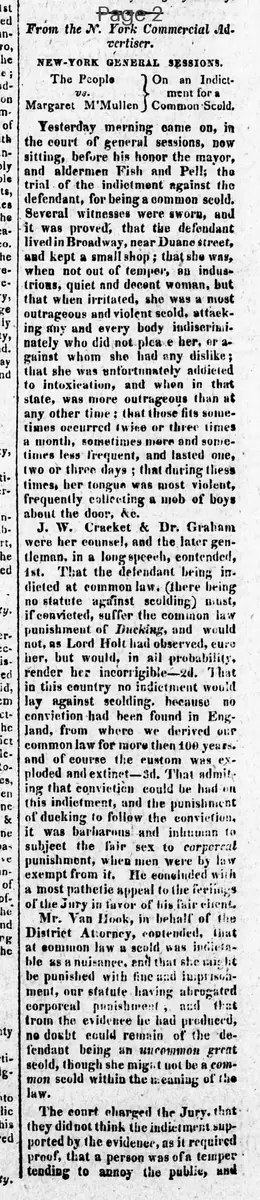
NEW-YORK GENERAL SESSIONS.
The People vs. Margaret M'Mullen on an Indictment for a Common Scold.
Yesterday morning came on, in the court of general sessions, now sitting, before his honor the mayor, and aldermen Fish and Pell; the trial of the indictment against the defendant, for being a common scold.
Several witnesses were sworn, and it was proved, that the defendant lived in Broadway, near Duane street, and kept a small shop; that she was, when not out of temper, an industrious, quiet and decent woman, but that when irritated, she was a most outrageous and violent scold, attacking any and every body indiscriminately who did not please her, or against whom she had any dislike; that she was unfortunately addicted to intoxication, and when in that state, was more outrageous than at any other time; that those fits sometimes occurred twice or three times a month, sometimes more and sometimes less frequent, and lasted one, two or three days; that during these times, her tongue was most violent, frequently collecting a mob of boys about the door, &c.
J. W. Cracket & Dr. Graham were her counsel, and the latter gentleman, in a long speech, contended,
1st. That the defendant being indicted at common law, (there being no statute against scolding) must, if convicted, suffer the common law punishment of Ducking, and would not, as Lord Holt had observed, cure her, but would, in all probability, render her incorrigible—2d. That in this country no indictment would lay against scolding, because no conviction had been found in England, from where we derived our common law for more than 100 years, and of course the custom was exploded and extinct—3d. That admitting that conviction could be had on this indictment, and the punishment of ducking to follow the conviction, it was barbarous and inhuman to subject the fair sex to corporal punishment, when men were by law exempt from it. He concluded with a most pathetic appeal to the feelings of the Jury in favor of his fair client.
Mr. Van Hook, in behalf of the District Attorney, contended, that at common law a scold was indictable as a nuisance, and that she might be punished with fine and imprisonment, our statute having abrogated corporal punishment, and that from the evidence he had produced, no doubt could remain of the defendant being an uncommon great scold, though she might not be a common scold within the meaning of the law.
The court charged the Jury, that they did not think the indictment supported by the evidence, as it required proof, that a person was of a temper tending to annoy the public, and
That proof of these few instances of avoiding did not, in their opinion, support the indictment; that this was the first instance (except the one lately in Boston) of an indictment for this offence, and that it would be better that the parties should be acquitted, than that a new bill of prosecution should be opened, a sharper remedy than by indictment being to be had—viz binding the parties for their good behaviour. Upon the whole, the court advised an acquittal. The Jury pronounced a verdict of Not Guilty.
This trial being novel, being the first in this state, caused much anxiety to the female part of the audience, and apparently some anxiety: and some of them seemed to fear that this invasion of the rights of women might ultimate in their being deprived of their principal weapon of offence. And we congratulate them upon the defeat of this attempt to muzzle them.
What sub-type of article is it?
What themes does it cover?
What keywords are associated?
What entities or persons were involved?
Where did it happen?
Story Details
Key Persons
Location
New York, Broadway Near Duane Street
Event Date
Yesterday Morning
Story Details
Margaret M'Mullen tried in New York General Sessions for being a common scold; witnesses testified to her violent outbursts when irritated or intoxicated; defense argued against ducking punishment and its applicability; prosecution claimed she was indictable as a nuisance; court found evidence insufficient and advised acquittal; jury returned not guilty verdict.