Thank you for visiting SNEWPapers!
Sign up free
Editorial
February 12, 1926
Union Labor Bulletin
Little Rock, Pulaski County, Arkansas
What is this article about?
The editorial criticizes the American Federation of Labor for partnering with anti-prohibition organizations backed by alcohol interests, arguing that alcohol harms workers' lives and progress, while sobriety has advanced labor movements, as seen in the Railroad Brotherhoods and British labor.
Clipping
OCR Quality
98%
Excellent
Full Text
Is Labor Wet?
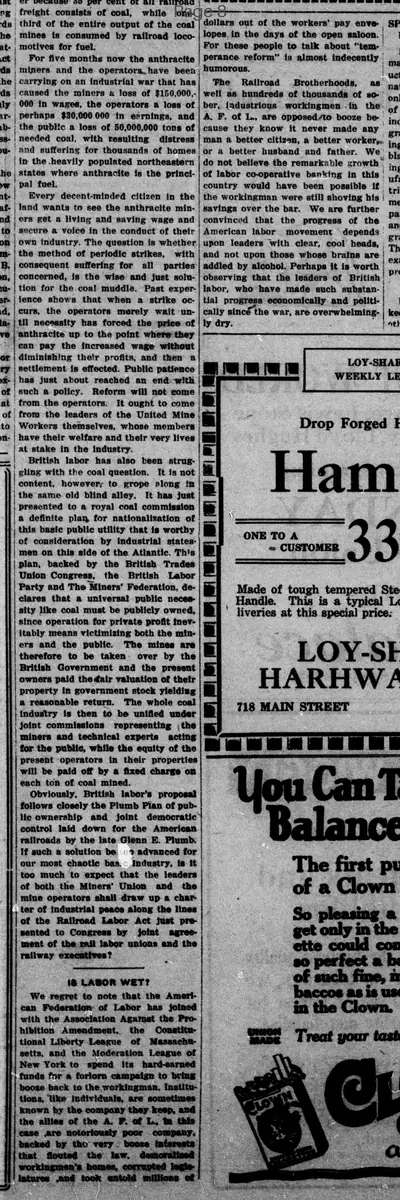
We regret to note that the American Federation of Labor has joined with the Association Against the Prohibition Amendment, the Constitutional Liberty League of Massachusetts, and the Moderation League of New York to spend its hard-earned funds for a forlorn campaign to bring booze back to the workingman. Institutions, like individuals, are sometimes known by the company they keep, and the allies of the A. F. of L. in this case are notoriously poor company, backed by the very booze interests that flouted the law, demoralized workingmen's homes, corrupted legislatures and took untold millions of dollars out of the workers' pay envelopes in the days of the open saloon.
For these people to talk about "temperance reform" is almost indecently humorous.
The Railroad Brotherhoods, as well as hundreds of thousands of sober, industrious workingmen in the A. F. of L., are opposed to booze because they know it never made any man a better citizen, a better worker, or a better husband and father. We do not believe the remarkable growth of labor co-operative banking in this country would have been possible if the workingman were still shoving his savings over the bar. We are further convinced that the progress of the American labor movement depends upon leaders with clear, cool heads, and not upon those whose brains are addled by alcohol. Perhaps it is worth observing that the leaders of British labor, who have made such substantial progress economically and politically since the war, are overwhelmingly dry.
We regret to note that the American Federation of Labor has joined with the Association Against the Prohibition Amendment, the Constitutional Liberty League of Massachusetts, and the Moderation League of New York to spend its hard-earned funds for a forlorn campaign to bring booze back to the workingman. Institutions, like individuals, are sometimes known by the company they keep, and the allies of the A. F. of L. in this case are notoriously poor company, backed by the very booze interests that flouted the law, demoralized workingmen's homes, corrupted legislatures and took untold millions of dollars out of the workers' pay envelopes in the days of the open saloon.
For these people to talk about "temperance reform" is almost indecently humorous.
The Railroad Brotherhoods, as well as hundreds of thousands of sober, industrious workingmen in the A. F. of L., are opposed to booze because they know it never made any man a better citizen, a better worker, or a better husband and father. We do not believe the remarkable growth of labor co-operative banking in this country would have been possible if the workingman were still shoving his savings over the bar. We are further convinced that the progress of the American labor movement depends upon leaders with clear, cool heads, and not upon those whose brains are addled by alcohol. Perhaps it is worth observing that the leaders of British labor, who have made such substantial progress economically and politically since the war, are overwhelmingly dry.
What sub-type of article is it?
Temperance
Labor
Moral Or Religious
What keywords are associated?
Prohibition
Afl
Labor
Wet
Dry
Booze Interests
Temperance
Workingmen
Sobriety
Alcohol Reform
What entities or persons were involved?
American Federation Of Labor
Association Against The Prohibition Amendment
Constitutional Liberty League Of Massachusetts
Moderation League Of New York
Railroad Brotherhoods
British Labor Leaders
Editorial Details
Primary Topic
Criticism Of Afl's Alliance With Anti Prohibition Groups
Stance / Tone
Strongly Pro Prohibition And Anti Alcohol Interests
Key Figures
American Federation Of Labor
Association Against The Prohibition Amendment
Constitutional Liberty League Of Massachusetts
Moderation League Of New York
Railroad Brotherhoods
British Labor Leaders
Key Arguments
Afl Joining With Booze Backed Groups To Campaign Against Prohibition
Allies Are Poor Company Tied To Interests That Harmed Workers
Alcohol Demoralized Homes, Corrupted Legislatures, And Took Workers' Money
Prohibition Supporters Include Sober Workingmen Who Know Booze's Harms
Labor Co Operative Banking Growth Tied To Sobriety
Labor Progress Requires Clear Headed Leaders, Not Alcohol Addled Ones
British Labor's Success Linked To Dry Leaders