Thank you for visiting SNEWPapers!
Sign up free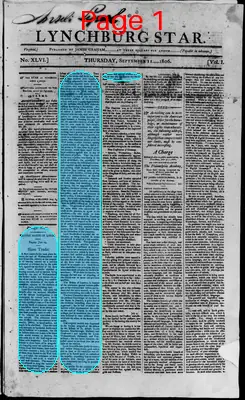
Lynchburg Star
Lynchburg, Virginia
What is this article about?
In the British House of Lords on June 24, Lord Grenville advocated for abolishing the slave trade, citing its inhumanity, injustice, and poor policy, referencing Africa, the middle passage, and West Indies treatment. Despite opposition from Lord Hawkesbury, the resolution concurring with the Commons passed 41-10, with a motion for an address to the King for international measures.
Clipping
OCR Quality
Full Text
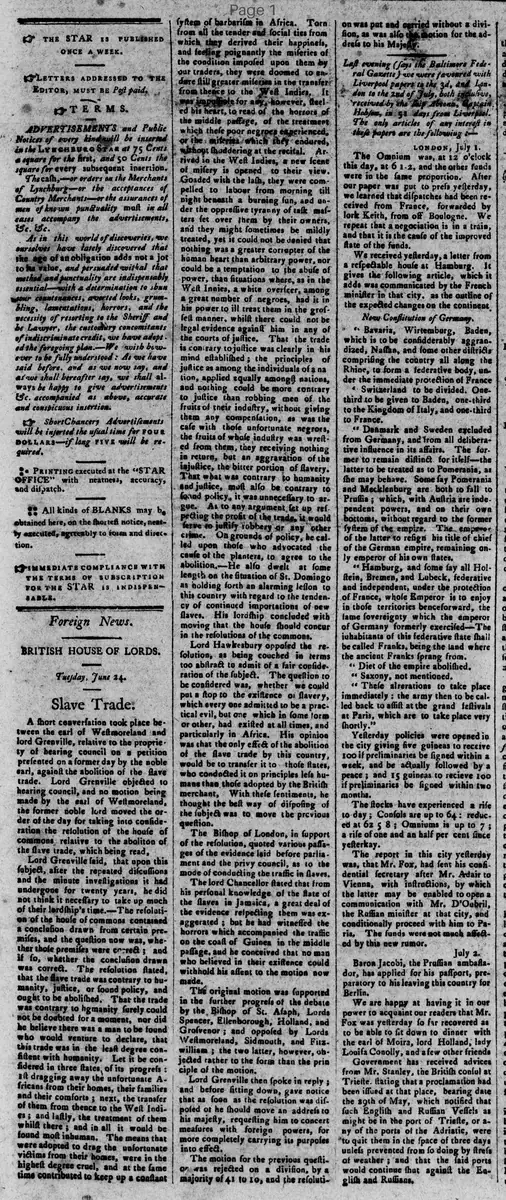
BRITISH HOUSE OF LORDS.
Tuesday, June 24.
Slave Trade.
A short conversation took place between the earl of Westmoreland and lord Grenville, relative to the propriety of hearing counsel on a petition presented on a former day by the noble earl, against the abolition of the slave trade. Lord Grenville objected to hearing counsel, and no motion being made by the earl of Westmoreland, the former noble lord moved the order of the day for taking into consideration the resolution of the house of commons, relative to the abolition of the slave trade, which being read, Lord Grenville said, that upon this subject, after the repeated discussions and the minute investigations it had undergone for twenty years, he did not think it necessary to take up much of their lordships' time.—The resolution of the house of commons contained a conclusion drawn from certain premises, and the question now was, whether those premises were correct; and if so, whether the conclusion drawn was correct. The resolution stated, that the slave trade was contrary to humanity, justice, or sound policy, and ought to be abolished. That the trade was contrary to humanity surely could not be doubted for a moment, nor did he believe there was a man to be found who would venture to declare, that this trade was in the least degree consistent with humanity. Let it be considered in three states, of its progress: In dragging away the unfortunate Africans from their homes, their families and their comforts; next, the transfer of them from thence to the West Indies; and lastly, the treatment of them whilst there: and in all it would be found most inhuman. The means that were adopted to drag the unfortunate victims from their homes, were in the highest degree cruel, and at the same time contributed to keep up a constant system of barbarism in Africa. Torn from all the tender and social ties from which they derived their happiness, and feeling poignantly the miseries of the condition imposed upon them by our traders they were doomed to endure still greater miseries in the transfer from thence to the West Indies. It were impossible for any (however deeply seared his heart) to read of the horrors of the middle passage, of the treatment which these poor negroes experienced or the infernal tricks they endured, without shuddering at the recital. Arrived in the West Indies, a new scene of misery is opened to their view. Goaded with the lash, they were compelled to labour from morning till night beneath a burning sun, and under the oppressive tyranny of such masters set over them by their owners, and they might sometimes be mildly treated, yet it could not be denied that nothing was a greater corrupter of the human heart than arbitrary power, nor could there be a temptation to the abuse of power, than situations where as in the West Indies, a white overseer, among a great number of negroes, had it in his power to ill treat them in the grossest manner, whilst there could not be legal evidence against him in any of the courts of justice. That the trade is contrary to justice was clearly in his mind established; the principles of justice as among the individuals of a nation, applied equally amongst nations, and nothing could be more contrary to justice than robbing men of the fruits of their industry, without giving them any compensation, as was the case with those unfortunate negroes, the fruits of whose industry was wrested from them, they receiving nothing in return, but an aggravation of the injustice, the bitter portion of slavery. That what was contrary to humanity and justice, must also be contrary to sound policy, it was unnecessary to argue. As to any argument set up respecting the profit of the trade—it would serve to justify robbery or any other crime. On grounds of policy, he called upon those who advocated the cause of the planters, to agree to the abolition.—He also dwelt at some length on the situation of St. Domingo as holding forth an alarming lesson to this country with regard to the tendency of continued importations of new slaves. His lordship concluded with moving that the house should concur in the resolutions of the commons. Lord Hawkesbury opposed the resolution, as being couched in terms too abstract to admit of a fair consideration of the subject. The question to be considered was, whether we could put a stop to the existence of slavery, which every one admitted to be a practical evil, but one which in some form or other, had existed at all times, and particularly in Africa. His opinion was that the only effect of the abolition of the slave trade by this country, would be to transfer it to those states, who conducted it on principles less human than those adopted by the British merchant. With these sentiments, he thought the best way of disposing of the subject was to move the previous question. The Bishop of London, in support of the resolution, quoted various passages of the evidence laid before parliament and the privy council, as to the mode of conducting the traffic in slaves. The lord Chancellor stated that from his personal knowledge of the state of the slaves in Jamaica, a great deal of the evidence respecting them was exaggerated; but he had witnessed the horrors which accompanied the traffic on the coast of Guinea in the middle passage, and he conceived that no man who believed in their existence could withhold his assent to the motion now made. The original motion was supported in the further progress of the debate by the Bishop of St. Asaph, Lords Spencer, Ellenborough, Holland, and Grosvenor; and opposed by Lords Westmoreland, Sidmouth, and Fitzwilliam; the two latter, however, objected rather to the form than the principle of the motion. Lord Grenville then spoke in reply; and before sitting down, gave notice that as soon as the resolution was disposed of he should move an address to his majesty, requesting him to concert measures with foreign powers, for more completely carrying its purposes into effect. The motion for the previous question was rejected on a division, by a majority of 41 to 10, and the resolution was put and carried without a division, as was also motion for the address to his Majesty.
What sub-type of article is it?
What keywords are associated?
What entities or persons were involved?
Where did it happen?
Foreign News Details
Primary Location
West Indies
Event Date
Tuesday, June 24
Key Persons
Outcome
the motion for the previous question was rejected by a majority of 41 to 10; the resolution concurring with the commons on abolition of the slave trade was carried without division; motion for address to the king passed without division.
Event Details
Debate in the House of Lords on the resolution from the House of Commons to abolish the slave trade, deemed contrary to humanity, justice, and sound policy. Lord Grenville supported abolition, detailing cruelties in Africa, middle passage, and West Indies, citing St. Domingo as a warning. Lord Hawkesbury opposed, moving previous question, arguing abolition would transfer trade elsewhere. Supported by Bishop of London, Lord Chancellor, and others; opposed by Westmoreland, Sidmouth, Fitzwilliam on form. Grenville gave notice of address to King for measures with foreign powers.