Thank you for visiting SNEWPapers!
Sign up free
Editorial
June 16, 1849
The Daily Union
Washington, District Of Columbia
What is this article about?
An editorial lambasts the Whig party for repeatedly changing names, from Federal to Republican, while remaining a deceptive force opposing democratic interests, favoring banks, high tariffs, and capital over labor. It highlights Henry Clay and Daniel Webster's ties to the Taylor administration.
Clipping
OCR Quality
98%
Excellent
Full Text
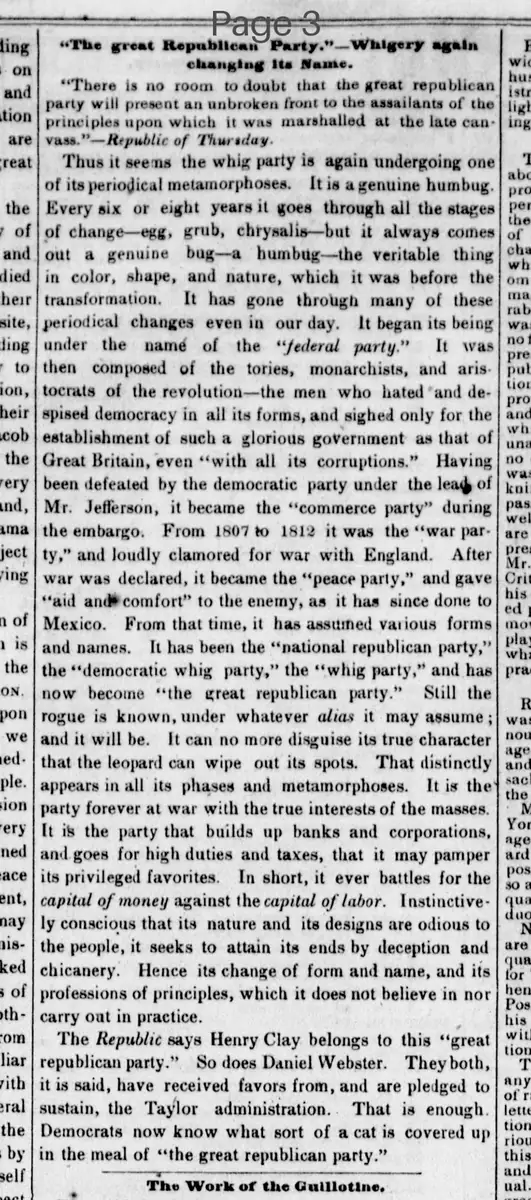
"The great Republican Party."-Whigery again changing its Name.
"There is no room to doubt that the great republican party will present an unbroken front to the assailants of the principles upon which it was marshalled at the late canvass."—Republic of Thursday.
Thus it seems the whig party is again undergoing one of its periodical metamorphoses. It is a genuine humbug. Every six or eight years it goes through all the stages of change—egg, grub, chrysalis—but it always comes out a genuine bug—a humbug—the veritable thing in color, shape, and nature, which it was before the transformation. It has gone through many of these periodical changes even in our day. It began its being under the name of the "federal party." It was then composed of the tories, monarchists, and aristocrats of the revolution—the men who hated and despised democracy in all its forms, and sighed only for the establishment of such a glorious government as that of Great Britain, even "with all its corruptions." Having been defeated by the democratic party under the lead of Mr. Jefferson, it became the "commerce party" during the embargo. From 1807 to 1812 it was the "war party," and loudly clamored for war with England. After war was declared, it became the "peace party," and gave "aid and comfort" to the enemy, as it has since done to Mexico. From that time, it has assumed various forms and names. It has been the "national republican party," the "democratic whig party," the "whig party," and has now become "the great republican party." Still the rogue is known, under whatever alias it may assume; and it will be. It can no more disguise its true character than the leopard can wipe out its spots. That distinctly appears in all its phases and metamorphoses. It is the party forever at war with the true interests of the masses. It is the party that builds up banks and corporations and goes for high duties and taxes, that it may pamper its privileged favorites. In short, it ever battles for the capital of money against the capital of labor. Instinctively conscious that its nature and its designs are odious to the people, it seeks to attain its ends by deception and chicanery. Hence its change of form and name, and its professions of principles, which it does not believe in nor carry out in practice.
The Republic says Henry Clay belongs to this "great republican party." So does Daniel Webster. They both, it is said, have received favors from, and are pledged to sustain, the Taylor administration. That is enough. Democrats now know what sort of a cat is covered up in the meal of "the great republican party."
"There is no room to doubt that the great republican party will present an unbroken front to the assailants of the principles upon which it was marshalled at the late canvass."—Republic of Thursday.
Thus it seems the whig party is again undergoing one of its periodical metamorphoses. It is a genuine humbug. Every six or eight years it goes through all the stages of change—egg, grub, chrysalis—but it always comes out a genuine bug—a humbug—the veritable thing in color, shape, and nature, which it was before the transformation. It has gone through many of these periodical changes even in our day. It began its being under the name of the "federal party." It was then composed of the tories, monarchists, and aristocrats of the revolution—the men who hated and despised democracy in all its forms, and sighed only for the establishment of such a glorious government as that of Great Britain, even "with all its corruptions." Having been defeated by the democratic party under the lead of Mr. Jefferson, it became the "commerce party" during the embargo. From 1807 to 1812 it was the "war party," and loudly clamored for war with England. After war was declared, it became the "peace party," and gave "aid and comfort" to the enemy, as it has since done to Mexico. From that time, it has assumed various forms and names. It has been the "national republican party," the "democratic whig party," the "whig party," and has now become "the great republican party." Still the rogue is known, under whatever alias it may assume; and it will be. It can no more disguise its true character than the leopard can wipe out its spots. That distinctly appears in all its phases and metamorphoses. It is the party forever at war with the true interests of the masses. It is the party that builds up banks and corporations and goes for high duties and taxes, that it may pamper its privileged favorites. In short, it ever battles for the capital of money against the capital of labor. Instinctively conscious that its nature and its designs are odious to the people, it seeks to attain its ends by deception and chicanery. Hence its change of form and name, and its professions of principles, which it does not believe in nor carry out in practice.
The Republic says Henry Clay belongs to this "great republican party." So does Daniel Webster. They both, it is said, have received favors from, and are pledged to sustain, the Taylor administration. That is enough. Democrats now know what sort of a cat is covered up in the meal of "the great republican party."
What sub-type of article is it?
Partisan Politics
Economic Policy
What keywords are associated?
Whig Party
Republican Party
Humbug
Name Change
Partisan Politics
Banks Corporations
High Duties
Capital Labor
Henry Clay
Daniel Webster
What entities or persons were involved?
Whig Party
Great Republican Party
Federal Party
Democratic Party
Henry Clay
Daniel Webster
Taylor Administration
Mr. Jefferson
Editorial Details
Primary Topic
Whig Party Name Changes And Deceptive Nature
Stance / Tone
Hostile Critique Of Whig Party As Humbug
Key Figures
Whig Party
Great Republican Party
Federal Party
Democratic Party
Henry Clay
Daniel Webster
Taylor Administration
Mr. Jefferson
Key Arguments
Whig Party Undergoes Periodical Name Changes But Remains A Humbug
Originated As Federal Party Of Tories, Monarchists, And Aristocrats Opposing Democracy
Shifted Names: Commerce Party During Embargo, War Party 1807 1812, Peace Party After War
Assumed Forms: National Republican, Democratic Whig, Whig, Now Great Republican Party
Always At War With Interests Of The Masses
Supports Banks, Corporations, High Duties, And Taxes For Privileged Favorites
Battles Capital Of Money Against Capital Of Labor
Uses Deception And Chicanery To Hide Odious Nature
Henry Clay And Daniel Webster Tied To Taylor Administration