Thank you for visiting SNEWPapers!
Sign up free
Foreign News
April 4, 1882
The Daily Gazette
Wilmington, New Castle County, Delaware
What is this article about?
London press doubts Dr. Lamson's chances of avoiding execution for murder, dismissing his insanity plea involving aconitine. Home Secretary Sir William Harcourt refuses to present related documents to Parliament, citing precedent.
Clipping
OCR Quality
98%
Excellent
Full Text
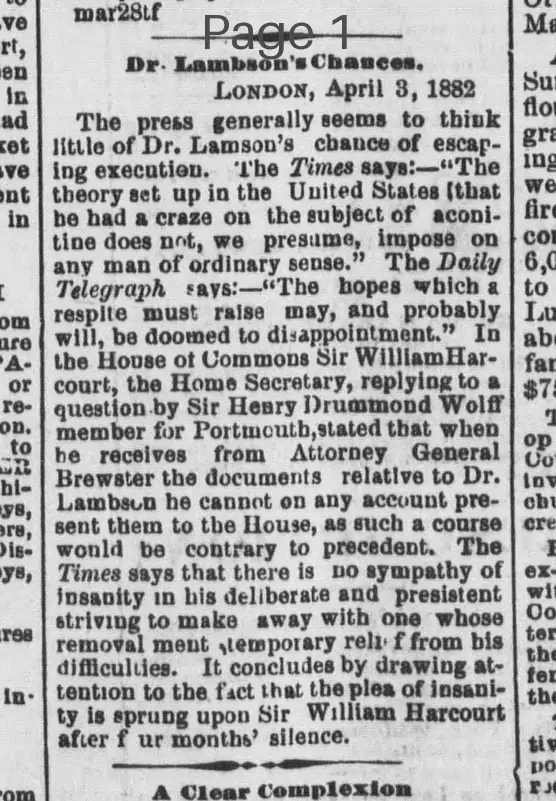
Dr. Lambson's Chances.
LONDON, April 3, 1882
The press generally seems to think little of Dr. Lamson's chance of escaping execution. The Times says:-"The theory set up in the United States (that he had a craze on the subject of aconitine does not, we presume, impose on any man of ordinary sense." The Daily Telegraph says:-"The hopes which a respite must raise may, and probably will, be doomed to disappointment." In the House of Commons Sir William Harcourt, the Home Secretary, replying to a question by Sir Henry Drummond Wolff member for Portsmouth, stated that when he receives from Attorney General Brewster the documents relative to Dr. Lamson he cannot on any account present them to the House, as such a course would be contrary to precedent. The Times says that there is no sympathy of insanity in his deliberate and persistent striving to make away with one whose removal meant temporary relief from his difficulties. It concludes by drawing attention to the fact that the plea of insanity is sprung upon Sir William Harcourt after four months' silence.
LONDON, April 3, 1882
The press generally seems to think little of Dr. Lamson's chance of escaping execution. The Times says:-"The theory set up in the United States (that he had a craze on the subject of aconitine does not, we presume, impose on any man of ordinary sense." The Daily Telegraph says:-"The hopes which a respite must raise may, and probably will, be doomed to disappointment." In the House of Commons Sir William Harcourt, the Home Secretary, replying to a question by Sir Henry Drummond Wolff member for Portsmouth, stated that when he receives from Attorney General Brewster the documents relative to Dr. Lamson he cannot on any account present them to the House, as such a course would be contrary to precedent. The Times says that there is no sympathy of insanity in his deliberate and persistent striving to make away with one whose removal meant temporary relief from his difficulties. It concludes by drawing attention to the fact that the plea of insanity is sprung upon Sir William Harcourt after four months' silence.
What sub-type of article is it?
Political
What keywords are associated?
Dr Lamson
Execution Chances
Insanity Plea
Aconitine
House Of Commons
Sir William Harcourt
What entities or persons were involved?
Dr. Lamson
Sir William Harcourt
Sir Henry Drummond Wolff
Attorney General Brewster
Where did it happen?
London
Foreign News Details
Primary Location
London
Event Date
April 3, 1882
Key Persons
Dr. Lamson
Sir William Harcourt
Sir Henry Drummond Wolff
Attorney General Brewster
Outcome
low chances of escaping execution; plea of insanity dismissed by press and government
Event Details
Press opinions from The Times and Daily Telegraph express skepticism about Dr. Lamson's insanity defense regarding aconitine poisoning. In Parliament, Home Secretary Sir William Harcourt declines to share documents on the case, per precedent.